


This article was automatically translated from the original Turkish version.
+1 More
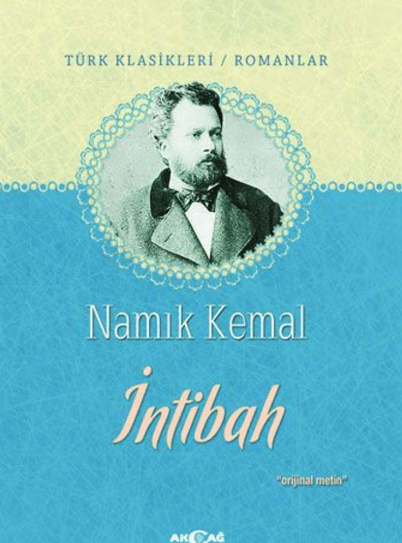
Intibah (Book)
Author(s) | Namık Kemal | ||||||||
|---|---|---|---|---|---|---|---|---|---|
Publisher(s) | Akçağ Yayınları | ||||||||
Category | Novels Turkish Classics | ||||||||
Language(s) | Turkish | ||||||||
Number of Pages | 216 | ||||||||
Publication Date | Publication Date | ||||||||
Intibah was written by Namık Kemal, a pivotal figure in Tanzimat-era Turkish literature. Composed between 1873 and 1875 during the author’s exile in Famagusta, the novel is regarded by literary historians as Turkey’s first literary novel. It was first published under the title “Son Pişmanlık” but later, due to censorship, adopted the titles “Intibah – Sergüzeşt-i Ali Bey” and eventually simply “Intibah.” The novel was first published in its complete form in 1876.
The protagonist of the novel, Ali Bey, is the only son of a prominent and affluent family in Istanbul. Raised with great care by his mother after his father’s death, he receives a fine education and is portrayed as a man of high moral character. He leads a balanced and respected life in accordance with the expectations of his family and social circle. However, this orderly existence begins to unravel after he偶然 meets a woman named Mahpeyker.
Mahpeyker is a powerful and compelling woman who once served as a concubine but later moved through various social circles, challenging conventional moral standards. Ali Bey, unaware of her past, is drawn to her charm and begins to pursue a close relationship with her despite all warnings from his family. This relationship leads Ali Bey to distance himself from his social environment, weakens his bond with his mother, and triggers a visible transformation in his character. Mahpeyker attempts to exert emotional and social control over Ali Bey, but over time his loyalty and love give way to jealousy and vengeance.
The turning point in Ali Bey’s life occurs when he meets another woman, Dilaşub. Dilaşub represents the traditional ideal of womanhood: pure, gentle, obedient, and raised within the harem system. Unlike Mahpeyker, she has a spotless past and is accepted by Ali Bey’s mother. Gradually, Ali Bey drifts away from Mahpeyker and turns toward Dilaşub. Disturbed by this shift, Mahpeyker plots revenge. As Dilaşub’s life comes under threat, Ali Bey is torn between love, conscience, remorse, and a sense of responsibility.
The novel concludes with Ali Bey’s emotional turmoil between these two women, his choices, and his ultimate “awakening” (intibah). Initially a man in harmony with societal values, Ali Bey’s indulgence in passion leads to mistakes that profoundly affect not only his own life but also the lives of those around him.
In this context, the novel critically examines the conflict between individual desires and social norms, the destructive impact of moral decline and remorse, and the roles assigned to women in society. The events confronting the characters illustrate how personal choices can yield life-altering consequences.
Misguided Choice and Remorse
The pivotal moment in Ali Bey’s life is his encounter with Mahpeyker and the emotional relationship that follows. This choice contradicts the values of his family and society and triggers a profound transformation within him. His relationship with Mahpeyker leads him to isolate himself socially and morally weaken. In later sections of the novel, Ali Bey confronts the consequences of his decisions. Amid emotional and social losses, he begins an internal reckoning, leading to a growing awareness. This process brings to the forefront the central theme of remorse.
Individual and Society
The novel emphasizes the social consequences faced by an individual who defies societal norms. Although Ali Bey acts according to his own will in his relationship with Mahpeyker, he violates unwritten social rules. This transgression results not only in personal but also in social decline. His mother’s disapproval weakens family ties, while his friendships and social standing are also damaged by the relationship. The novel illustrates through concrete examples the outcomes that arise when an individual’s desires clash with societal values.
Representations of Women
The novel presents two contrasting female archetypes. Mahpeyker is a woman who once served as a concubine, independent and strong but deemed “improper” by society. Her character is shaped largely by passion, jealousy, and calculation. Dilaşub, in contrast, embodies the traditional ideal: gentle, obedient, possessing a pure past, and full of love. Through these two characters, Namık Kemal outlines the prevailing understanding of women in his era. Women are portrayed either as idealized innocent figures or as “dangerous” women cast outside the bounds of society.
Education and Morality
Ali Bey is presented as a character with a high level of education. Yet this education does not safeguard his moral integrity. Throughout the novel, Ali Bey’s intellectual knowledge fails to prevent him from making emotional misjudgments. This underscores the importance not only of academic education but also of moral and familial upbringing in shaping an individual. The author demonstrates that moral values are shaped by an individual’s environmental and cultural conditions.
Fate and Intibah (Awakening)
The title of the novel, “Intibah,” is an Arabic-derived word meaning “awakening” or “realization.” In the novel, this concept materializes through Ali Bey’s inner transformation and remorse following the events he endures. The character eventually becomes aware of his mistakes, albeit belatedly. This awakening marks a personal turning point for him, but it comes at a cost: loss, loneliness, and suffering. The novel conveys that an individual’s fate is shaped by his choices, yet not every choice is reversible.
"İntibah yahud Sergüzeşt-i Ali Bey (Namık Kemal)." *Türk Edebiyatı İsimler Sözlüğü*. Accessed July 16, 2025. http://tees.yesevi.edu.tr/madde-detay/intibah-yahud-serguzest-i-ali-bey-namik-kemal#:~:text=%C4%B0ntibah%20ya%20da%20di%C4%9Fer%20ad%C4%B1yla,y%C4%B1l%C4%B1nda%20Vakit%20gazetesinde%20tefrika%20edilmi%C5%9Ftir.
Kemal, Namık. İntibah. Ankara: Akçağ Yayınları, 2020.

Intibah (Book)
Author(s) | Namık Kemal | ||||||||
|---|---|---|---|---|---|---|---|---|---|
Publisher(s) | Akçağ Yayınları | ||||||||
Category | Novels Turkish Classics | ||||||||
Language(s) | Turkish | ||||||||
Number of Pages | 216 | ||||||||
Publication Date | Publication Date | ||||||||
Plot
Themes Explored