This article was automatically translated from the original Turkish version.
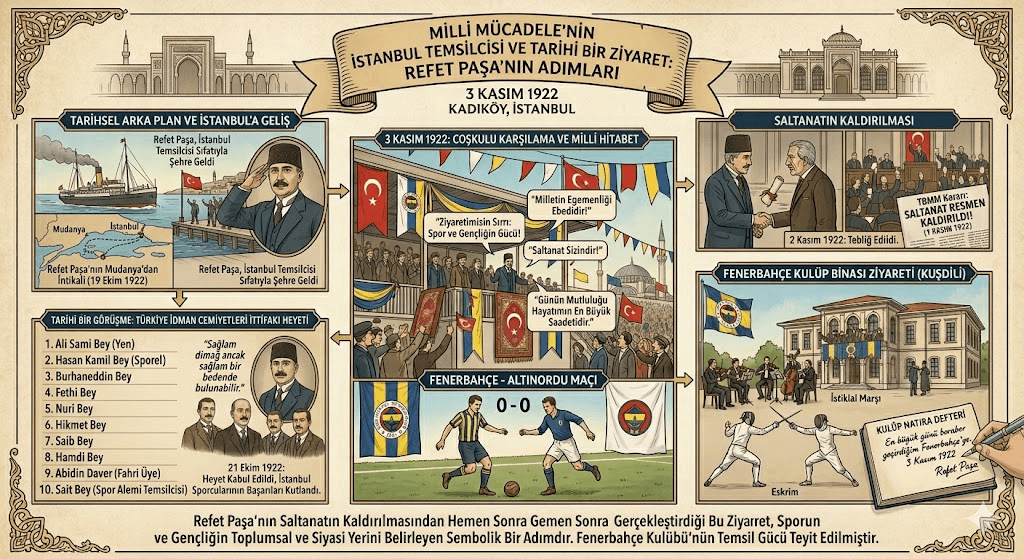
Following the military phase of the National Struggle in Anatolia culminating in the victory of 30 August and the signing of the Mudanya Armistice, Refet Paşa, in his capacity as a representative of the Grand National Assembly of Türkiye, arrived in Istanbul on 19 October 1922. Welcomed by the public and civil society organizations in Istanbul, which had been under occupation since 16 March 1920, Refet Paşa quickly established contact with the sports community and took a symbolic step in defining the social and political role of sport and youth in the new era by visiting the Fenerbahçe Sports Club on 3 November 1922.【1】
In accordance with the armistice signed after the victory of the liberation struggle in Anatolia, Refet Paşa arrived in Istanbul from Mudanya on 19 October 1922. Istanbul had been under the control of occupying forces since 16 March 1920. As the representative of the TBMM, Refet Paşa engaged in various official and social meetings during his stay. Within this context, two days after his arrival, on 21 October 1922, leaders of the city’s sports clubs paid him a formal visit of greeting. Through these discussions, the sports community expressed its expectations regarding the end of the occupation.【2】
On Saturday afternoon, 21 October 1922, a delegation led by Ali Sami Bey (Yen), president of the Turkish Sports Associations Alliance (TİCİ), was received by Refet Paşa. The delegation included Hasan Kamil Bey (Sporel) representing Fenerbahçe, along with Burhaneddin, Fethi, Nuri, Hikmet, Saib, and Hamdi Bey. Also present were honorary members Abidin Daver and Sait Bey, representing the magazine Spor Alemi. During this meeting, Refet Paşa expressed his satisfaction with the achievements of Istanbul’s athletes against the occupying forces. He emphasized that nations must complete not only their intellectual development but also their physical development, asserting that a sound mind can exist only in a sound body. Although he had been unable to closely follow sports activities due to his duties during the National Struggle, he stressed that societies preserving their initiative could overcome disasters.【3】
Shortly after his first meeting with the sports delegation, on 1 November 1922, the Grand National Assembly of Türkiye adopted the decision to abolish the Ottoman Sultanate. Refet Paşa formally communicated this decision to Sultan Vahdettin at Dolmabahçe Palace on 2 November 1922. With this proclamation, sovereignty officially passed to the Turkish nation. On the very next day, 3 November 1922, Paşa undertook one of his first official visits by visiting Fenerbahçe Club.【4】
On Friday, 3 November 1922, designated as a holiday for athletes, crowds began gathering at the Kadıköy Pier from early morning. The field of the İttihat Club, where the competitions were to be held, was decorated with flags, and carpets were laid from the entrance to the building. The Fenerbahçe Club building in Kuşdili was adorned with white-red and yellow-navy decorations. Refet Paşa arrived at the Kadıköy Pier by the Nil steamboat, where he was greeted by the Red Crescent and sports delegations. Due to time constraints, it was decided to first observe the competitions, and he proceeded to the İttihat Club field. At the entrance to the field, athletes from Altınordu and Fenerbahçe stood in opposing lines to salute him.【5】
Refet Paşa took his place on the stadium balcony, where a platform had been prepared for him, and delivered a speech to the athletes gathered on the field. He emphasized that youth had played a major role in the victory achieved. Referring to the abolition of the sultanate the previous day, he declared that henceforth only the sovereignty of the nation would be valid in Türkiye. He concluded his address with the words: “Young people! The sultanate is yours,” and described the day as the happiest of his life.【6】
Following the address at the stadium, a football match was played between the Fenerbahçe and Altınordu teams, ending in a 0–0 draw. After a tea reception held at the conclusion of the match, Refet Paşa proceeded to the Fenerbahçe Club’s headquarters building in Kuşdili. As he entered the building, the club orchestra performed the Independence March. As part of the program, fencing competitions were held, and Paşa was given a tour of the building, during which he met the club’s executive board and athletes on the upper floor. The club’s orchestra at the time performed various musical pieces. The visit to this historic building, which was destroyed in the fire of 1932, ended with Paşa’s departure amid public celebrations.【7】
Refet Paşa Infographic (Visual Generated by AI)
During the visit, Refet Paşa inscribed a personal note into the Fenerbahçe Club Memory Book presented to him. He wrote: “The greatest day I spent together with Fenerbahçe. 3 November 1922, Refet Paşa,” and signed it. Ali Sami Yen’s contemporary assessments confirm that victories achieved by Turkish teams against foreign clubs during the occupation years served as a source of morale for the people of Istanbul and reflected the National Struggle on the sports field. Refet Paşa’s visit immediately after announcing the abolition of the sultanate documents the recognition of the sports community’s social standing within the process of national sovereignty and affirms the representative power of Fenerbahçe Club during this pivotal period.【8】
Fenerbahçe Tarihi. "Refet Paşa’nın Fenerbahçe Kulübü’nü Ziyareti." Accessed March 28, 2026. https://fenerbahcetarihi.org/2020/11/12/refet-pasanin-fenerbahce-kulubunu-ziyareti/
T.C. Ministry of National Defense. "TÜMGENERAL İBRAHİM REFET BELE." Accessed May 8, 2026. https://www.msb.gov.tr/DevletBuyuklerimizDetay/ibrahim-refet-bele
[1]
Fenerbahçe Tarihi. "Refet Paşa’nın Fenerbahçe Kulübü’nü Ziyareti." Erişim Tarihi 28 Mart 2026. https://fenerbahcetarihi.org/2020/11/12/refet-pasanin-fenerbahce-kulubunu-ziyareti/
[2]
Fenerbahçe Tarihi. "Refet Paşa’nın Fenerbahçe Kulübü’nü Ziyareti." Erişim Tarihi 28 Mart 2026. https://fenerbahcetarihi.org/2020/11/12/refet-pasanin-fenerbahce-kulubunu-ziyareti/
[3]
Fenerbahçe Tarihi. "Refet Paşa’nın Fenerbahçe Kulübü’nü Ziyareti." Erişim Tarihi 28 Mart 2026. https://fenerbahcetarihi.org/2020/11/12/refet-pasanin-fenerbahce-kulubunu-ziyareti/
[4]
Fenerbahçe Tarihi. "Refet Paşa’nın Fenerbahçe Kulübü’nü Ziyareti." Erişim Tarihi 28 Mart 2026. https://fenerbahcetarihi.org/2020/11/12/refet-pasanin-fenerbahce-kulubunu-ziyareti/
[5]
Fenerbahçe Tarihi. "Refet Paşa’nın Fenerbahçe Kulübü’nü Ziyareti." Erişim Tarihi 28 Mart 2026. https://fenerbahcetarihi.org/2020/11/12/refet-pasanin-fenerbahce-kulubunu-ziyareti/
[6]
Fenerbahçe Tarihi. "Refet Paşa’nın Fenerbahçe Kulübü’nü Ziyareti." Erişim Tarihi 28 Mart 2026. https://fenerbahcetarihi.org/2020/11/12/refet-pasanin-fenerbahce-kulubunu-ziyareti/
[7]
Fenerbahçe Tarihi. "Refet Paşa’nın Fenerbahçe Kulübü’nü Ziyareti." Erişim Tarihi 28 Mart 2026. https://fenerbahcetarihi.org/2020/11/12/refet-pasanin-fenerbahce-kulubunu-ziyareti/
[8]
Fenerbahçe Tarihi. "Refet Paşa’nın Fenerbahçe Kulübü’nü Ziyareti." Erişim Tarihi 28 Mart 2026. https://fenerbahcetarihi.org/2020/11/12/refet-pasanin-fenerbahce-kulubunu-ziyareti/
Historical Background and Refet Paşa’s Arrival in Istanbul
First Meeting with the Turkish Sports Associations Alliance Delegation
Abolition of the Sultanate and the Process of National Sovereignty
The 3 November 1922 Kadıköy Program and Preparations
Refet Paşa’s Address to the Athletes and Political Declarations
Fenerbahçe–Altınordu Match and Visit to the Club Headquarters
Club Memory Book Entries and the Historical Significance of the Visit