


This article was automatically translated from the original Turkish version.
+1 More
Radio theatre is an artistic narrative form nourished by literature and theatre arts. As it lacks visual elements, it fills this void through voice, dialogue, sound effects, and music. It assumes the function of extending theatrical thought, art, and culture to a national audience through a contemporary perspective. Because listeners visualize characters and settings within their own imagination, it differs from visual media such as television.
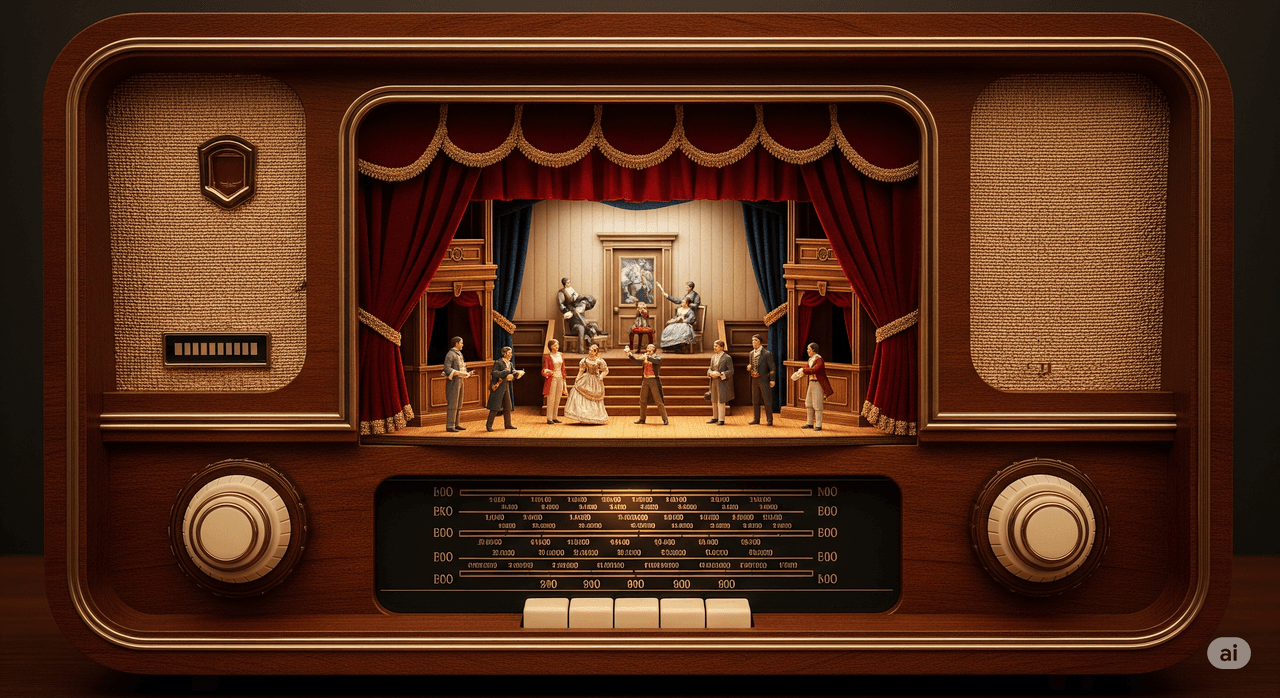
The Theatre of the Mind (Generated with Artificial Intelligence)
Radio theatre has a structure that draws its themes from human experience, offering multidimensional critiques of the individual or society while reflecting values and exposing flaws. Sometimes it emerges as an entire program dramatized for broadcast, known as “Theatre on Radio” or “Radio Play.” This format provides a foundation for developing other language skills by relying primarily on listening ability. Its purpose is to prioritize works that carry cultural, educational, artistic, and observational value, avoiding plays based solely on primitive emotions. During periods when technology and media tools were limited, it was a popular program type among listeners.
The earliest examples of radio theatre worldwide date back to the 1920s. Although some classical works by Shakespeare were broadcast on the BBC on 16 February 1923, Richard Hughes’s play A Comedy of Danger【1】 , first aired on 15 January 1924, is generally recognized as the first radio play.
Radio broadcasting in Türkiye began in 1927. The development of radio theatre followed a trajectory parallel to the institutional and technological evolution of radio broadcasting.
Radio broadcasting initially operated under the management of the Turkish Telegraph and Telephone Anonymous Company (TTTAŞ). During these early years, broadcasts were mostly live, as recording and storage capabilities were limited. Between 1936 and 1940, under the administration of the Post, Telegraph and Telephone Directorate, short comedic radio plays—such as monologues and sketches lasting under 30 minutes—appeared within entertainment programs. In 1940, radio administration was transferred to the General Directorate of Press, resulting in organizational changes. During this period, a “Theatre Section” was established to prepare radio plays, and seven individuals worked in this unit between 1941 and 1942. Emphasis was placed on copyrighted works, expanding the pool of writers; of the 654 plays submitted by writers by the end of 1941 and early 1942, 76 were deemed suitable for broadcast. Strict censorship mechanisms were in place during these years. Additionally, between 1941 and 1944, 104 children’s plays adapted from national and international classics were broadcast via the “Radio Children’s Club.”
During this period, radio plays continued to hold a prominent place within cultural and artistic programming. In 1949, the Radio Theatre Unit was dissolved, and productions began to be prepared by artists from the State Theatre and Opera in Ankara and the City Theatre in Istanbul. With the transition to a multi-party system, political controls intensified. Criticism arose over the limited circle allowed to write radio plays and the tendency of commission members to broadcast their own works. It was found that four of the ten plays produced in 1949 were written by individuals employed at the radio station. Censorship was also prominent during this period; even mild criticism such as “There has been much activity in municipalities this year. They plan to increase transportation vehicles. If they start in May, hopefully they will see results by January” was removed from the script.
On 1 May 1964, Türkiye’s radio stations were transferred to TRT, an autonomous public institution under constitutional protection. During this period, radio theatre productions were broadcast under numerous program titles such as Perde Arası, Mikrofonda Tiyatro, Pazar Tiyatrosu, and Arkası Yarın. Notable figures in literature and theatre, including Adalet Ağaoğlu and Turgut Özakman, served as managers or advisors in this section. In the 1970s, Radio Theatre was broadcast twice weekly for one hour each time, while Arkası Yarın aired daily except Sundays for 20 minutes. In 1975, 51 plays were broadcast on TRT-1 and 91 on TRT-2. However, toward the end of the 1970s, original production declined due to political pressure from nationalist coalition governments and the appointment of conservative administrators, leading to an increase in repeat broadcasts. During this period, radio theatre also served as a supplementary income source for theatre actors.
In the 1980s, the widespread adoption of television in Türkiye began to surpass radio listenership. According to a public opinion survey conducted in 1985, Arkası Yarın ranked fifth and Radio Theatre eighth in listener preferences. With the launch of commercial radio stations in the 1990s, TRT chose to compete with them rather than uphold public service broadcasting, leading to changes in programming content. The dominance of popular culture and television’s visual nature reduced the writing, production, and listening rates of radio theatre. For example, the annual production count on Istanbul and Ankara radio stations, which exceeded 100 in 1949, dropped below 10 on Istanbul Radio during the 2000s.
TRT was established under Law No. 359, based on Article 121 of the Constitution, as a neutral public legal entity. Its broadcasting principles include commitment to Atatürk’s reforms, support for national culture and education, and respect for national traditions. The goal of radio and television plays is defined as spreading theatrical thought, art, and culture nationwide. Within this framework, plays are selected from contemporary and classical national and international dramatic literature, while fatalistic and pessimistic works are avoided.
In the case of Ankara Radio, the production process of a radio play proceeds through the following stages:
Radio theatre is regarded as an effective tool in developing the cognitive skill of listening comprehension. Listening, an active interpretive process in which heard content is mentally structured, constitutes 45 percent of language proficiency. Radio theatre fulfills various functions in cultivating this skill:
A study found that a test group regularly exposed to radio theatre performed significantly better in listening comprehension tests than a control group that did not listen. In particular, on questions measuring higher-order thinking skills according to Bloom’s taxonomy—such as analysis, evaluation, and creation—the test group outperformed the control group by an average of 20 percent.【2】
Radio plays are considered authentic material for teaching Turkish to foreign learners. These texts, not originally produced for pedagogical purposes, serve a functional role by reflecting the culture of the target language and demonstrating its nuances and boundaries. They free learners from temporal and spatial constraints, allowing them to adjust their own learning pace.【3】
The absence of visual elements requires listeners to mentally reconstruct characters, settings, and events. This process enriches the listener’s imagination and fosters creativity.【4】
Radio Theatre: The Postman | Comedy (TRT Dinle)
Today, radio theatre continues to be broadcast on TRT Radyo-1. Recordings are still made in the historic studio built in 1938 at Ankara Radio House. However, there has been a marked decline in production numbers; for instance, no new productions have been made on Istanbul Radio for over a year, and its studio is now used as a music studio.
TRT’s “TRT Dinle” application has become a vital archive for radio theatre. This app provides access to numerous domestic and international works categorized by genre, including drama, family, crime, adventure, romance, and comedy. New media platforms such as the internet, podcasts, CD recordings, and mobile phones offer new opportunities for sustaining this program format.
Numerous writers, directors, and actors have contributed to the development of radio theatre in Türkiye.
Anadolu Ajansı. "Radyo tiyatrosunun 82 yıllık sahnesi: Radyoevi." Accessed June 30, 2025.https://www.aa.com.tr/tr/kultur-sanat/radyo-tiyatrosunun-82-yillik-sahnesi-radyoevi/1732768.
Cankaya, Özden. “Kaybolan bir program formatı: Radyo tiyatrosu.” *Selçuk İletişim* 6, no. 4 (2013): 5–17. Accessed June 30, 2025.https://dergipark.org.tr/en/pub/josc/issue/19022/200601
Karadağ, Nurhan. "Radyo tiyatrosu eğitimi." *Tiyatro Araştırmaları Dergisi* 7, no. 7 (1976): 163–173. Accessed June 30, 2025.https://dergipark.org.tr/en/download/article-file/118375
Miçooğulları, Mehmet. "Yabancılara Türkçe öğretiminde dinleme becerisi: otantik materyal olarak TRT dinle ve radyo tiyatroları." *Uluslararası Karamanoğlu Mehmetbey Eğitim Araştırmaları Dergisi* 3, Özel Sayı 1 (2021): 14–21. Accessed June 30, 2025.https://dergipark.org.tr/tr/pub/ukmead/issue/64998/944579.
TRT Arşiv Youtube Kanalı. "Radyo Tiyatrosu - 'Kendi Kendine Konuşmak'." Accessed June 30, 2025.https://www.youtube.com/watch?v=3-d1tN-XmGA&list=PLPsdkR5olmzmBZGJ_YRFsWtECK-E8v5WV&index=23.
Tiryaki, Esra Nur, and Semra Kolcu Canatar. "Radyo tiyatrosunun dinlediğini anlama becerisine etkisi." *Uluslararası Karamanoğlu Mehmetbey Eğitim Araştırmaları Dergisi* 3, Special Issue 1 (2021): 42–49. Accessed June 30, 2025.https://dergipark.org.tr/tr/download/article-file/1883955.
[1]
Özgür Cankaya, “Kaybolan Bir Program Formatı: Radyo Tiyatrosu,” Selçuk İletişim 6, no. 4 (2013): 7, Erişim 30 Haziran 2025, https://dergipark.org.tr/en/download/article-file/177804#page=3.
[2]
Esra Tiryaki ve Semra Kolcu, "Radyo tiyatrosunun dinlediğini anlama becerisine etkisi," Uluslararası Karamanoğlu Mehmetbey Eğitim Araştırmaları Dergisi 3, Özel Sayı 1 (2021): 48, Erişim 30 Haziran 2025, https://dergipark.org.tr/tr/download/articlefile/1883955#page=7.
[3]
Mehmet Miçooğulları, "Yabancılara Türkçe öğretiminde dinleme becerisi: otantik materyal olarak TRT dinle ve radyo tiyatroları," Uluslararası Karamanoğlu Mehmetbey Eğitim Araştırmaları Dergisi 3, Özel Sayı 1 (2021): 14–21, Erişim 30 Haziran 2025, https://dergipark.org.tr/tr/download/article-file/1794351. (Dipnotta tüm makale kullanıldığı için sayfa yönlendirmesi yapılmamıştır.)
[4]
Cankaya, “Kaybolan Bir Program Formatı,” 13, https://dergipark.org.tr/en/download/article-file/177804#page=9.

Definition and Scope
Historical Development
Development of Radio Theatre in Türkiye
1927–1946 Period
1946–1960 Period
1960–1980 Period
From the 1980s to the Present
Institutional Structure and Production Process
Legal Framework and Broadcasting Principles (TRT Era)
Production Stages
Theoretical Approaches and Educational Function
Impact on Listening Comprehension
Use as Authentic Material
Imagination and Creativity
Application Areas and Current Status
TRT Broadcasts
Digital Platforms and New Media
Key Figures and Works