


This article was automatically translated from the original Turkish version.
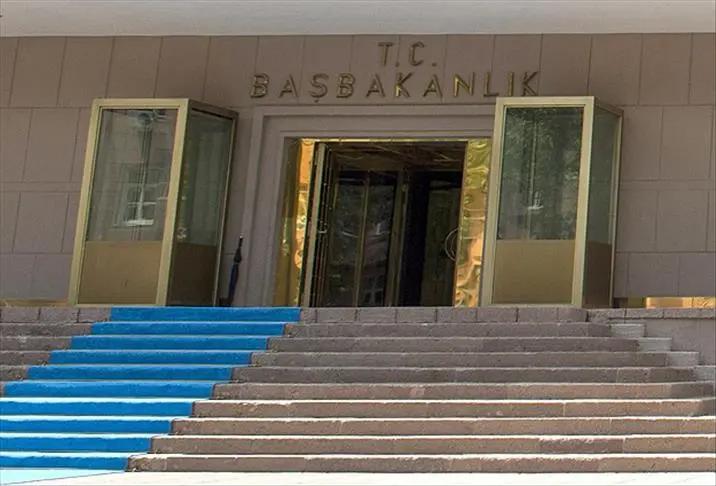
History of the Prime Ministry
Prime Ministership in the Republic of Türkiye | 1923-2018 | ||||||||
|---|---|---|---|---|---|---|---|---|---|
First Prime Minister | İsmet İnönü | ||||||||
Last Prime Minister | Binali Yıldırım | ||||||||
Total Number of Prime Ministers | 27 | ||||||||
Longest-Serving Prime Ministers | Recep Tayyip Erdoğan (11 years 7 months) Süleyman Demirel (10 years 10 months) İsmet İnönü (16 years) | ||||||||
First Female Prime Minister | Tansu Çiller | ||||||||
Total Number of Governments Formed | 65 | ||||||||
Youngest Prime Minister | Ali Fethi Okyar - 38 years old (1924) | ||||||||
Oldest Prime Minister | İsmet İnönü - 77 years old (1961) | ||||||||
Prime Ministry served as the highest administrative authority of the executive branch within the governance system of the Türkiye Republic, having emerged de facto during the Ankara Government period in 1920 and formally integrated into the state apparatus upon the proclamation of the Republic in 1923. As head of government, the Prime Minister presided over the Council of Ministers, coordinated between ministries, was responsible for implementing the government’s overall policy, and supervised ministers to ensure their compliance with the Constitution and laws. According to Article 112 of the 1982 Constitution, the Prime Minister also held the authority to propose to the President of the Republic the termination of ministers’ duties and occupied a central position within the administrative structure as the supreme authority over the ministries.
The Prime Ministry occupied the core of the state’s executive authority, and the effectiveness of state administration was largely shaped by the functioning of the government. Its organizational structure and areas of responsibility expanded over time, assuming the role of a key administrative unit by coordinating public services, implementing government policies, and overseeing services encompassing numerous ministries related to the state’s general policy. It also played a decisive role in coordinating the information society, digital transformation, and e-government initiatives.
However, following the constitutional amendment referendum held on 16 April 2017, the Türkiye Republic transitioned to the Presidential Government System. In accordance with this systemic change, the office of Prime Minister was abolished by constitutional provision. On 9 July 2018, when the new regulation came into force, executive authority was fully transferred to the President of the Republic, the Council of Ministers system was terminated, and the Prime Ministry organization was dissolved.
The state is the fundamental organizational form developed by societies throughout history, and its sustainable operation requires an institutional bureaucracy. Bureaucracy encompasses the entire state apparatus, public officials, and official correspondence. In ancient Turkish and Islamic states, the vizier, who conducted state affairs on behalf of the ruler, stood at the head of the bureaucratic structure. In Turkish culture, the khan represents courage while the vizier embodies knowledge and wisdom. The institution of vizierate became concrete during the Göktürk period and was transmitted through Sassanid-influenced structures from the Abbasids to the Seljuks and subsequently to the Ottomans. In the Great Seljuk State, the central council known as the “Divân-ı Sultan” and its head, the official bearing the title “Sahib-i Divân-ı Devlet,” corresponded to the modern institutions of the Council of Ministers and the Prime Ministry.
The institutional structure of the Ottoman State was shaped under the influence of preceding Turkish-Islamic states, but these institutions matured through Ottoman practices. The Sadaret office was an important institution nourished by this tradition and reflecting the influences of earlier states, particularly in its organizational framework. The Divân, recognized as the precursor of the Sadaret, was the Ottoman Empire’s first high administrative, judicial, and political organ, established during the reign of Orhan Bey, with Hacı Kemaleddin’s son Alaaddin Paşa appointed as its first vizier.
Divân-ı Hümâyûn functioned as the decision-making body in Ottoman politics, administration, military, judicial, and financial matters during the empire’s early and middle periods. The Divân was open to all Ottoman subjects regardless of religion, ethnicity, or social class. It served as the highest forum for discussing the state’s economic and financial issues and also fulfilled the role of the upper court within the judicial hierarchy. The Kazaskers represented sharia law, while the Grand Vizier and other members represented customary and administrative law.
Laws and regulatory decisions were made within the Divân, which had four main bureaus responsible for executing the state’s high politics and bureaucratic procedures: the Divân, Tahvil, Ruus, and Amedî offices. These bureaus, which recorded all central administration records except financial matters, later formed the foundation of modern government organs and the civil bureaucracy.
From the late seventeenth century onward, as state affairs shifted to the Bâbıâlî (Bâbıâsafî) center, the functions of Divân-ı Hümâyûn diminished; during the Tanzimat period, it became a symbolic institution within the Sadaret-i Uzma Dairesi (Prime Ministry).
In the Ottoman Empire, the administrator serving as the sole representative of the sultan was called a vizier. As the number of viziers increased, the highest-ranking vizier was granted the title “Grand Vizier.” The Grand Vizier was the absolute representative of the sultan, and his words and writings were considered the sultan’s firman. The sultan’s seal was entrusted to the Grand Vizier, who assumed responsibility for all state affairs. As president of the Divân-ı Hümâyûn, the Grand Vizier reviewed and resolved second-tier state matters in his own council. From the reign of Kanuni Sultan Süleyman onward, titles such as “Sadr-ı âzam,” “Sadr-ı âli,” and “Sadaret-penah” began to be used for the Grand Vizier, with “Sadrâzam” becoming predominant.
During the classical Ottoman period, the central authority of state administration was the Divân-ı Hümâyûn. From the second half of the seventeenth century onward, the Divân’s functions were reduced to symbolic roles such as distributing accession bonuses, paying soldiers’ salaries, and receiving ambassadors. During this period, the importance of the Bâbıâlî, presided over by the Grand Vizier, increased. Clerks from the Divân-ı Hümâyûn, beginning with the Reisülküttap, transferred to the Bâbıâlî, where new central administrative offices were established under senior officials such as the Kethuday-ı sadr-ı âlî, Reisülküttap, and Çavuşbaşı.
Reforms were implemented in these offices before the Tanzimat period. In 1835, the Sadaret Kethudalığı was restructured as the “Mülkiye Nezareti” (Ministry of Interior), the Reisülküttaplik became the “Umur-ı Hariciye Nezareti” (Ministry of Foreign Affairs) in the same year, and the Çavuşbaşılık was reorganized as the “Deavi Nezareti” (Ministry of Justice) in 1836.
After abolishing the Janissary Corps, II. Mahmud implemented major reforms in the state apparatus, establishing the Ministries of Interior, Foreign Affairs, and Finance. Additionally, through a hatt-ı hümayun issued on 30 March 1838, he requested that after the last Grand Vizier Rauf Paşa, the title “Sadaret” be replaced with “Başvekâlet” and “Sadrazam” with “Başvekil.” These titles remained in use until II. Mahmud’s death in 1839, after which Hüsrev Paşa resumed the title of Sadrazam with broad powers during the reign of Abdülmecid.
After the proclamation of the First Constitutional Era, Ahmed Vefik Paşa was offered the Sadaret, but he insisted that the title “Başvekillik” was required by the constitutional system and assumed office under this title on 4 February 1878. Sadık Paşa also served under the same title, but shortly afterward Mütercim Rüştü Paşa resumed the title of Sadrazam. After the effective suspension of the Constitutional Era, the title “Başvekil” was used from 29 August 1879 to 3 December 1882, a period of three and a half years. During this time, government heads included Said Paşa (three times), Kadri Paşa, Abdurrahman Paşa, and Ahmed Vefik Paşa.
With the establishment of the Ankara Government by the Grand National Assembly on 23 April 1923, the head of government bore the title “Reis of the Council of Executive Ministers.” Upon the proclamation of the Republic, the constitution added a provision naming this position “Başvekil.” On 10 January 1945, this title was officially changed to “Başbakan.”
The Government Period of the Grand National Assembly of Türkiye (TBMM) began with the opening of the TBMM on 23 April 1920 and continued until the proclamation of the Republic. During this period, executive authority was exercised through the Council of Executive Ministers elected from within the TBMM. Initially, a Provisional Executive Council was established, followed by the Council of Executive Ministers. The council’s president was initially the President of the TBMM (Mustafa Kemal Paşa), but from 1921 onward, he was elected by secret ballot among assembly members. Government members were accountable to the Assembly, and various governments were formed and resigned during this period. This period, lasting until the proclamation of the Republic in 1923, established the state structure of modern Türkiye based on national sovereignty. With the proclamation of the Republic, the government system evolved into the new Prime Ministry structure.
Governments and Periods Served as President of the Council of Executive Ministers
Governments and Periods Served as President of the Council of Executive Ministers
Governments and Periods Served as President of the Council of Executive Ministers
Governments and Periods Served as President of the Council of Executive Ministers
By a decision adopted on 14 April 1923, the relationship between the President of the Council of Executive Ministers and the Council itself was clarified, with the president sharing responsibility with the Council. With the proclamation of the Republic on 29 October 1923, the title “Başvekil” gained official status and the Başvekâlet organization was established. On 10 January 1945, following constitutional simplification, the term “Prime Ministry” came into use.
The Prime Ministry serves as the highest executive organ of the Türkiye Republic government, presiding over the Council of Ministers. The Prime Minister is appointed by the President of the Republic from among members of the TBMM, forms a cabinet, and submits it for approval by the TBMM. The Prime Minister coordinates the implementation of the government program, ensures cooperation among ministries, and manages central and auxiliary service units within the Prime Ministry organization. Within the Prime Ministry, Undersecretaries, Directors of the Private Office, and various advisory and oversight units are located.
The title of Prime Minister was the official designation for the person holding the highest executive authority and presiding over the Council of Ministers in the Türkiye Republic between 1923 and 2018. This office, established with the proclamation of the Republic in 1923, was abolished by the constitutional amendment adopted in 2017.
The first Prime Minister of the Türkiye Republic was İsmet İnönü (1884–1973), appointed to this position in the first Republic Government established on 30 October 1923.
The last Prime Minister in the history of the Türkiye Republic was Binali Yıldırım (b. 1955). Yıldırım assumed the office of Prime Minister on 24 May 2016 with the formation of the 65th Republic of Türkiye Government and became the final holder of the position when the office was abolished with the implementation of the Presidential Government System on 9 July 2018. Thus, the office of Prime Minister in the Türkiye Republic has been consigned to history.
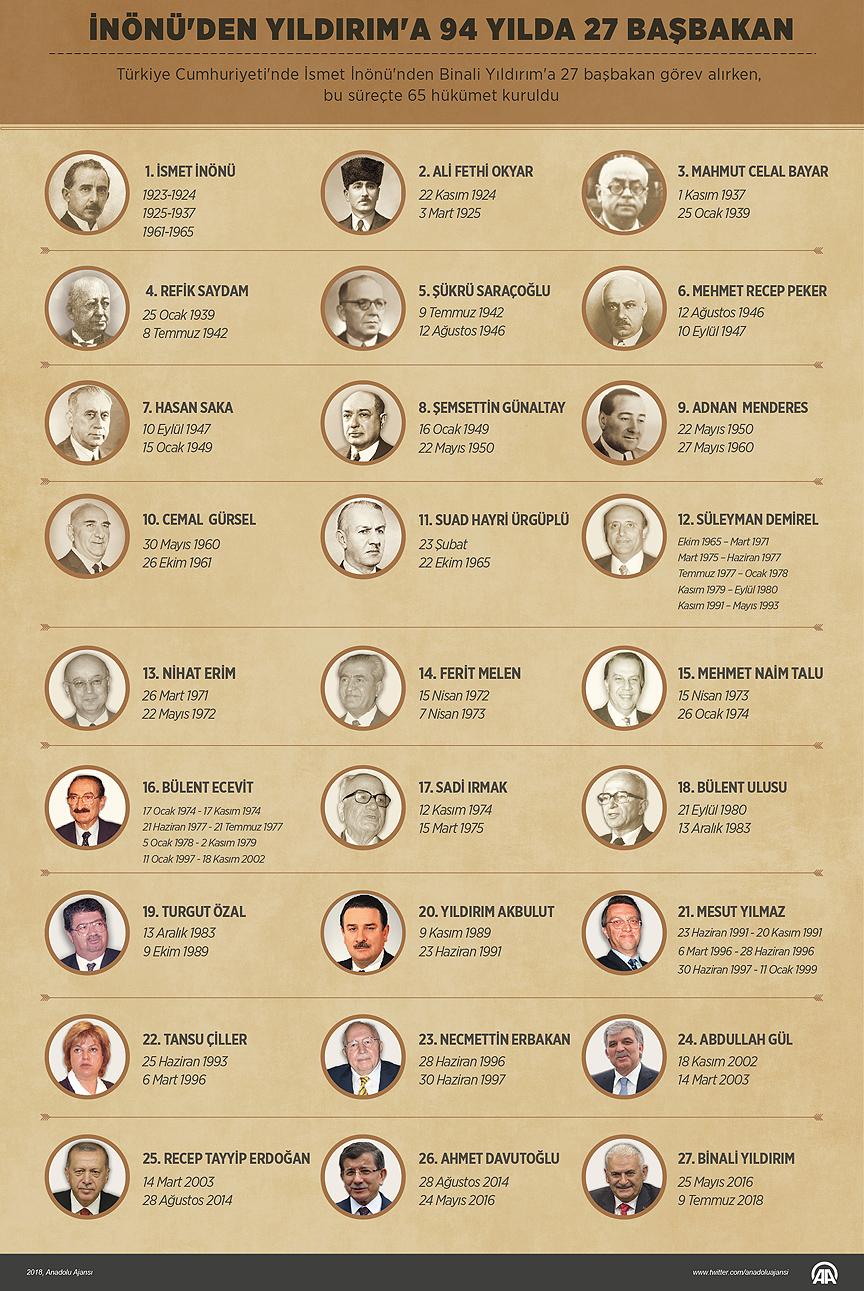
1923-2018 Yılları Arasında Görev Yapmış Başbakanlar İnfografiği - (AA)
Anadolu Ajansı. "Başbakanlıktan Açıklama." Accessed May 19, 2025.
Anadolu Ajansı. "Binali Yıldırım Son Başbakan Olarak Tarihe Geçti." Accessed May 19, 2025.
Anadolu Ajansı. "Davutoğlu’nun Başbakanlıktaki 21 Ayı." Accessed May 19, 2025.
Anadolu Ajansı. "İnönü’den Yıldırım’a 94 Yılda 27 Başbakan." Accessed May 19, 2025.
T.C. Cumhurbaşkanlığı Devlet Arşivleri Başkanlığı. "Devlet Arşivleri Genel Müdürlüğü Yayını: Başbakanlık." Accessed May 19, 2025.

History of the Prime Ministry
Prime Ministership in the Republic of Türkiye | 1923-2018 | ||||||||
|---|---|---|---|---|---|---|---|---|---|
First Prime Minister | İsmet İnönü | ||||||||
Last Prime Minister | Binali Yıldırım | ||||||||
Total Number of Prime Ministers | 27 | ||||||||
Longest-Serving Prime Ministers | Recep Tayyip Erdoğan (11 years 7 months) Süleyman Demirel (10 years 10 months) İsmet İnönü (16 years) | ||||||||
First Female Prime Minister | Tansu Çiller | ||||||||
Total Number of Governments Formed | 65 | ||||||||
Youngest Prime Minister | Ali Fethi Okyar - 38 years old (1924) | ||||||||
Oldest Prime Minister | İsmet İnönü - 77 years old (1961) | ||||||||
No Discussion Added Yet
Start discussion for "Prime Ministry of Türkiye" article
History
Sadaret and Divân-ı Hümâyûn in the Ottoman Period
Functions of Divân-ı Hümâyûn
Grand Vizier and His Functions
Development of Bâbıâlî and Sadaret
Prime Ministry from the Tanzimat to the Republic
Government Period of the Grand National Assembly of Türkiye
Presidents of the Council of Executive Ministers
Mustafa Kemal Atatürk (1881–1938)
Fevzi Çakmak (1876–1950)
Hüseyin Rauf Orbay (1881–1964)
Ali Fethi Okyar (1880–1943)
Prime Ministry in the Republican Era
Prime Ministers
Mustafa İsmet İnönü (1884–1973)
Governments and Periods Served as Prime Minister
Ali Fethi Okyar (1880–1943)
Governments and Periods Served as Prime Minister
Mahmut Celal Bayar (1883–1986)
Governments and Periods Served as Prime Minister
Dr. İbrahim Refik Saydam (1881–1942)
Governments and Periods Served as Prime Minister
Mehmet Şükrü Saraçoğlu (1887–1953)
Governments and Periods Served as Prime Minister
Recep Peker (1889–1950)
Governments and Periods Served as Prime Minister
Prof. Hasan Hüsnü Saka (1885–1960)
Governments and Periods Served as Prime Minister
Ord. Prof. Mehmet Şemsettin Günaltay (1883–1961)
Governments and Periods Served as Prime Minister
Adnan Menderes (1899–1961)
Governments and Periods Served as Prime Minister
Cemal Gürsel (1895–1966)
Governments and Periods Served as Prime Minister
Suat Hayri Ürgüplü (1903–1981)
Governments and Periods Served as Prime Minister
Süleyman Demirel (1924–2015)
Governments and Periods Served as Prime Minister
Prof. Dr. İsmail Nihat Erim (1912–1980)
Governments and Periods Served as Prime Minister
Ferit Melen (1906–1988)
Governments and Periods Served as Prime Minister
Mehmet Naim TALU (1919–1998)
Governments and Periods Served as Prime Minister
Mustafa Bülent ECEVİT (1925–2006)
Governments and Periods Served as Prime Minister
Ord. Prof. Dr. Mahmut Sadi IRMAK (1904–1990)
Governments and Periods Served as Prime Minister
Bülend ULUSU (1923–2015)
Governments and Periods Served as Prime Minister
Turgut ÖZAL (1927–1993)
Governments and Periods Served as Prime Minister
Yıldırım AKBULUT (1935–2021)
Governments and Periods Served as Prime Minister
Ahmet Mesut YILMAZ (1947–2020)
Governments and Periods Served as Prime Minister
Prof. Dr. Tansu ÇİLLER (1946– )
Governments and Periods Served as Prime Minister
Prof. Dr. Necmettin ERBAKAN (1926–2011)
Governments and Periods Served as Prime Minister
Doç. Dr. Abdullah GÜL (1950– )
Governments and Periods Served as Prime Minister
Recep Tayyip ERDOĞAN (1954– )
Governments and Periods Served as Prime Minister
Prof. Dr. Ahmet Davutoğlu (1959– )
Governments and Periods Served as Prime Minister
Prof. Dr. Binali Yıldırım (1955– )
Governments and Periods Served as Prime Minister
The First and Last Prime Minister of the Türkiye Republic
The First Prime Minister
The Last Prime Minister