


This article was automatically translated from the original Turkish version.
Image processing is one of the most important fields of modern technology and is used across a wide range of applications from computer vision systems to medical imaging. Edge detection is a fundamental step in analyzing and interpreting images. It is essential for identifying the boundaries of objects in an image and extracting meaningful information from these boundaries. The Prewitt Filter is a classic edge detection method developed for this purpose.
In image processing, edge detection identifies object boundaries by detecting changes in intensity. Edges are regions in an image where pixel brightness or color values undergo abrupt changes. These regions typically define the shapes, contours, and structural properties of objects. Edge detection plays a critical role in many areas such as:
The Prewitt filter is a classic convolution-based operator developed for edge detection in image processing. Proposed in the 1970s by Judith M. S. Prewitt, this method is designed to detect intensity gradients in digital images, that is, changes in brightness or color values. Edge detection is a critical step for identifying object boundaries in an image and performing structural analysis on them. The Prewitt filter has drawn attention for its simplicity, computational efficiency, and ability to provide directional information during this process.
The Prewitt filter consists of two 3x3 kernel matrices applied to an image matrix. These kernels detect intensity changes separately in the horizontal and vertical directions. When the filter outputs are combined, information about both the location and direction of edges is obtained. Prewitt’s approach became popular in the early days of image processing technology and laid the foundation for later methods such as the Sobel operator.
The Prewitt filter operates using two 3x3 kernel matrices.
These kernels are applied to each pixel of an image through a convolution operation. Convolution computes a weighted sum of the pixel’s neighbor pixels. For example, the horizontal kernel (Gx) multiplies the intensity values on the left side of a pixel with a negative weight and those on the right side with a positive weight. If there is an intensity change (an edge) in this region, the Gx value becomes a large positive or negative number; otherwise, it yields a value close to zero. Similarly, the vertical kernel (Gy) detects intensity changes from top to bottom.
When the Prewitt Filter is applied, horizontal (Gx) and vertical (Gy) gradients are computed for each pixel. These gradients are combined to determine the magnitude and direction of edges:
Gradient magnitude indicates the strength of the edge (the amount of intensity change), while gradient direction specifies the angle of the edge. This information is used to understand both the location and structure of edges.
To apply the Prewitt filter to an image, the following steps must be followed.
Original Image:
(Credit: Hassan Jadoon)
Image with Edges Detected by the Prewitt Filter:
(Credit: Hassan Jadoon)
In image processing, edge detection can be performed using various algorithms and operators. Although the Prewitt filter stands out as a classical method in this field, it is frequently compared with other operators such as Sobel, Scharr, and Canny. Each method has its own mathematical foundations, computational approaches, and application domains.
The Sobel operator has a structure very similar to the Prewitt filter and also operates using 3x3 kernel matrices. However, Sobel’s kernels compute intensity gradients by assigning higher weights to central pixels:
Mathematical Differences: In the Prewitt filter, each neighboring pixel is evaluated with equal weight (1 or -1), whereas in the Sobel operator, the central row or column (2 and -2) receives higher weight. This allows Sobel to produce a smoother gradient transition and greater resistance to noise.
Performance and Precision: Sobel provides sharper edge detection than Prewitt because the additional weight assigned to central pixels helps better capture the gradient. However, this extra weight increases computational complexity only marginally, and this difference is negligible on modern systems.
Application Scenarios: Prewitt may be preferred for images with low noise and simple edge structures, while Sobel delivers better results for more complex or noisy images. For example, in a medical image such as an X-ray, Sobel can capture finer details more effectively than Prewitt.
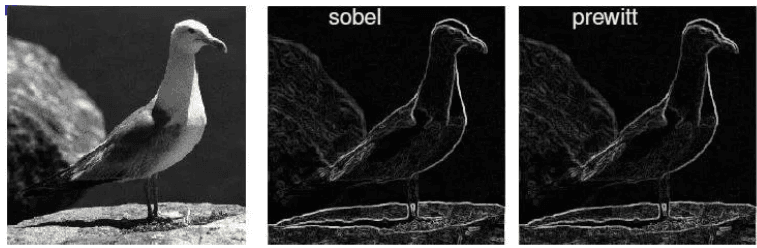
(Credit: Onur Yozcu)
The Scharr operator is considered a derivative of Sobel and is optimized to better detect diagonal edges. Its kernels are as follows:
Mathematical Differences: Scharr uses higher weights (-10 and 10) compared to Sobel, making gradient calculation more precise. Compared to Prewitt’s simple structure, Scharr’s weighting scheme provides superior performance in detecting diagonal edges such as those at 45° or 135°.
Performance and Precision: Scharr requires more computation than Prewitt, but this additional cost results in clearer detection of diagonal edges. Prewitt’s design, which focuses on smooth horizontal and vertical edges, can be weak in detecting diagonal edges.
Application Scenarios: Scharr is ideal for images containing complex geometric patterns or slanted edges such as road lanes or natural landscapes. Prewitt is preferred in cases where simpler and more uniform edge structures are sufficient.
Unlike Prewitt, Canny is a multi-stage edge detection algorithm consisting of several steps rather than just a single convolution filter:
Mathematical Differences: While Prewitt is merely a simple gradient calculation filter, Canny processes this gradient information at a more advanced level. Unlike Prewitt’s single-stage structure, Canny’s multi-stage approach enables the extraction of finer and more continuous edges.
Performance and Precision: Canny is significantly more precise and noise-resistant than Prewitt. While Prewitt has a high probability of detecting false edges in noisy images, Canny’s noise filtering step minimizes this issue. However, Canny’s computational cost is much higher than that of Prewitt.
Application Scenarios: Canny is preferred in applications requiring high accuracy, such as road detection in autonomous vehicles or biomedical analysis for defining cell boundaries. Prewitt is used in fast prototyping or systems requiring low computational power.
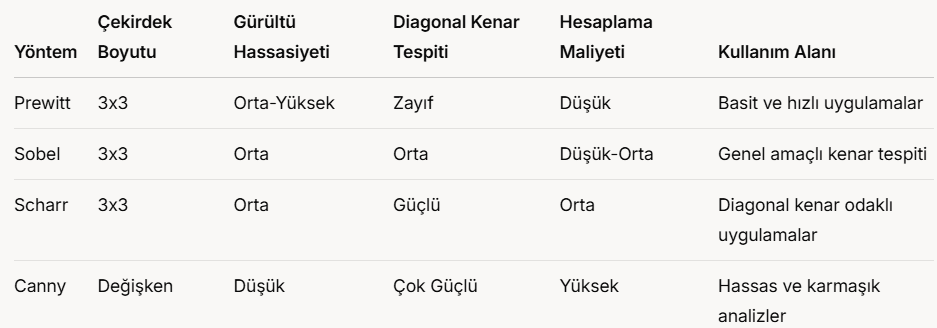
Comparative Performance Analysis (Generated by artificial intelligence.)
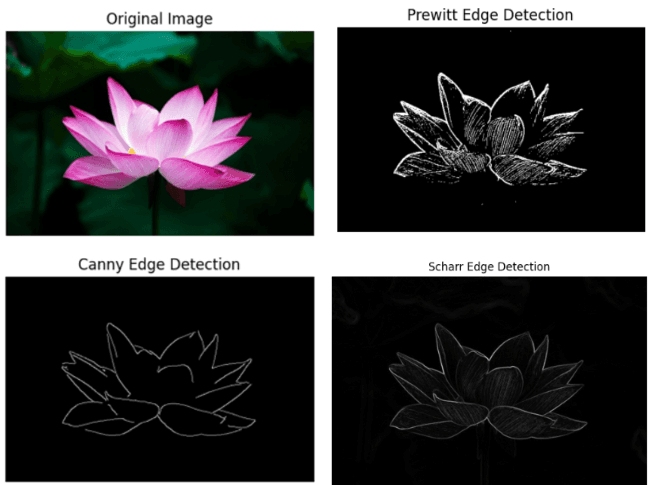
(Credit: Roboflow)
Application Areas of the Prewitt Filter
Despite its theoretical simplicity, the Prewitt filter is used in many practical applications.
Medical imaging is one of the most common areas where the Prewitt filter is applied. Images obtained through imaging techniques such as MRI, X-ray, CT scans, and ultrasound are often analyzed to determine the boundaries of organs, bones, or pathological structures. The Prewitt filter detects intensity changes in these images to reveal edges, assisting doctors or automated systems in diagnosis.
In industrial applications, the Prewitt filter is frequently used for defect detection and quality control in production processes. On production lines, surface cracks, scratches, or other anomalies in products can often be detected as edges. The Prewitt filter helps rapidly identify such defects, improving production quality.
In security systems, the Prewitt filter plays an important role in applications such as motion detection, face recognition, and object tracking. In real-time video streams, edge detection serves as a fast and effective preprocessing step.
Robotics and autonomous vehicles rely heavily on image processing techniques for environmental perception and navigation. The Prewitt filter is ideal for providing edge information in these systems with low computational cost.
The Prewitt filter is widely used as a fundamental tool in image processing education. In academic studies, students and researchers use this filter to learn edge detection concepts and understand the foundations of more complex algorithms.
The Prewitt filter is not limited to technical fields; it can also be used in art and creative projects. In image processing art, edge detection is regarded as a tool for generating aesthetic effects.
GeeksforGeeks. "Edge Detection Using Prewitt, Scharr and Sobel Operator."Accessed Adresi.
Netcad. "Filtre." Accessed [Date].Accessed Adresi.
Patrice, J. "Prewitt Operator." University of Auckland.Accessed Adresi.
SciPy. "scipy.ndimage.prewitt." Accessed [Date].Accessed Adresi.
Tutorialspoint. "Prewitt Operator." Accessed [insert date].Accessed Adresi.
Yıldırım, M., & Kaya, Y. (2016). Görüntü İşleme Teknikleri ile Kenar Tespiti. DergiPark.
Yılmaz, A., & Kaya, E. (2023). *Görüntü İşlemede Kenar Tespit Algoritmalarının Karşılaştırılması*. DergiPark.Accessed Adresi.
Çayıroğlu, İ. "Görüntü İşleme Ders Notları - 7. Hafta."Accessed Adresi.
Çelik, E. "MATLAB Görüntü İşleme: Konvolüsyon, Prewitt ve Sobel Filtreleri".Accessed Adresi.

The Importance of Edge Detection in Image Processing
Prewitt Filter
Mathematical Structure of Prewitt Kernels
Gradient Magnitude and Direction
Application of the Prewitt Filter
Implementation of the Prewitt Filter in the Python Programming Language
Advantages and Disadvantages of the Prewitt Filter
Advantages
Disadvantages
Comparison of the Prewitt Filter with Other Edge Detection Methods
Comparison with the Sobel Operator
Comparison with the Scharr Operator
Comparison with the Canny Edge Detection Algorithm
Medical Image Analysis
Industrial Control and Quality Assurance
Security Systems and Video Analysis
Robotics and Autonomous Systems
Education and Academic Research
Art and Creative Applications