


This article was automatically translated from the original Turkish version.
Polyvagal Theory
Founder(s) | Stephen W. Porges | ||||||||
|---|---|---|---|---|---|---|---|---|---|
Our peripheral nervous system is divided into two main branches: the somatic and the autonomic. The autonomic system itself is further divided into the parasympathetic and sympathetic systems. Our parasympathetic and sympathetic systems enable us to respond appropriately in threatening situations.
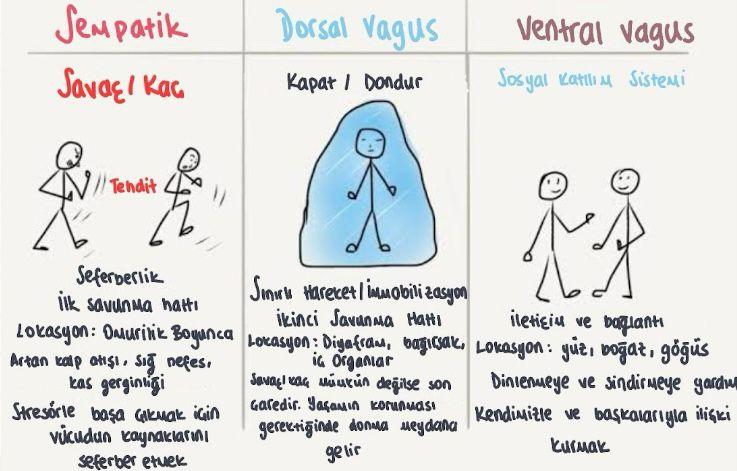
The Polyvagal Theory primarily focuses on the role of the vagus nerve in regulating our emotions. The vagus is the primary nerve of our parasympathetic nervous system main and connects our body to our brain. The vagus sends bidirectional signals from the brain to internal organs and from internal organs back to the brain and is also known as traveler. Our vagus nerve splits into two branches: the dorsal vagus, located below our diaphragm dorsal, is responsible for managing the region below the diaphragm, while the ventral vagus, located above the diaphragm, is responsible for managing the remaining region.
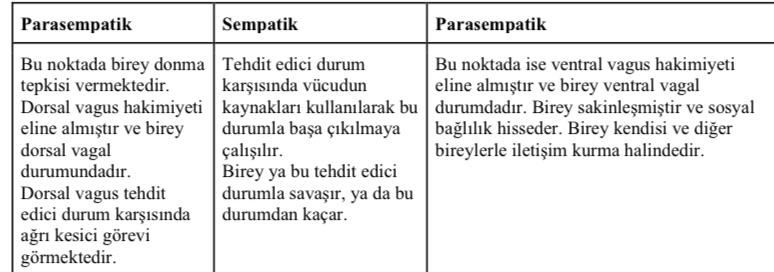
Individuals scan their environment through neuroception for cues of safety and danger. If they encounter a threatening situation and perceive themselves as sufficiently empowered, they respond with either a fight or a flight response. These responses are mediated by the individual’s sympathetic system system. If the threatening situation individual is overwhelming and the individual perceives their resources as insufficient, they enter a freeze response. This freeze response is mediated by the dorsal vagus, the part of the vagus nerve located above the diaphragm, and individuals in this state are said to be in a dorsal vagal state.
When a threatening situation subsides, individuals begin to return to their normal state, relaxing and calming down while reestablishing connection with their environment. In this state, the ventral vagus takes control and individuals are in a ventral vagal state. However, for most individuals, returning to this state of normalcy and connection Dönme car seems you've provided only the Turkish word "hali," which translates to "carpet" or "rug" in English, depending on context.In an encyclopedic context, the most appropriate translation would be:**carpet**If you have additional context (e.g., a full sentence or paragraph), please provide it for a more accurate and nuanced translation. is not easy. After experiencing a threatening situation, individuals may remain stuck in freeze responses and continue to reside in a dorsal vagal state. The goal of Polyvagal Theory is to guide the individual first from the dorsal vagal state to the sympathetic state (that is, to engage in fight or flight behaviors) and then to the ventral vagal state. It is essential that this transition occurs in a calm and balanced manner.
The Purpose of Polyvagal Theory
Polivagal Academy. "Bağ Kurmanın Sinir Bilimi." Polivagal Akademi Resmi Web Sitesi. Accessed February 7, 2025. https://polivagalakademi.com/.
Porges, Stephen. Polivagal Teori Rehberi Güvende Hissetmenin Dönüştürücü Gücü. Çev. Ece Turkmut Dere, İstanbul: Türkiye Psikonet Yayınları, 2022.
Özel, Dilara. "Somatik deneyimleme: Afet ve acil durumlarla çalışmada yeni bir yaklaşım." Eskişehir Osmangazi Üniversitesi Sosyal Bilimler Dergisi 25, no. 1 (2024): 101–117.

Polyvagal Theory
Founder(s) | Stephen W. Porges | ||||||||
|---|---|---|---|---|---|---|---|---|---|
Our Nervous System and the Vagus Nerve
Responses to Threats
The Purpose of Polyvagal Theory