This article was automatically translated from the original Turkish version.
At some point in my life—during a meeting, in a classroom, on a street—I felt this: “Something is wrong, but no one is saying anything; maybe I’m misunderstanding.” And I stayed silent. Later, I learned that almost everyone in that room had felt the same thing. Everyone had inferred from each other’s silence that “this must be normal.” We had all deceived each other.
This experience taught me this: Silence is not approval. But we read it that way. Because when humans face uncertainty, they look around. If the faces around them are calm, the brain concludes “no danger,” and if no one objects, it assumes “there is nothing to object to.” This is a deeply ingrained reflex, and it often misleads us.
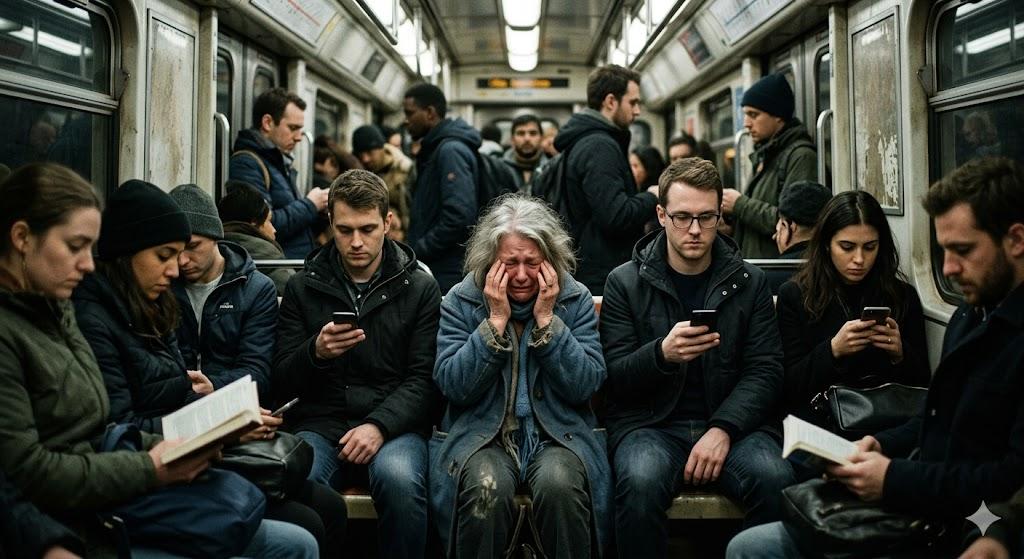
Visual Representing Pluralistic Ignorance (Generated by Artificial Intelligence)
What strikes me most is this: This illusion is not merely an individual blindness—it is a lie collectively produced. No one is deliberately lying. Everyone simply thinks, “If others are behaving this way, I should too.” And that is enough; it is sufficient to sustain a norm that no one truly believes in.
I saw this most clearly on social media. When a post receives thousands of likes, we assume it must be right. When a viewpoint is quietly passed over, we assume it has been accepted. But what lies behind those likes? Perhaps the majority simply thought, “Everyone is sharing it, so I should too.” Algorithms already amplify what is popular, and we mistake popularity for truth. Thus, pluralistic ignorance becomes a self-reinforcing cycle in digital spaces.
Sometimes I wonder: A group of people witness something disturbing, and no one intervenes. Why? Because no one intervenes. To break this cycle, someone must shatter it—alone, right in the center of everyone’s gaze.
Here lies the real question: Who will raise the first voice? From my observations, often just one person saying, “Actually, I think this is wrong” is enough. In that moment, everyone in the room takes a breath. Because that sentence makes something possible: the permission to speak one’s own truth.
But this is not easy. Raising the first voice means risking social judgment. It means bearing the looks that ask, “Why did you fixate on this?” And the hardest part is speaking anyway, while still carrying the possibility that “maybe I am wrong.”

Visual Representing Pluralistic Ignorance (Generated by Artificial Intelligence)
I believe pluralistic ignorance is not merely a psychological phenomenon—it is also a moral failure. Because sustaining that silence can have the same consequence as complicity in injustice. No one actively causes harm, but everyone passively permits it. And throughout history, most of the greatest injustices have survived only because of this passive consent.
“Everyone is doing it” is one of the most dangerous phrases I have ever heard. Because it contains both an excuse and a trap. Whenever I hear it now, I ask myself: Is it really everyone? Or is it just that everyone thinks everyone else is doing it?
The difference is profound. And perhaps seeing that difference is the beginning of everything.