

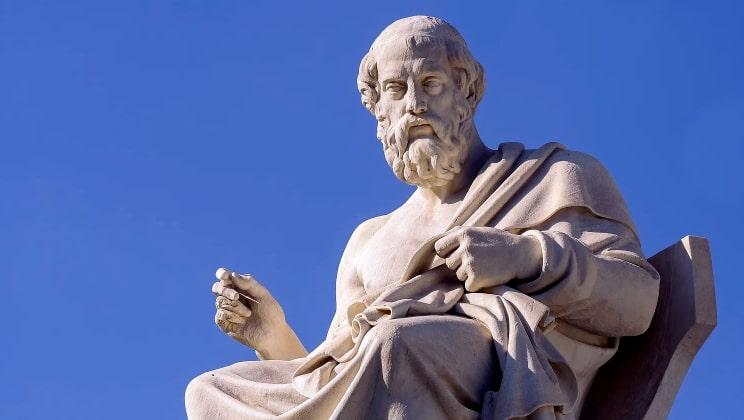

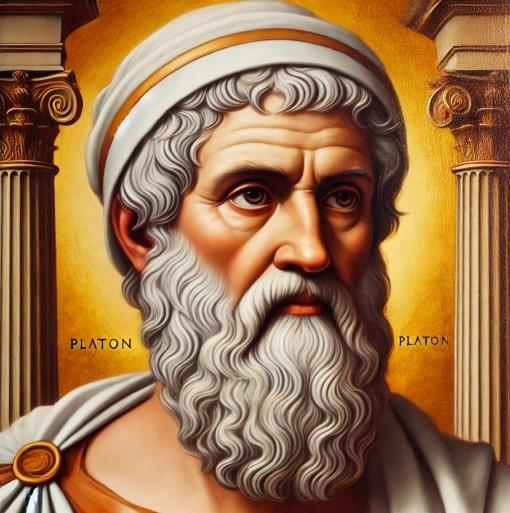
Plato
Real Name | Aristokles | ||||||||
|---|---|---|---|---|---|---|---|---|---|
Nickname | Plato (meaning 'broad-shouldered') | ||||||||
Date of Birth | 428/427 or 424/423 BCE | ||||||||
Place of Birth | Athens, Colytus (Greece) | ||||||||
Date of Death | 348/347 BCE | ||||||||
Mother | Perictione (descendant of the lawgiver Solon) | ||||||||
Father | Ariston (noble Athenian, descendant of the legendary king Codrus) | ||||||||
Siblings | Adeimantus Glaucon Potone (sister) | ||||||||
Major Works | • Apology, Crito, Euthyphron, Protagoras (early period), • Republic, Symposium, Phaedo, Gorgias (middle period), • Timaeus, Sophist, Laws (late period) | ||||||||
Plato (c. 428/427 – c. 348/347 BCE) is one of the most influential figures in ancient Greek thought. A student of Socrates and teacher of Aristotle, Plato profoundly shaped not only the history of philosophical thought but also the Western world’s understanding of politics, education, and science. Through founding the Academy, he laid the foundations of systematic education. His dialogues, written in a distinctive literary style, revolve around themes such as justice, knowledge, virtue, and the ideal society.
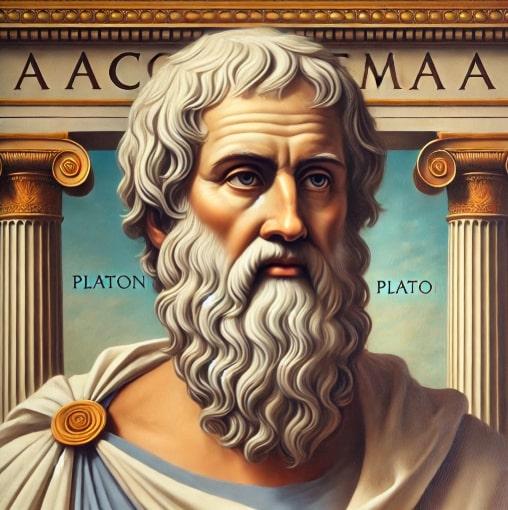
Portrait of Plato, representative. Designed with artificial intelligence.
Plato was likely born in 428/427 or 424/423 BCE in the Kolitos district near Athens. Although there is some disagreement over the exact date, most sources point to the years before the Peloponnesian War. His family belonged to the Athenian aristocracy. His father, Ariston, was said to descend from the royal lines of Athens and Messenia, while his mother, Perictione, was believed to be a descendant of the Athenian lawgiver Solon. After his father’s death, his mother married the statesman and diplomat Pyrilampes.
Plato’s real name was Aristocles; the nickname Plato (meaning “broad-shouldered”) is thought to have been given to him because of his physical build or his powerful oratory. His early education, received from leading teachers of the time, was enriched by the ideas of figures such as Parmenides, Pythagoras, and Cratylus, which shaped his foundational assumptions in metaphysics and epistemology.
The most decisive figure in shaping Plato’s intellectual world was Socrates. Plato met Socrates in his youth and was deeply influenced by his philosophical method of inquiry. Socrates’ execution in 399 BCE radically altered Plato’s views on Athenian politics and his own intellectual path. Thereafter, he withdrew from politics and devoted himself to philosophy, taking on the task of preserving Socrates’ ideas in written form. In Plato’s dialogues, Socrates frequently appears as the main character.
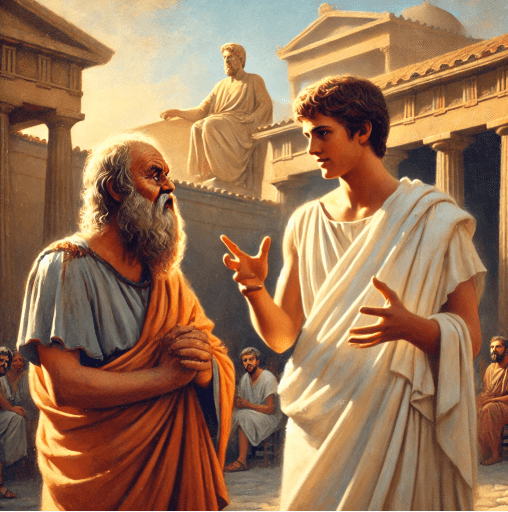
Representative image of the meeting between Socrates and Plato. Designed with artificial intelligence.
After Socrates’ death, Plato embarked on a journey lasting approximately twelve years. His travels to Egypt, Southern Italy, and Sicily introduced him to Pythagorean thought and deepened his knowledge of geometry, astronomy, cosmology, and religion. During this period, Plato began writing, and his works are conventionally divided into three main periods: early, middle, and late. These journeys nourished his speculative views on nature, knowledge, and the universe.
Plato’s philosophical system is best known for his Theory of Forms (Theory of Ideas). According to him, the world perceived by the senses is changeable and deceptive; true knowledge can only be attained through reason, by grasping immutable and perfect “forms” or “ideas.”
Plato’s epistemology distinguishes between knowledge and belief. For him, knowledge is the comprehension of the Forms. In his moral philosophy, virtue is equated with knowledge. These ideas are elaborated in detail in his work The Republic. Plato constructs his ideal state on three classes—rulers, guardians, and producers—and introduces the concept of the “philosopher-king.” In his theory of the soul, he divides it into three parts: reason (logos), appetite (epithymia), and spirit or anger (thymos).
Plato’s works are written in dialogue form and are notable for both their literary qualities and philosophical depth. In his early works, he remains faithful to Socrates’ views; in his middle and late works, he develops his own metaphysical theories.
His major works include:

A dramatic, representative image of Plato writing a dialogue in a dim setting. Designed with artificial intelligence.
Around 387 BCE, Plato founded the Academy, considered the first organized institution of higher learning in the Western world, near the sacred grove of Akademeia in northwestern Athens. This school offered a curriculum encompassing many disciplines, including mathematics, philosophy, political theory, astronomy, and biology. Plato organized the Academy not only to transmit theoretical knowledge but also to train statesmen and lawmakers. The school endured for nearly 900 years. Among its students was Aristotle.
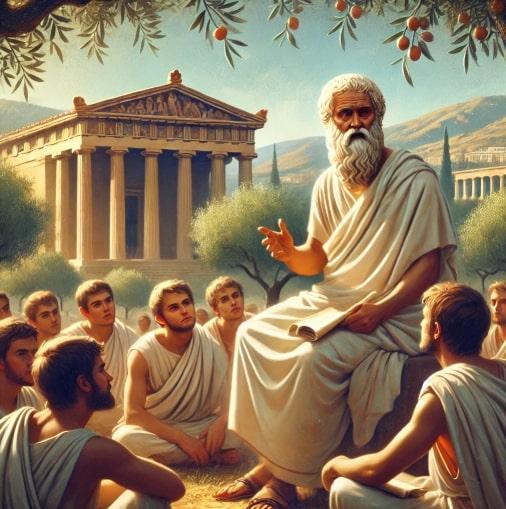
Representative image of Plato teaching students at the Academy. Designed with artificial intelligence.
Plato’s philosophical thought is closely tied to politics. The idea of the “philosopher-king” lies at the center of his political vision. In 367 BCE, he traveled to Syracuse to serve as an advisor to Dionysius II, attempting a political reform. However, this experience ended in failure; Plato was imprisoned for a time and eventually returned to Athens. This event led him to completely sever ties with practical politics.
Plato died in Athens in 348/347 BCE at the Academy. The exact cause of death is uncertain, though various accounts exist.
His philosophical legacy extended far beyond antiquity, influencing Christian thought in the Middle Ages, the Renaissance, the Enlightenment, and modern philosophy. The Academy model pioneered the Western university system; his dialogic method has left a lasting imprint on education and the history of thought.
Plato is one of the foundational figures not only of Western philosophy but of human thought as a whole. The theoretical frameworks he provided in areas such as ontology, epistemology, ethics, politics, and education have been both supported and criticized in subsequent centuries, yet never ignored. His transformation of Socrates’ legacy of questioning into a systematic philosophical structure, and his institutionalization of philosophy through the Academy, have secured his place as one of the cornerstone figures in the history of philosophy.

Plato
Real Name | Aristokles | ||||||||
|---|---|---|---|---|---|---|---|---|---|
Nickname | Plato (meaning 'broad-shouldered') | ||||||||
Date of Birth | 428/427 or 424/423 BCE | ||||||||
Place of Birth | Athens, Colytus (Greece) | ||||||||
Date of Death | 348/347 BCE | ||||||||
Mother | Perictione (descendant of the lawgiver Solon) | ||||||||
Father | Ariston (noble Athenian, descendant of the legendary king Codrus) | ||||||||
Siblings | Adeimantus Glaucon Potone (sister) | ||||||||
Major Works | • Apology, Crito, Euthyphron, Protagoras (early period), • Republic, Symposium, Phaedo, Gorgias (middle period), • Timaeus, Sophist, Laws (late period) | ||||||||
Early Life and Family
Meeting Socrates and His Influence
Travels and Philosophical Maturation
Philosophical Ideas and Key Concepts
Major Works and Literary Style
Founding of the Academy and Educational Activities
Plato’s Political Life and Experiments
Death and Legacy
Historical and Philosophical Significance of Plato