


This article was automatically translated from the original Turkish version.
+1 More
A Pitot tube is an instrument used to measure the velocity of a flowing fluid. Pitot tubes are employed in wind tunnels and on aircraft in flight to calculate airspeed using anemometers. They are also used to measure liquid flow rates.
Invented in the early 18th century by French engineer Henri Pitot, it was later modified into its modern form in the mid-19th century by French scientist Henry Darcy.
A Pitot tube consists of two hollow tubes that measure pressure at different points along a pipe. One tube measures impact or stagnation pressure, while the other measures only static pressure, typically the pressure at the pipe wall. These hollow tubes can be mounted separately onto a pipe or assembled together within a single housing.
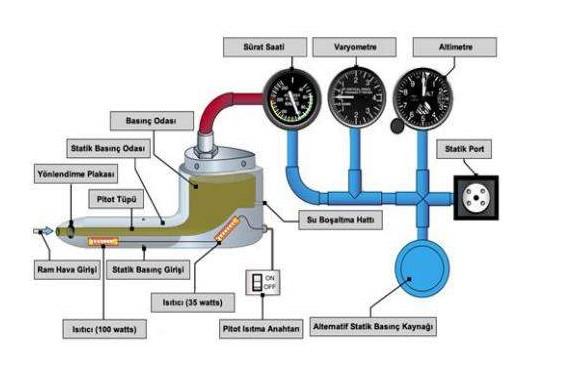
Principle of Pitot tube operation [1]
The Pitot tube is positioned parallel to and opposite the direction of fluid flow, namely air.
As the fluid passes through the Pitot tube, it measures the resultant pressure, which is the sum of the dynamic pressure caused by the relative motion between the vehicle and the fluid and the static pressure exerted on all surfaces of the fluid.
This total pressure causes a sensitive diaphragm in the system to expand, while the static pressure from the static ports causes the diaphragm to contract proportionally to the static pressure. The difference between these two movements is termed dynamic pressure.
The dynamic pressure is reflected on the airspeed indicator scale. The Pitot tube provides Indicated Airspeed (IAS), which is calculated from the difference between static and dynamic air pressure. IAS is calibrated to Corrected Airspeed (CAS) using an aircraft-specific correction table. However, at high speeds, air compresses in front of the Pitot tube, yielding Equivalent Airspeed (EAS). Since temperature and air density vary with altitude, the final calculated value is the True Airspeed (TAS), adjusted for the specific altitude. In computerized systems, TAS is computed and displayed directly to the pilot.
The equation representing the system’s operation:
Total pressure (pt) = Static pressure (ps) + Dynamic pressure (1/2rhoV2)

When the aircraft is not in flight, the Pitot tube must be protected from external factors such as insects. For this purpose, it is covered with a protective cap. If the cap is left on or the Pitot tube becomes clogged, the airspeed indicator may show a zero reading, and erroneous sensor data can lead to accidents.
On 11 March 2018, a Bombardier Challenger 604 business jet departed from the United Arab Emirates bound for Istanbul and crashed in Iran, with no survivors. Subsequent reports indicated that the aircraft entered an abnormal condition at 38,000 feet (12,600 meters) while flying at zero airspeed. The cause of the zero airspeed was determined to be a faulty airspeed indicator; the pilot, believing the aircraft was accelerating, pulled up the nose to counter the perceived increase in speed. However, since the actual speed had not increased, the maneuver caused the aircraft to lose airspeed and enter a stall. The report emphasized that the airspeed indicators were inaccurate due to a clogged Pitot tube and inadequate or incomplete pre-flight maintenance.
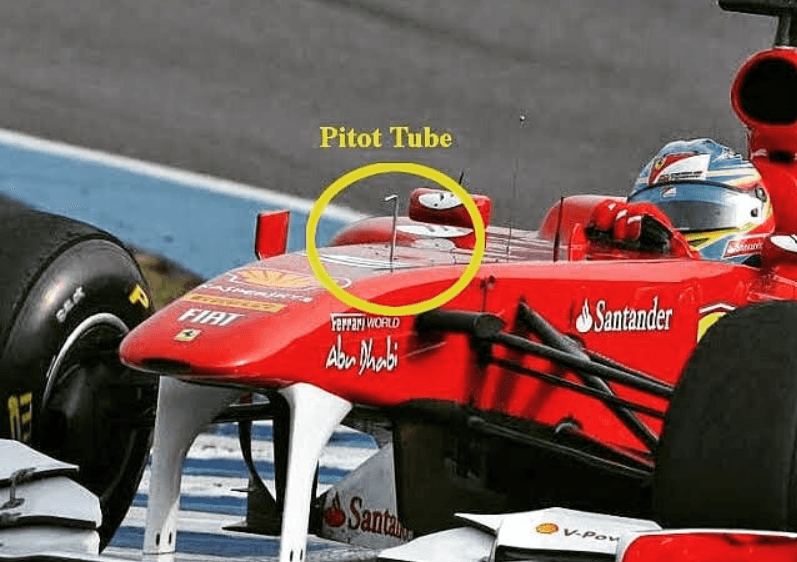
Example of Pitot tube use in F1 cars [2]
In a typical F1 car, since the vehicle has many shapes that alter the speed of airflow as it passes through, teams can relocate Pitot tubes to different positions to obtain various data sets.
Akkaş, M. (2021). *Henri Pitot Kimdir Pitot Tüpü Nedir?* Accessed January 19, 2025.
CNN Türk. (2020) *İran'da 11 kişinin öldüğü jet kazasında nihai rapor ortaya çıktı!* Accessed January 19, 2025.
Ekrem, C. (2024). *Pitot Tüpü Nedir?* Accessed January 19, 2025.
Endüstrilab. (2022). *Pitot tüpü nedir ve ne için kullanılır?* Accessed January 19, 2025.https://endustrilab.com/pitot-tupu-nedir-ve-ne-icin-kullanilir/
Yağlı, B.R. (2020). *Pitot Tüpü Nedir? Nasıl Ölçülür? Neden Önemlidir?* Accessed January 19, 2025.https://www.arabam.com/blog/genel/pitot-tupu-nedir-nasil-olculur-neden-onemlidir/

Principle of Operation of the Pitot Tube
Advantages of the Pitot Tube
Disadvantages of the Pitot Tube