This article was automatically translated from the original Turkish version.
+1 More
Aircraft Type | Twin turboprop, fixed foreplane, three-surface aircraft | ||||||||
|---|---|---|---|---|---|---|---|---|---|
Parent Company | BAYKAR (Türkiye) | ||||||||
Manufacturer | Piaggio Aerospace (Italy) | ||||||||
Purpose of Use | VIP Passenger Transport and Light Cargo UAV Ambulance Military Patrol Passenger Transport Radio Calibration Experimental Performance Analysis | ||||||||
First Flight Date | 23 September 1986 | ||||||||
Entry into Service Date | 30 September 1990 | ||||||||
Production Quantity | 246 (December 2020) | ||||||||
User Nations | Canada Poland Russia United Arab Emirates Türkiye Italy | ||||||||
Engine Variants | PT6A-66B PT6A-66 | ||||||||
Status | Active - In Production | ||||||||
The Piaggio P.180 family is a group of executive/VIP light transport aircraft designed and manufactured in Italy by Piaggio Aerospace. These aircraft are known for their innovative designs and advanced engineering. The P.180 is equipped with twin turboprop engines mounted on the fuselage, arranged in a pusher configuration. This setup enhances the aircraft’s aerodynamic efficiency while providing a quieter cabin environment.
Unlike most conventional aircraft, its design employs a three-surface configuration consisting of a small forward canard (fixed surface), a conventional horizontal tail, and the main wing. This configuration ensures balanced flight characteristics, although it is often mistaken for a conventional canard design. Additionally, the main wing spars pass behind the passenger cabin, offering a significant advantage in interior layout.
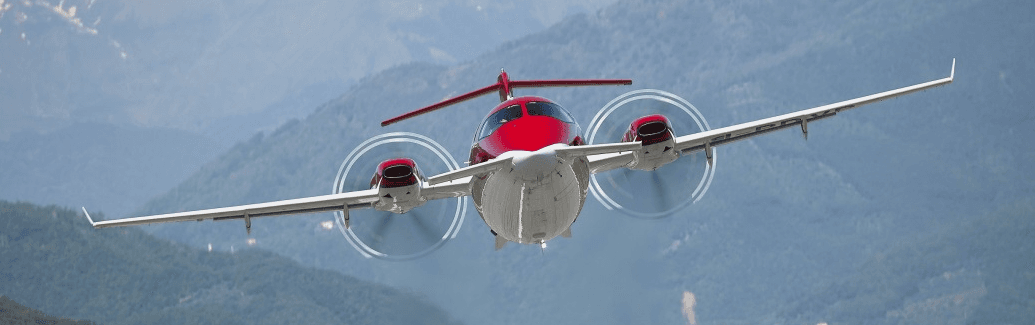
Piaggio P.180 EVO from the Piaggio P.180 Family (Piaggio Aerospace)
Other members of the Piaggio P.180 family cater to diverse user needs by retaining the core features of the base model while offering a wider cabin, extended range, and enhanced technological capabilities. The aircraft are known for their fast and efficient transport performance, as well as their luxurious passenger cabins and low operating costs.
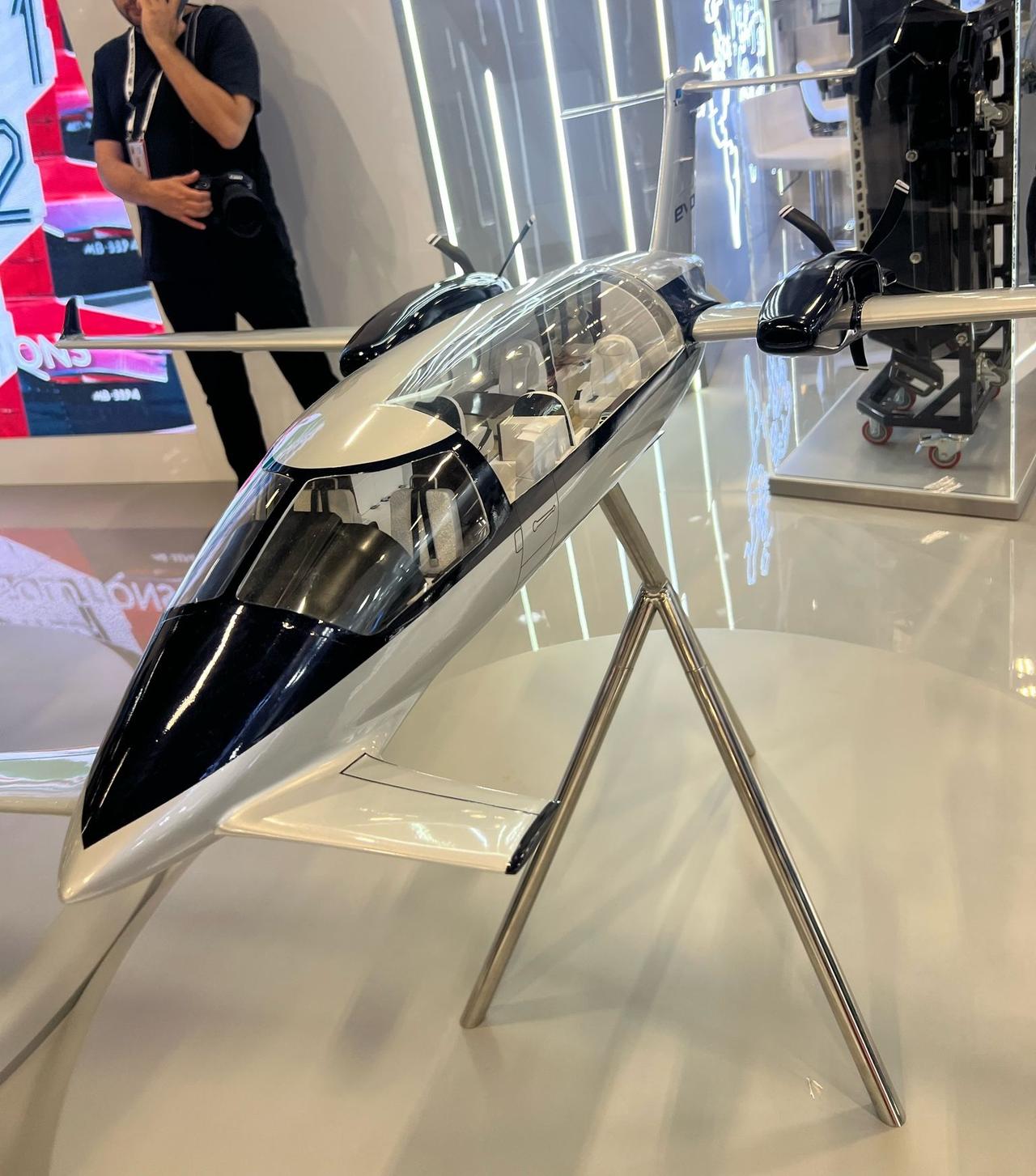
Model P.180 EVO Displayed at IDEF 2025 (Photographer’s Capture)
The design and technological features of the P.180 prioritize flight safety, comfort, and efficiency, establishing it as one of the most modern business jets today. These aircraft offer an ideal solution for both commercial and private use, making them popular for VIP transportation, executives, and private business travelers. Additionally, they can carry up to nine passengers in a pressurized cabin up to 24,000 feet and are operated by one or two pilots.
Furthermore, the Avanti is listed as the world’s fastest propeller-driven aircraft【1】.
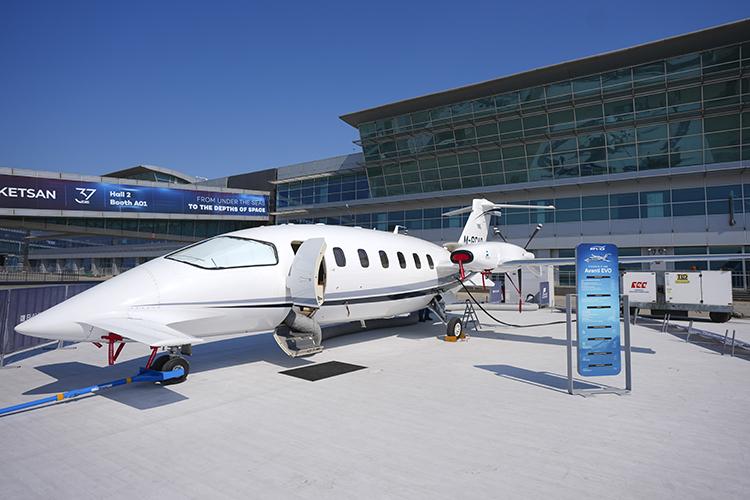
Piaggio P.180 Avanti II with Tail Code M-GCAP Displayed at IDEF 2025 Static Display (Anadolu Ajansı)
In the 1980s, numerous manufacturers sought to develop fast and efficient business jets targeting major corporations. One of the models to emerge during this period was the Piaggio P.180 Avanti. Design work began in 1979; wind tunnel tests were conducted in Italy and the United States in 1980 and 1981. The project was led by Prof. Jan Roskam from University of Kansas and Prof. Jerry Gregorek from Ohio State University.

Left: Prof. Jan Roskam and Right: Prof. Jerry Gregorek (Jawhawk Global, Celestis)
The aircraft’s design was planned around a three-lifting-surface configuration: a forward fixed lifting surface, a main wing, and a horizontal tail. This structure provided low drag and high efficiency. In 1982, Piaggio’s chief engineer Alessandro Mazzoni filed a patent for the design. In 1983, a collaboration with Learjet accelerated fuselage development. Learjet’s influence is clearly visible in the Avanti’s slanted forward windshield and delta-shaped tail surfaces, which were added to enhance flight stability and prevent stall conditions.
Despite Learjet’s withdrawal from the project in 1986 due to financial difficulties, Piaggio continued development and conducted the first flight on 23 September 1986. The aircraft received certification from Italy and the United States in 1990. The first 12 airframes were manufactured in Kansas and then shipped to Italy for final assembly. Although the project was temporarily suspended in 1994, it was revived in 1998 under the leadership of Piero Ferrari.
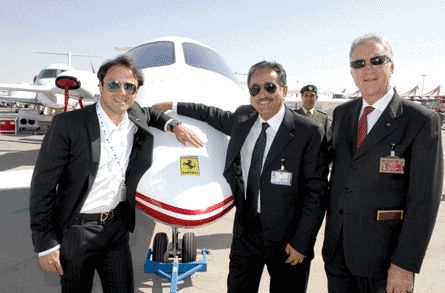
Ferrari and Piaggio Aerospace Executives at the Dubai 2007 Show (Flight Global)
Launched in 2005, the Avanti II featured more powerful PT6A-66B engines and digital “glass cockpit” avionics. This model outperformed many jets in fuel efficiency and performance. It was equipped with modern flight safety systems such as TCAS, TAWS, and weather radar. Compared to the Beechcraft King Air 200 with the same engines, the Avanti II was approximately 100 knots faster. This speed advantage was one of the key factors that established it as the fastest twin-engine civil turboprop.
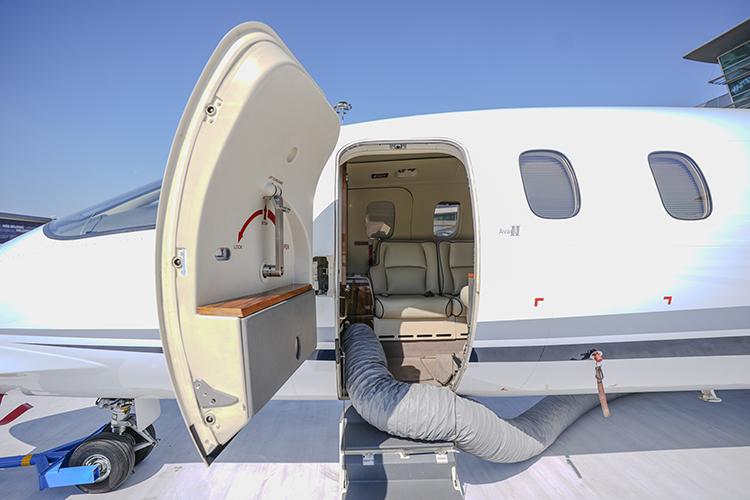
Piaggio P.180 Avanti II with Tail Code M-GCAP Displayed at IDEF 2025 Static Display (Anadolu Ajansı)
The unmanned variant developed in 2013, the P.1HH HammerHead, experienced a crash in 2016 following test flights. Production was moved to the new Albenga facility in 2015, and the first EVO model was delivered in 2016.
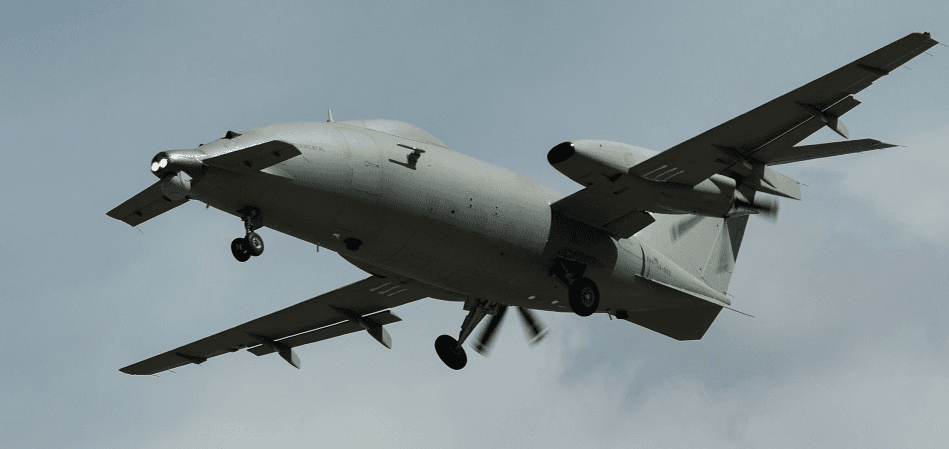
Piaggio P.1HH-HammerHead Variant ((Piaggio Aerospace)
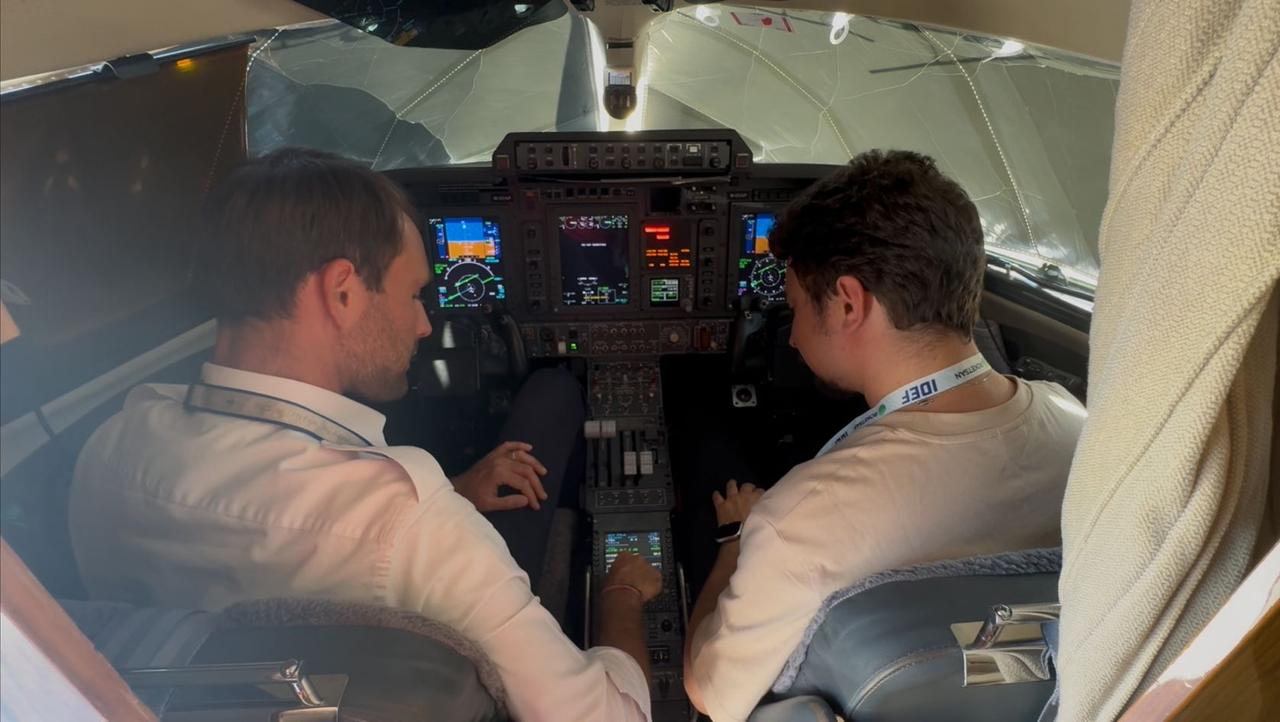
Cockpit View of Piaggio P.180 Avanti II at ‘GPU on / Hot and Bright’ Position at IDEF 2025 Static Display (Photographer’s Capture)
In 2018, Piaggio Aerospace declared concordato due to financial difficulties. Avanti sales dropped from 30 units in 2008 to only 3 in 2018. That same year, the Italian government announced nearly 700 million euros in orders and support to rescue the project. These included new aircraft, modernization, engine maintenance services, and unmanned systems. By 2020, a total of 246 Avantis had been produced and over 1 million flight hours had been accumulated. The aircraft continue to operate actively in Europe, the Americas, Asia-Pacific, and Africa.
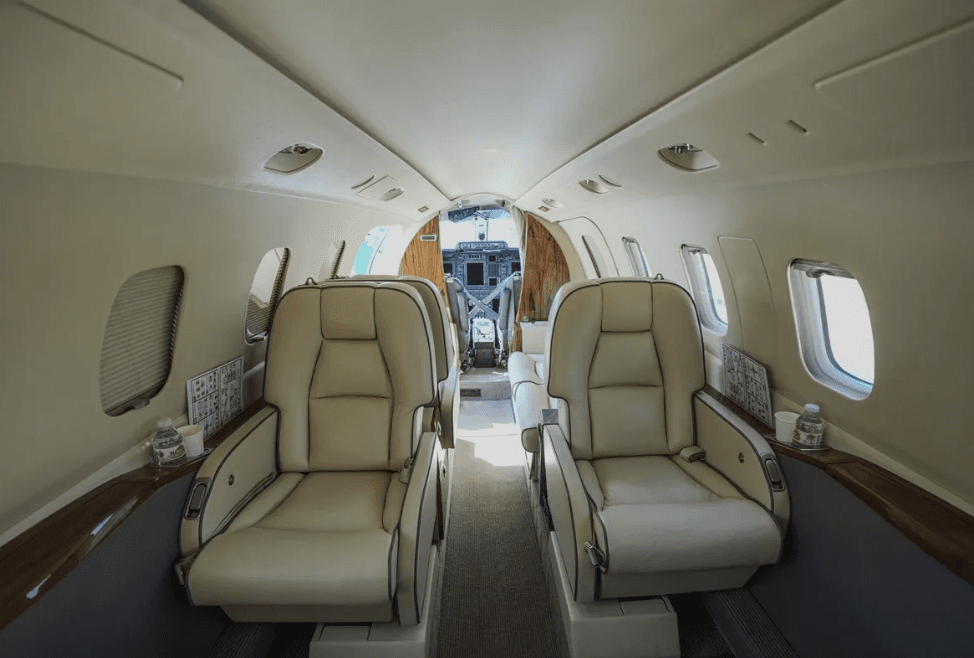
Interior View of Piaggio P.180 Avanti II at IDEF 2025 Static Display (Photographer’s Capture)
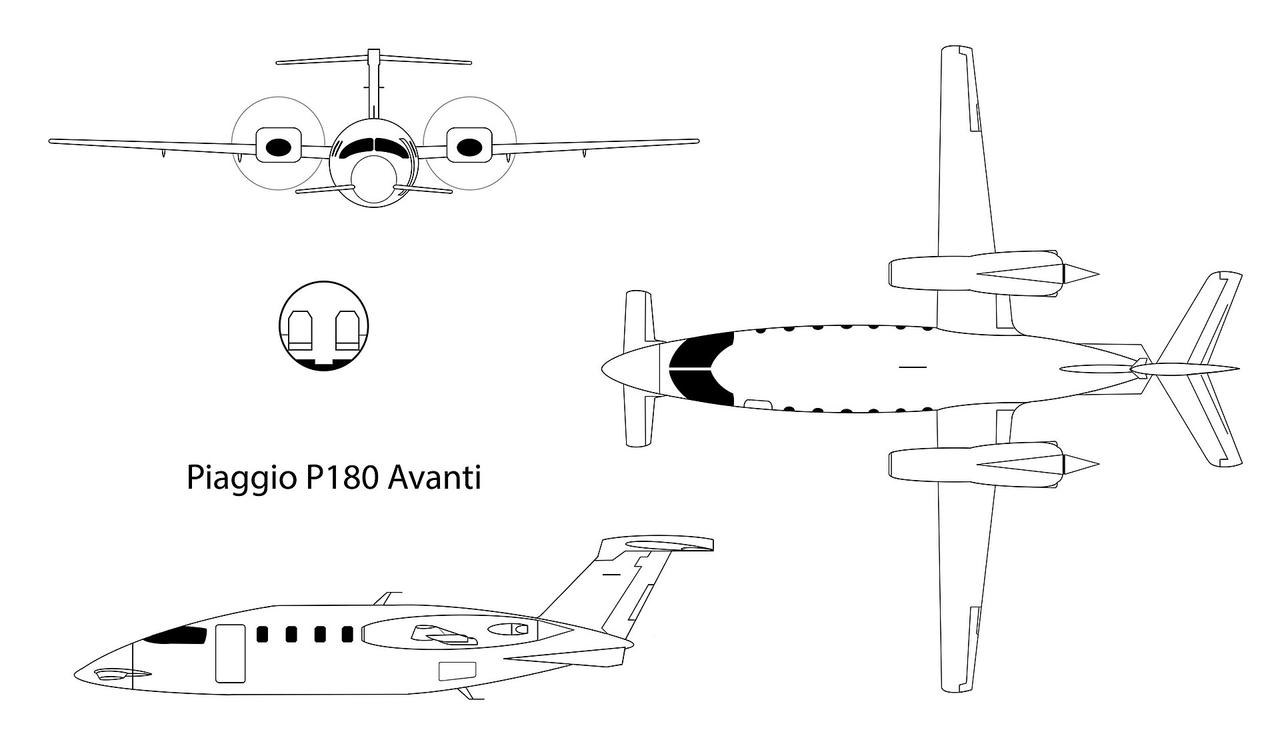
Plan Views of the Piaggio P.180 Avanti from Different Angles (Doc8643)
The Avanti’s counter-rotating turboprop engines are mounted to a high-efficiency main wing located behind the cabin. The aircraft features a three-lifting-surface design consisting of a fixed forward surface (canard-like), a main wing, and a T-tail. Flaps on the forward surface open automatically in coordination with the main wing flaps, reducing the load on the tail surface and enabling a smaller wing and tail design. This configuration was patented in 1982 and provides a more spacious cabin than other business jets in its class.

Piaggio P.180 Avanti EVO Cabin Width Comparison (Piaggio Aerospace)
The forward surface stalls before the main wing, inducing a nose-down response that enhances flight safety. Additionally, the slight sweep and negative dihedral of the forward surface optimize airflow to the engine inlets and tail surfaces. The fuselage shape is specially designed to generate 20% of the total lift through laminar flow, with the remaining 80% generated by the forward and rear lifting surfaces.
The Avanti II is significantly more efficient than small jets flying at the same speed and altitude. Laminar flow is preserved up to 50% better than in conventional turboprops. Its specific range is 3.1 km/kg, approximately 70% more efficient than typical jets. However, these advantages are achieved at relatively lower speeds such as 315 KTAS and FL410.
Cabin noise levels are very low (approximately 68 dBA) because the engines and propellers are located at the rear. However, exterior noise levels are higher. The high-frequency noise generated by the pusher configuration has caused complaints at some airports. For example, the aircraft has been criticized for noise at Naples (Florida) and Aspen (Colorado) airports.
Piaggio P.180 Avanti II with Tail Code M-GCAP Registered in the Isle of Man (Youtube)
Maximum takeoff distance at sea level is 869 m, and landing distance is 872 m. In 2008, 30 units were delivered, but by 2013, this number had dropped to 2.
The range of the most advanced EVO variant is 1,809 nautical miles.
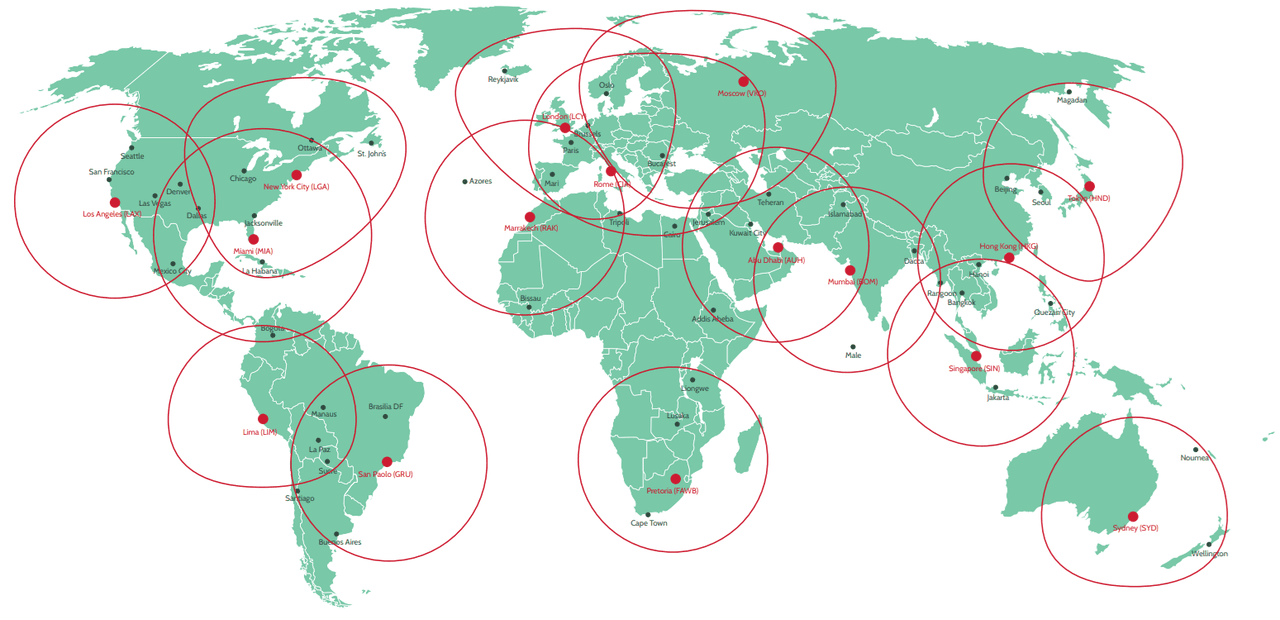
Piaggio P.180 EVO Range Specifications (Piaggio Aerospace)
Piaggio P.180 EVO and Competitor Aircraft Range Comparison Table (Piaggio Aerospace)
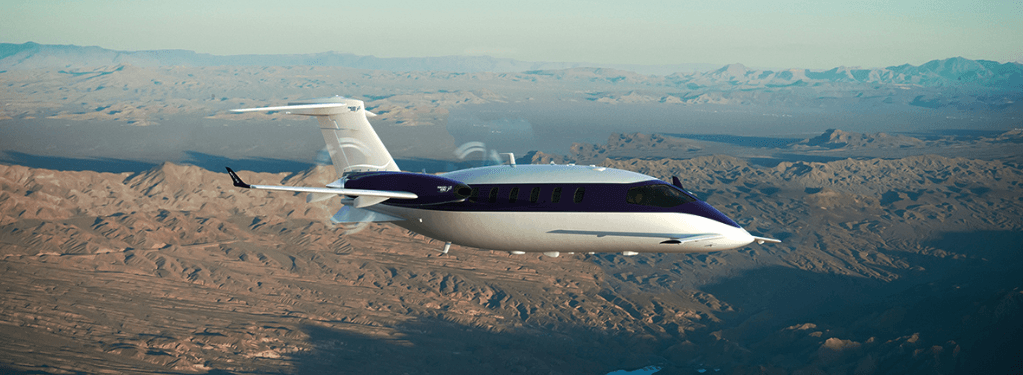
Piaggio P.180 EVO Variant (Piaggio Aerospace)
The new-generation EVO model features composite Hartzell scimitar (curved) propellers, winglets, and an optional additional fuel tank (total range of 1,770 nautical miles). Climb capability, range, and fuel efficiency have been improved, while exterior noise levels have been reduced by 68%. The EVO model received EASA certification in 2014 and FAA certification in 2015. Its initial price was $7.4 million, rising to $7.695 million by 2021.
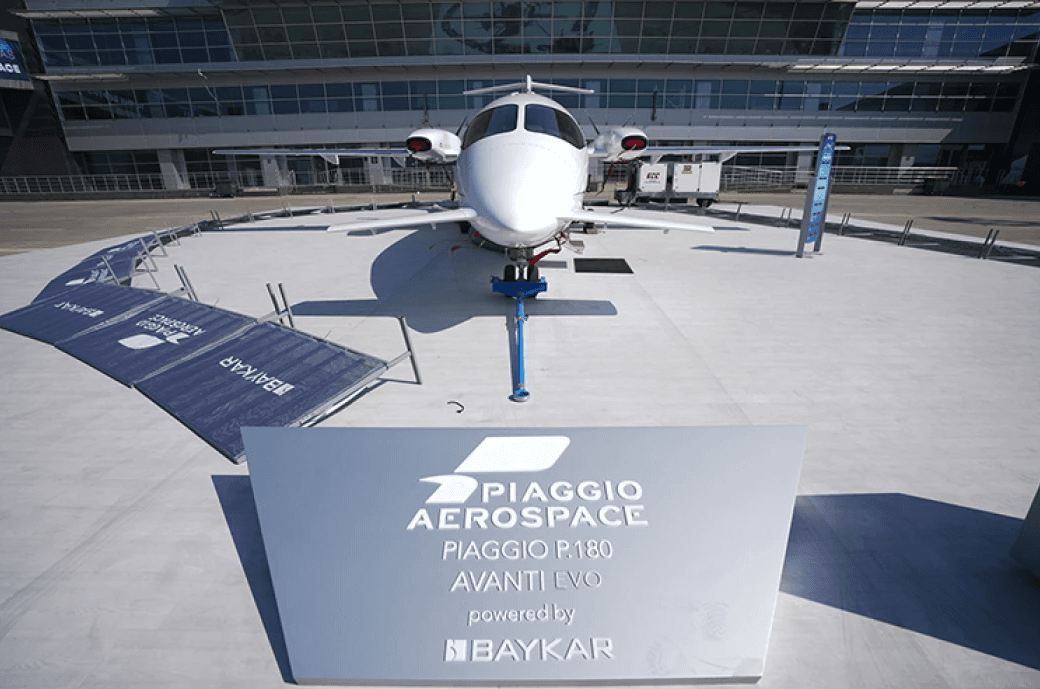
Piaggio P.180 Avanti II with Tail Code M-GCAP Displayed at IDEF 2025 Static Display (Anadolu Ajansı)
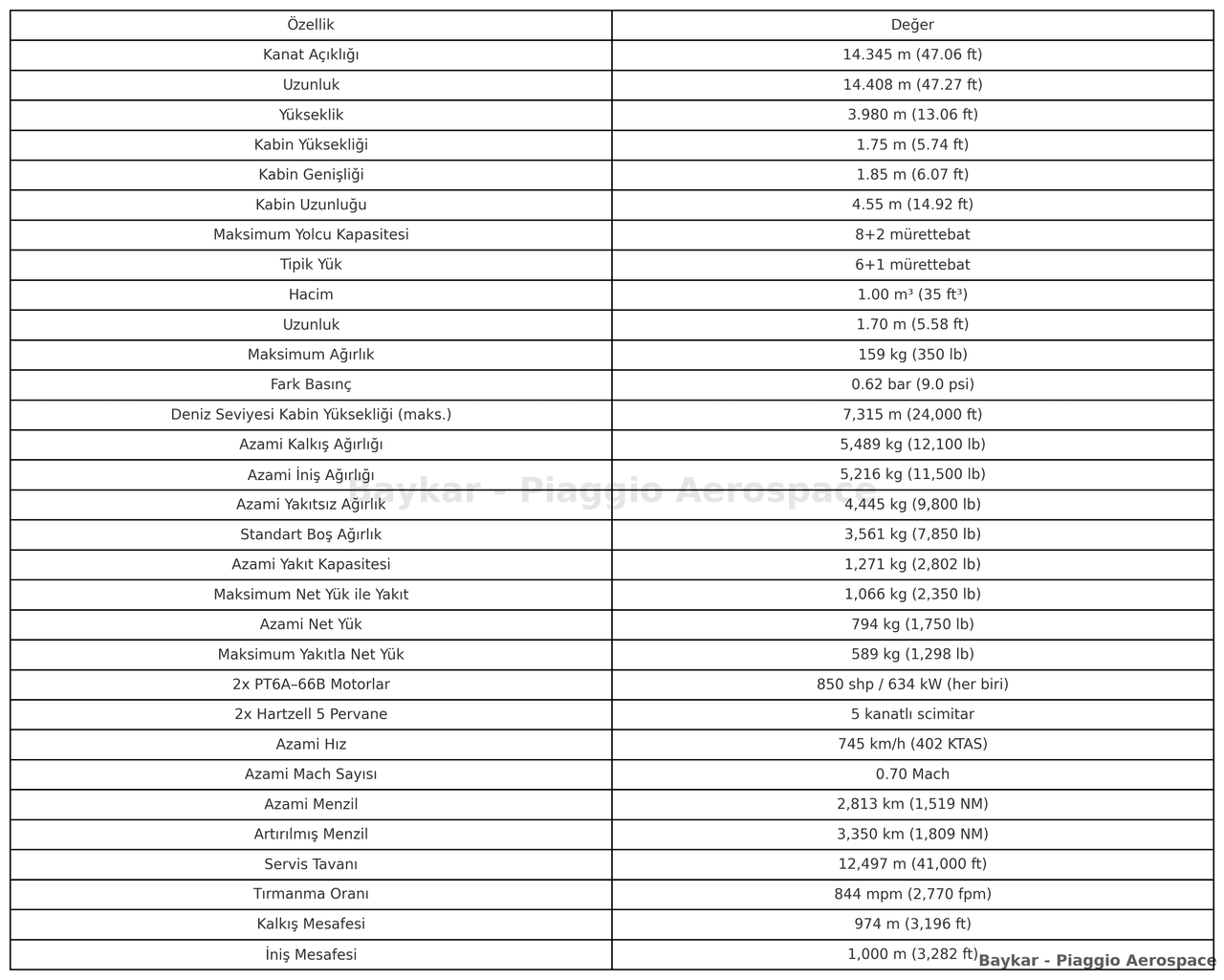
Technical Specifications for the Piaggio P.180 Avanti Evo (Created by the Author)
Piaggio P.180 Family (Piaggio Aerospace)
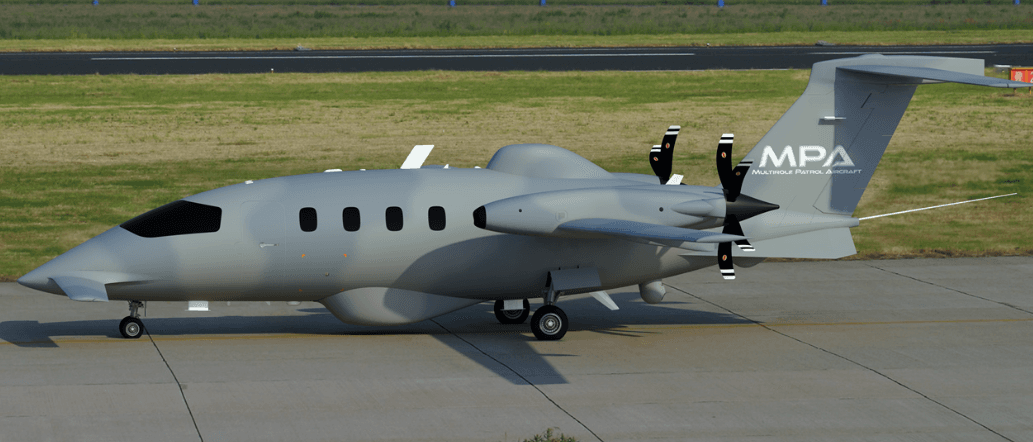
Piaggio P.180 MPA – MPA Variant (Piaggio Aerospace)
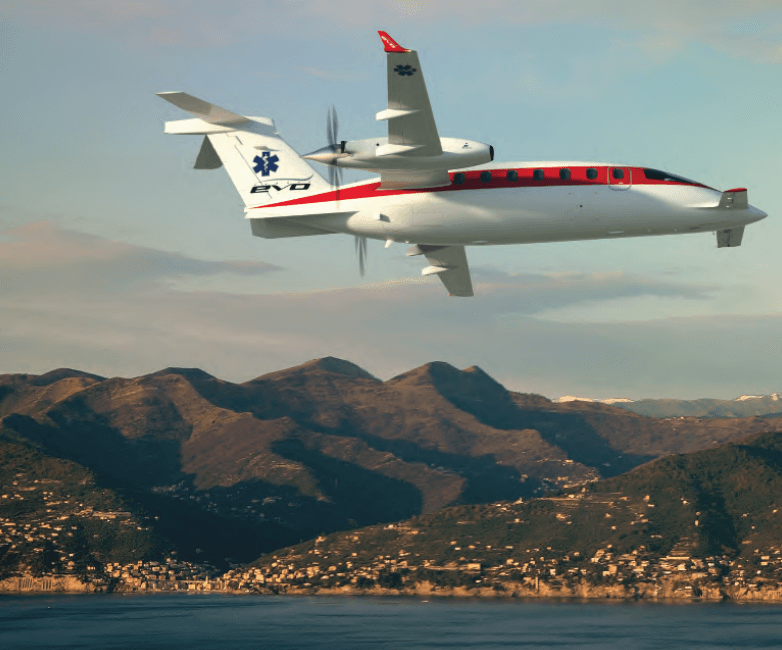
Piaggio P.180 AMB – Ambulance Variant (Piaggio Aerospace)
The Piaggio P.180 family has experienced one fatal accident in its history.
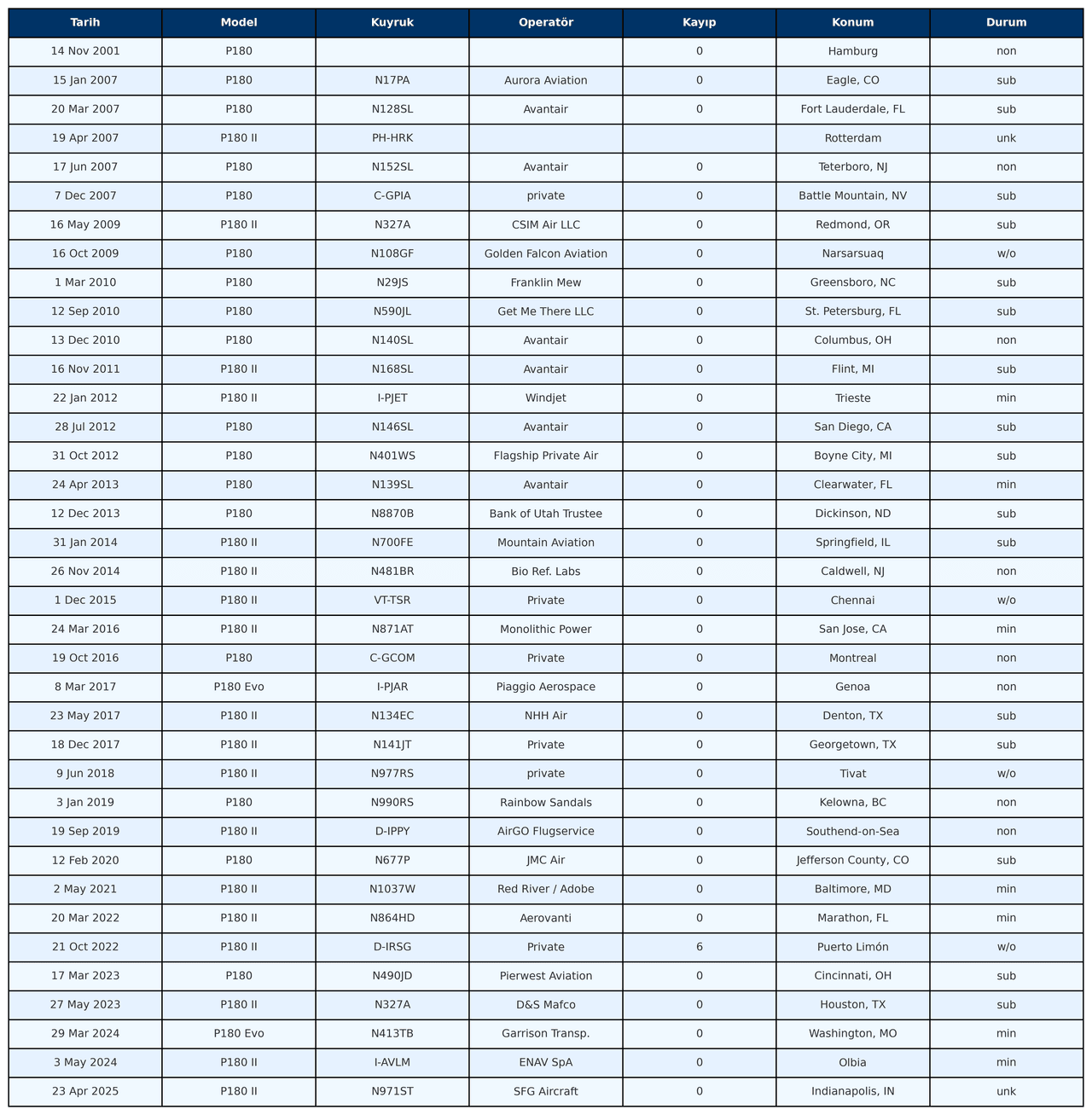
Piaggio P.180 Family Accident Table (Source: Aviation Safety Network)
On 21 October 2022, the aircraft disappeared from radar while approaching Puerto Limón Airport in Costa Rica during a private flight originating from Palenque (Mexico). The aircraft descended to approximately 2,000 feet and crashed into the sea. Radar and ATC communications were lost.
Search and rescue teams in the area recovered only fragments of debris and two bodies. The main fuselage and flight recorders were not located. Onboard were German businessman Rainer Schaller and his family. A total of six people lost their lives in the accident.
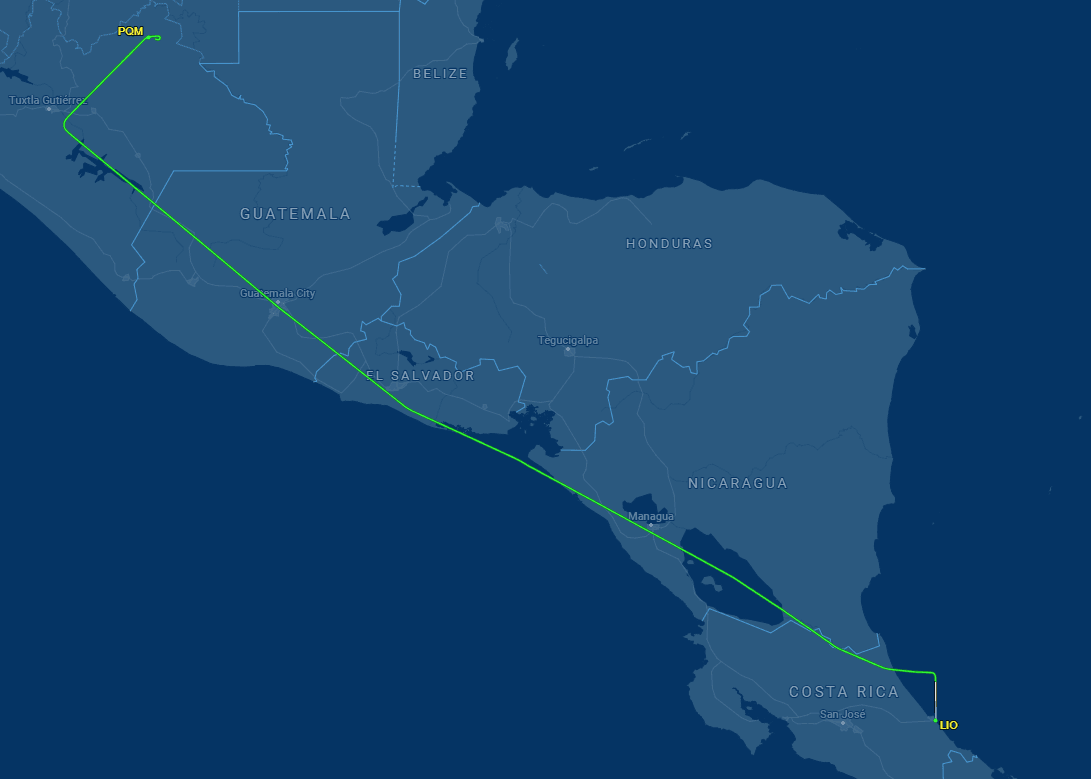
Flight Path Data for D-IRSG’s Final Flight (Created by the Author)
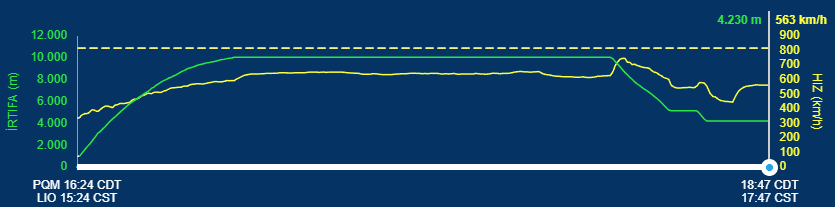
Altitude and Speed Data for D-IRSG’s Final Flight (Created by the Author)
Baykar has made a significant international move by acquiring the majority stake in the Italian aerospace company Piaggio Aerospace. This acquisition was officially approved by the Italian government, allowing Baykar to outpace numerous global competitors. On 27 December 2024, Italy’s Ministry of Enterprises and Made in Italy approved the sale of the country’s historic aerospace firm Piaggio Aerospace to Baykar.
The P.180 Avanti, developed by Piaggio, is a platform distinguished by its aerodynamic design and high fuel efficiency. Baykar aims to leverage this platform not only for civil aviation but also for unmanned systems, developing UAV technologies integrated onto the P.180 airframe.
With the acquisition, Baykar intends to actively utilize Piaggio’s existing production facilities in Italy to expand its European manufacturing capacity and strengthen its market position.
Mr. Selçuk Bayraktar’s First Flight on the Piaggio P.180 Aircraft (Youtube)
Baykar has declared its commitment to preserving the existing workforce at Piaggio and expanding employment opportunities to increase production capacity. This step represents a strategic initiative aimed not only at production but also at enhancing regional economic contribution.
The engineering expertise of both companies will be combined to conduct joint R&D activities, particularly in unmanned aerial vehicle projects. Innovative initiatives such as the unmanned conversion of the Avanti platform are among the focal points of this partnership. Baykar CEO Selçuk Bayraktar has indicated that modernizing the Avanti platform will involve the use of more advanced, locally produced, or open-architecture compatible next-generation avionics systems. He has noted that the current Rockwell Collins systems will be replaced by more modern, digital, and software-driven flight management systems.
Test Flight of the P.180 Aircraft by Aviation Journalist Tolga Özbek at IDEF 2025 (Youtube)
ASN. "Piaggio P-180 Avanti." Accessed August 4, 2025.https://asn.flightsafety.org/asndb/type/P180
Acar, Mevlüt, Küre. "Piaggio Aerospace." Accessed August 4, 2025.https://kureansiklopedi.com/tr/detay/piaggio-aerospace
Anadolu Ajansı. "Gökyüzünün Ferrari'si IDEF 2025'te sergilendi." Accessed August 4, 2025.https://www.aa.com.tr/tr/idef-2025/gokyuzunun-ferrarisi-idef-2025te-sergilendi/3642601
BAA-ACRO, "Crash of a Piaggio P1.HH HammerHead off Levanzo Island," Accessed August 4, 2025,https://www.baaa-acro.com/crash/crash-piaggio-p1hh-hammerhead-levanzo-island
BAYKAR, "BAYKAR İTALYAN HAVACILIK DEVİ PİAGGIO AEROSPACE'İN YENİ SAHİBİ OLACAK." Accessed August 4, 2025.https://baykartech.com/tr/press/baykar-italyan-havacilik-devi-piaggio-aerospacein-yeni-sahibi-olacak/
Bayraktar Selçuk, Küre. "Selçuk Bayraktar." Accessed August 4, 2025.https://kureansiklopedi.com/detay/selcuk-bayraktar
BloombergHT. "Özel Röportaj | Baykar Yönetim Kurulu Başkanı Selçuk Bayraktar." YouTube. Accessed August 4, 2025.https://www.youtube.com/watch?v=XCq4Igg5pDI&ab_channel=BloombergHT
Celestis. Accessed August 4, 2025.https://www.celestis.com/participants-testimonials/dr-gerald-m-jerry-gregorek/
Cpocketts. "Piaggio Avanti P.180 M-GCAP - Beautiful morning Departure - Gloucestershire Airport." YouTube, Accessed August 18, 2025.https://www.youtube.com/watch?v=FxFv1Yveuw4&ab_channel=cpocketts
Doc8643, "P180", Accessed August 4, 2025,https://doc8643.com/aircraft/P180
Flight Global. "Dubai 2007: Avanti’s successful formula for Ferrari star Massa." Accessed August 4, 2025.https://www.flightglobal.com/dubai-2007-avantis-successful-formula-for-ferrari-star-massa/77248.article
Jawkhawk Global. Accessed August 4, 2025.https://jayhawkglobal.ku.edu/aero-roskam-faculty-opportunity-fund
Ohio State University. Accessed August 4, 2025.https://www.osu.edu/
Piaggio Aerospace, "Piaggio Aerospace: the P.180 fleet reaches one million flight hours." Accessed August 4, 2025.https://www.piaggioaerospace.it/en/media/archivio/news/2020-12-01-piaggio-aerospace-the-p180-fleet-reaches-one-million-flight-hours
Piaggio Aerospace. "Media." Accessed August 4, 2025.https://piaggioaerospace.it/en/media
Piaggio Aerospace. Accessed August 4, 2025.
RSG Group. Accessed August 4, 2025.https://rsggroup.com/en/corporate/rainer-schaller-founder-of-rsg-group/
Selçuk Bayraktar, "BAYKAR PIAGGIO P180 ile test uçuşu yaptım." YouTube, Accessed August 4, 2025.https://www.youtube.com/watch?v=2_q18RWN8cs&ab_channel=tolgaozbekcom
Selçuk Bayraktar, "Cenova'daki Piaggo Aerospace'in pistine Piaggio P180 uçağıyla ilk inişimiz..." YouTube, Accessed August 4, 2025,https://www.youtube.com/watch?v=Qu3dKRQLq_U&ab_channel=Sel%C3%A7ukBayraktar
Türkiye Cumhuriyeti Dışişleri Bakanlığı. "Ülke Künyesi." Accessed August 4, 2025.https://www.mfa.gov.tr/italya-kunyesi.tr.mfa
Türkiye Cumhuriyeti Dışişleri Bakanlığı. "Ülke Künyesi." Accessed August 4, 2025.https://www.mfa.gov.tr/kosta-rika-kunyesi.tr.mfa
Türkiye Cumhuriyeti Dışişleri Bakanlığı. "Ülke Künyesi." Accessed August 4, 2025.https://www.mfa.gov.tr/meksika-kunyesi.tr.mfa
University of Kansas, Accessed August 4, 2025,https://www.ku.edu/
Uzun, Sümeyra, Küre. "TurboProp Motor." Accessed August 4, 2025.https://kureansiklopedi.com/tr/detay/turboprop-motor-2
Uzun, Sümeyra, Küre. "Uçak." Accessed August 4, 2025.https://kureansiklopedi.com/detay/ucak-3
marcasmode8606. "Youtube." Accessed August 4, 2025.https://www.youtube.com/shorts/JFMeP3s48pI
[1]
Piaggio Aerospace, “Piaggio Aerospace: the P.180 fleet reaches one million flight hours,” basın bülteni, 1 Aralık 2020, https://www.piaggioaerospace.it/en/media/archivio/news/2020-12-01-piaggio-aerospace-the-p180-fleet-reaches-one-million-flight-hours

Aircraft Type | Twin turboprop, fixed foreplane, three-surface aircraft | ||||||||
|---|---|---|---|---|---|---|---|---|---|
Parent Company | BAYKAR (Türkiye) | ||||||||
Manufacturer | Piaggio Aerospace (Italy) | ||||||||
Purpose of Use | VIP Passenger Transport and Light Cargo UAV Ambulance Military Patrol Passenger Transport Radio Calibration Experimental Performance Analysis | ||||||||
First Flight Date | 23 September 1986 | ||||||||
Entry into Service Date | 30 September 1990 | ||||||||
Production Quantity | 246 (December 2020) | ||||||||
User Nations | Canada Poland Russia United Arab Emirates Türkiye Italy | ||||||||
Engine Variants | PT6A-66B PT6A-66 | ||||||||
Status | Active - In Production | ||||||||
No Discussion Added Yet
Start discussion for "Piaggio P.180 Family" article
Historical Development
Piaggio P.180 Family – Design, Efficiency, and Noise Characteristics
Design and Aerodynamics
Flight Safety and Aerodynamic Details
Fuel Efficiency and Comparisons
Interior and Exterior Noise
Performance
Range
Avanti EVO (Post-2014)
Technical Specifications
Piaggio Avanti – Variants
Past Accidents Involving the Piaggio P.180 Family
D-IRSG (Piaggio P.180 Avanti II) Accident
Baykar & Piaggio Aerospace Partnership – Strategic Expansion and Technological Transformation
New Transformation of the Avanti Platform
Production and Growth in Europe
Preservation and Expansion of Employment
R&D and Technology Transfer