


This article was automatically translated from the original Turkish version.
+1 More
Photovoltaic (PV) technology is a method that generates electricity from sunlight. PV cells are made of semiconductor materials that convert sunlight directly into electricity. These cells are typically a few centimeters in size and each produces about 1–2 W of power. Photovoltaic cells are usually covered with protective materials such as glass and plastic to protect them from environmental factors.
PV cells work by releasing electrons from the atoms of the material when struck by photons in sunlight. These free electrons generate an electric current, producing direct current (DC) electricity. This electricity is generally not used directly before being converted to alternating current (AC) for household use.
Since the amount of electric current produced by a single PV cell is small, cells are combined to form larger units called modules or panels. These panels can be used individually or connected together to create larger systems known as arrays. This modular structure allows photovoltaic systems to be scaled to meet small or large energy demands.
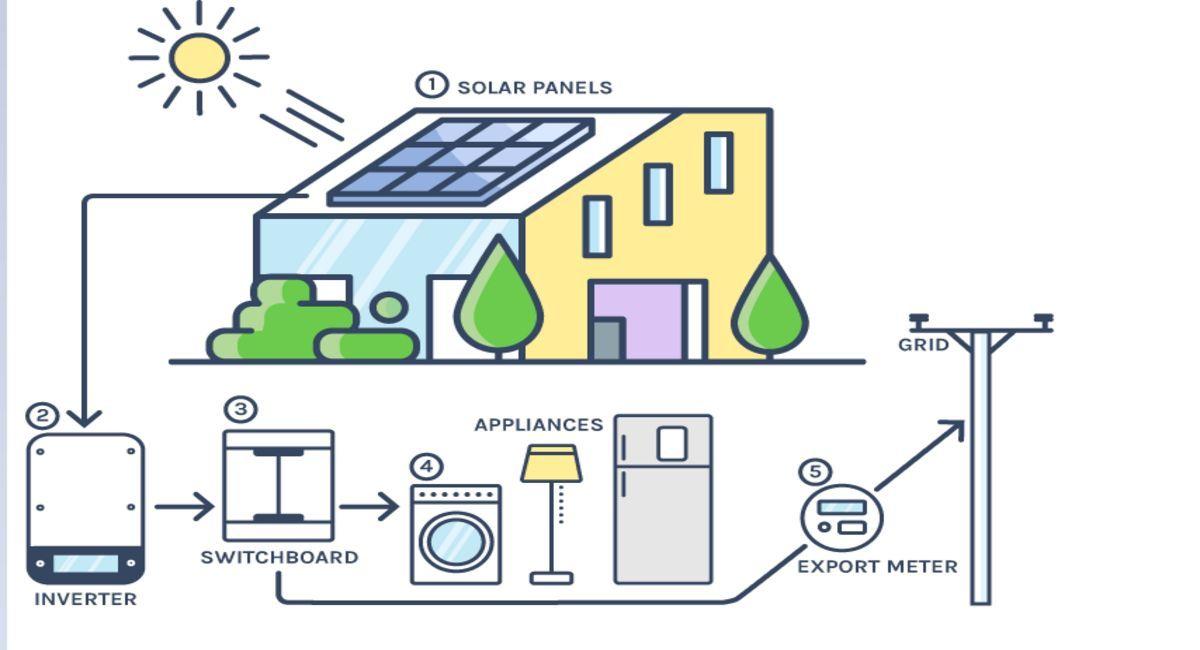
Photovoltaic System
1. Solar Panels: Solar panels consist of photovoltaic cells. Sunlight falling on the cells is converted into electrical energy through the photovoltaic effect. Most solar panels are made of crystalline silicon, which has a theoretical efficiency limit of 33%. Other semiconductor materials are also used but these panels are more expensive.
2. Inverters: The electricity generated by photovoltaic systems is in the form of direct current (DC). However, since household electricity uses alternating current (AC), this DC must be converted to AC. Inverters are used for this purpose. They convert DC into AC, making the electricity suitable for household appliances. Inverters typically operate with high efficiency, providing more than 90% efficiency without compromising safety.
3. Racking System (Mounting Structures): Photovoltaic panels are installed on special mounting systems designed to capture sunlight most efficiently. These mounting structures are made from durable materials such as aluminum or steel and ensure that panels can withstand extreme weather conditions such as wind. Additionally, panels are grounded to ensure electrical safety. Mounting systems for flat roofs typically use ballasted systems, while those for sloped roofs are fixed directly to the roof. Some systems include tracking systems that follow the sun’s movement, but these are more expensive.
4. Other Components
In a photovoltaic system, sunlight is absorbed by photovoltaic cells to generate DC electricity. This electricity is converted to AC via inverters, making it usable. Additionally, large photovoltaic systems can be connected to the electrical grid, allowing surplus energy to be transmitted to others.
These large-scale facilities connect to the electrical grid to provide clean energy to wide areas.
In conclusion, photovoltaic (PV) systems are one of the most common methods for efficiently generating electricity from solar energy. Suitable for both small homes and large power stations, these systems offer an environmentally friendly energy alternative and are becoming increasingly popular with each passing day.
Energy Education. "Fotovoltaik Sistem." Energy Education. Accessed January 25, 2025.https://energyeducation.ca/encyclopedia/Photovoltaic_system
U.S. Department of Energy. "Solar Photovoltaic Technology Basics." Energy.gov. Accessed January 25, 2025.https://www.energy.gov/eere/solar/solar-photovoltaic-technology-basics
U.S. Energy Information Administration. "Photovoltaics and Electricity." Energy Explained. Accessed January 25, 2025.https://www.eia.gov/energyexplained/solar/photovoltaics-and-electricity.php.

Principle of Operation of PV Cells
Combining PV Cells
Components of a Photovoltaic System
Principle of Operation of Photovoltaic Systems and Large-Scale Systems
Notable Large Photovoltaic Systems
Advantages of Photovoltaic Systems