


This article was automatically translated from the original Turkish version.
Fotodynamic cutting tips are next-generation manufacturing components that perform cutting not only through mechanical contact, as in traditional cutting tools, but also via light-based energy transfer, supported by lasers, light energy, or photon-active materials. These systems are particularly prominent in precision material processing, biocompatible surface shaping, and micro-mechanical applications. This technology, which emphasizes the role of light in the cutting mechanism, offers controlled, damage-free, and microscopic-level machining beyond conventional chip-removal methods.
Such tips typically consist of cutting surfaces coated with laser-responsive microfilaments, photothermal coatings, or photon-emitting nanostructures. During cutting, the tip generates a localized photothermal effect before contacting the target surface, causing the material on the workpiece surface to soften or vaporize. This transition reduces cutting resistance and minimizes tool wear. This advantage becomes critical when machining difficult materials such as ceramics, glass, composites, or biomedical alloys.
Unlike conventional cutting tools, photodynamic tips do not need to maintain continuous contact. This enables high surface quality when machining vibration-sensitive surfaces or micro-components. Additionally, micro-cracking, thermal stress, and chip deformation on the surface are significantly reduced. As a result, tool life is extended and surfaces requiring no post-processing are achieved.
The photon-active materials used in the design of these systems commonly include carbon nanotubes, titanium nitride (TiN) coatings, plasmonic nanoparticles, and specialized ceramic-fiber hybrids. These materials absorb light at specific wavelengths and generate localized heat on the surface. This heat can be adjusted according to the desired cutting depth and geometry. In this regard, photodynamic tips can be classified as “smart” cutting systems.
Fotodynamic cutting technologies are typically integrated with CNC systems, micro-lathes, lithography platforms, and robotic machining systems. This integration enables software-controlled algorithms to define variables such as light intensity, cutting depth, and tool movement. Thus, the system dynamically adjusts both contact forces and light intensity in real time to achieve optimal cutting conditions.
The industrial importance of this technology extends beyond material processing precision. Photodynamic tips also offer advantages such as reduced energy consumption, shortened production time, and minimized human error. Their use is increasingly common in medical implant manufacturing, microelectronic component shaping, and sectors requiring optical precision.
Research demonstrates that photodynamic cutting technology can enhance cutting quality not only through thermal effects but also via photochemical interactions. Certain polymers and biomaterials change their chemical structure under light exposure, becoming easier to shape. This enables highly precise and hygienic production processes with minimal thermal damage.
From a design perspective, the modular production of photodynamic tips allows multiple systems sensitive to different wavelength ranges to be used on the same production platform. For example, two distinct tips active at 532 nm and 1064 nm wavelengths can be employed within a single micro-optical system. This provides flexibility for multi-material or multi-layer manufacturing applications.
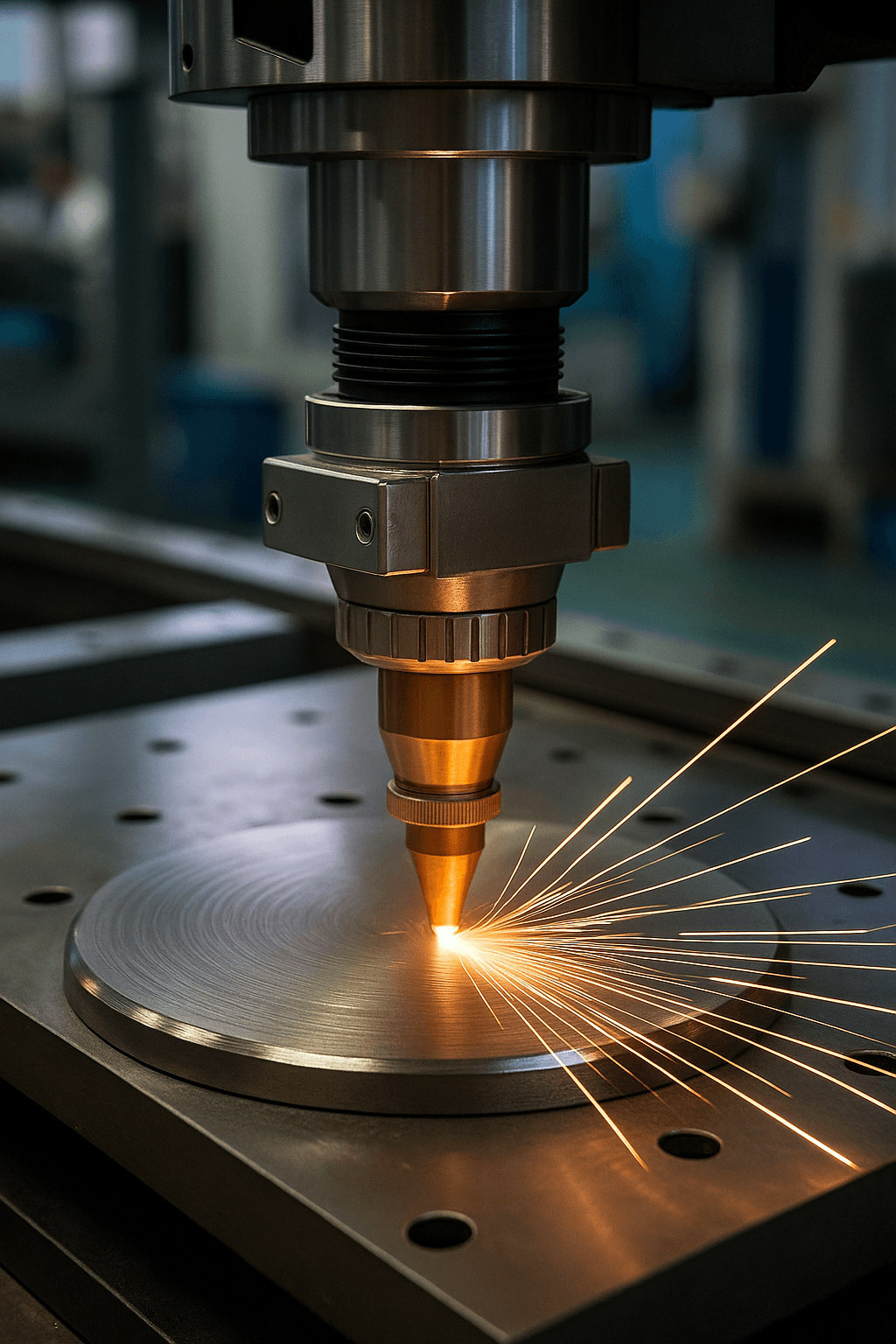
High-Precision CNC Laser Cutting Tip (This Image Was Generated by Artificial Intelligence)
The effectiveness of photodynamic cutting tips largely depends on the photon-active properties of the materials used. The preferred coating or core materials in these tips must possess the ability to absorb light at specific wavelengths and generate localized heat. For this purpose, carbon nanotubes, gold or silver nanoparticles, plasmonic semiconductors (such as titanium nitride), and advanced ceramic-polymer hybrid structures are favored. These materials can produce effective thermal responses even at low light intensities.
The thermal interaction mechanisms in these systems aim not at direct chip removal but at pre-heating and material softening. As a result of the photothermal effect, micro-level softening or vaporization occurs on the workpiece surface. This transition reduces the cutting tool’s contact force, lowers friction, and increases cutting precision. This feature is especially critical for difficult-to-machine materials such as glass, ceramics, medical alloys, and microelectronic substrates.
Photochemical interactions are also observed in certain materials. Particularly in polymeric or biocompatible materials, photon energy can induce not only heating but also bond breaking or molecular reconfiguration. This means that light contributes to the cutting process not only thermally but also chemically. This results in significantly reduced deformation during cutting.
One of the most significant advantages of photodynamic cutting tips is their ability to substantially reduce micro-damage and deformation on the workpiece surface. In conventional mechanical cutting, direct contact between the tool and material can cause friction, heating, and micro-cracking. In photodynamic systems, however, the material is locally softened by light, reducing contact forces and maintaining surface roughness at minimal levels.
This technology enables higher surface quality in applications requiring tight tolerances, such as optical components, biomedical implants, and microchip platforms. Thanks to photodynamic effects, plastic deformation marks do not appear on the surface, chip removal becomes more controlled, and a homogeneous structure is maintained along the cut line. This reduces or even eliminates the need for post-processing operations.
Nevertheless, despite these advantages, thermal fatigue and wear can occur in regions of the tool exposed to high energy concentrations. Coating surfaces that continuously absorb light may oxidize over time or lose structural integrity. Therefore, material selection for photodynamic tips must prioritize not only wear resistance but also optical stability.
Especially tips equipped with multi-layer coatings or hybrid ceramic structures can demonstrate longer life and greater resistance to wear. These tips can complete hundreds of cutting cycles without performance degradation, even under high-intensity light. Thus, achieving a balanced relationship between surface quality and wear performance is a critical design criterion for the sustainable use of photodynamic cutting technologies.
Photodynamic cutting tips are not directly integrable into conventional tooling machines, as these systems require not only mechanical but also optoelectronic control. Therefore, their integration into CNC systems and robotic production cells demands specialized solutions at both software and hardware levels. Laser power regulators, optical modulators, and real-time monitoring systems are critical infrastructure components for the integrated operation of photodynamic tips.
Photodynamic tips used with robotic arms offer significant advantages in tasks requiring micro-precision. These tips, guided by laser beams, can perform high-precision machining on complex geometries. Additionally, by directing the light, the cutting direction can be altered without requiring multi-axis control, simplifying system architecture.
In terms of application areas, photodynamic tips are most widely used in sectors demanding high precision, such as biomedical manufacturing, optical component shaping, and microelectronic circuit processing. For example, in the surface shaping of dental implants, intraocular lenses, and surgical blades, this technology enables both more precise and sterile production. Furthermore, microstructures on glass substrates can be shaped without chip generation using photodynamic methods.
In addition, photodynamic systems are also being tested in specialized fields such as defense, aerospace, and sensor manufacturing. Particularly in environments requiring non-contact cutting, this technology holds great potential for processing vibration-free and heat-sensitive components. This diversity demonstrates that photodynamic cutting tips offer a multidisciplinary production solution beyond classical tooling technologies.
While photodynamic cutting tips are advanced technology products, they also present certain technical challenges. The most fundamental issue is the high precision required by the system. Proper positioning, uniform coating, and light-guided orientation of the photon-active materials on the tip surface demand specialized engineering during production. This complexity can extend the manufacturing process and increase quality control burdens to ensure compliance with standards.
Another major barrier to widespread adoption is cost. The specialized coatings, laser optical components, and cooling systems used in photodynamic tips are expensive. Additionally, the CNC infrastructure must be adapted to be compatible with optical modules, increasing initial setup costs and creating access barriers for small and medium-sized manufacturers. Consequently, photodynamic systems are currently preferred mainly in high-value-added sectors such as medicine, aerospace, and defense.
However, these high-tech products offer sustainability advantages in the long term. Reduced energy consumption during cutting, extended tool life, and decreased need for post-processing all contribute to lowering the environmental impact of production. Therefore, photodynamic cutting systems are considered part of green manufacturing technologies.
Moreover, because contact forces are low in photodynamic systems, production processes can be designed to be more human-health-conscious, and maintenance requirements for machine components are reduced. In this regard, the sustainability dimension of the system is linked not only to energy consumption but also to system durability and waste generation. Wider adoption of this technology is possible with the development of new materials and more economical laser systems.
In smart tip systems, parameters such as surface roughness, temperature, and vibration can be continuously monitored during cutting, and tip behavior can be adjusted accordingly. For example, if excessive heating is detected, light intensity can be reduced; if vibration increases, cutting speed can be optimized. Such predictive and adaptive control enhances production quality while extending tool life. This approach also provides advantages in early detection of production errors and automatic implementation of corrective measures.
In conclusion, the future of photodynamic cutting tips lies not merely in their function as cutting tools but in their evolution into sensitive, energy-efficient, and self-regulating intelligent components of manufacturing systems. This development trajectory aligns with the Industry 5.0 vision, supporting human-centered, precise, sustainable, and flexible production models.
Kong, Xianjun, Zhanpeng Dang, Xiaole Liu, Minghai Wang, and Ning Hou. “Simulation and Experimental Analysis of Tool Wear and Surface Roughness in Laser Assisted Machining of Titanium Alloy.” *Crystals* 13, no. 1 (2023): 40. Accessed June 12, 2025. https://doi.org/10.3390/cryst13010040.
Necula, B. S., I. Apachitei, L. E. Fratila-Apachitei, E. J. van Langelaan, and J. Duszczyk. "Titanium Bone Implants with Superimposed Micro/Nano-Scale Porosity and Antibacterial Capability." *Acta Biomaterialia* 10, no. 11 (2014): 4744–4753. Accessed June 12, 2025. https://www.sciencedirect.com/science/article/abs/pii/S0169433213003449.
Phillips, Katherine C., Hemi H. Gandhi, Eric Mazur, and S. K. Sundaram. "Ultrafast Laser Processing of Materials: A Review." *Advances in Optics and Photonics* 7, no. 4 (2015): 684–712. Accessed June 12, 2025. https://opg.optica.org/aop/abstract.cfm?uri=aop-7-4-684.
Steen, William M., and Jyotirmoy Mazumder. *Laser Material Processing*. 4th ed. Springer, 2010. Accessed June 12, 2025. https://doi.org/10.1007/978-1-84996-062-5.
Zeng, Haohao, and Yuanyuan Liu. “Optimization of Laser-Tool Distance and Laser Power in Laser-Assisted Milling under Material Softening and Surface Quality Constraints.” *The International Journal of Advanced Manufacturing Technology* 134 (2024): 4667–4675. Accessed June 12, 2025. https://doi.org/10.1007/s00170-024-14458-y.

No Discussion Added Yet
Start discussion for "Photodynamic Cutting Tips" article
Fotodynamic Materials and Thermal-Energy Interactions
Surface Quality, Micro-Damage, and Wear Behavior
System Integration and Application Areas
Technical Challenges, Cost, and Sustainability Dimensions
Smart and Adaptive Tips