This article was automatically translated from the original Turkish version.
+2 More
Event | Philippe Petit's high wire walk between the Twin Towers | ||||||||
|---|---|---|---|---|---|---|---|---|---|
Type | Performance art | ||||||||
Date | 7 August 1974 | ||||||||
Place | World Trade Center | ||||||||
Elevation | 417 metres (1,350 ft) | ||||||||
Duration | 45 minutes | ||||||||
Number of Transitions | 8 | ||||||||
Start Time | 07.15 | ||||||||
Team | Jean-François Heckel Paul Mark Albert Barry Greenhouse Jean-Pierre Annie Allix Jean-Louis Blondeau Philippe Petit | ||||||||
Preparation Time | 6 years | ||||||||
Basic Material | Balance beam (approximately 8 m - 25 kg) Tirfor mechanical pulling device Intercom and guide wire system Galvanized steel cable (approximately 200 kg) Side tension lines (cavaletti) | ||||||||
Important Adaptations | The Walk (Film) Man on Wire (Documentary) | ||||||||
Written Work | To Reach the Clouds: My High Wire Walk Between the Twin Towers (Petit Philippe) | ||||||||
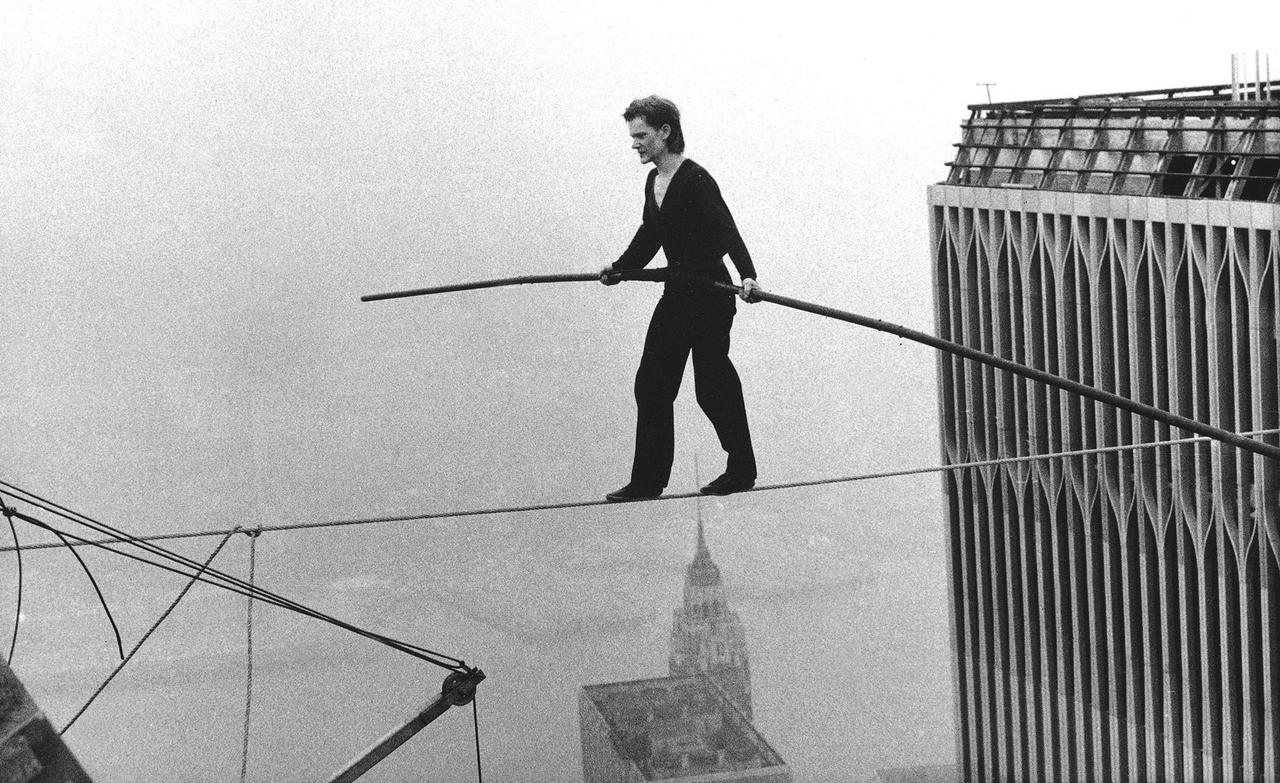
The Twin Towers Tightrope Walk, is a high-wire performance carried out on the morning of 7 August 1974 by French high-wire artist Philippe Petit between the North and South Towers of the World Trade Center in New York without any safety equipment. Petit and his team secretly infiltrated the rooftops overnight, stretched a steel cable across the approximately 60-metre gap between the two towers, set up their balance systems, and as dawn broke the artist stepped onto the wire.
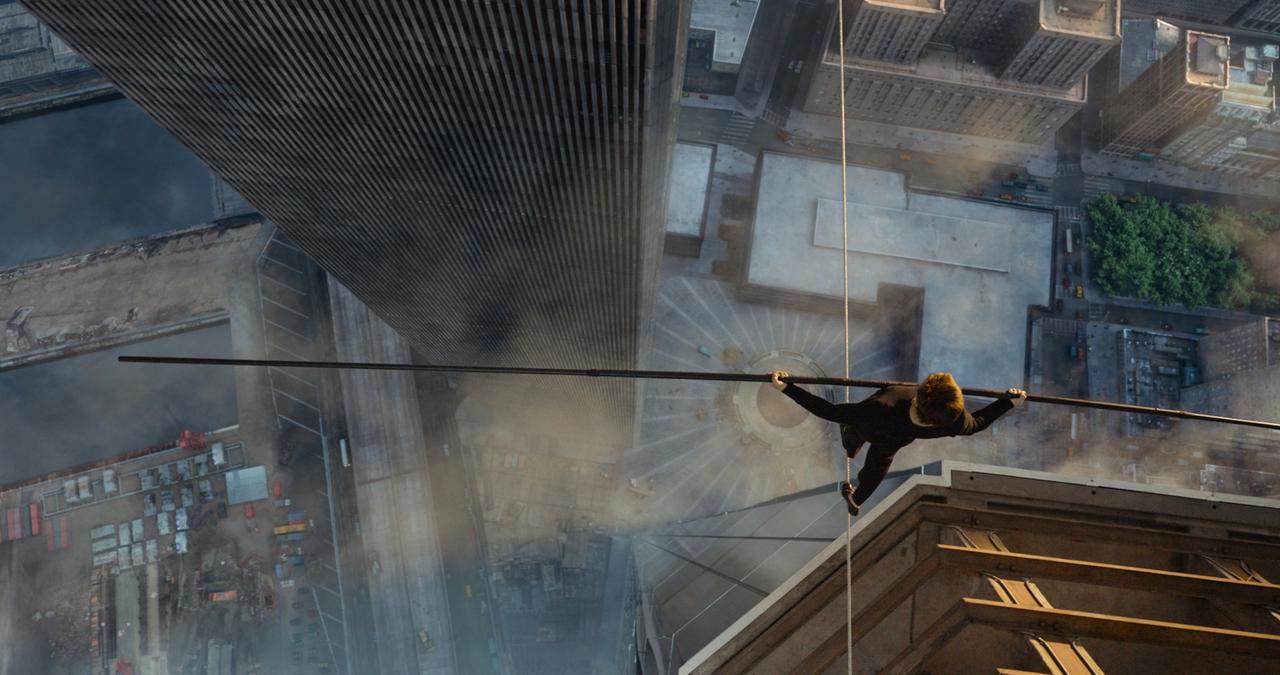
Reenactment of the Walk from The Walk Film (IMDb)
During the approximately one-hour performance Petit crossed between the towers eight times, transforming his act into a “show” through gestures such as kneeling to bow and even lying on his back on the wire. The performance was halted by police intervention; after detention medical evaluation and legal proceedings the artist was not fined on the condition of a short public performance in the public interest.
The event quickly entered global consciousness as a high-risk performance executed at the zenith of the urban landscape during a period when the Twin Towers were still newly established in the city’s skyline; in subsequent years it became a lasting reference point both in discussions of performance aesthetics and in the cultural memory of the towers following 11 September.
As early as 1968 while the Twin Towers were still under construction Philippe Petit conceived a high-wire performance between the two towers of the World Trade Center. To this end he conducted regular reconnaissance missions in New York observing the flow of people and spaces around and inside the building noting the worker and office traffic ascending to the roof during lunch hours and partnering with photographer Jim Moore on a helicopter flight to measure the gap between the towers multiple times recording it at approximately 60 metres.
Field-collected data was compiled into a notebook titled “WTC Organization”; temporary solutions were devised to bypass access restrictions such as using walking sticks to reduce suspicion and control and evading security personnel through performative maneuvers. Since such performances were prohibited on the Twin Towers scenarios were developed during the planning phase to circumvent surveillance and security.
Technical preparation progressed through consultations with Omankowsky known in the tightrope world as “Papa Rudy” who helped determine the configuration of the balance pole the main cable and the lateral tension lines (cavaletti). The logistical and execution team became clearly defined during this period: Jean-Louis Blondeau for photography and coordination Annie Allix Petit’s close collaborator Australians Mark and Paul who would later depart Albert from New York and Jean-François and Jean-Pierre (JP) who joined in the final stage.
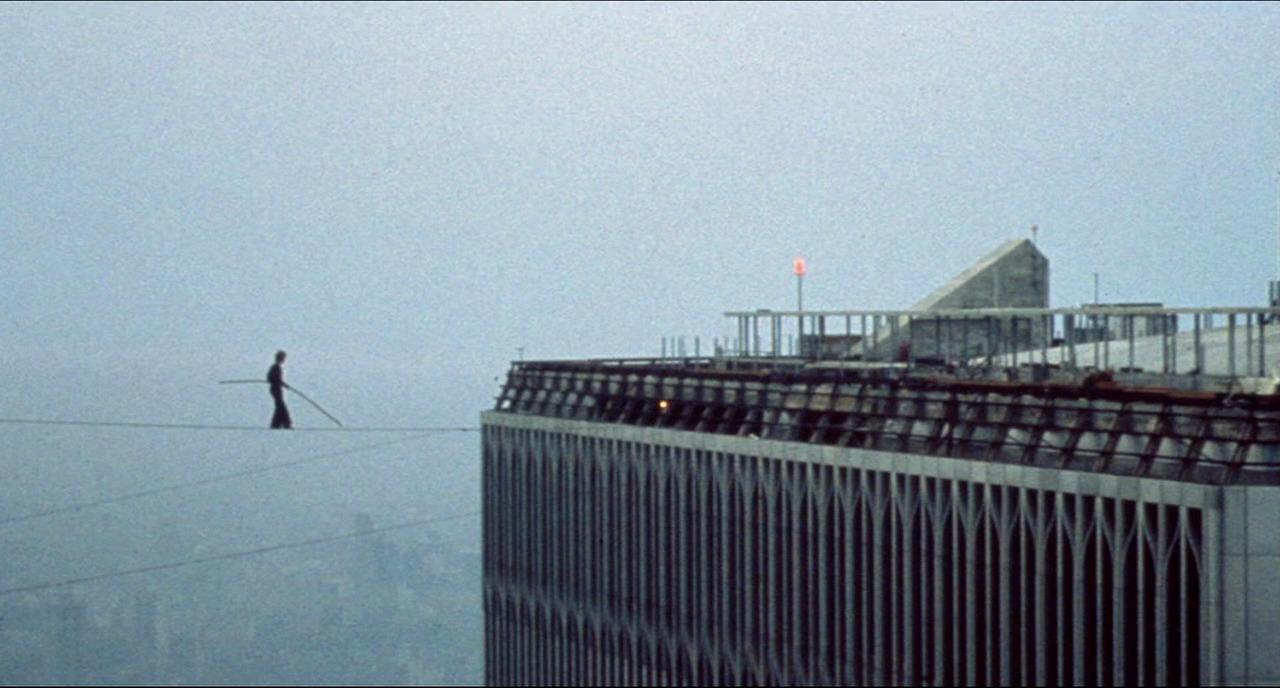
Reenactment of the Walk Moment – Man on Wire (IMDb)
Communication devices were procured from around Times Square. The Tirfor winch required to tension the cable was obtained through persuasion during a trip to Boston with JP; a brief police inquiry occurred during a street cable cleaning but preparations continued without interruption.
Practical verification of internal access was achieved through contact with Barry Greenhouse who worked on the 82nd floor of the South Tower. A “fake delivery” scenario was used to pass cardboard boxes through security as “office supplies” and transport them to the 82nd floor thereby testing the cargo flow elevator usage and access routes. Parallel to this Petit increased his visibility through street performances and interviews while compiling the details of the preparations into a written plan which he sent to Jean-Louis as a twenty-one-page document and also accessed architectural drawings to professionally finalize the anchor points and cable route.
In the final phase discussions on timing and methodology intensified; the core team gathered in Boston on 4 August 1974 to review equipment and task distribution and finalized loading and access scenarios on 6 August. This framework formed the logistical and technical foundation for the walk on the morning of 7 August 1974.
The setup was based on three principles: tensioning a main steel cable between the two towers limiting sway and torsion with lateral tension lines (cavaletti) and managing weight transfer during the walk using a long balance pole. Distance measurements were verified through repeated checks and the gap was accepted as approximately 60 metres. This value served as the fundamental parameter in calculations and field adjustments for cable tension sag and wind effects. Measurement and visual verification were conducted through combined rooftop inspections and helicopter observations.
The initial connection between the towers was established using a gradual transition technique via a lightweight guide line (fishing line). Smooth unwinding of the guide line from the pulley was deemed critical; when an incorrect spooling was detected the line was rewound. This guide line served as a transfer chain enabling the gradual progression to thicker intermediate lines and finally to the main steel cable. For the final positioning and tensioning of the main cable a mechanical winch (Tirfor) was preferred on-site; the device had been procured in advance and its operational suitability confirmed prior to the operation. This method ensured the cable’s transport across the gap anchoring and controlled approach to target tension values.
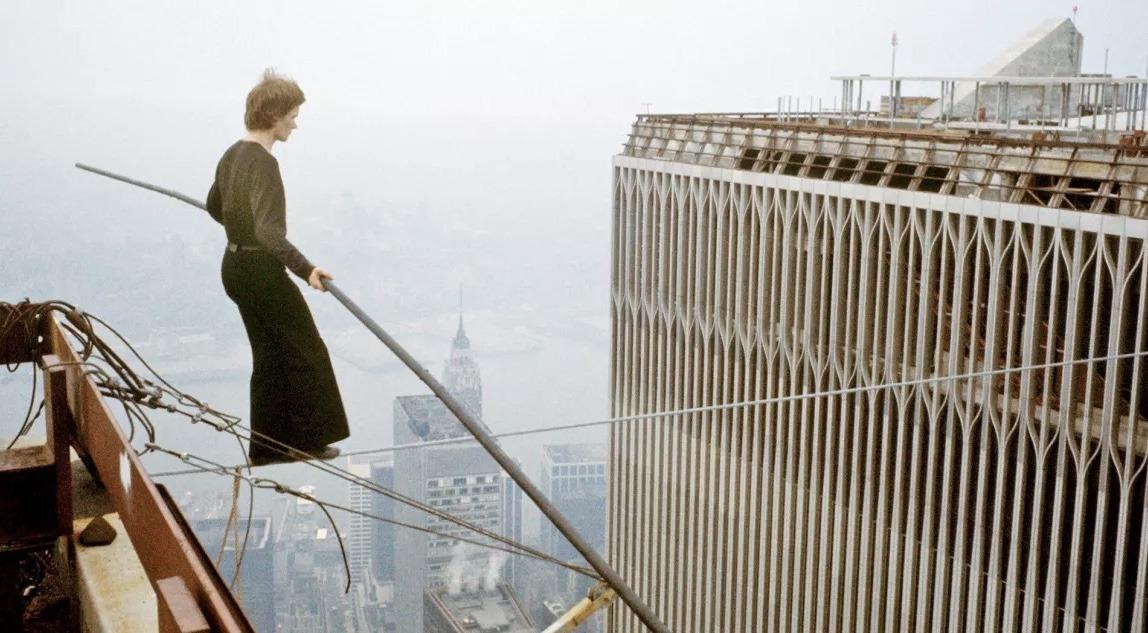
Reenactment of Stepping onto the Wire – Man on The Wire (IMDb)
Lateral tension lines (cavaletti) were employed to ensure dynamic stability of the main cable. These lines were positioned to dampen horizontal sway against sudden gusts and cable resonance; wind conditions were monitored during attachment and adjustment. An intercom system was installed for voice communication between rooftops; critical components such as the intercom unit and small tools were transported to the roof via a rope-and-pulley system in bags. When encountering security personnel or early morning workers during the setup brief hiding or waiting procedures were applied and once communication was reestablished the sequence of connection and tensioning resumed.
During the walk the balance pole served as the primary tool for micro-adjustments and continuous management of the center of gravity on the wire. The placement of all equipment anchor points and load paths had been predetermined in the planning phase through correlation with architectural drawings (plans and sections) and field mock-ups/demonstrations. This technical preparation enabled pre-setting of cable tension sag tolerances lateral tension line positions and safe exit and descent points on the day of the operation.
On the evening of 6 August 1974 the team split into two groups and reached the rooftops using cargo elevators and service routes; when unexpected activity or security patrols were observed brief hiding and waiting procedures were implemented. In the first phase equipment was assembled to prepare and launch the guide line to the opposite tower; an intercom system was installed and necessary components were hoisted to the roof in bags via rope systems. Throughout the night the logistical flow continued via a “package–opposite roof–feedback” cycle; although a delay occurred due to an encounter with a security officer communication was reestablished and the flow resumed.
The spooling of the guide line on the pulley was a critical detail and was rechecked; when incorrect spooling was detected the line was rewound. This ensured the guide line was successfully transferred to the opposite roof and through the gradual transition technique the intermediate line then the main steel cable were pulled across the gap. As the main cable was secured on the opposite tower mechanical tensioning (Tirfor) was applied and repeated adjustments were made to approach balanced sag and tension values. Throughout these stages delays encountered by the team (late arrivals of members unexpected logistical blockages) strained the operation schedule; nevertheless the setup steps were carried out sequentially.
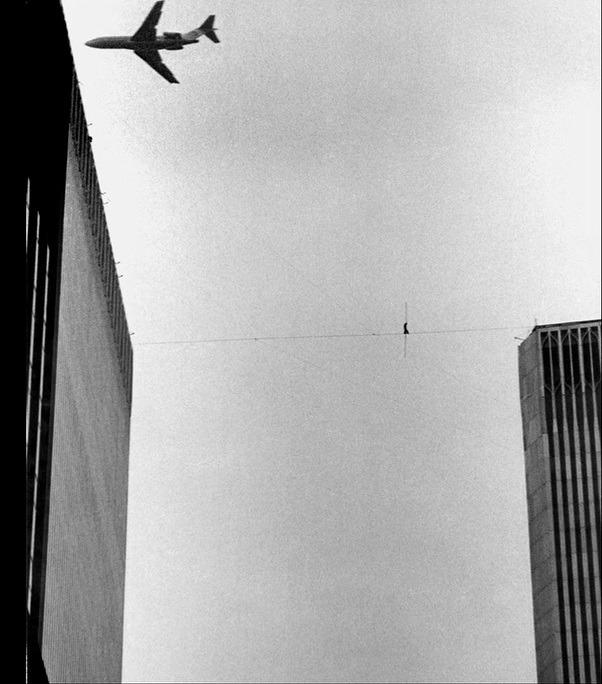
Walk from Below – Man on The Wire (IMDb)
Lateral tension lines (cavaletti) were attached to ensure dynamic stability of the main cable. During this time pressure increased due to pre-dawn winds and activity on the roof; irregularities and adjustment issues with the lateral lines were reported tension rose within the team and some members even discussed abandoning the operation. An unexpected encounter with a businessperson on the roof created a distracting interruption; the interaction was managed controllably without escalating into conflict and setup steps resumed from where they had paused.
As dawn approached final adjustments were made to the cable tension and lateral line attachments. Following the final coordination calls via intercom confirmation was received from the opposite roof that photographic and video recording equipment was ready. At this time pre-walk clothing and gear were checked; details such as Petit’s clothing choice (black turtleneck etc.) were rapidly finalized in a narrow niche on the roof. In the final inspection steps exit and descent points mechanical condition of anchors and balance pole readiness were reconfirmed; then the intercom lines were disconnected and the decision was made to proceed to the walk phase.
The moment of stepping onto the wire marked the final stage of the operation. At the roof edge the balance pole was shouldered; as increasing pedestrian and vehicular movement below merged with the morning light the first few metres of the wire were traversed with careful control of weight transfer and micro-adjustments. At this point the setup and preparation phase was complete and the walk phase had begun; the detailed progression gestures and number of crossings will be addressed in the next section.
The walk began shortly after the final adjustments to the wire were completed in the early morning. The first steps were taken as the balance pole was shouldered at the roof edge; the artist simultaneously managed the tension created by the void below and the sway of the wire while maintaining precise control over weight transfer through micro-adjustments. Sources describe this initial moment as the “moment of truth” in which intense focus was established and the physical tension between the boundaries of safety and the “abyss below” was bodily navigated.
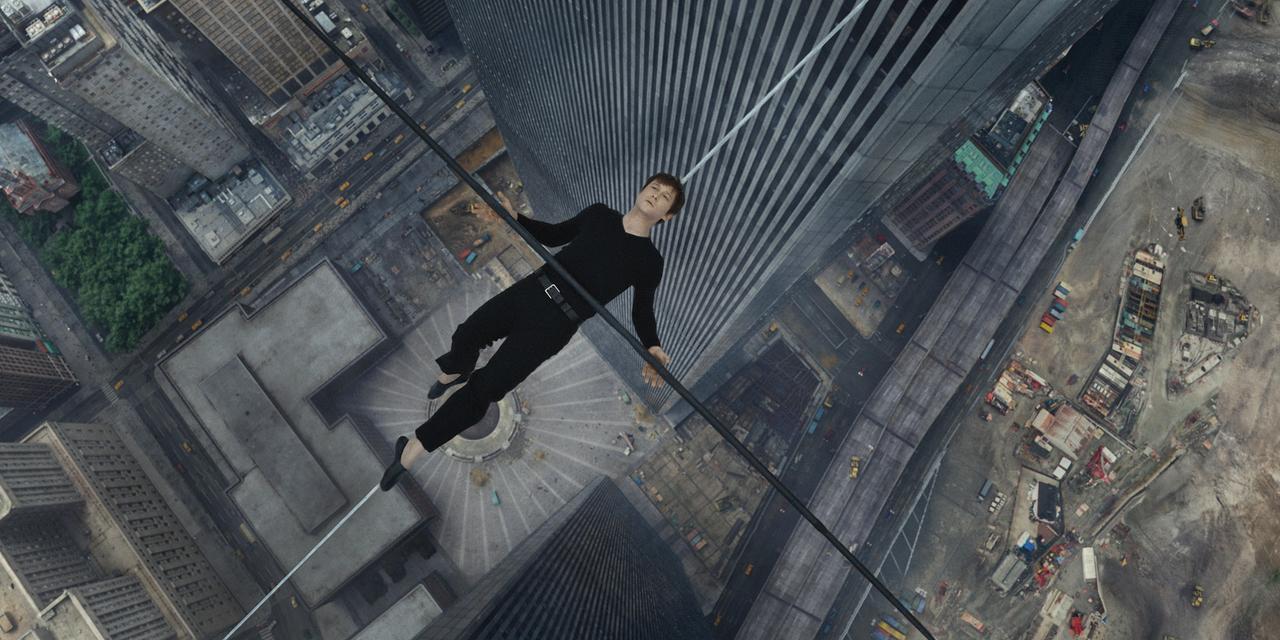
Reenactment of the Artist Lying on His Back on the Wire – The Walk (IMDb)
As the performance progressed it achieved a completeness beyond classical tightrope walking. Sources note that during the walk the artist performed various gestures including kneeling to bow pausing to observe the surroundings and lying on his back on the wire. These gestures are interpreted not merely as demonstrations of technical skill but as integral components of an aesthetic relationship with the space; the experience of “being in the air” is emphasized as the body’s position on the wire is jointly staged.
Throughout the crossings the crowd below displayed clear reactions of astonishment and admiration. The upward surge of audience responses created an effect that strengthened the walk’s resonance within the urban landscape establishing an indirect interaction between the artist and spectators. Sources record moments such as a “first crossing” followed by a pause to observe the surroundings and acknowledge the crowd’s reaction; this demonstrates the transformation of the act from a purely technical performance into a performative event.
The internal experience during the walk is described in testimonies as a volatile mixture of fear joy and freedom. Particularly the perceptual challenges posed by the height and the interaction between wind and wire demanded continuous reaffirmation of bodily control; yet the artist spoke of an experience described as “contact with the air” and “bond with the elements.” These narratives suggest that the performance involved not only the management of physical risk but also the management of a sensory-aesthetic relationship with the space.
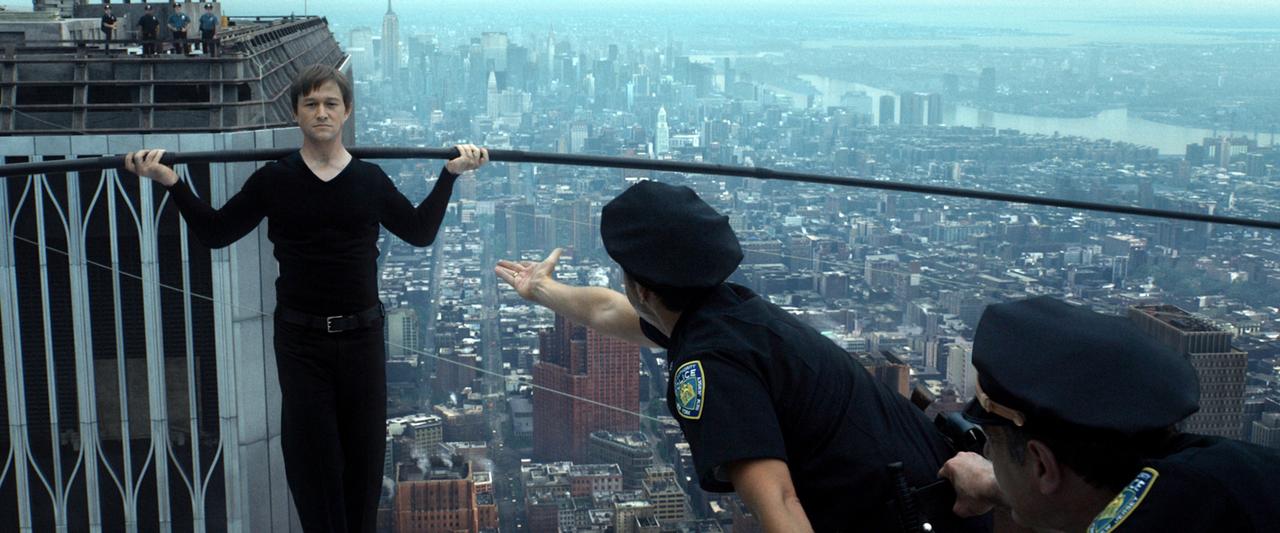
Reenactment of Police Intervention – The Walk (IMDB)
Upon completion of the walk Petit returned to the roof; police intervention began immediately. During subsequent stages (detention transport and legal proceedings) the artist’s characterization of the act as “great joy” and his brief performative response to the question of motive (“I walk when I see two towers”) have become frequently cited details in literature. These data are interpreted as part of the public perception of the walk and the artist’s strategy for framing the act.
Immediately after the walk police intervention was activated on both the roof and ground levels and the artist was taken into custody and transported to a police station. Routine procedures such as fingerprinting were carried out; shortly thereafter he was transported by ambulance to a hospital for a medical evaluation and psychiatric examination.
Upon return to the station interrogation and photography took place in a crowded environment due to intense media interest. Sources record the anecdote that he managed to open his handcuffs with a paperclip; this phase of the operation chain exhibited an extraordinary flow both in terms of security and media management.
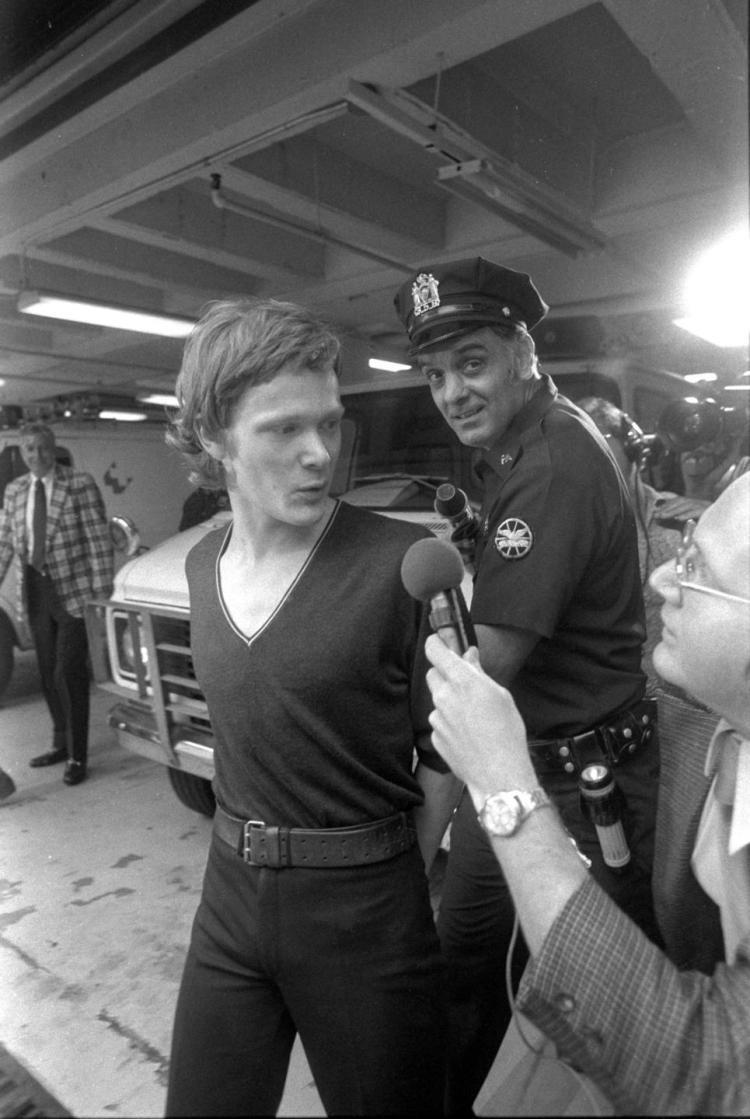
Reenactment of Arrest – Man on The Wire (IMDb)
In the legal phase Petit’s brief responses to the press regarding the motive of the act and his emphasis on “great joy” stood out. This narrative contributed independently of the legal assessment to the public perception of the act as possessing “artistic merit.”
At the conclusion of the investigation and prosecution phase the New York County District Attorney exercised discretion to decline filing criminal charges on the condition that Petit perform a short public show for children. Accordingly all arrest records and related misdemeanor files against him were dropped. This resolution can be regarded as a practical application reflecting a balance between urban security and public order on one hand and artistic freedom of expression on the other.
Immediately after the walk media attention intensified; the artist was repeatedly interrogated and photographed by a large crowd of reporters at the station. In brief statements to the press he described the act as “great joy” and his concise phrase “I juggle when I see three oranges I walk when I see two towers” was widely reported. During the same period the anecdote of him opening his handcuffs with a paperclip was recorded amid the press throng. These elements were decisive in conveying the event’s high news value and its performative dimension to the public.
After descending from the roof the congratulations from construction workers and the chaos at the police station were portrayed in media coverage with contrasting tones: on one side workers celebrating on the other bureaucratic processes involving law enforcement and medical transport. This dual image rendered the act simultaneously “celebrated” and “intervened upon” in headlines and descriptions.
Man on Wire Documentary (Discover History)
Simultaneous with the legal process commercial offers emerged; various institutions proposed commercialization initiatives which the artist rejected. This choice was highlighted in the media as “commitment to artistic identity” and contributed to framing the act in public perception not as an advertisement or marketing stunt but as an independent artistic expression.
The prosecutor’s decision to forgo criminal penalties in exchange for a public short performance (a children’s park show) was reported in public news as a “practical compromise”; this event became part of the immediate public visibility of the walk. The information that the related park performance was conceived as a kind of “show” and “thank you” despite weather conditions was regarded as a development that transferred the event’s ensuing curiosity and interest into an institutional framework.
The cultural continuity of the event was reinforced through primary texts and audiovisual representations. Philippe Petit’s own account (To Reach the Clouds) and the visual archive of the day and its aftermath became foundational reference points for later assessments; the 2008 documentary Man on Wire transported the planning-execution chain to a broad audience using archival footage and testimonies thereby centralizing the walk in collective memory. This process is also linked to the transformation of the Twin Towers from a controversial local symbol in the 1970s into a rapidly “humanized” urban icon following the walk.
After 11 September 2001 the meaning horizon of the event expanded significantly. In academic writing the “choreography over the abyss” of 1974 has been identified as being reinterpreted in the context of the towers’ destruction within the city’s and disaster’s memory; images and testimonies have been observed to generate an intertemporal associative field surpassing the event’s own time. In this context the walk is now read not merely as a technical tightrope achievement but also as a node of memory constructed around urban loss and commemoration.
Official Trailer of The Walk Film (Sony Pictures Entertainment)
Among adaptations Robert Zemeckis’s The Walk (2015) holds a special place. The film opens its narrative with a framing device in which Petit directly addresses the viewer from the torch balcony of the Statue of Liberty and periodically returns to this motif interrupting the linear flow; this framing places Petit in an empyreal (elevating) narrative position beyond concerns of space height security or legality.
Thus in the 2015 context the act is reinterpreted as a “lament for the fallen towers”; the juxtaposition of the Statue of Liberty (the city’s 19th-century symbol) with the WTC (the 1970s financial/global ambition) on the same visual plane links the event to icons of “freedom resistance and national spirit.” Film analyses emphasize that this reframing obscures the economic and urban context of the 1970s and rewrites the walk around the discourse of national memory and exceptionalism.
9/11 Memorial Staff. “On This Day: Philippe Petit's Iconic High-Wire Feat.” *National September 11 Memorial & Museum*, August 7, 2021. Accessed October 9, 2025.https://www.911memorial.org/connect/blog/day-philippe-petits-iconic-high-wire-feat
Audiovisual Sources
Ben-Shaul, Daphna. "Abyssal Choreography: The Ropedancer’s Unsettling Agency and Philippe Petit’s Walks." Dance Research Journal 55, no. 1 (2023): 46–67. Accessed October 9, 2025.
Carucci, John. “Philippe Petit Recreates High-Wire Walk Between World Trade Center’s Twin Towers on 50th Anniversary.” AP News, August 8, 2024. Accessed October 9, 2025.https://apnews.com/article/philippe-petit-twin-towers-walk-anniversary-cathedral-ed874eff0c55831fbae1b28f5c398dc3
Discover History. "Man On Wire - Full Documentary (2008) Philippe Petit's High-Wire Walk." YouTube. Accessed October 9, 2025.https://www.youtube.com/watch?v=JWHZLRmu1ts&t=4923s.
Fabry, Merrill. “The True Story Behind The Walk.” TIME, September 29, 2015. Accessed October 9, 2025.https://time.com/4048476/true-story-the-walk/.
IMDb. "Man on Wire." Accessed October 9, 2025.https://www.imdb.com/title/tt1155592/.
IMDb. "The Walk." Accessed October 9, 2025.https://www.imdb.com/title/tt3488710/.
Petit, Philippe. *Man on Wire*. New York: Skyhorse Pub., 2008. Accessed October 9, 2025.https://archive.org/details/manonwire0000peti
Petit, Philippe. *To Reach the Clouds: My High-Wire Walk Between the Twin Towers*. Illustrated ed. New York: Skyhorse Publishing Company, Incorporated, 2007. Accessed October 9, 2025.https://books.google.com.tr/books/about/To_Reach_the_Clouds.html?id=hXAKkgEACAAJ
Research Works
Shanks, Gwyneth. “The Politico-Aesthetics of Groundlessness and Philippe Petit’s High-Wire Walk.” *Performance Matters* 2, no. 2 (2016): 43–62. Accessed October 9, 2025.https://performancematters-thejournal.com/index.php/pm/article/view/48
Sony Pictures Entertainment. “THE WALK - Official Trailer [HD] - Oct 2015.” YouTube. Accessed October 9, 2025.https://www.youtube.com/watch?v=GR1EmTKAWIw.

Event | Philippe Petit's high wire walk between the Twin Towers | ||||||||
|---|---|---|---|---|---|---|---|---|---|
Type | Performance art | ||||||||
Date | 7 August 1974 | ||||||||
Place | World Trade Center | ||||||||
Elevation | 417 metres (1,350 ft) | ||||||||
Duration | 45 minutes | ||||||||
Number of Transitions | 8 | ||||||||
Start Time | 07.15 | ||||||||
Team | Jean-François Heckel Paul Mark Albert Barry Greenhouse Jean-Pierre Annie Allix Jean-Louis Blondeau Philippe Petit | ||||||||
Preparation Time | 6 years | ||||||||
Basic Material | Balance beam (approximately 8 m - 25 kg) Tirfor mechanical pulling device Intercom and guide wire system Galvanized steel cable (approximately 200 kg) Side tension lines (cavaletti) | ||||||||
Important Adaptations | The Walk (Film) Man on Wire (Documentary) | ||||||||
Written Work | To Reach the Clouds: My High Wire Walk Between the Twin Towers (Petit Philippe) | ||||||||
No Discussion Added Yet
Start discussion for "Philippe Petit's Tightrope Walk Between the Twin Towers (1974)" article
Preparation and Planning (1968–1974)
Technical Setup and Method
Execution of the Operation (6–7 August 1974)
Progression of the Walk
Intervention and Legal Proceedings
Media and Public Reaction
Memory and Adaptations