


This article was automatically translated from the original Turkish version.
+1 More
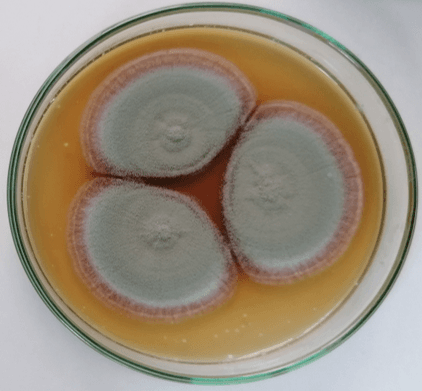
Penicillium Canescens (Pınar Güner)
Scientific Name(s) | Penicillium canescens Thom (1923) | ||||||||
|---|---|---|---|---|---|---|---|---|---|
Division | Ascomycota | ||||||||
Class | Eurotiomycetes | ||||||||
Order | Eurotiales | ||||||||
Optimum Temperature | 25–30 °C | ||||||||
Metabolites | pectinase, amylase, protease, phytase, antifungal compounds | ||||||||
Penicillium canescens is a mold species belonging to the genus Penicillium, commonly found in soil, air, plant surfaces, and various food products. This species is recognized for its rapid sporulation, characteristic greenish-gray colonies, and high enzyme production capacity. P. canescens typically exhibits a saprophytic lifestyle and plays a significant role in the decomposition of organic matter. It is also frequently evaluated in biotechnological applications, particularly for the production of industrial enzymes.
Penicillium canescens is a fungus classified within the phylum Ascomycota, class Eurotiomycetes, order Eurotiales, and family Aspergillaceae. Taxonomically, it is closely related to species such as Penicillium chrysogenum and Penicillium citrinum. The species was first described by Thom in 1923. Within the genus Penicillium, it is placed in the subgroup “subgenus Penicillium, section Canescentia”.
In laboratory cultures, P. canescens forms rapidly growing colonies that are typically gray-green or bluish-green in color. Dense sporulation is observed at the center of the colonies, while the margins exhibit white or pale yellow mycelial growth. Conidiophores are usually short, branched, and terminate in swollen phialides. Conidia are round or ellipsoidal and arranged in chains. Microscopically, it displays the typical Penicillium appearance.
Penicillium canescens is widely distributed across many regions of the world. It has been isolated particularly from soil, cereal products, decaying plant material, flour-based products, cheese, and other dairy items. It can also be found in enclosed environments, especially on moist wall surfaces and in air samples.
One of the most notable features of P. canescens is its high enzyme production capacity. This species synthesizes numerous industrial enzymes, including amylase, pectinase, cellulase, protease, and phytase. These enzymes are used in the food, agriculture, paper, textile, and biofuel industries. Additionally, some isolates have been reported to produce antifungal and antibacterial compounds. These characteristics make P. canescens a valuable microorganism for biotechnological and environmental applications.
Penicillium canescens is an important microorganism, particularly for pectinase production. Pectinases are used in the fruit juice industry to clarify juice and reduce viscosity. Furthermore, the phytase enzyme produced by this species is employed in animal feed to enhance phosphorus bioavailability. P. canescens has also proven effective in biological degradation processes and certain bioremediation studies.
Generally non-pathogenic, this species is rarely reported to cause disease in humans. However, it has the potential to act as an opportunistic pathogen in individuals with compromised immune systems. Some isolates of Penicillium canescens have been reported to produce mycotoxin-like metabolites; therefore, careful analysis is required in cases of food contamination.
Recent genetic analyses have shown that P. canescens possesses extensive genetic diversity and can be differentiated into distinct ecotypes. Genome analyses have revealed that this species carries a high number of genes encoding hydrolytic enzymes. This feature has encouraged its use in research related to the breakdown of lignocellulosic materials and biofuel production.
Bertinetti, B. V., N. I. Peña, and G. M. Cabrera. “An Antifungal Tetrapeptide from the Culture of Penicillium canescens.” Chemistry & Biodiversity 6, no. 8 (2009): 1178–84. Accessed October 19, 2025. https://doi.org/10.1002/cbdv.200800336
Brian, P. W., H. G. Hemming, J. S. Moffatt, and C. H. Unwin. “Canescin, an Antibiotic Produced by Penicillium canescens.” Transactions of the British Mycological Society 36, no. 3 (1953): 243–47. Accessed October 19, 2025. https://doi.org/10.1016/S0007-1536(53)80009-4

Penicillium Canescens (Pınar Güner)
Scientific Name(s) | Penicillium canescens Thom (1923) | ||||||||
|---|---|---|---|---|---|---|---|---|---|
Division | Ascomycota | ||||||||
Class | Eurotiomycetes | ||||||||
Order | Eurotiales | ||||||||
Optimum Temperature | 25–30 °C | ||||||||
Metabolites | pectinase, amylase, protease, phytase, antifungal compounds | ||||||||
No Discussion Added Yet
Start discussion for "Penicillium canescens" article
Taxonomy and Classification
Morphological Characteristics
Ecological Distribution and Isolation Sources
Physiological and Biochemical Properties
Industrial and Biotechnological Significance
Pathological and Toxicological Properties
Genetic and Molecular Studies