


This article was automatically translated from the original Turkish version.
Pencil, a writing and drawing instrument typically made of wood with a core filled with a mixture of graphite and clay. Despite its name containing the word "lead," it contains no lead element. This misnomer arises from the metallic luster of graphite being mistaken for lead. For centuries, the pencil has served as a fundamental tool in writing, drawing, and design.
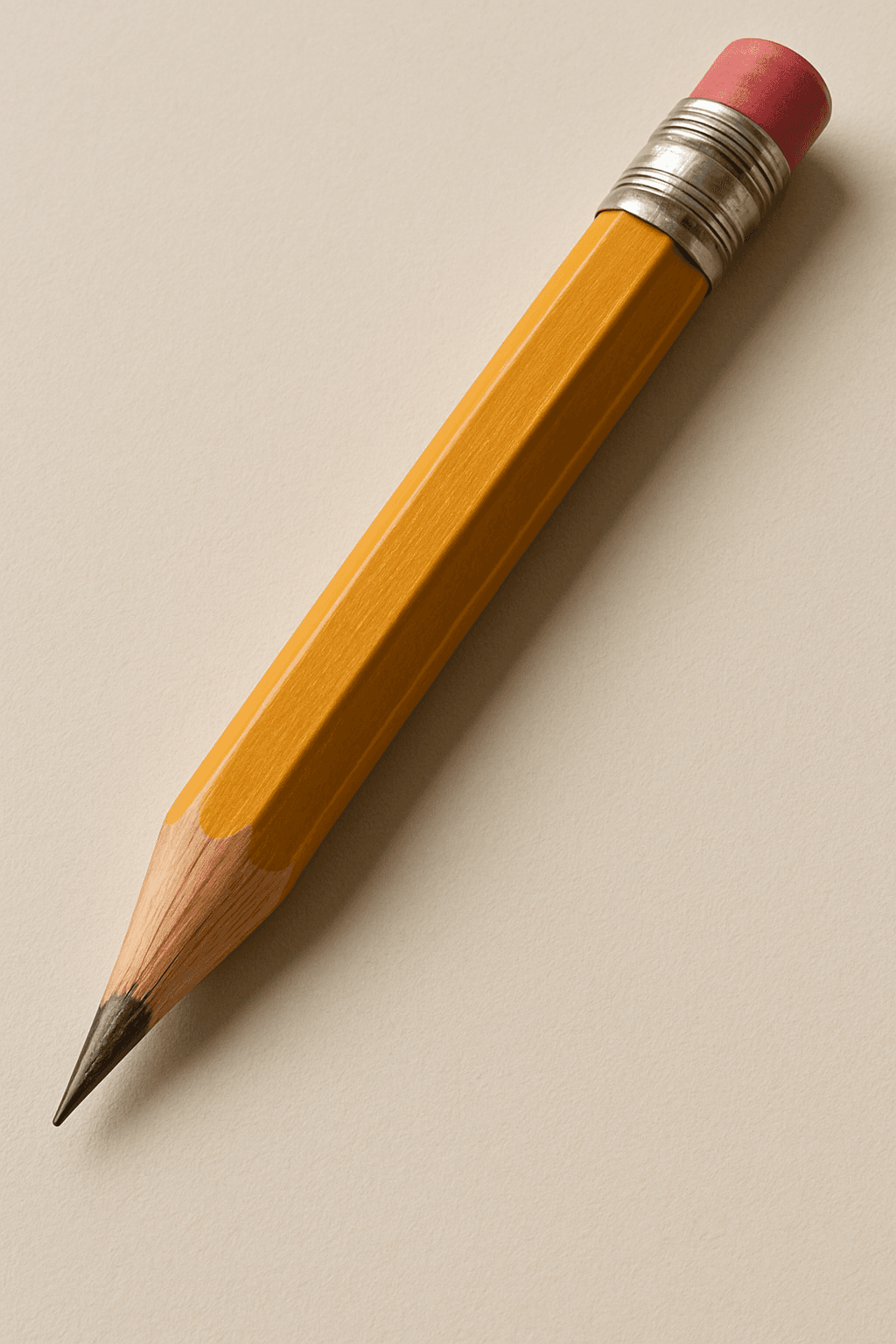
Pencil. (Generated by artificial intelligence.)
The history of the pencil dates back to the mid-16th century. In 1565, Swiss naturalist Conrad Gesner noted that graphite could be used for writing. At the time, graphite was confused with lead and referred to as "plumbago." Pure graphite deposits found in the Cumberland region of England were used by shepherds to mark sheep and later encased in wood to make them more practical.
In 1795, French officer and inventor Nicolas-Jacques Conté succeeded in producing pencils with varying degrees of hardness by combining graphite with clay and patented this method. This technique remains the standard in pencil manufacturing today. Around the same time, Austrian architect Joseph Hardtmuth conducted similar work and founded the company KOH-I-NOOR in Vienna in 1792 to begin pencil production.
Pencil manufacturing consists of several key stages:
Pencils vary in hardness depending on the ratio of graphite to clay in their cores. These grades are indicated by the letters "H" (hard) and "B" (black). As the H grade increases, the pencil becomes harder and produces lighter lines; as the B grade increases, the pencil becomes softer and produces darker lines. "HB" denotes a medium hardness.
Berkel, Adnan. “Kurşun Kalem Sanayiimiz Ve Ham Madde Istekleri”. Journal of the Faculty of Forestry Istanbul University 2, no. 2 (July 1952): 24–31. Accessed May 16, 2025.
Özlem Ak. "Kurşun Kalem." Bilim ve Teknik, October 2014. Accessed May 16, 2025.

History
Manufacturing Process
Hardness Grades