


This article was automatically translated from the original Turkish version.
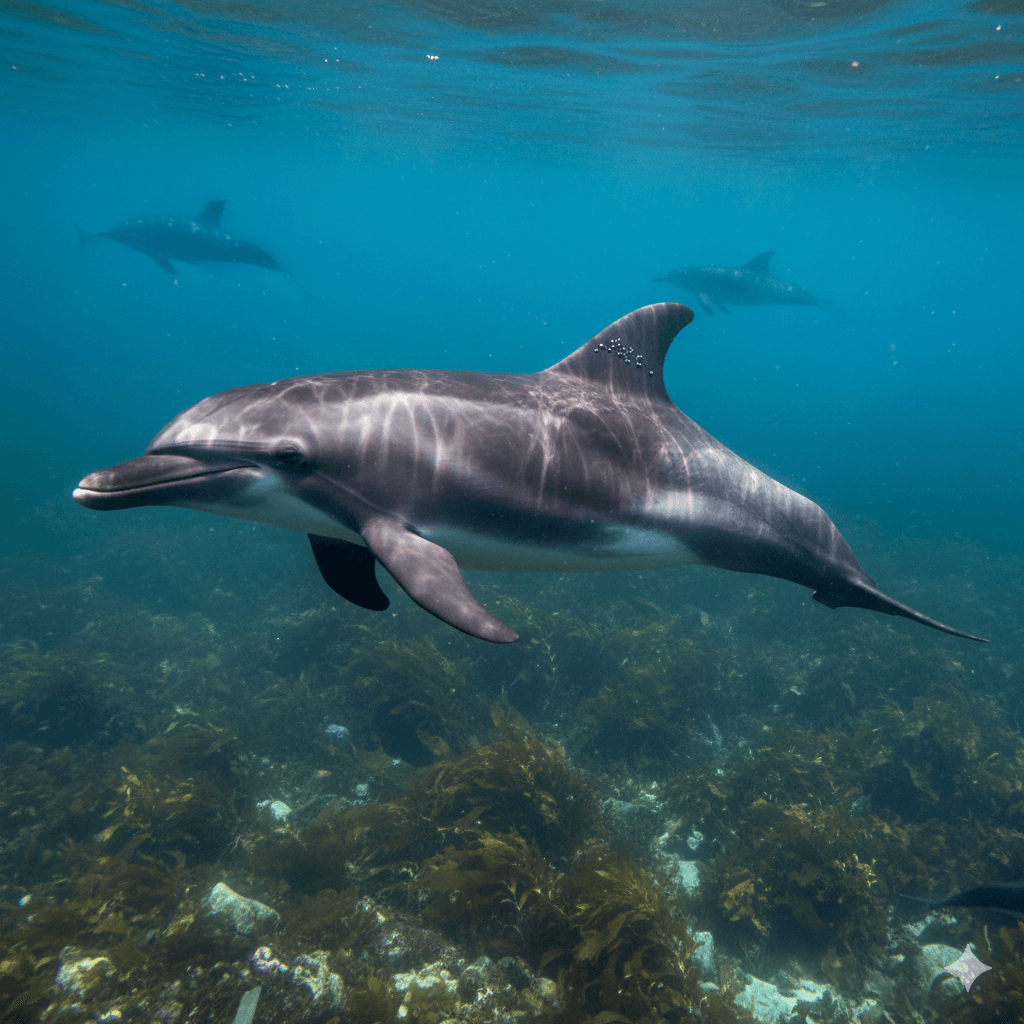
Peale Yunusu (Generated by Artificial Intelligence.)
Genus | Cephalorhynchus | ||||||||
|---|---|---|---|---|---|---|---|---|---|
Specie(s) | C. australis / Lagenorhynchus australis | ||||||||
Family | Delphinidae | ||||||||
Class | Mammalia | ||||||||
Phylum | Chordata | ||||||||
Conservation Status | Least Concern (IUCN 3.1) | ||||||||
Peale’s dolphin is a marine mammal with the scientific name Lagenorhynchus australis. The species is endemic to the coastal waters south of South America.
Peale’s dolphin is a typical-sized member of its family. At birth it is approximately 1 metre (3 ft 3 in) long and reaches up to 2.1 metres (6 ft 11 in) when fully mature. Adult weight is about 115 kg (254 lb). The dolphin has a robust body and a small beak. Adult Peale’s dolphins are dark grey to black in colour. Immediately behind each flipper there is a white patch, also known as “armpits.” On the flanks, a large grey-white patch is present above the flipper. The dorsal fin is large for this species. They also possess a distinctive pair of black eye rings extending toward the snout. Juveniles are lighter grey than adults. From a distance, the species resembles the dusky dolphin and can be confused with it. Small bumps are present along the leading edge of the flippers in mature individuals.
Peale’s Dolphin (Cayetano Espinosa)
Peale’s dolphin is endemic to the coastal waters south of South America. On the Pacific side its range extends as far north as Valdivia in Chile; on the Atlantic side it ranges from Golfo San José in Argentina southward to the Beagle Channel and the Falkland Islands (Malvinas). It has been reported to reach as far north as Buenos Aires in Argentina and Concón in Chile. It is most commonly found south of Puerto Montt in Chile, around the Falkland Islands, and in Tierra del Fuego. It typically inhabits coastal areas near fast-moving waters such as the entrances to channels and narrow straits, as well as sheltered bays. Although occasional observations suggest occasional movements into open ocean, studies in the Strait of Magellan in Chile indicate that populations remain year-round in specific nearshore areas. The total population is unknown, but recent estimates suggest approximately 21,800 individuals in the southwestern South Atlantic portion of its range. It is known to be abundant around the Falkland Islands and in the Strait of Magellan off the Chilean coast.
Peale’s dolphins usually occur in small groups of about five individuals, sometimes up to twenty. Rarely, much larger groups of over 100 have been recorded during summer and autumn. This species is agile and acrobatic. It is known to ride the bow waves of large vessels and swim alongside smaller boats. Peale’s dolphins have been observed playing and interacting with each other in small groups. They are often seen slowly swimming near kelp beds. They have also been observed associating with other marine mammals such as Commerson’s dolphins. Underwater acoustic recordings have shown that Peale’s dolphins produce both broadband clicks and tonal whistles.
Peale’s dolphins (Lagenorhynchus australis) feed on a variety of molluscs, crustaceans, cephalopods and fish. In the southwest South Atlantic, they forage in coastal ecosystems primarily on demersal and bottom-dwelling fish such as the southern hake and Patagonian grenadier. They employ feeding strategies involving surrounding prey in large groups, forming wide circles or starburst patterns.
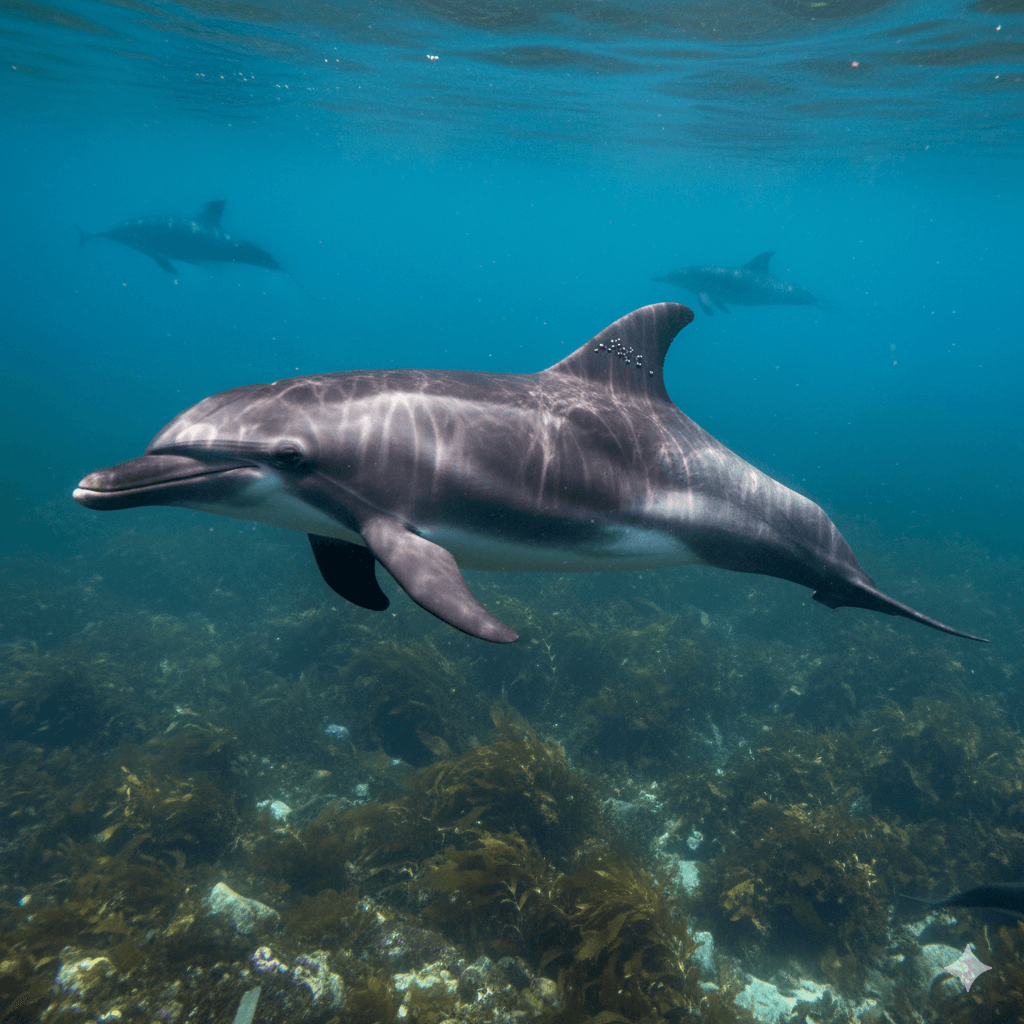
Peale’s Dolphin (Generated by Artificial Intelligence)
Peale’s dolphins give birth between October and April. However, very little data is available on the reproductive habits of this species.
The Peale’s dolphin’s tendency to remain in small, nearshore areas makes it vulnerable to human activities. It is listed as “Least Concern” on the IUCN Red List. It is also listed on Appendix II of the Convention on the Conservation of Migratory Species of Wild Animals (CMS) and Appendix II of CITES. Between the 1970s and 1980s, it was hunted by Chilean fishermen. In Argentina it has been reported to become entangled in gillnets, although the extent of this threat is unknown. Like all dolphin species, it is at risk from entanglement in fishing gear, and research is ongoing into the effects of marine pollution on this species. Hunting for bait has declined.
Cayetano Espinosa. "Delfin austral - Peale's dolphin - Yaqu Pacha Chile." YouTube. Accessed November 10, 2025. https://www.youtube.com/watch?v=41UeolDJSoE&t=17s
Food and Agriculture Organization of the United Nations (FAO). *Marine Mammals of the World: FAO Species Identification Guide for Fishery Purposes – Cetaceans, Seals, Sirenians and Otters*. Rome: FAO. 2002. “Peale’s dolphin (Lagenorhynchus australis)”. pp. 150–151. Accessed October 20, 2025. https://www.fao.org/4/t0725e/t0725e23.pdf
Hammond, P.S., Bearzi, G., Bjørge, A., Forney, K., Karczmarski, L., Kasuya, T., Perrin, W.F., Scott, M.D., Wang, J.Y., Wells, R.S. & Wilson, B. “Lagenorhynchus australis.” ResearchGate. Accessed October 20, 2025. https://www.researchgate.net/publication/314246632_Lagenorhynchus_australis
MarineBio Conservation Society. “Peale’s Dolphins, Lagenorhynchus australis.” MarineBio: Marine Life Encyclopedia & Conservation Society. Accessed October 20, 2025. https://www.marinebio.org/species/peales-dolphins/lagenorhynchus-australis/

Peale Yunusu (Generated by Artificial Intelligence.)
Genus | Cephalorhynchus | ||||||||
|---|---|---|---|---|---|---|---|---|---|
Specie(s) | C. australis / Lagenorhynchus australis | ||||||||
Family | Delphinidae | ||||||||
Class | Mammalia | ||||||||
Phylum | Chordata | ||||||||
Conservation Status | Least Concern (IUCN 3.1) | ||||||||
No Discussion Added Yet
Start discussion for "Peale's dolphin (Lagenorhynchus australis)" article
Morphological Characteristics and Appearance
Population Distribution and Habitat
Behaviour and Diet
Reproduction
Conservation Status