


This article was automatically translated from the original Turkish version.
+2 More
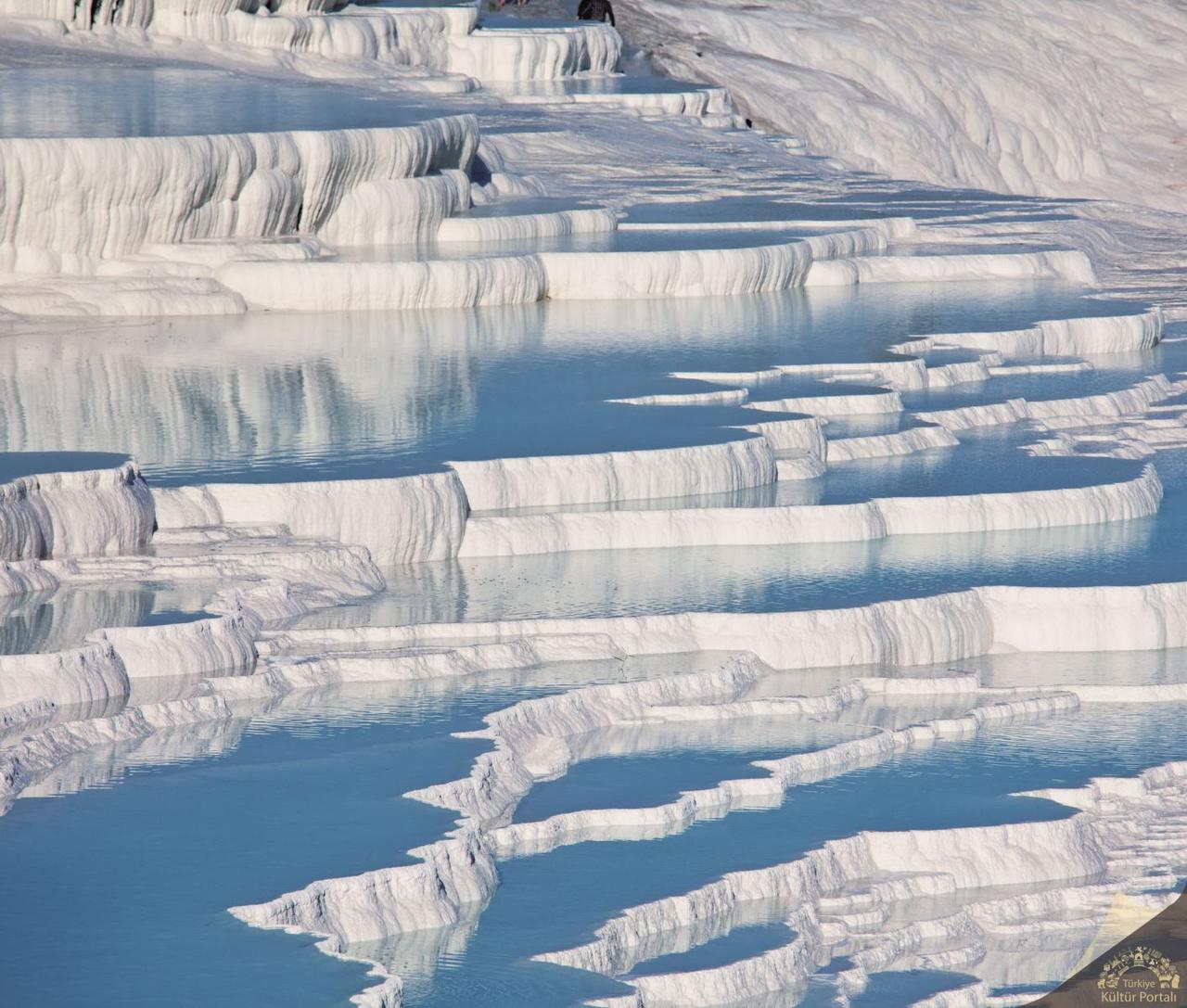
Pamukkale Travertines
Location | Türkiye Denizli Province | ||||||||
|---|---|---|---|---|---|---|---|---|---|
UNESCO Acceptance Date | 1988 | ||||||||
Pamukkale Travertines are a natural formation located within the boundaries of Denizli province in Türkiye. These travertines result from chemical precipitations caused by thermal waters emerging from underground. Pamukkale is a globally recognized natural site renowned for the visual and ecological richness of its travertine formations and is listed on the UNESCO World Heritage List.
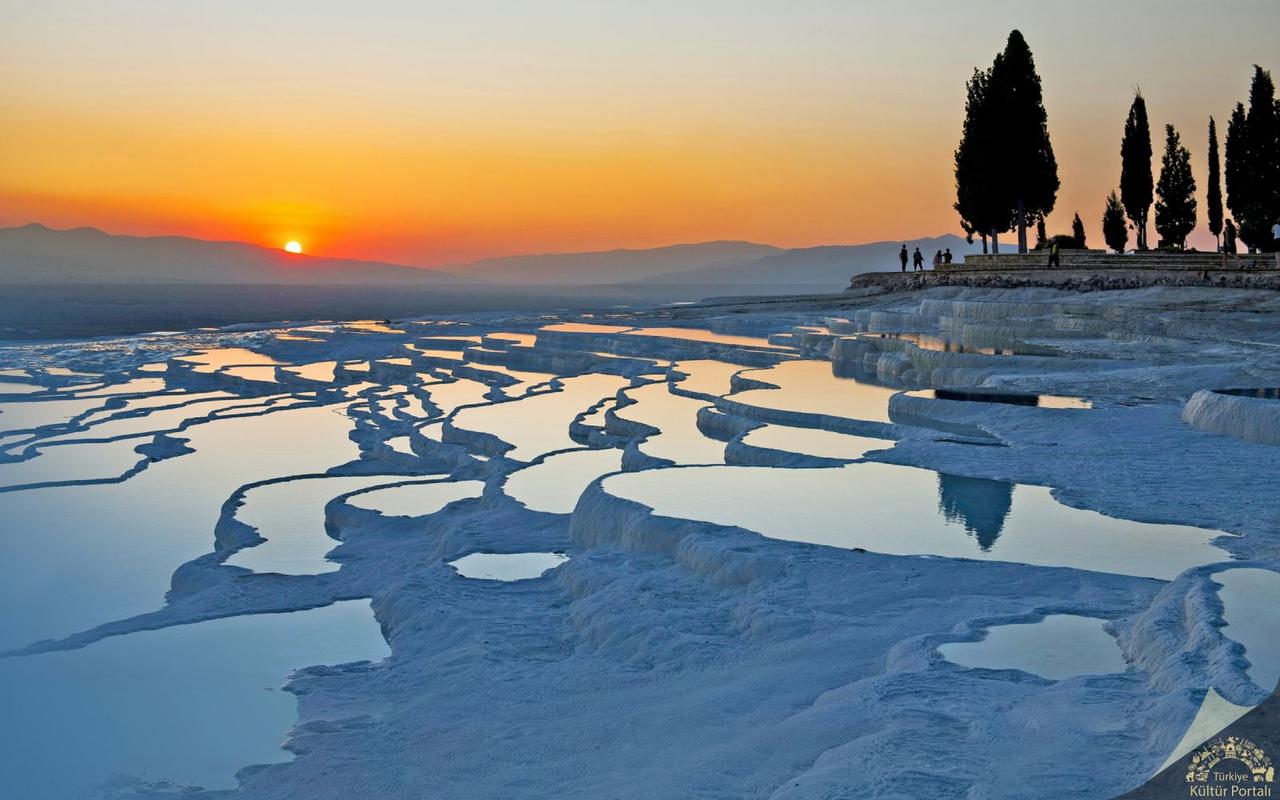
Pamukkale Travertenleri (Türkiye Kültür Portalı)
Travertine is a type of rock that forms through the deposition of calcium carbonate (CaCO3) when water evaporates and carbon dioxide (CO2) gas is released into the atmosphere. The formation of Pamukkale travertines originates from the chemical composition of thermal springs in the region, particularly their high concentration of calcium bicarbonate. Thermal water dissolves mineral-rich substances from underground and carries them into solution. When this water reaches the surface, the dissolved substances react with oxygen in the atmosphere. This chemical process, occurring over a long time span under specific environmental conditions, leads to the formation of white travertine layers.
Pamukkale features 17 different hot water sources with temperatures ranging from 35°C to 100°C. These springs enrich the water with minerals through underground tectonic movements and chemical reactions, enabling travertine formation. The water emerging from these sources flows along a channel approximately 320 meters long, forming travertine terraces that reach heights of up to 60 to 70 meters.
The formation of travertines begins with the precipitation of calcium bicarbonate in hot water as it combines with oxygen in the atmosphere to form
calcium carbonate (CaCO3). This chemical process can be summarized as: Ca(HCO3)2 + O2 → CaCO3 + CO2 + CO + H2O
Initially precipitating in a gel-like form, this substance hardens over time into white travertine layers. The process continues continuously through a cycle of dissolution and precipitation.
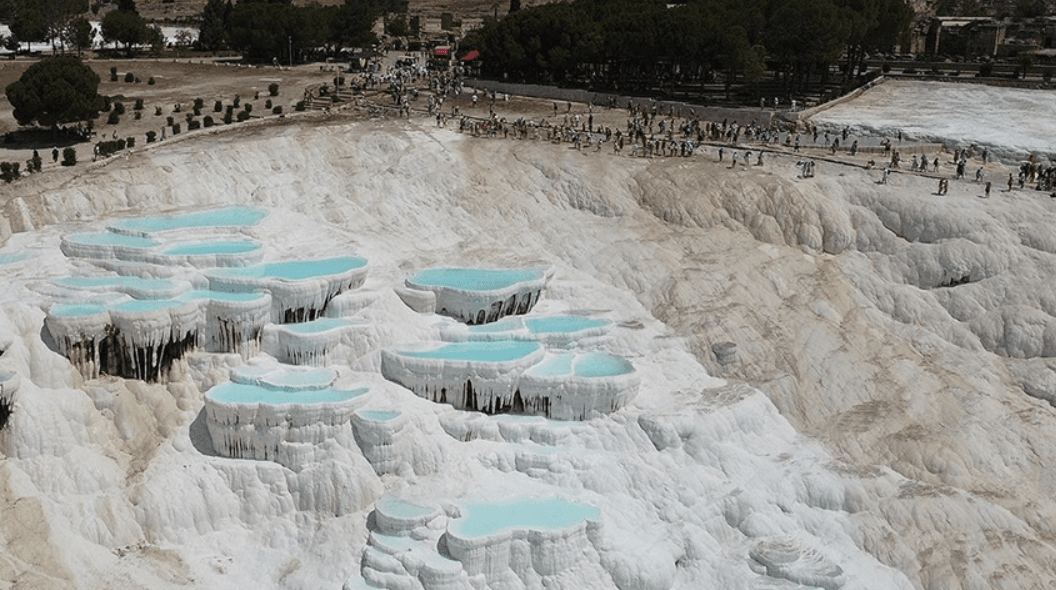
Pamukkale Travertenleri (Anadolu Ajansı)
The travertines of Pamukkale sometimes suffer damage due to intense visitor interest. Walking on the travertines can crush the still-soft calcium carbonate deposits, disrupting the natural structure. Therefore, a management strategy is required that ensures controlled water flow and prevents visitor damage to the travertines. Additionally, excessive water directed to the same area can lead to algal growth and pollution, causing the travertines to lose their natural whiteness.
The whiteness of Pamukkale results from the precipitation of calcium bicarbonate in thermal water as it reacts with atmospheric oxygen. The process by which travertines acquire their white color varies depending on local climatic conditions, heat loss, and the duration of water flow. These factors influence the density and structure of the layers formed on the travertines.
The thermal waters of Pamukkale undergo various chemical changes after emerging from the source. While the water at the spring head contains an average of 725 mg/L of carbon dioxide, this concentration drops to 145 mg/L near the travertines. Similarly, calcium bicarbonate levels decrease from 1200 mg/L at the source to 400 mg/L downstream. These changes enable the slow but continuous growth of the travertines.
Approximately 499.9 mg of calcium carbonate precipitates per liter of water in the Pamukkale travertines. Based on this calculation, theoretically, an area of 4.9 km² could be whitened by a layer one millimeter thick annually. However, this rate is difficult to achieve in practice, as environmental conditions and human interactions hinder travertine growth at this pace.
The conservation of Pamukkale is of great importance. To ensure the continued healthy existence of this unique formation created by natural processes, environmental impacts must be minimized and visitor numbers must be managed. Pamukkale, which carries not only natural but also cultural value, must be preserved as part of humanity’s heritage and passed on to future generations.
The Pamukkale travertines are not merely a visual wonder but also hold significant scientific value. This area, possessing both natural and cultural importance, continues to be studied in depth through research in geosciences, chemistry, and ecology.
Anadolu Ajansı. "Pamukkale yaz sıcaklarında da turistlerin gözdesi." Accessed April 24, 2025.https://www.aa.com.tr/tr/yasam/pamukkale-yaz-sicaklarinda-da-turistlerin-gozdesi/2655665
Polat, Selahattin. "Türkiye’de Traverten Oluşumu, Yayılış Alanı ve Korunması." Marmara Coğrafya Dergisi, no. 23 (2013): 389–428.
Türkiye Kültür Portalı. "Pamukkale Hierapolis Antik Kenti - Denizli." Accessed April 24, 2025.https://www.kulturportali.gov.tr/turkiye/denizli/gezilecekyer/pamukkale-hierapolis-antik-kenti

Pamukkale Travertines
Location | Türkiye Denizli Province | ||||||||
|---|---|---|---|---|---|---|---|---|---|
UNESCO Acceptance Date | 1988 | ||||||||
No Discussion Added Yet
Start discussion for "Pamukkale Travertines" article
Formation of Travertine
Geological Structure and Thermal Springs of Pamukkale
Formation of Travertines and Chemical Reactions
Visitor Impacts and Conservation Measures
Origin of Whiteness and Influencing Factors
Chemical Changes and Water Composition
Precipitation Rate and Whitening of the Area
Conservation and Sustainability