
Born | February 15 1809 | ||||||||
|---|---|---|---|---|---|---|---|---|---|
Died | April 19 1874 | ||||||||
Occupations | Publisher Writer Designer Architect | ||||||||
Education | Royal Academy Schools Apprenticeship with Lewis Vulliamy | ||||||||
Major Travels | Spain Egypt Türkiye Greece Italy | ||||||||
Notable Works | Sydenham 1854) Crystal Palace iç dekorasyonları (1851 St James’s Hall (1858 Londra) Examples of Chinese Ornament (1867) The Grammar of Ornament (1856) Plans Elevations Sections and Details of the Alhambra (1842–1845) | ||||||||
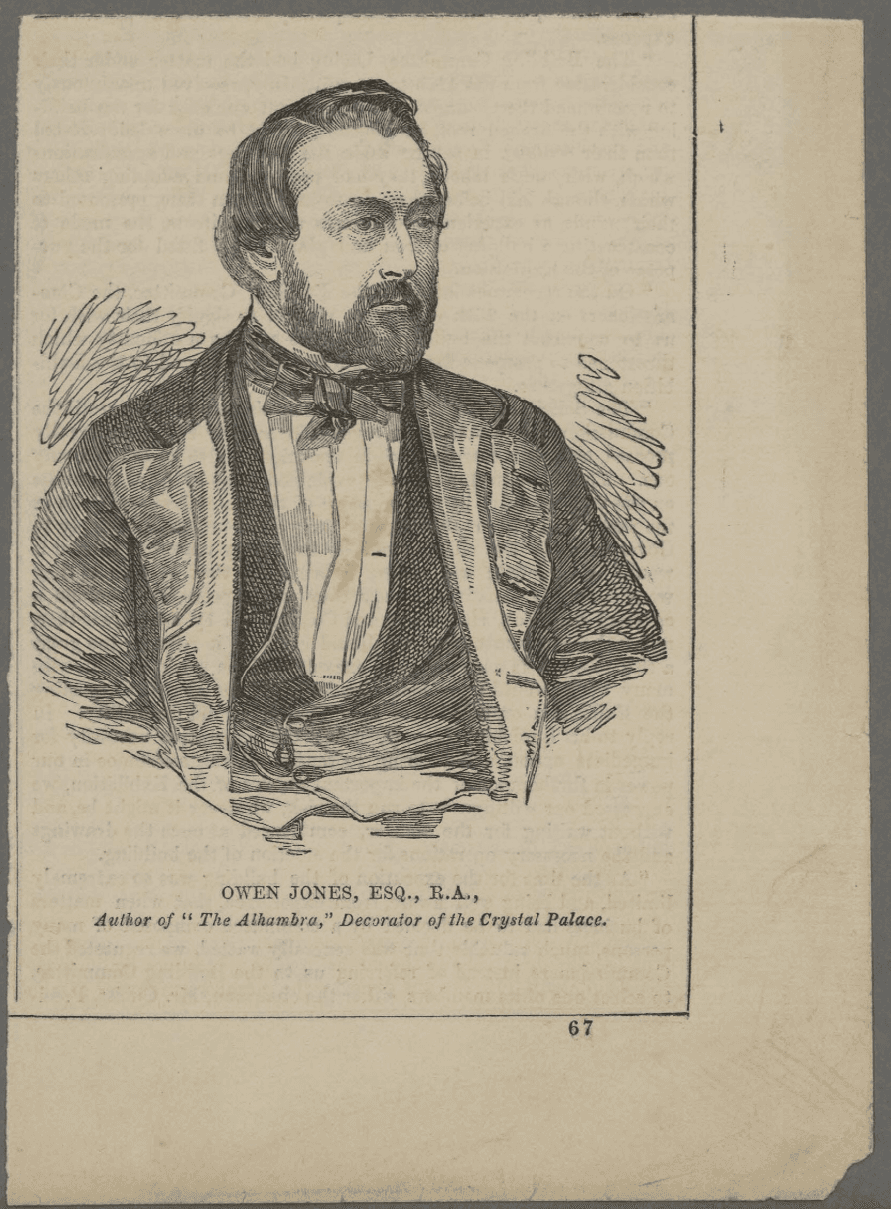
Owen Jones (1809–1874) was an English architect, designer, writer, and publisher. He became known in the 19th century for his theories on color, geometry, and ornament, and his work The Grammar of Ornament (1856) left a lasting influence on the development of modern decorative arts.
Owen Jones was born in London on 15 February 1809. In 1825, he began his professional career as an apprentice to architect Lewis Vulliamy. During his student years, Vulliamy had traveled in Italy, Greece, and in 1818 Istanbul, where he made detailed drawings not only of classical ruins but also of mosques, using the new scientific drawing instruments of the period. These experiences passed on to Jones both direct observations of Islamic architecture and systematic methods for documenting architecture.
From 1829 onward, Jones studied architecture at the Royal Academy Schools in London. There, alongside classical architecture, he became acquainted with debates on architectural polychromy. The knowledge he gained during his apprenticeship and academic years laid the foundation for his later focus on color and ornament.
Between 1832 and 1834, Jones traveled through Italy, Greece, Türkiye, and Egypt before moving on to Spain. In Athens, together with Jules Goury, he studied mosque decorations in Cairo and Istanbul, documented ancient monuments along the Nile, and carried out a six-month detailed study at the Alhambra Palace in Granada. Following Goury’s death from cholera in 1834, Jones continued the research on his own and took on the responsibility of preparing their collected material for publication.
The geometric and color-based surface design principles he developed during this period took shape in his tile designs of the 1840s and in the publication Plans, Elevations, Sections and Details of the Alhambra (1842–1845). Regarded as one of the most influential works on Islamic architecture, the publication was considered a major milestone both in documenting the Alhambra and in advancing color printing techniques.
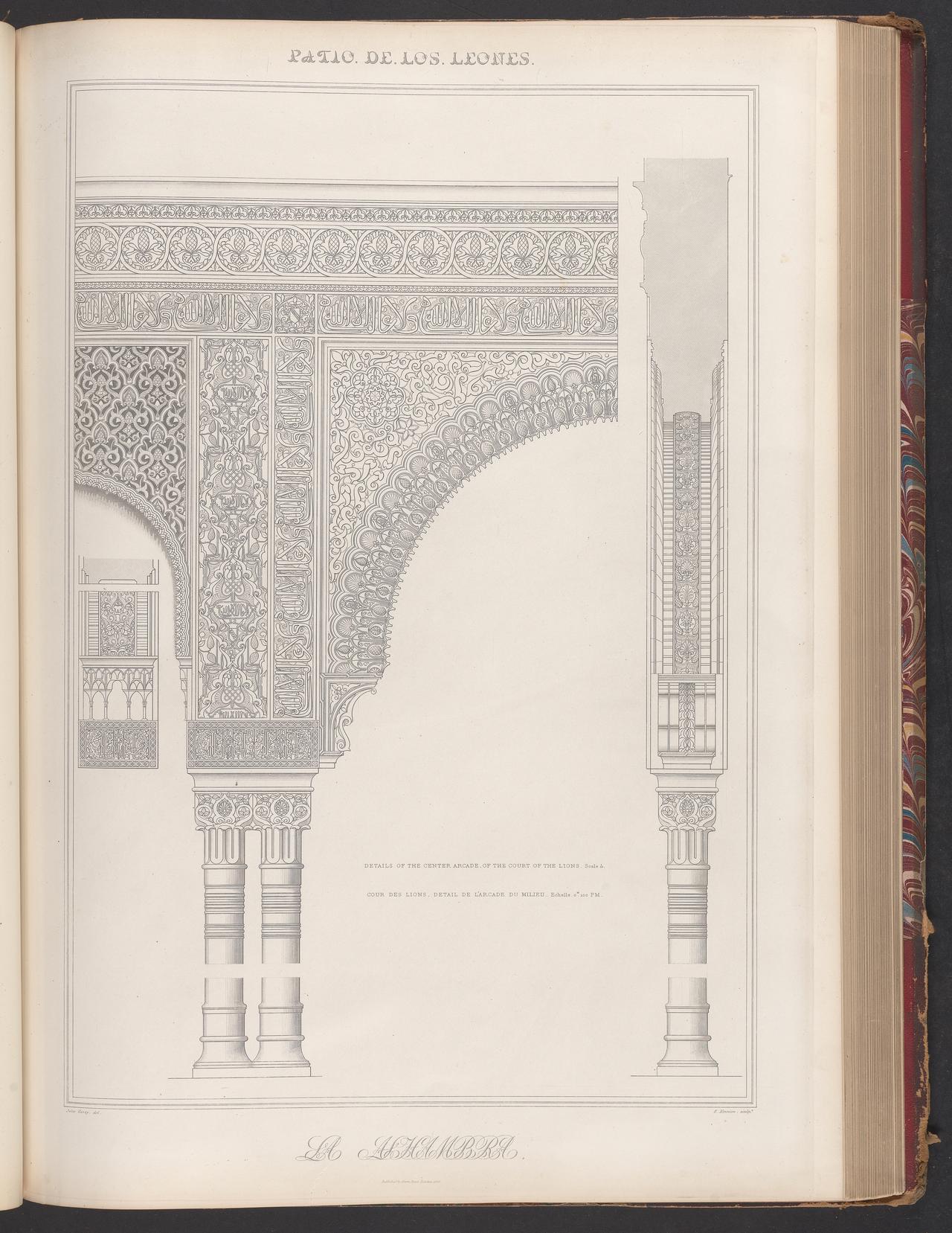
Facade Section of the Alhambra - Plans, Elevations, Sections and Details of the Alhambra (rawpixel)
Among Owen Jones’s notable architectural works was St James’s Hall, completed in 1858. Located between Regent Street and Piccadilly, the building served for nearly half a century as London’s principal concert hall. Jones also carried out various interior designs for commercial and public buildings, including:
Jones’s projects produced striking examples of vibrant polychromy and rich ornamentation, which became characteristic features of shopping venues and exhibition spaces of the period.
Among the few surviving original decorations, the ceiling ornamentation at 16 Carlton House Terrace is especially notable; today, the building is owned by the British Academy.
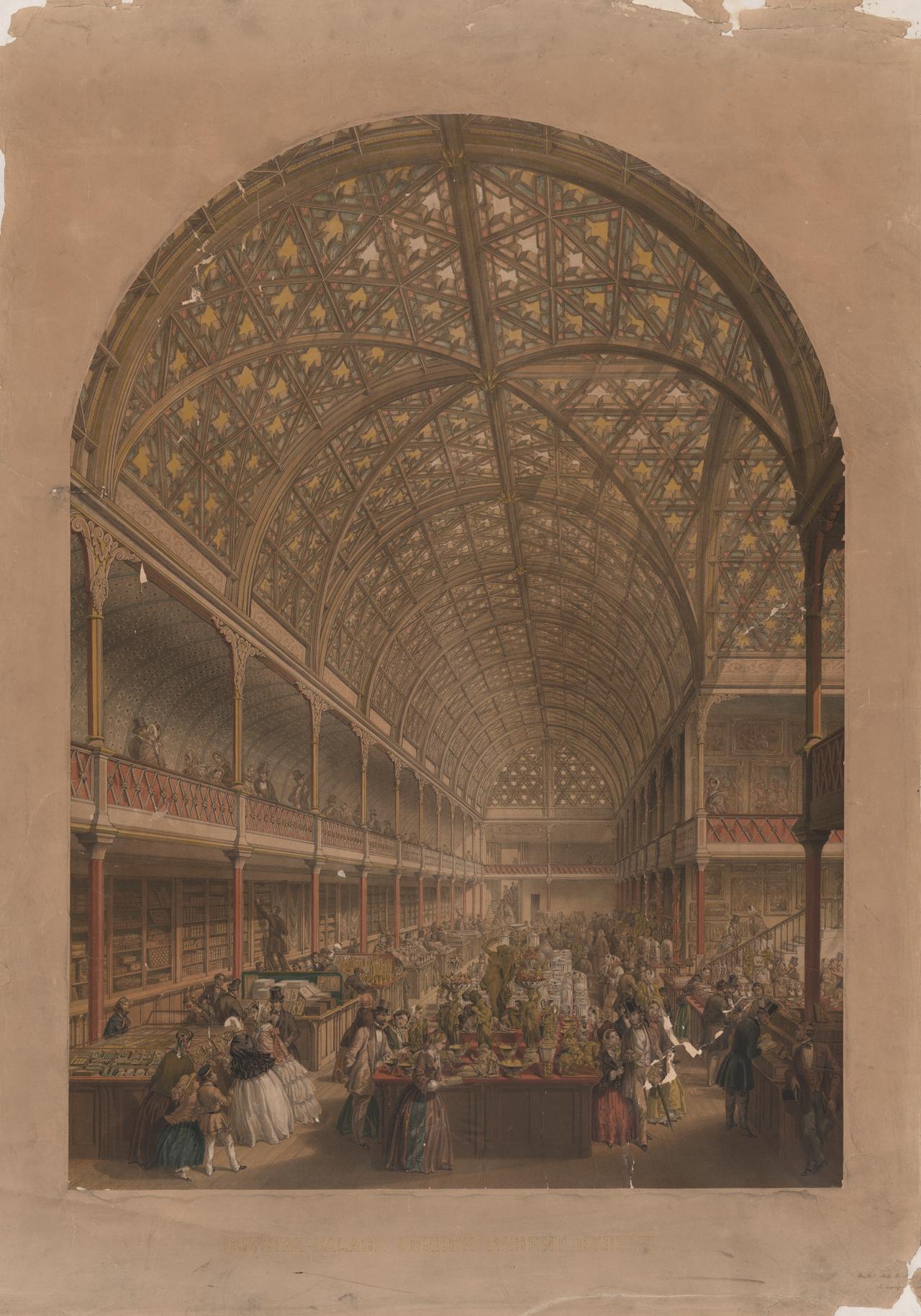
Crystal Palace (rawpixel)
Owen Jones was among the most influential figures in 19th-century decorative art theory. He systematized his views through lectures, articles, and books, including:
Jones’s theory emphasized that ornament preceded architecture and the other arts, that geometric structure was indispensable, and that color played a fundamental role in revealing form. These approaches became part of the foundational principles that shaped modern design education.
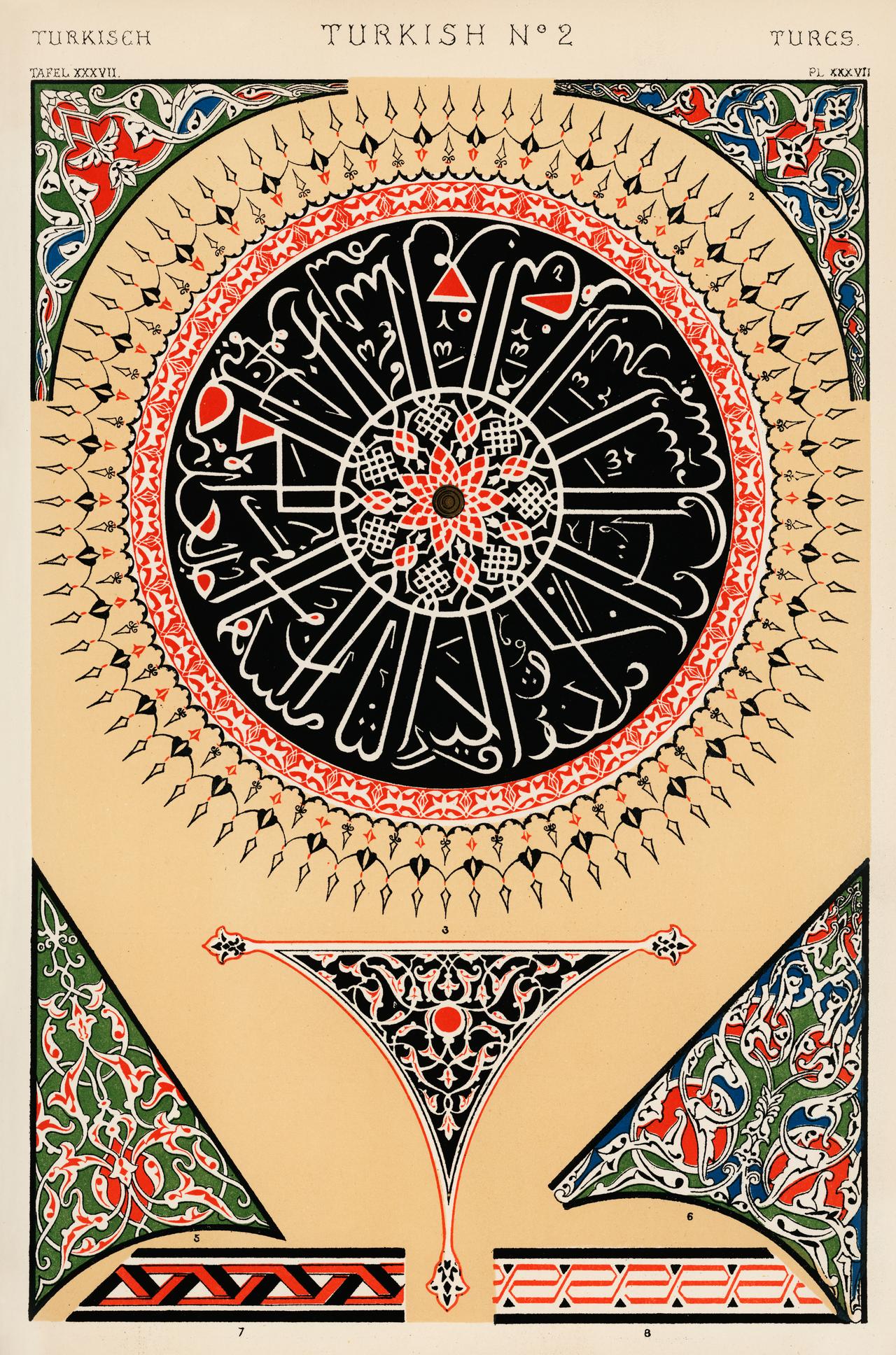
The Grammar of Ornament, Turkish Pattern (rawpixel)
Among his contemporaries, Owen Jones was often mentioned alongside A.W.N. Pugin and John Ruskin; however, unlike them, he opposed the direct imitation of past styles. By asserting that the principles of ornament were universal, Jones sought to lay the groundwork for a new design language suited to his age.
From the time of its publication, The Grammar of Ornament became a foundational resource for design education not only in Britain but also across Europe. For more than a century, the book was kept in the libraries of art schools as a standard reference.
Through students such as Christopher Dresser, Jones’s principles were transmitted to later generations and helped establish the foundations of national art education in Britain. Although his reputation gradually faded as much of his work was lost, his ideas on polychromy, geometric design, and nature-derived ornament strongly influenced both Victorian decoration and subsequent debates on art and style.
Owen Jones died in London on 19 April 1874. With his passing, the prolific body of work he had created as one of the leading architects and designers of his time was largely dispersed. Nevertheless, his theoretical contributions have endured, most notably through The Grammar of Ornament, which continues to shape the study of decorative arts.
AHRnet. “Jones, Owen 1809 - 1874.” Biographical Dictionary of British and Irish Architects 1800-1950. Accessed September 30, 2025. https://architecture.arthistoryresearch.net/architects/jones-owen
Forty, Adrian. “Owen Jones and the V&A (2023) and Style and Solitude (2023) – Review.” DRAWING MATTER. Accessed September 30, 2025. https://drawingmatter.org/owen-jones-and-the-va-2023-and-style-and-solitude-2023-review/
Newton, Charles. “Dresser and Owen Jones.” The Journal of the Decorative Arts Society 1850 - the Present, no. 29 (2005): 30–41. Accessed September 30, 2025. http://www.jstor.org/stable/41809364
NLW. “Owen Jones, Esq., R.A author of "The Alhambra", decorator of the Crystal Palace.” The National Library of Wales. Accessed September 30, 2025. https://viewer.library.wales/4674168#?xywh=-763%2C-463%2C3735%2C3191
Rawpixel. “Crystal palace London Regent Street, [ca. 1851] JPG.” Rawpixel. Accessed September 30, 2025. https://www.rawpixel.com/image/7686837/crystal-palace-london-regent-street-ca-1851
Rawpixel. “Plans, elevations, sections, and details of the Alhambra / from drawings taken on the spot in 1834 by Jules Goury, and in 1834 and 1837 by Owen Jones ; with a complete translation of the Arabic inscriptions, and an historical notice of the kings of Granada from the conquest of that city by the Arabs to the expulsion of the Moors, by Pasqual de Gayangos JPG.” Rawpixel. Accessed September 30, 2025. https://www.rawpixel.com/image/9180345/image-books-art-public-domain
Rawpixel. “Vintage pattern illustration. Digitally enhanced from our own 19th Century Grammar of Ornament book by Owen Jones JPG.” Rawpixel. Accessed September 30, 2025. https://www.rawpixel.com/image/2562/free-illustration-image-mandala-turkish-pattern
Searight, Sarah, and ﺳﻴﺮﺍﻳﺖﺳﺎﺭﺓ. “Owen Jones: Travel and Vision of the Orient / ﺃﻭﻳﻦ ﺟﻮﻧﺰ: ﺍﻟﺮﺣﻠﺔ ﻭﺭﺅﻳﺔ ﺍﻟﺸﺮﻕ.” Alif: Journal of Comparative Poetics, no. 26 (2006): 128–46. Accessed September 30, 2025. http://www.jstor.org/stable/30197946
V&A. “Owen Jones and the Grammar of Ornament.” Victoria and Albert Museum. Accessed September 30, 2025. https://www.vam.ac.uk/articles/owen-jones-and-the-grammar-of-ornament#slideshow=7716019588&slide=0
Born | February 15 1809 | ||||||||
|---|---|---|---|---|---|---|---|---|---|
Died | April 19 1874 | ||||||||
Occupations | Publisher Writer Designer Architect | ||||||||
Education | Royal Academy Schools Apprenticeship with Lewis Vulliamy | ||||||||
Major Travels | Spain Egypt Türkiye Greece Italy | ||||||||
Notable Works | Sydenham 1854) Crystal Palace iç dekorasyonları (1851 St James’s Hall (1858 Londra) Examples of Chinese Ornament (1867) The Grammar of Ornament (1856) Plans Elevations Sections and Details of the Alhambra (1842–1845) | ||||||||
Early Life and Education
Early Travels and First Works
Architectural and Interior Applications
Theory and Publications
Legacy and Influence
Death
This article was created with the support of artificial intelligence.