


This article was automatically translated from the original Turkish version.
Outlier value detection is the process of identifying instances in a data set that differ significantly from other observations. These values often represent rare events measurement errors fraudulent activities or systematic issues arising during data collection. Accurate detection of outliers is critical for the accuracy and generalizability of machine learning models.
Machine learning algorithms particularly statistical methods and regression analyses can be significantly affected by outliers. These values can mislead the model’s learning process introduce bias and ultimately reduce model performance. In particular in small data sets outliers can substantially alter the model’s trend.
These methods identify extreme points based on the distribution of the data and typically operate under the assumption of normal distribution.
Z-score: Measures how far a data point is from the mean in terms of standard deviations.

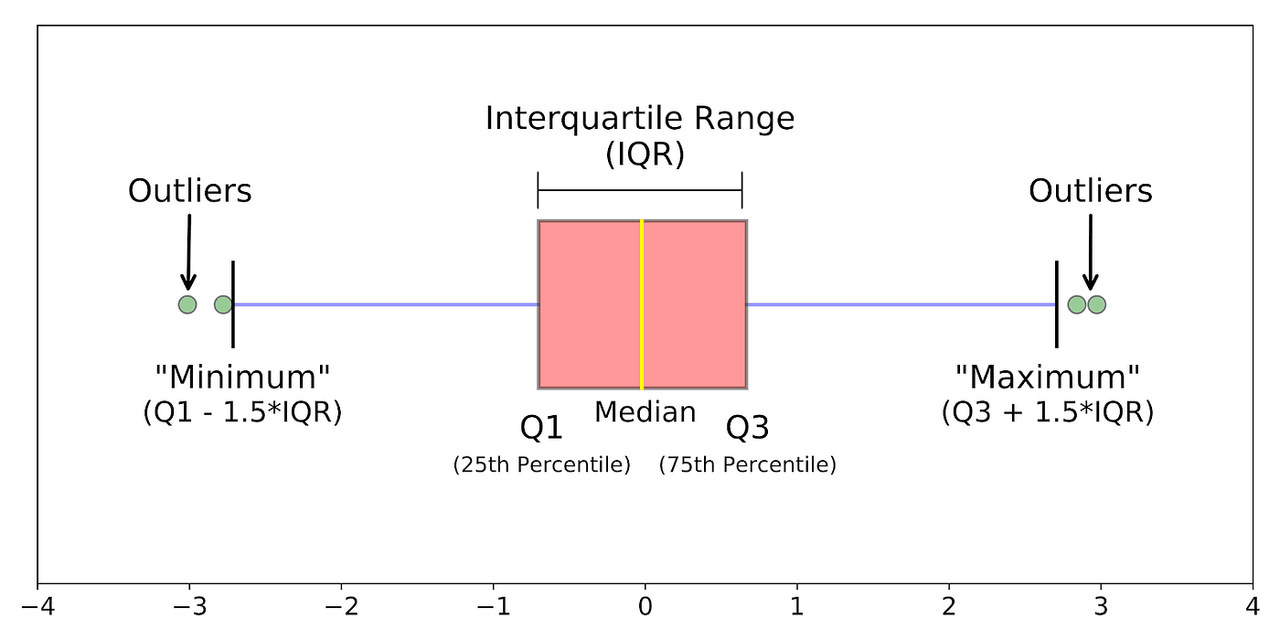
IQR (Interquartile Range): Relies on the distance between quartiles.

IQR Method (Source: )
Isolation Forest: A tree-based algorithm that identifies outliers by isolating them. Outliers can be isolated with fewer partitioning steps than normal points.
One-Class SVM (Support Vector Machine): Commonly used for outlier detection in high-dimensional data. It constructs a model that captures the majority of data points and considers points outside this boundary as outliers.
Autoencoders: These structures operate using deep learning and attempt to reconstruct the input data. Data points that cannot be reconstructed accurately (with high error) are classified as outliers.
DBSCAN (Density-Based Spatial Clustering of Applications with Noise): Marks data points in low-density regions as outliers.
K-means: Points that are far from cluster centers can be considered outliers.
Removal: Outliers can be removed from the data set. However this method is risky if a significant portion of the data consists of outliers.
Transformation: The impact of extreme values can be reduced using methods such as logarithmic transformation.
Correction: Outliers can be investigated to determine their causes and errors in the data source can be corrected.
Separate Modeling: A separate model can be built for outliers for example in fraud detection systems.
Outlier detection is one of the fundamental building blocks for the reliability of machine learning applications. These methods must be carefully applied both to improve model performance and to understand anomalous or rare events in the data. Both classical statistical methods and modern machine learning approaches offer extensive application possibilities in this context.
Aggarwal, Charu C. *Outlier Analysis.* 2nd ed. Cham: Springer, 2017.https://doi.org/10.1007/978-3-319-47578-3
Chandola, Varun, Arindam Banerjee, and Vipin Kumar. “Anomaly Detection: A Survey.” ACM Computing Surveys 41, no. 3 (2009): 1–58.https://doi.org/10.1145/1541880.1541882.
Liu, Fei Tony, Kai Ming Ting, and Zhi-Hua Zhou. “Isolation Forest.” *2008 Eighth IEEE International Conference on Data Mining* (2008): 413–422.https://doi.org/10.1109/ICDM.2008.17.
Schölkopf, Bernhard, John C. Platt, John Shawe-Taylor, Alex J. Smola, and Robert C. Williamson. “Estimating the Support of a High-Dimensional Distribution.” Neural Computation 13, no. 7 (2001): 1443–1471.https://doi.org/10.1162/089976601750264965.

Outlier Detection in Machine Learning
Impact of Outliers
Outlier Detection Methods
Statistical Methods
Machine Learning Based Methods
Density and Clustering Methods
Strategies for Handling Outliers
Application Areas