


This article was automatically translated from the original Turkish version.

Our school, Susurluk Imam Hatip Middle School, located in the Susurluk district of Balıkesir province, formed the SIHO team in February 2025 with inquisitive and research-oriented students. Our team is a middle school-level student group participating in the TEKNOFEST 2025 “Robolig Competition,” developing solutions in the fields of unmanned ground vehicles and wireless communication. As a team, we conduct our work with a focus on digital independence in Türkiye, the use of domestic hardware, and forward-looking technological development. Despite all challenges, we continue to improve ourselves with determination.
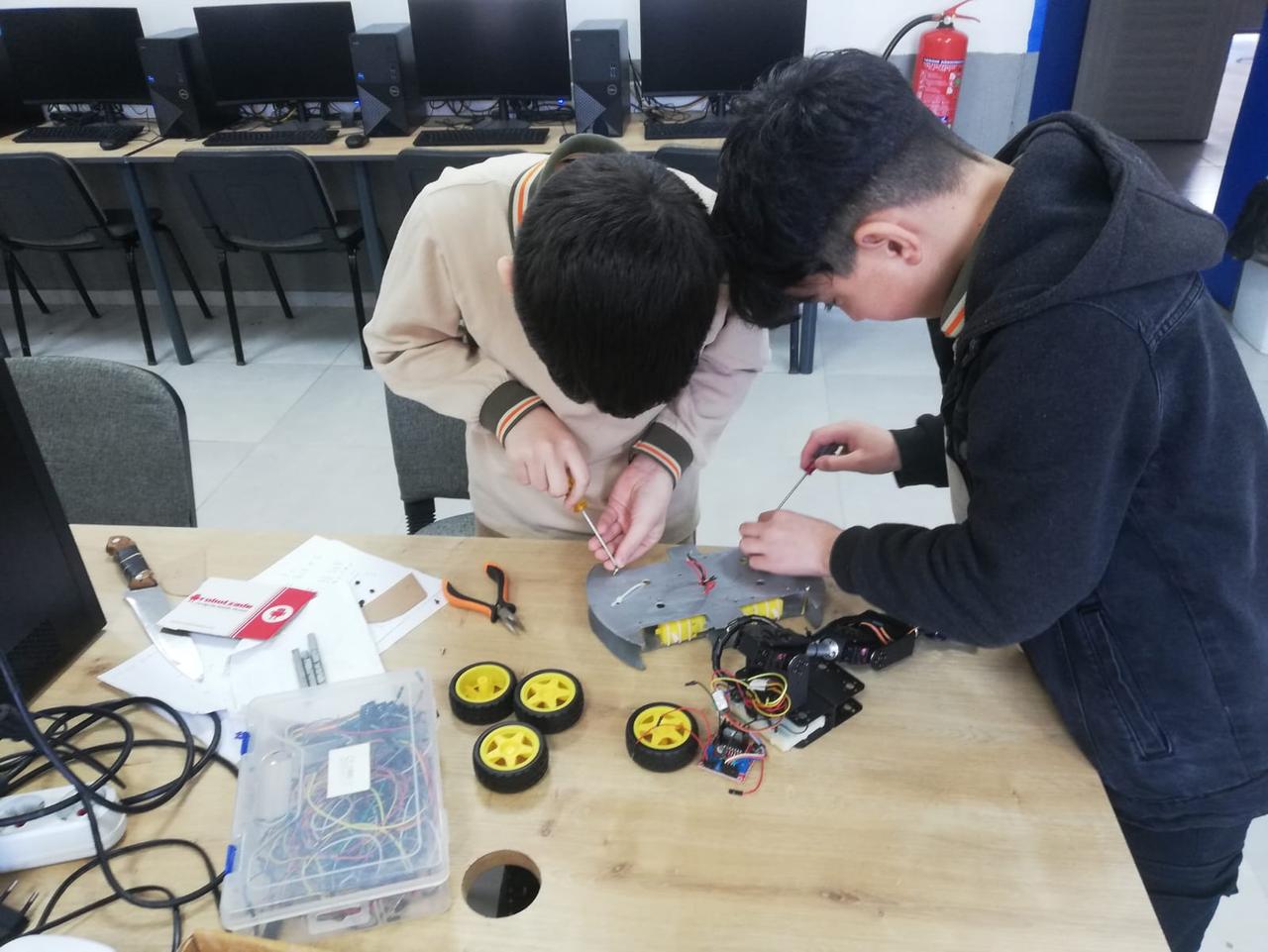
SIHO Team Developing the Project. (Photo: Erkan Bulut)
It all began during lunch break in the cafeteria over simit and ayran. The topic of robots in our Information Technology class suddenly sparked an idea in our minds. “Why don’t we build our own robot?” we asked each other. This idea did not fade away among class notes; instead, it erupted from our hearts, burning with the desire to turn thoughts into reality. We imagined something more than just a conventional remote-controlled car. At that moment, the adventure that started as the “simit and ayran” project quickly became the first step toward the birth of Sihobot.
Once our idea became clear, we immediately gathered for a brainstorming session. Each of us focused on a different aspect of the project. Some of us thought about the robot’s frame, while others considered its brain—that is, its programming. We defined our project’s core objective: a robotic arm mounted on a four-wheeled chassis, controllable via remote control. We wanted to create a magical robot, so we named it Sihobot. Our goal was not merely to build a moving toy but to design a robot capable of overcoming difficult obstacles and manipulating objects with precision. Ideas flew around the room, and every new suggestion only fueled our excitement further.
Our project was a true trial-and-error process. In our first attempts, when we connected the motors incorrectly, Sihobot did not move as intended but seemed to be dancing. Sometimes, due to balance issues with the chassis, the robot would veer unpredictably from one corner of the course to another. These failures never discouraged us. On the contrary, each mistake taught us something new and motivated us to do better. After classes, we met in empty classrooms or at home, assembling parts while writing program code. A motor working properly or a battery staying in place counted as a major achievement for us.
One of the biggest challenges was ensuring the precision of the robotic arm. For the arm to move at the correct angle and pick up and release objects, we needed highly sensitive motors and accurate programming. Initially, the arm’s movements were jerky and uncontrolled. To solve this, we tested different motors and sensors. Another challenge was the delay in communication between the remote control and the robot. Commands sent from the controller sometimes arrived late at the robot. To address this, we optimized the program and successfully minimized the delays.
One of our most unforgettable moments was the day we recorded Sihobot’s first successful movement. When the robotic arm successfully picked up and released an object for the first time, we all jumped for joy. In that moment, all our fatigue and sleepless nights were worth it. Another funny incident occurred during testing when unintended commands caused the robot to suddenly lurch forward and collide with the classroom door. We had no idea what to do at that moment.
Our aim with this project was not simply to build a robot. Our fundamental goal was to apply the theoretical knowledge we learned in class to practical use, understand the importance of teamwork, and experience firsthand how an idea becomes reality. The Sihobot project became a learning platform for us. We learned to celebrate our failures and treat our successes as motivation to achieve even more. In the future, we aim to further develop this robot to make it suitable for robotics competitions or more complex tasks. This project was a solid step toward our future, and we will continue to take that step with passion.
Starting the Journey: An Idea Over a Simit and Ayran
The Decision-Making Process: Ideas Collide
What We Experienced During the Process: Trials, Errors, and Successes
Challenges We Faced: Puzzles to Solve
Interesting and Funny Moments
Our Goal: A Step Toward the Future