This article was automatically translated from the original Turkish version.
+1 More
Binomial Name | Anthocharis cardamines | ||||||||
|---|---|---|---|---|---|---|---|---|---|
Team(s) | Lepidoptera | ||||||||
Family | Pieridae | ||||||||
Genus | Anthocharis | ||||||||
Kingdom(s) | Animalia | ||||||||
Phylum | Arthropoda | ||||||||
Class | Insecta | ||||||||
Conservation Status | Least Concern (LC) | ||||||||
Orange-tip (Anthocharis cardamines) is a species belonging to the family Pieridae (white butterflies) within the order Lepidoptera (butterflies and moths). Its scientific name was established by Carl Linnaeus in 1758. Taxonomically, it is classified within the kingdom Animalia, phylum Arthropoda, class Insecta, and order Lepidoptera.
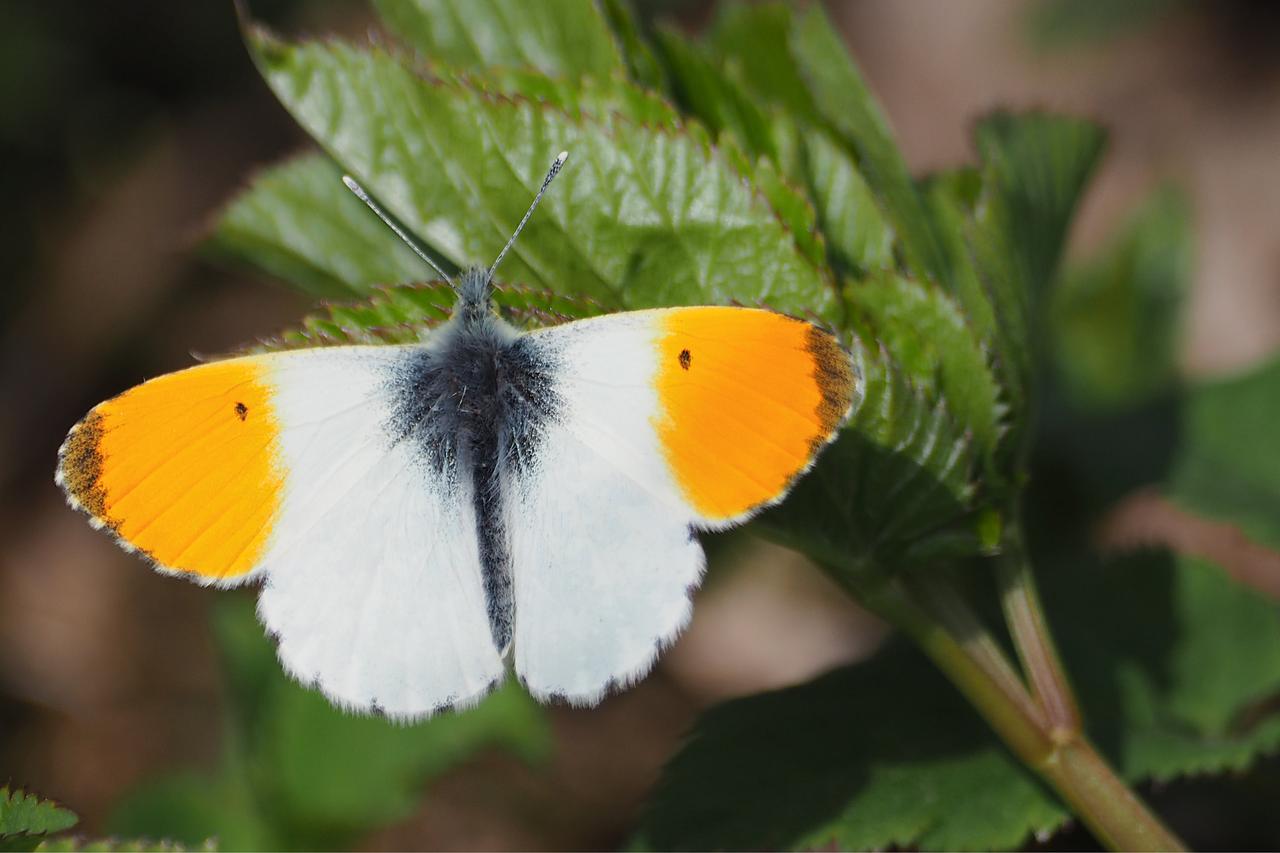
Anthocharis cardamines is a species exhibiting pronounced sexual dimorphism. Male individuals have a distinctive orange patch on the outer margins of their forewings, which gives the butterfly its common name; the remainder of the wings is white. Females lack this orange patch; instead, their forewing tips display dark black or grey markings, and their wing coloration ranges from cream to white. Both sexes have undersides of their hindwings with a mottled green and white camouflage pattern that provides protection from predators when the butterfly is at rest.
The orange-tip is typically a univoltine species, completing its flight period in the spring months. Throughout its life cycle, its larvae feed on a variety of plant species, adopting a polyphagous diet. The primary food sources for the larvae are plants from the family Brassicaceae (cabbages), especially Cuckooflower (Cardamine pratensis) and Garlic Mustard (Alliaria petiolata). The butterfly inhabits a range of habitats with moist and rich vegetation, including meadows, woodland edges, riverbanks, grasslands, and gardens.
The spring flight period, during which reproductive activity peaks, shows high phenological sensitivity to environmental factors such as temperature fluctuations. This sensitivity carries the risk of disrupted synchrony between egg-laying and the flowering of host plants under conditions of climate change. A. cardamines overwinters in the pupal (chrysalis) stage, remaining inactive until the following spring.
Due to its wide geographic distribution and generally stable populations, Anthocharis cardamines is classified as Least Concern on the IUCN Red List in Europe.
AdaMerOs-Kelebek Türkiye. "Papilio machaon Linnaeus, 1758." *Adam Erke Kelebek.* Accessed October 21, 2025. http://www.adamerkelebek.org/IcerikDetay.asp?IcerikKatId=9&TurId=37
Ebdon, Sam, Gertjan Bisschop, Konrad Lohse, Ilik Saccheri, and James Davies. “The Genome Sequence of the Orange-Tip Butterfly, Anthocharis cardamines (Linnaeus, 1758).” Wellcome Open Research 7, no. 260 (2022): 1–13. Accessed October 28, 2025. https://pmc.ncbi.nlm.nih.gov/articles/PMC9643846/pdf/wellcomeopenres-7-20088.pdf
Mueller, Michael. "Aurorafalter JPG." Flickr. Accessed October 21, 2025. https://flic.kr/p/2ebD6JP

Binomial Name | Anthocharis cardamines | ||||||||
|---|---|---|---|---|---|---|---|---|---|
Team(s) | Lepidoptera | ||||||||
Family | Pieridae | ||||||||
Genus | Anthocharis | ||||||||
Kingdom(s) | Animalia | ||||||||
Phylum | Arthropoda | ||||||||
Class | Insecta | ||||||||
Conservation Status | Least Concern (LC) | ||||||||
No Discussion Added Yet
Start discussion for "Orange Tip (Anthocharis cardamines)" article
Morphological Characteristics
Ecology and Diet
Reproduction and Phenology
Conservation Status