


This article was automatically translated from the original Turkish version.

The rise of open-source artificial intelligence models has become one of the most important debates in the digital world. On one hand, institutions such as Meta, Mistral, and EleutherAI advocate for democratizing AI research by making increasingly powerful models accessible to everyone; on the other, security experts argue that this approach could create an uncontrolled technological environment that puts individuals, institutions, and even states at risk. This dilemma presents itself not merely as a technical decision but as a multi-layered issue caught between freedom, innovation, security, and global power balances.
The open-source movement has long been the fundamental driving force behind freedom, collaboration, and progress in the software world. Yet today’s debate is not about ordinary software; it concerns artificial intelligence models with millions of parameters capable of performing complex tasks in natural language, conducting analysis, and possessing advanced generative capabilities. Making these models openly available means granting people access to tools more powerful than any previously seen in history. While this presents a tremendous opportunity for innovation, it also increases the potential for misuse.
On one side stands transparency and accessibility; on the other, security and control. The debate sharpens precisely at this point. Advocates of open-source AI argue that the best way to prevent the monopolization of knowledge and technology is through open models. They contend that concentrating powerful AI tools in the hands of only a few large corporations could, in the long term, slow both economic and scientific progress. Openness is the natural dynamic of innovation. An ecosystem where everyone can contribute increases competition and reduces dependencies.
Yet the security side is far more cautious. The more advanced an AI model becomes, the greater its potential for misuse. A wide spectrum of risks emerges, ranging from generating instructions for biological threats, automating cyberattacks, producing flawless propaganda content, to manipulating personal data. For this reason, some researchers view “open AI” not as unlimited freedom but as unlimited risk.
Today, Meta’s LLaMA models, Mistral AI’s high-performance open models, and community-driven projects are leading the way in bringing powerful AI tools outside closed ecosystems. Meanwhile, institutions such as OpenAI, Google DeepMind, and Anthropic argue that powerful models should only be distributed under controlled conditions. This approach raises a fundamental question: “Should closed systems be preferred for security, or openness for innovation?”
At the heart of this debate lies a much deeper issue: Who will control artificial intelligence?
This question has become one of the key determinants of technology policy, global competition, and societal transformation. Open-source models can help distribute technological power more broadly; yet if misdirected, they can also sustain structures that exploit that same power.
In this article, we will examine in depth the rise of open-source AI, the contradictions arising between freedom and security, its economic and geopolitical impacts, corporate strategies, and possible futures. Are we truly moving toward a more democratic technology, or are we building an uncontrollable risk zone?
Open-source artificial intelligence is based on the principle of sharing model weights, training code, or usage capabilities with the public. This sharing enables researchers and developers to examine, retrain, improve, and deploy these models in real-world applications. The open-source approach aims to increase transparency in AI and prevent the concentration of knowledge and technology within a narrow circle.
This idea traces its roots to the open-source movement in software. Projects such as Linux, Apache, and Python enabled technology to spread rapidly worldwide and fostered innovation through collective effort. In AI, this approach emerged later because modern models require far greater complexity and massive amounts of data and computational power. Nevertheless, research communities laid the first foundations of open-source AI from the second half of the 2010s onward.
One turning point in its acceleration was the development of the “GPT-Neo” and “GPT-J” models by the EleutherAI community. Intended as an alternative to OpenAI’s closed GPT-3 model, this initiative revealed the transformative power of the open-source ecosystem. Subsequently, Stability AI’s public release of the Stable Diffusion model created a major breakthrough in generative AI. Opening visual generation to everyone rapidly transformed both creative industries and ethical debates.
Today, the most significant momentum has come from Meta’s LLaMA models. By releasing high-performance language models under open-source licenses, Meta provided researchers and developers with a broad playing field. The LLaMA series drew attention not only for its technical success but also for demonstrating how powerful open-source approaches can be. This step encouraged new players like Mistral AI to develop even more ambitious open models.
In a short time, open-source AI has moved beyond being merely an academic ideal to becoming a strategic element at the center of the global technology race. For many countries, companies, and researchers, these models have begun to play a decisive role in both economic competition and digital sovereignty. At this point, open-source AI carries a dual character: it is both a force that increases technological diversity and a structure that complicates oversight.
The open-source AI ecosystem has grown at an extraordinary pace in recent years. This growth has been driven not only by technology companies but also by independent researchers, communities, and state-backed initiatives. The most striking feature of this ecosystem is the convergence of actors with different motivations: some embrace open-source strategies to accelerate innovation, others to gain competitive advantage, and still others to support the democratization of AI.
The strongest driving force in this ecosystem is Meta, formerly known as Facebook. Meta’s LLaMA models have significantly lowered barriers to accessing large language models. The release of an open-source version of these models during a period dominated by closed systems triggered a major shift within the research community. Another impact of the LLaMA series was its requirement for far less computational power to run powerful language models. This enabled even small teams and independent developers to build advanced AI applications.
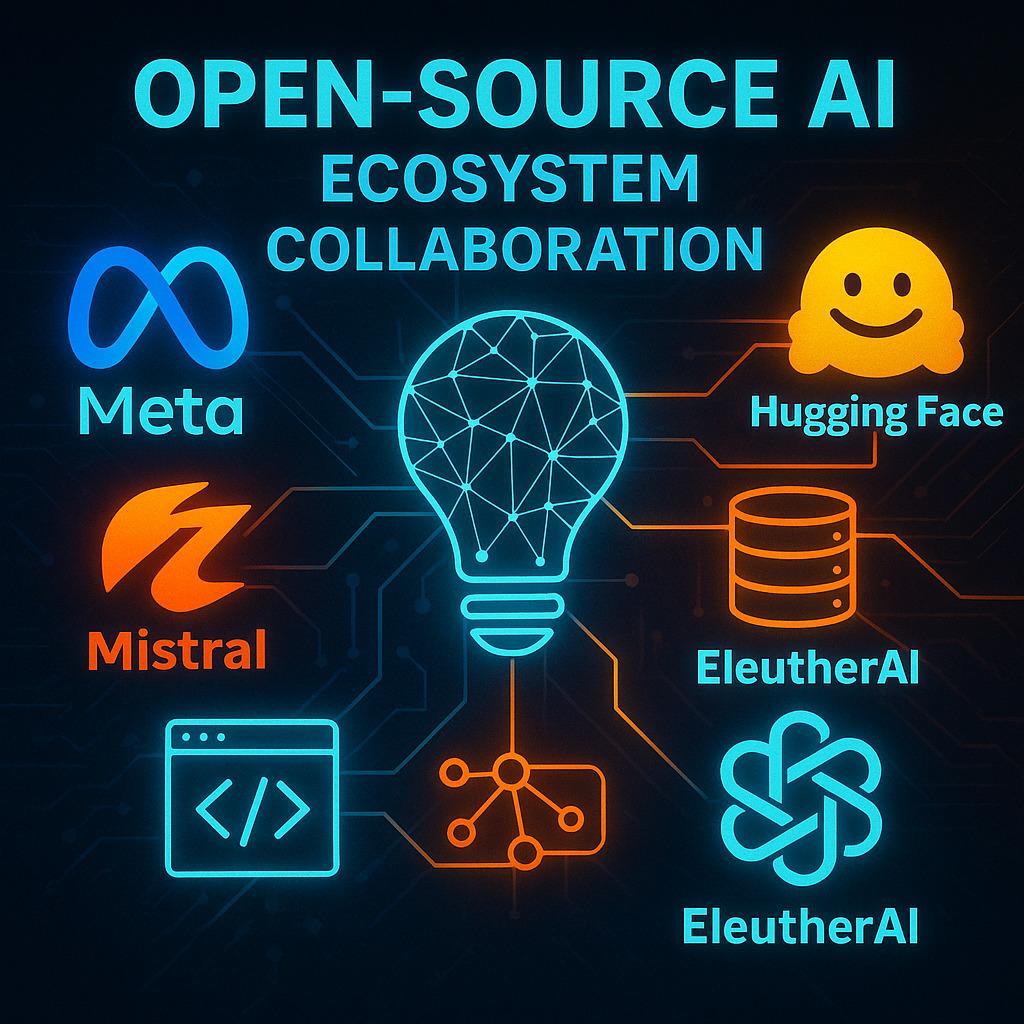
Depiction of AI Systems (Generated by AI)
One of the rising actors in the ecosystem is also Mistral AI. This Paris-based company quickly gained global attention by releasing open models capable of competing with major players in performance. Mistral’s strategy is built on offering open-source modules while simultaneously developing commercially strong and efficient models. This hybrid approach helped the company rapidly build a wide user base.
HuggingFace has become the backbone of the open-source AI ecosystem. The platform provides a community space enabling the sharing of thousands of models, datasets, and training tools. Researchers, developers, and companies can both publish their own models and benefit from others’ work. HuggingFace is no longer merely a distribution platform in open AI; it has evolved into a central hub for setting standards and enabling collaboration.
EleutherAI, rooted in the origins of this ecosystem, still plays a vital role. As a community-based organization, EleutherAI has developed alternative systems arguing that large language models should not remain in the hands of only big corporations. Models such as GPT-Neo, GPT-J, and GPT-NeoX formed the foundation of the first major breakthroughs in open-source AI.
This broad ecosystem has also become influential in state strategies. Many countries are integrating open-source models into their national AI projects to reduce costs and decrease external dependencies. In particular, developing nations view open-source AI as a means to reduce technological inequality.
Yet this growth brings new questions to the forefront. As the ecosystem strengthens, it may accelerate the democratization of AI but also weaken oversight mechanisms. The accessibility and modifiability of open models are not only factors that empower them but also turn them into risk elements.
The strongest defense of open-source AI lies in its ability to democratize technology. Concentrating large language models under the control of only a few tech giants carries the risk of slowing scientific progress and centralizing power. Open models offer an alternative by making AI research accessible to a much broader community.
One of the core pillars of the open-source ecosystem is the acceleration of innovation through sharing. In closed systems, researchers cannot fully understand how models operate, making it impossible to analyze advanced algorithms or produce alternatives. Open-source models, by making their architecture, weights, and training methodologies accessible to all, enable collective scientific advancement. This is a significant advantage for small teams, independent researchers, and universities.
Another point is the reduction of economic inequality. Accessing large language models can be costly and difficult in developing countries. Open-source models facilitate these nations’ participation in digital transformation, making the global innovation network more inclusive. The impact of open-source models is especially strong in fields such as natural language processing, health technologies, educational applications, and public services. Enabling not only large corporations but also local startups and academic researchers to access powerful AI tools increases economic diversity.
Moreover, open-source AI offers a critical advantage in terms of transparency and accountability. In closed systems, it is often impossible to understand how a model makes decisions. This becomes a major problem when bias, injustice, or erroneous decisions occur. In open models, researchers can directly examine the system’s internal structure, detect errors, and conduct ethical evaluations. Openness also creates important opportunities for security audits because more eyes uncover more potential issues.
Community-based development is another of the strongest aspects of open models. Platforms like HuggingFace enable thousands of developers to collaborate, refine models, add new capabilities, and build a shared knowledge base. Such collective effort generates a far wider field of innovation than any single company could provide.
In short, open-source AI is seen as one of the foundational pillars of freedom, collaboration, and scientific progress. According to its advocates, the technological future will be fairer and more innovative if powerful AI develops not behind closed doors but within a structure where all segments of society can contribute.
Alongside the advantages of freedom and innovation offered by open-source AI, serious security concerns exist. Critics argue that making these models publicly available provides not only creative developers but also malicious actors with extremely powerful tools. The more capable language models become, the more numerous and diverse their misuse scenarios grow.
The foremost risk is the generation of harmful content. Advanced models can rapidly produce propaganda texts, generate fake news designed to manipulate audiences, and even automatically replicate content targeting specific social groups. The ease with which open-source models can be modified makes such use cases even more dangerous because limiting security layers can be removed and the model can be “customized” to desired ends.
More technical risks concentrate in the field of cybersecurity. Some open models can unintentionally guide users in generating malicious code, writing phishing emails, or creating automated attack tools. Such capabilities open new attack vectors for experienced hackers while enabling individuals with limited technical knowledge to carry out more sophisticated attacks. In closed models, strong filters and behavioral constraints mitigate such threats; in open-source models, these safeguards can be easily disabled.
One of the most controversial areas is biological threat scenarios. Advanced language models have the potential to generate dangerous information in biotechnology. The free availability of open models means such knowledge could be accessed by broad audiences without proper oversight. These risks are prompting many scientists and government officials worldwide to adopt a more cautious stance on open-source AI.
Another dimension of these security concerns lies in scalability and speed of development. Because open-source models are accessible to hundreds of thousands of developers globally, they can generate uncontrolled proliferation. A model initially possessing limited capabilities can quickly be improved, expanded, or repurposed for more dangerous goals by the community. This situation makes technological control more difficult and hinders regulatory institutions from keeping pace with the rapidly evolving environment.
Finally, the widespread adoption of open models exposes the lack of global coordination. Different countries adopt varying policies on open AI, and the absence of international standards creates legal uncertainty. A model deemed security-threatening in one country may be freely released in another. This asymmetry facilitates the cross-border spread of risks.
From a security perspective, open-source AI is a power without boundaries and rapidly evolving. While advocates see it as the foundation of freedom, critics argue it exposes societies to serious threats through an uncontrolled technological momentum. Thus, the core of the debate is not “the power of technology” but how this power should be managed and constrained.
Beyond their technical and ethical dimensions, open-source AI debates carry significant economic and geopolitical impacts. In recent years, AI has become central to nations’ digital sovereignty strategies. Consequently, open-source models have become a strategic element affecting not only developers but also states, corporations, and global power balances.
Economically, open-source models enable broader adoption of AI technologies. Small and medium enterprises, graduate students, independent researchers, and new startups can work with open-source models instead of relying on expensive closed systems. This encourages local economic growth and prevents innovation from becoming concentrated in a few major companies. In particular, developing countries view open-source AI as a crucial opportunity to reduce economic inequality.
Yet its geopolitical dimension is more complex. Open-source AI models have not only democratized technology but also become part of international power struggles. The technology competition between the United States and China spans many areas, from chip production to data policies, and open-source models play a critical role in this rivalry. The release of open models by U.S.-based companies may contribute to global technology standards shifting toward a U.S.-centric structure. Meanwhile, China prefers a more centralized and state-controlled AI ecosystem, leading to a more cautious reception of open-source models within its borders.
The European Union holds a different perspective. The EU emphasizes strict regulations in AI to prioritize security and ethical standards. At the same time, acknowledging that open-source models support innovation, the EU seeks a more balanced approach. Many European universities and state-funded research centers view open-source AI as part of their national digital strategies.
Open-source models are directly linked to the concept of digital sovereignty. For a country to develop models in its own language, using its own datasets, and aligned with its cultural context, open-source is a vital tool. Relying on closed models can make nations economically and technologically dependent. Open models, by contrast, offer much greater flexibility for localization, customization, and integration into national infrastructures.
Another geopolitical impact of open-source models emerges in technology transfer. In closed systems, technology transfer is extremely limited; open-source models, however, enable any actor with sufficient computing power and datasets to access powerful AI tools. This can affect global power balances both positively and negatively. While it accelerates the spread of innovation, it also allows powerful technologies to be adapted by diverse actors without control.
In conclusion, open-source AI is a tool that enhances economic dynamism, democratizes access to technology, and shapes debates on national sovereignty. Yet it is also a technology caught in global power struggles and met with varying security policies across countries. Therefore, the future of open-source models will be determined not only by corporate strategies but also by the geopolitical calculations of states.
At the heart of debates surrounding open-source AI lies an ethical dilemma: the conflict between openness for societal benefit and restriction for societal security. These two principles represent different approaches and values regarding how AI technology should be developed and distributed.
Proponents of openness argue that making knowledge and technology freely available will make societies more free, innovative, and democratic. They contend that concentrating powerful AI tools in the hands of only a few corporations could create a “power monopoly.” This monopolization leads to ethical risks such as lack of transparency, accountability issues, and societal dependency. Open models reduce these risks and ensure technology is shared more fairly.
However, open models also have ethically problematic aspects. The primary concern is that malicious actors can easily access these technologies. Open models allow security filters to be removed or manipulated, potentially enabling harmful applications such as fraud, disinformation, cyberattacks, and biological threats. For this reason, some ethicists argue that the principle of “openness for all” can, under certain conditions, become “danger for all.”
Another debate centers on inequality and power distribution. While open-source advocates claim that making models accessible to all reduces inequality, critics argue that granting equal access to those who benefit from technology and those who misuse it can produce unjust outcomes. Some ethical frameworks therefore propose “criteria-based openness”: not everyone has unrestricted access, but trusted researchers, institutions, and communities may gain access if they meet specific conditions.
Closed models, however, are not ethically flawless either. Closed AI systems carry significant problems such as lack of transparency and unaccountability. When it is unknown how a model operates, which data it was trained on, or how errors are corrected, it can produce harmful or discriminatory outcomes, causing societal damage. Openness advocates argue that closed systems intensify technological elitism and knowledge monopolization.
At the center of this ethical dilemma lies this question:
“Where lies greater societal benefit: in openness or in security?”
There is no single correct answer to this question. The benefits of openness are valuable in terms of knowledge sharing and innovation; yet security concerns, especially regarding critical technologies, cannot be ignored. For this reason, many experts advocate hybrid models that combine both approaches: models are neither fully closed nor completely unrestricted; instead, controlled openness is achieved through ethical and technical mechanisms ensuring security, transparency, and accountability.
This ethical debate will become even more complex as the open-source AI ecosystem grows. Public perceptions of technology, state policies, corporate strategies, and research community demands will be the key factors determining how this dilemma is resolved in the future.
Open-source AI sits at the center of one of the most critical debates shaping the future of technology. On one side are major advantages: democratizing access to information, accelerating innovation, and enabling even small communities to access powerful AI tools. On the other side are serious risks: misuse, security vulnerabilities, biological and digital threats, generation of misleading content, and loss of global control. The balance struck between these two extremes will reshape not only the technology sector but also the economy, politics, security policies, and social structures in the coming years.
The open-source ecosystem continues to grow. Meta’s LLaMA models, Mistral AI’s high-performance open systems, and HuggingFace’s global community demonstrate that advanced AI can progress not only through major corporations but through contributions from everyone. In contrast, institutions such as OpenAI, Google DeepMind, and Anthropic advocate a more controlled and security-focused closed approach to mitigate risks. These differing approaches reveal that a clear global consensus on AI’s future has yet to emerge.
The approach that will succeed in the future will likely emerge somewhere between these two extremes. Unrestricted openness may create serious security threats; fully closed systems may slow innovation and concentrate power in the hands of a few corporations. Therefore, a shared view among AI experts, policymakers, and diverse segments of society is that controlled openness offers a more sustainable path. This approach requires establishing ethical and technical governance mechanisms that determine who, how, and under what conditions models are made accessible.
In conclusion, open-source AI is not merely a technical debate; it is a civilizational choice, a societal vision, and a security strategy. The decisions made here are so significant that they will affect the future of everyone who develops and uses technology. The fragile balance between the benefits of openness and the needs of security is a process that must be thoughtfully considered and carefully managed from today onward.
Who will maintain this balance in the world of tomorrow: states, corporations, or global communities?
The answer to this question is not yet clear. But one thing is certain: open-source AI will remain the most powerful debate shaping the direction of technology, and the decisions it influences will directly determine humanity’s future.
Bai, Yuntao, et al. "Constitutional AI: Harmlessness from AI Feedback." *arXiv* (2022). Accessed February 19, 2026. https://arxiv.org/abs/2212.08073
Floridi, Luciano, and Massimo Chiriatti. "GPT-3: Its Nature, Scope, Limits, and Consequences." *Minds and Machines* 30, no. 4 (2020): 681–694. Accessed February 19, 2026. https://link.springer.com/content/pdf/10.1007/s11023-020-09548-1.pdf
Jiang, Albert Q., et al. "Mistral 7B." *arXiv* (2023). Accessed February 19, 2026. https://arxiv.org/abs/2310.06825.
Scao, Teven Le, et al. "BLOOM: A 176B-Parameter Open-Access Multilingual Language Model." *arXiv* (2022). Accessed February 19, 2026. https://arxiv.org/abs/2211.05100
Touvron, Hugo, et al. "LLaMA: Open and Efficient Foundation Language Models." *arXiv* (2023). Accessed February 19, 2026. https://arxiv.org/abs/2302.13971
UNESCO. "Recommendation on the Ethics of Artificial Intelligence." 2021. Accessed February 19, 2026. https://www.unesco.org/en/artificial-intelligence/ethics
What Is Open-Source Artificial Intelligence? A Brief History
The Open-Source Ecosystem: Meta, Mistral, HuggingFace, and Others
The Freedom Argument: Why Are Open-Source Models So Important?
The Security Risk Argument: Uncontrolled Power, Misuse, and Regulation Challenges
Economic and Geopolitical Dimensions: Global Competition, State Policies, and Digital Sovereignty
The Ethical Dilemma: Openness or Security?
Assessment: Seeking Balance in the Open AI Debate