This article was automatically translated from the original Turkish version.
+2 More
Location | Şanlıurfa Türkiye | ||||||||
|---|---|---|---|---|---|---|---|---|---|
First Construction | Early Islamic structure | ||||||||
Repair | 1191, repaired by Saladin | ||||||||
Material(s) | Stone | ||||||||
Historical Significance | An urban example of early Islamic architecture with a multilayered architectural fabric | ||||||||
Eski Ömeriye Camii is one of the religious structures located in the urban center of Şanlıurfa and holds an important place within the city’s historical mosque fabric. In terms of its plan characteristics and architectural composition, the structure is classified among the centrally planned mosques of Şanlıurfa and represents an example reflecting Ottoman-period mosque architecture in the region.
The exact construction date of Eski Ömeriye Camii is not known with certainty, but the building belongs to the group of mosques that took shape during the Ottoman period. Due to the absence of an inscriptive plaque, no direct date can be assigned to its construction. This common condition among Şanlıurfa’s mosques has led to the evaluation of many buildings’ construction dates through endowment documents and indirect historical sources. The structure has survived to the present day thanks to various repairs carried out in different periods. During these restoration works, the mosque’s original plan scheme was largely preserved, ensuring its functional continuity.
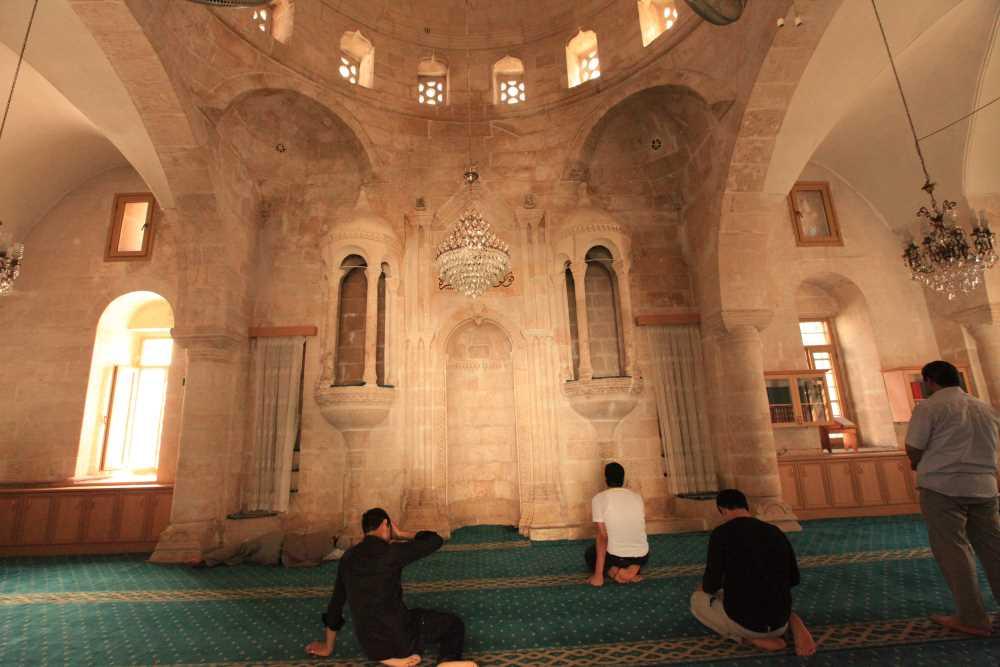
Eski Ömeriye Camii belongs to the group of mosques in which the central dome is extended laterally. It exhibits a centrally planned architectural concept, in which the main prayer space is covered by a central dome and supported by spaces extending from its sides. This plan type is one of the most frequently chosen schemes in Ottoman-period mosque architecture in Şanlıurfa.
In the wall masonry and roofing system of the mosque, limestone—commonly used in Şanlıurfa’s mosques—has been preferred. Known locally as “Urfa stone,” this material has been used as a building material in the region for many years due to its durability and ease of workability.
The prayer space presents a unified interior experience through its arrangement centered under the main dome. Lighting is provided through window openings in the walls, enabling balanced natural illumination of the space. Interior elements such as the mihrab, minbar, and müezzin mahfili are designed with the simple aesthetic commonly found in Şanlıurfa mosques. Decorative elements have been kept to a minimum, with functionality prioritized.
Decorative elements have been applied only to a limited extent in Eski Ömeriye Camii. The modest architectural style typical of Şanlıurfa’s mosques is also evident here. There is no use of tile decoration or elaborate stone carving. This reflects the mosque’s architectural conception, which emphasizes its function as a place of worship rather than monumental expression.
Accessed December 12, 2025.
Kürkçüoğlu, A. Cihat. “Şanlıurfa Camileri.” ŞURKAV. Accessed December 13, 2025. https://files.surkav.org.tr/urfa_camileri.pdf.
T.C. Kültür ve Turizm Bakanlığı. "Eski Ömeriye Camii - Şanlıurfa," Kültür Portalı.
T.C.Şanlıurfa Büyükşehir Municipality. "Şanlıurfa Kültür ve Turizmi." Şanlıurfa Metropolitan Municipality Official Website. Accessed December 13, 2025. https://www.sanliurfa.bel.tr/icerik/68/621/sanliurfa-kultur-ve-turizmi
Location | Şanlıurfa Türkiye | ||||||||
|---|---|---|---|---|---|---|---|---|---|
First Construction | Early Islamic structure | ||||||||
Repair | 1191, repaired by Saladin | ||||||||
Material(s) | Stone | ||||||||
Historical Significance | An urban example of early Islamic architecture with a multilayered architectural fabric | ||||||||
History
Architectural Features
Interior Spatial Organization
Decorative Approach