This article was automatically translated from the original Turkish version.
+2 More
Name | North American B-25 Mitchell | ||||||||
|---|---|---|---|---|---|---|---|---|---|
Category | Medium Bomber | ||||||||
Origin | USA (North American Aviation) | ||||||||
Engine | 2 x Wright R-2600-92 Twin Cyclone radial engines | ||||||||
First Flight | 19 August 1940 | ||||||||
Crew | 5-6 | ||||||||
Length | 16.1 m | ||||||||
Wingspan | 20.6 m | ||||||||
Maximum Speed | 443 km/h | ||||||||
Maximum Takeoff Weight | 11700 kg | ||||||||
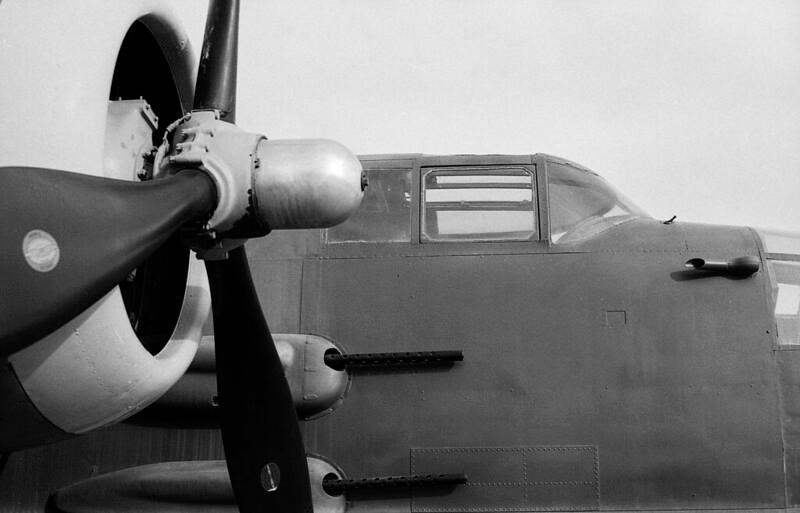
North American B-25 Mitchell, an American aviation pioneer General William "Billy" Mitchell, is a twin-engine medium bomber used by the Allies during the Second World War. Operating on every front of the war, the B-25 earned a reputation as a "versatile" and "reliable" platform due to its wide range of roles, evolving from its original level bombing mission to heavily armed ground attack gunship configurations. Nearly 10,000 units (9,816 delivered to the USAAF) of the B-25 were produced by North American Aviation (NAA) by the end of the war.
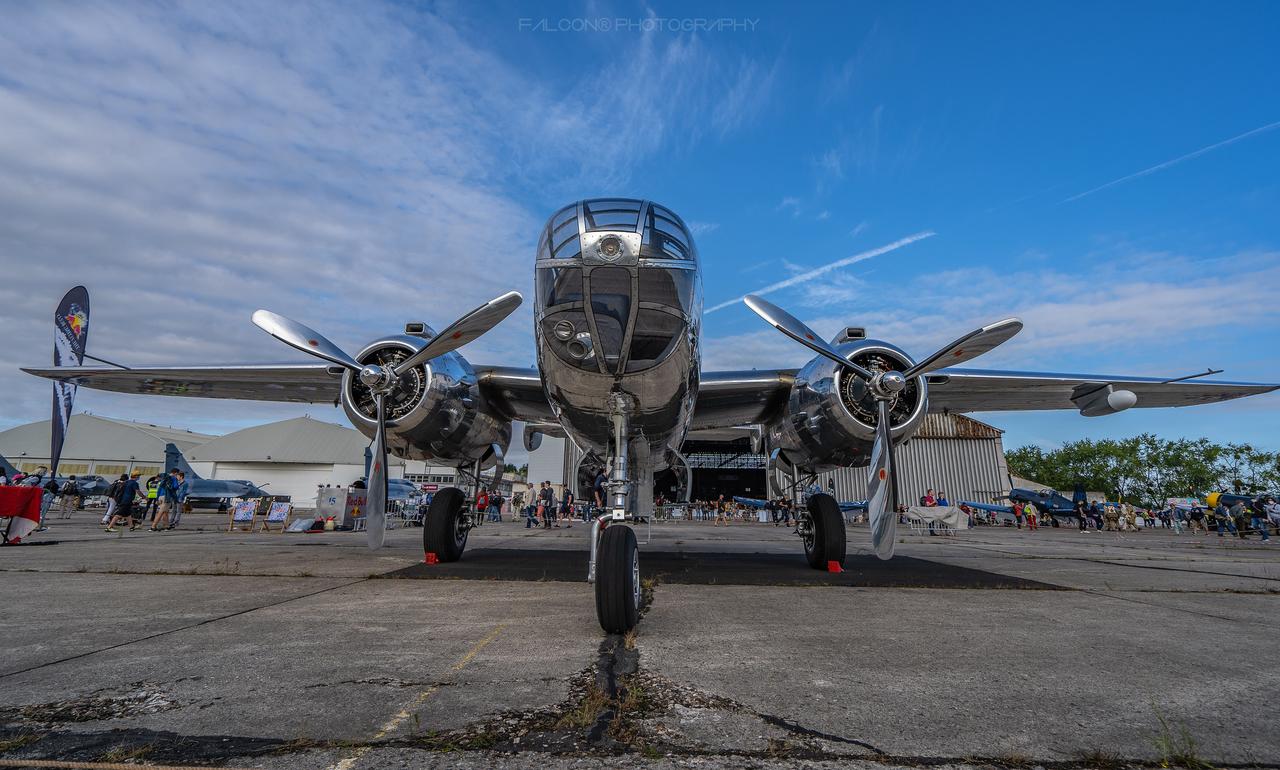
North American B-25 Mitchell (Flickr)
The design of the B-25 began in 1939 in response to a United States Army Air Forces requirement for a medium bomber capable of carrying a 3,000 lb bomb load, flying at 300 mph, and achieving a 2,000 mile range. The first prototype flew in August 1940.
B-25 Mitchell Grumpy (Fight to Fly Studio)
The B-25 is renowned for its ruggedness and high power-to-weight ratio, which enabled effective performance at low altitudes and in demanding conditions.
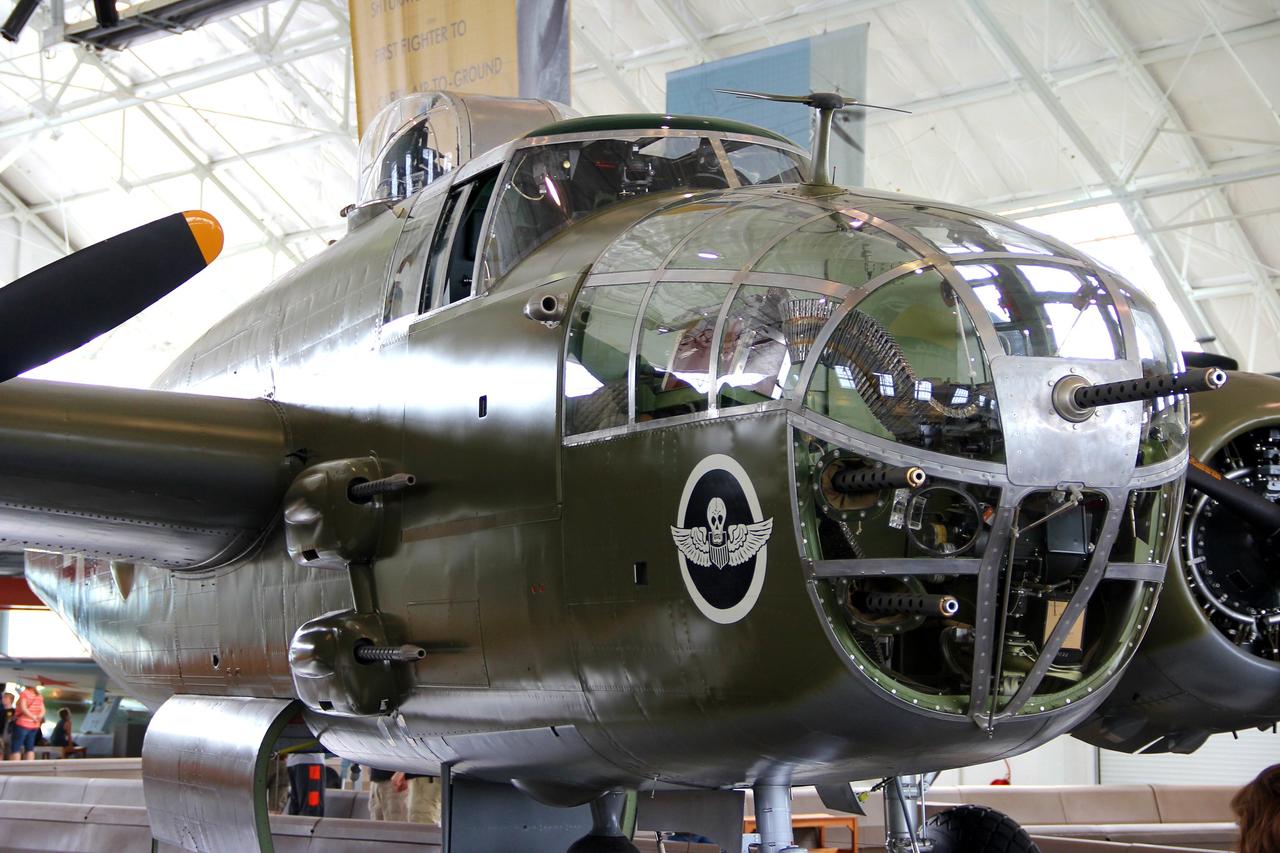
North American B-25 Mitchell (Flickr)
The B-25 was deployed across major theaters of war, from the Pacific to the Mediterranean and the China-Burma-India theater.
The variants of the B-25 continuously enhanced its attack capabilities:
B-25 Mitchell Medium Bomber (ZenosWarbirds)
Unlike some other medium bombers such as the B-26 Marauder, the B-25 survived postwar due to its ruggedness and ease of maintenance. B-25s were modified for training and VIP transport roles under designations such as TB-25L and remained in service with the USAF until the late 1950s. Today, approximately 45 B-25s remain airworthy worldwide and are displayed in aviation museums.
American Airpower Museum. "North American B-25 'Mitchell.'" Accessed October 20, 2025.https://www.americanairpowermuseum.com/north-american-b-25-mitchell/
American Heritage Museum. "Douglas SBD-5 Dauntless." Accessed October 20, 2025.https://www.americanheritagemuseum.org/aircrafts/douglas-sbd-5-dauntless/
DTIC (Defense Technical Information Center). "B-25 Gunships in the Pacific: Lessons in Innovation, Risk, and Alliance." DTIC (Defense Technical Information Center). Accessed October 20, 2025.https://apps.dtic.mil/sti/trecms/pdf/AD1147798.pdf
Fight to Fly Studio. "B-25 Mitchell Grumpy." YouTube. Accessed October 20, 2025.https://www.youtube.com/watch?v=ak3Ajf0BIJ4
Flickr. "Douglas SBD Dauntless fotoğrafı." Accessed October 20, 2025.https://www.flickr.com/photos/falcon_33/52554530514
Hornby Hobbies - Airfix. "B-25 Mitchell operating under desert skies." Accessed October 20, 2025.https://uk.airfix.com/community/blog-and-news/workbench/b-25-mitchell-operating-under-desert-skies
Hurlburt Field. "B-25J Mitchell." Hurlburt Field. Accessed October 20, 2025.https://www.hurlburt.af.mil/About-Us/Fact-Sheets/Fact-Sheets/Article/204591/b-25j-mitchell/
Lone Star Flight Museum. "North American B-25 Mitchell." Accessed October 20, 2025.https://lonestarflight.org/fly/north-american-b-25-mitchell/
National Museum of World War II Aviation. "North American B-25 Mitchell." National Museum of World War II Aviation. Accessed October 20, 2025.https://www.worldwariiaviation.org/aircraft/north-american-b-25-mitchell
National Museum of the United States Air Force. "North American B-25B Mitchell." National Museum of the United States Air Force. Accessed October 20, 2025.https://www.nationalmuseum.af.mil/Visit/Museum-Exhibits/Fact-Sheets/Display/Article/196310/north-american-b-25b-mitchell/
Naval History and Heritage Command. "Doolittle Raid: B-25B 'Mitchell' Bombers." Naval History and Heritage Command. Accessed October 20, 2025.https://www.history.navy.mil/content/history/museums/nmusn/explore/photography/wwii/wwii-pacific/turning-the-japanese-tide/1942-april-18-doolittle-raid-on-japan/b-25b-mitchell-bombers.html
Royal Canadian Air Force. "B-25 North American Mitchell - Historical Aircraft." Accessed October 20, 2025.https://www.canada.ca/en/air-force/services/aircraft/b-25.html
Scribd. "North American B-25 Mitchell." Accessed October 20, 2025.https://www.scribd.com/document/410652147/North-American-B-25-Mitchell
Simple Flying. "Legendary: The Versatility of the North American B-25 Mitchell In WW2." Accessed October 20, 2025.https://simpleflying.com/versatility-north-american-b-25-mitchell-ww2/
The Collings Foundation. "North American B-25 Mitchell." Accessed October 20, 2025.https://www.collingsfoundation.org/aircrafts/north-american-b-25-mitchell/
The National WWII Museum. "North American B-25 Mitchell." Accessed October 20, 2025.https://www.nationalww2museum.org/visit/museum-campus/us-freedom-pavilion/warbirds/north-american-b-25-mitchell
The National WWII Museum. "The Chopping Block: The Fate of Warplanes after WWII." The National WWII Museum. Accessed October 20, 2025.https://www.nationalww2museum.org/war/articles/chopping-block-fate-warplanes-after-wwii
Vaster, Clemens. "Douglas SBD Dauntless." Flickr. Accessed October 20, 2025.https://www.flickr.com/photos/clemensv/9334869595/in/photolist-fdTDvv-2oxZ51A-2o55Xsp-fdTE4x-fe8VSd-fe8TiJ-fe8UwE-fdTCxt-fe8UVq-2rnQ6jW-2oxZkV4-2pvcyxN-2koQCqK-2koUw77-GsFS8g-FbAHj3-2hqHbk8-f58otK-f58kfZ-2o53cvt-qLBBfg-FGabu3-2o53cz6-27qsXGA-2o53cAo-2o55Xom-NDDMKX-2nsLGTK-2rnQ2Pt-2hHSP4e-Ggcu9U-27hiMFm-biHWm6-2n76Fvg-2ik5dPx-2koV83A-dmrNNs-2ecpdWf-Ggcua5-RZCxWH-eUkidX-8bjk6M-2hqHbpb-2ebx8jd-GQMtx2-2ik5dMo-8bjk2F-FYBdx7-fCRv3P-2jHw3W8
Warbirds of Glory. "b-25 design analysis - The Restoration of B-25J 44-30733 Sandbar Mitchell." Accessed October 20, 2025.https://www.warbirdsofglory.org/design.asp
Warfare History Network. "What Made the B-25 Mitchell Bomber so Legendary." Accessed October 20, 2025.https://warfarehistorynetwork.com/article/what-made-the-b-25-mitchell-bomber-so-legendary/
Wings Aviation Museum. "B25 Mitchell 43-36140 Cockpit." Accessed October 20, 2025.https://www.wingsmuseum.co.uk/our-work/aircraft-restoration/b25-mitchell-43-36140/

Name | North American B-25 Mitchell | ||||||||
|---|---|---|---|---|---|---|---|---|---|
Category | Medium Bomber | ||||||||
Origin | USA (North American Aviation) | ||||||||
Engine | 2 x Wright R-2600-92 Twin Cyclone radial engines | ||||||||
First Flight | 19 August 1940 | ||||||||
Crew | 5-6 | ||||||||
Length | 16.1 m | ||||||||
Wingspan | 20.6 m | ||||||||
Maximum Speed | 443 km/h | ||||||||
Maximum Takeoff Weight | 11700 kg | ||||||||
No Discussion Added Yet
Start discussion for "North American B-25 Mitchell" article
Development and Design Features
Technical Specifications and Powerplant
Operational History and Key Missions
Variant Development and Armament Evolution
Postwar Legacy