

This article was automatically translated from the original Turkish version.
+2 More
Type(s) | Ağıt | ||||||||
|---|---|---|---|---|---|---|---|---|---|
Region(s) | Rumeli | ||||||||
Mode | Segah | ||||||||
Notator | İhsan Öztürk | ||||||||
Collector | Kubilay Dökmetaş | ||||||||
Source Person | Hüseyin Yaltırık | ||||||||
Repertory Number | 4998 | ||||||||
In the courtyard of Yeni Cami, there is an anonymous folk song associated with the Rumeli region, documented in the repertoire records. The song belongs to the folk music repertoire due to its melancholic narrative, themes of death and separation, and its melodic structure characteristic of the Segah makam.
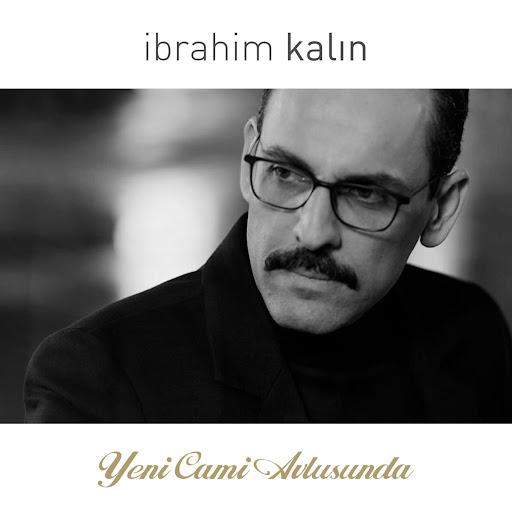
Yeni Cami Avlusunda - İbrahim Kalın (Poll Production)
The piece is registered in the repertoire under number 4998 as a lament song linked to the Rumeli region. The collector of the song is noted as Kubilay Dökmetaş, the transcriber as İhsan Öztürk, and the source informant as Hüseyin Yaltırık.
The song is composed in the Segah makam, with its tonic and final note identified as Si. It follows a 4/4 rhythmic structure and has a vocal range spanning six notes.
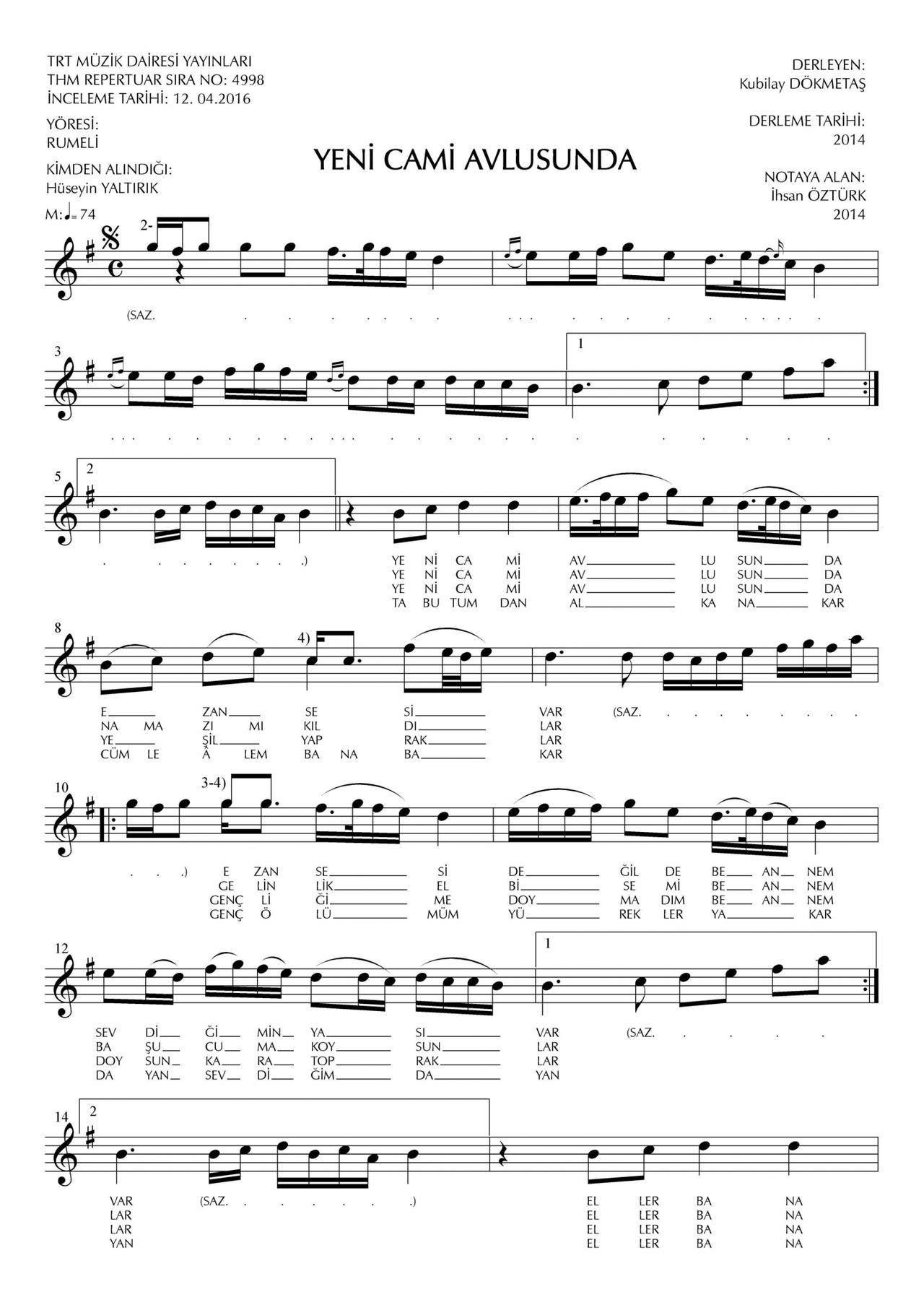
Nota Bilgileri (Repertükül)
In the courtyard of Yeni Cami
There is the call to prayer
It is not the call to prayer but my mother’s grief
It is the mourning of my beloved
My hands do not weep, my mother
They cannot bind the dark earth
I have a beloved and a beautiful mother
My heart cannot bear this
In the courtyard of Yeni Cami
Let them perform my prayer
My wedding dress, my mother
Let them place it beside my head
In the courtyard of Yeni Cami
Green leaves
I could not sate my youth, my mother
Let the dark earth be satisfied
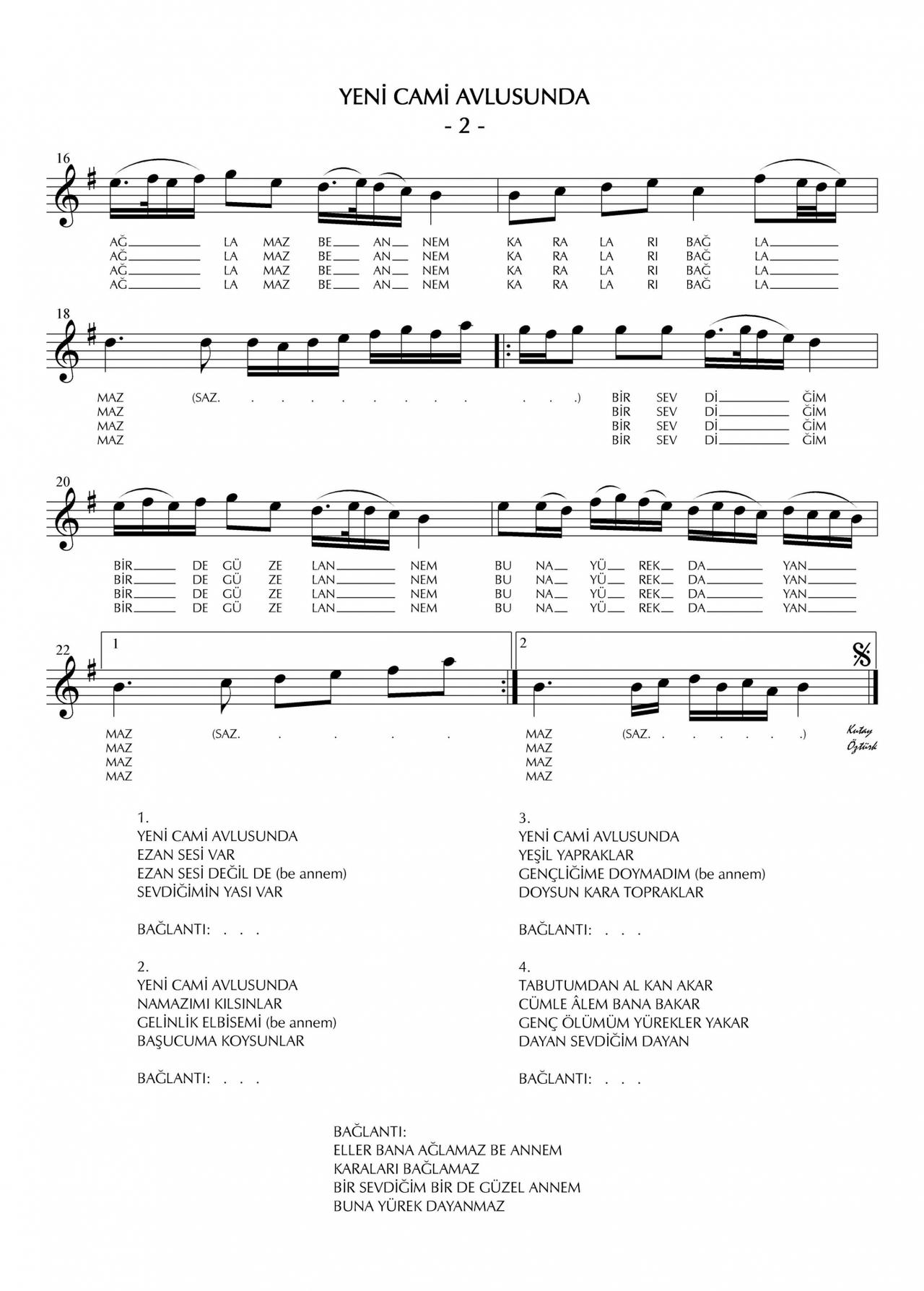
Nota Bilgileri (Repertükül)
Blood flows from my coffin
The whole world looks upon me
Endure, my beloved, endure
My youthful death scorches hearts
Some accounts link the song to a dramatic narrative connected to the Balkan region. However, there is no verified historical evidence supporting this story; it is known to have gained popularity recently in digital media and has been repeatedly reproduced across various platforms. Therefore, in repertoire records, the song is listed as an anonymous lament, and the narratives concerning its origin are not accepted as established historical facts.
Malumatfuruş. "Yeni Cami Avlusunda Türküsünün Kökenine Dair Kurgu Anlatı." *malumatfurus.org.* Accessed April 25, 2026. https://www.malumatfurus.org/yeni-cami-avlusunda-turkusunun-hikayesi/
Malumatfuruş. "Yeni Cami Avlusunda Türküsünün Kökenine Dair Kurgu Anlatı." January 5, 2022. Accessed April 25, 2026. https://www.malumatfurus.org/yeni-cami-avlusunda-turkusunun-hikayesi/
Poll Production. "İbrahim Kalın - Yeni Cami Avlusunda - (Official Video)." YouTube, June 30, 2021. Accessed April 25, 2026.
Repertükül - Türküpedia. "Yeni Cami Avlusunda." repertukul.com. Accessed April 25, 2026. https://www.repertukul.com/YENI-CAMI-AVLUSUNDA-4998

Type(s) | Ağıt | ||||||||
|---|---|---|---|---|---|---|---|---|---|
Region(s) | Rumeli | ||||||||
Mode | Segah | ||||||||
Notator | İhsan Öztürk | ||||||||
Collector | Kubilay Dökmetaş | ||||||||
Source Person | Hüseyin Yaltırık | ||||||||
Repertory Number | 4998 | ||||||||
No Discussion Added Yet
Start discussion for "New Mosque Courtyard (Türkü)" article
Regional and Repertoire Information
Lyrics of the Folk Song
Origins and Transmission