


This article was automatically translated from the original Turkish version.

Department of New Media and Communication
Definition | An academic department that combines theoretical knowledge with practice to study digital media technologies and communication processes. | ||||||||
|---|---|---|---|---|---|---|---|---|---|
Main Field | Digital marketing and advertising Social media and interaction, Media production and content management, Media ethics and media literacy Digital media and internet communication | ||||||||
Career Opportunities | Digital media agencies, News and content platforms, Advertising and public relations companies, Academia and research institutions, Social media management and content creation | ||||||||
Department of New Media and Communication is an interdisciplinary academic field that examines communication environments transformed by digitalization and their social cultural and economic impacts using scientific methods while integrating theoretical knowledge with practice. This department reevaluates classical approaches in communication sciences through digital media technologies to offer a holistic perspective on media production consumption and critique.
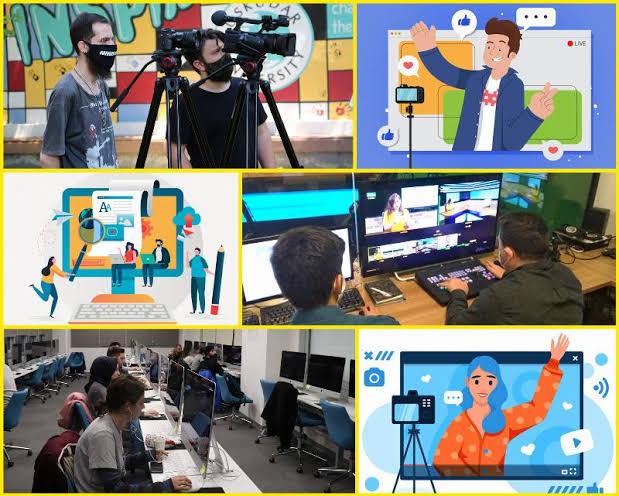
Yeni Medya Ve İletişim Bölümü (Üsküdar Üniversitesi)
New media distinguishes itself from traditional media through its interactive digital and user-centered structure. These media forms which form the foundation of the department have enabled individuals to become content creators transcended temporal and spatial boundaries and democratized access to information (Yaylagül 2014). The Department of New Media and Communication examines the theoretical foundations of this transformation by relating them to disciplines such as sociology psychology political science cultural studies and media criticism (Uysal 2013).
The curriculum includes courses on media literacy digital culture visual communication media history internet journalism digital marketing content creation data journalism and the interaction between artificial intelligence and media. Thus students acquire both traditional communication theories and practical skills in using contemporary digital media tools (Üsküdar University 2024).
New Media and Communication Program (Üsküdar University)
The aim of the Department of New Media and Communication is to cultivate individuals with critical thinking skills who can produce content in multi-media environments possess ethical values and have strong technological proficiency (Ankara University ILEF 2024). Students are equipped with competencies in areas such as media ethics news writing data visualization digital storytelling and social media strategies.
Another key objective of the department is to produce individuals who understand the evolving structure of the media industry. Contemporary issues such as the political economy of new media globalization and media surveillance society and digital citizenship are addressed within this context (Yaylagül 2014).
Graduates of the department can be employed in digital media agencies news portals social media units advertising and public relations firms digital marketing organizations and content production and management sectors. They also have opportunities to work in the press and publication units of public institutions cultural and artistic organizations academia and civil society organizations (Uysal 2013; Üsküdar University 2024).
Alongside technological advancements individual content creation podcasting and independent media initiatives via YouTube and social media platforms have created new opportunities for graduates. Therefore the department also supports skills related to entrepreneurship and the creative industries.
In Türkiye the Department of New Media and Communication is established as an academic unit at undergraduate graduate and doctoral levels in numerous universities with Ankara University Faculty of Communication (ILEF) being among the first. These departments aim to provide students with a holistic learning experience by supporting theoretical education with practical laboratory facilities and industry collaborations (Ankara University ILEF 2024).
The department also has a program structure that guides students toward interdisciplinary thinking and critical media literacy. Through this structure students develop the ability to question and analyze the impact of new media technologies on social structures (Yaylagül 2014).
Ankara University Faculty of Communication. "Yeni Medya ve İletişim." Ankara Üniversitesi İLEF. Accessed June 1, 2025.https://www.ilef.ankara.edu.tr/yeni-medya-ve-iletisim/
Google Books. "Compilation Book Related to the New Media and Communication Department." Accessed June 1, 2025.https://books.google.com/books?hl=tr&lr=&id=7DajDwAAQBAJ&oi=fnd&pg=PR5
Uysal, Ahmet. “Yeni Medya ve İletişim Araştırmaları.” Selçuk İletişim 7, no. 4 (2013): 15–25.https://dergipark.org.tr/en/download/article-file/275846
Yaylagül, Levent. “Kitle İletişim Kuramları: Eleştirel Bir Bakış.” CEEOL (Central and Eastern European Online Library). Accessed June 1, 2025.https://www.ceeol.com/search/article-detail?id=685771
Üsküdar Üniversitesi. "Medya ve İletişim." Üsküdar Üniversitesi İletişim Fakültesi. Accessed June 1, 2025.https://uskudar.edu.tr/iletisim-fakultesi/medya-ve-iletisim

Department of New Media and Communication
Definition | An academic department that combines theoretical knowledge with practice to study digital media technologies and communication processes. | ||||||||
|---|---|---|---|---|---|---|---|---|---|
Main Field | Digital marketing and advertising Social media and interaction, Media production and content management, Media ethics and media literacy Digital media and internet communication | ||||||||
Career Opportunities | Digital media agencies, News and content platforms, Advertising and public relations companies, Academia and research institutions, Social media management and content creation | ||||||||
No Discussion Added Yet
Start discussion for "New Media and Communication Department" article
Conceptual Framework and Academic Approach
Educational Objectives and Competencies
Application Areas and Employment Opportunities
Academic Structure and Institutionalization