


This article was automatically translated from the original Turkish version.
Network Administration-1
Description | Network technologies have become one of the fundamental infrastructures enabling communication among individuals and institutions. As the number of internet-connected devices increases, the importance of networks continues to grow. | ||||||||
|---|---|---|---|---|---|---|---|---|---|
Basic Components of Networks | End Devices: These are devices such as computers smartphones printers security cameras and IoT devices that users access directly. Intermediate Devices: These are devices such as routers switches firewalls and access points that direct and secure network traffic. Transmission Medium: These are the environments that enable data transmission such as copper cables fiber optics and wireless connections. | ||||||||
Network Types | LAN (Local Area Network): A network type that connects devices within a small area. WAN (Wide Area Network): A network type that connects multiple LANs over a wide area. | ||||||||
Network Protocols | DNS: Translates domain names into IP addresses. HTTP/HTTPS: Enables the transfer of web pages. Wi-Fi (IEEE 802.11): Defines wireless connections. TCP/IP: The fundamental protocol suite of the internet. Ethernet (IEEE 802.3): Provides wired data transmission. | ||||||||
In today’s world, network technologies have become one of the most important infrastructures enabling communication among individuals and institutions. Now, not only computers but also smartphones, tablets, smart home systems and even industrial machines are connected to the internet. According to research, the number of internet-connected devices worldwide is expected to reach 50 billion by 2025. This development further underscores the critical role networks play in our lives.
Networks are structures that enable data exchange and consist of specific components. These components can be grouped under three main categories:
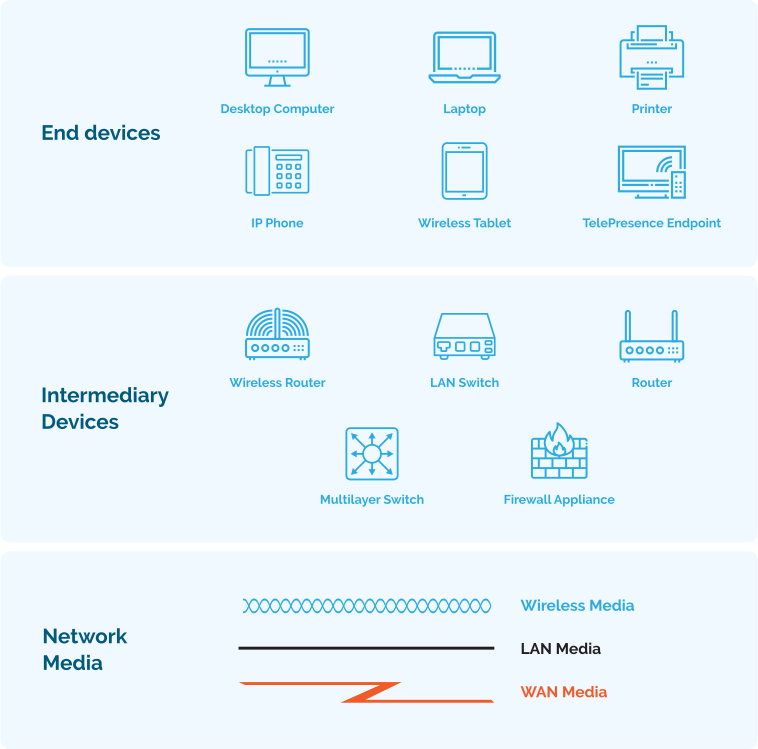
End devices are the devices directly accessed by users on the network. These devices communicate via IP addresses and perform the core functions of the network.
Examples of end devices include:
These devices serve as the starting point or destination of data within the network.
For example, an employee connecting to a company server or a smartphone accessing the internet via Wi-Fi are instances of end device usage.
Intermediary devices are responsible for routing and transmitting data across the network.
Devices in this category include:
For example, in a company office where multiple computers and printers share the same network, a switch (switch) is used to connect these devices. If the company needs to secure its internet connection, a firewall (firewall) is implemented.
This component determines how data is physically transmitted across the network. Transmission media define the method by which data is carried and can be of three different types:
What is End Device
Networks are classified into different categories based on their size, purpose, and coverage area.
A LAN is a network type that connects devices within a small area. It is commonly used in homes, offices, schools, and small businesses.
Characteristics:
A WAN is a larger network that connects multiple LANs. For example, the internet is a massive WAN.
Characteristics:
What Is WAN? LAN vs. WAN - Huawei
In a robust network design, the following four elements must be considered:
Network technologies are continuously evolving and adapting to new trends:
Network communication is not achieved merely by connecting hardware; it requires devices to exchange data according to specific rules. Computers, phones, and other network devices use certain protocols and models to communicate with each other. This section will examine the importance of network protocols, reference models, and data encapsulation processes.
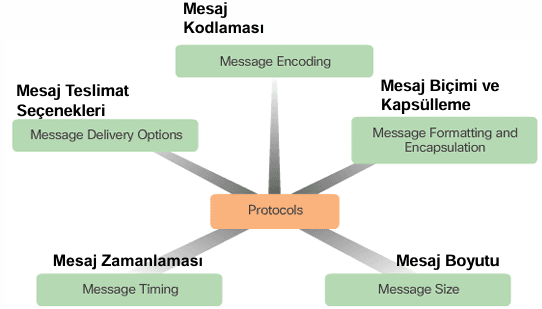
For networks to function properly, specific rules must be established. These rules define how communication occurs and ensure devices can operate compatibly. The rules created by network protocols consist of the following components:
Protocols Requirements
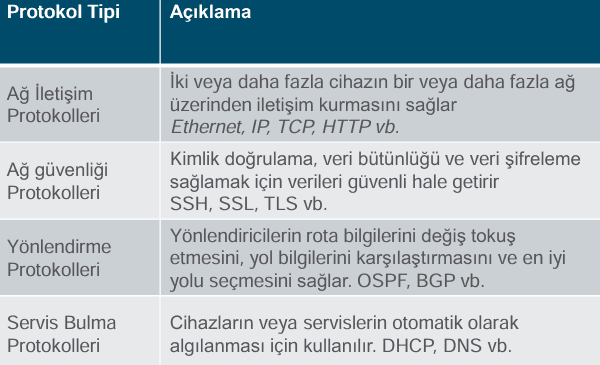
For two or more devices on a network to communicate seamlessly, they must adhere to a defined set of rules. This entire set of rules is called a protocol. Protocols are standards that determine how messages are sent, received, and interpreted.
Some commonly used protocols in network communication include:
These protocols determine how devices create, transmit, and interpret data packets.
Protocols
Network communication does not occur through a single protocol. Various protocols work together to form a more comprehensive and functional structure. These groups of protocols are called protocol suites.
1. TCP/IP Protocol Suite: Forms the foundation of the internet and is divided into four main layers:
2. OSI Protocol Suite: This seven-layer model was developed to ensure interoperability between systems from different manufacturers. The OSI model provides a structure covering all stages from physical connections to the application level.
3. AppleTalk: A protocol suite developed by Apple, specifically designed for Mac devices. It enabled communication among Macintosh computers during the pre-IP era.
4. Novell NetWare: A network operating system protocol suite developed by Novell, based on IPX/SPX protocols. It was widely used in LAN-based networks.
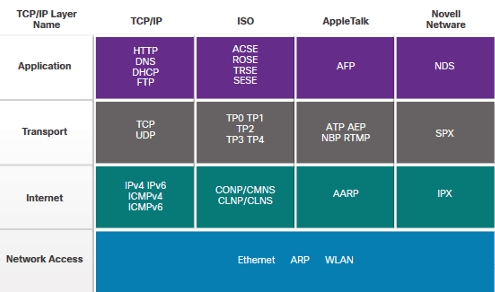
Network Protocols - Cisco
Various models have been developed to better understand how communication occurs in networks. The most widely known are the OSI Model and the TCP/IP Model.
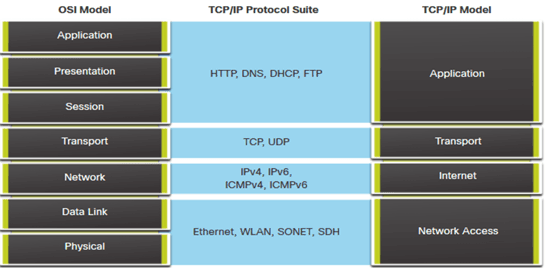
OSI vs TCP/IP - Cisco
The OSI model provides an open standard by dividing network communication into seven layers:
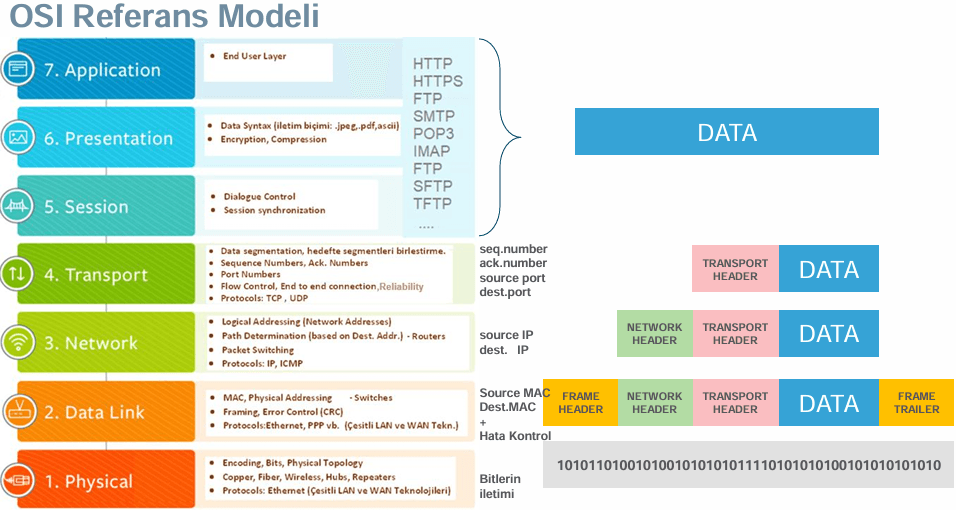
OSI Model - Cisco
The TCP/IP model, which forms the foundation of the internet, has a simplified structure consisting of four layers:
While the OSI model provides a theoretical framework, the TCP/IP model is an active system used in the real world. The TCP/IP model is more widely used than OSI because it was developed as the foundational protocol suite of the internet.
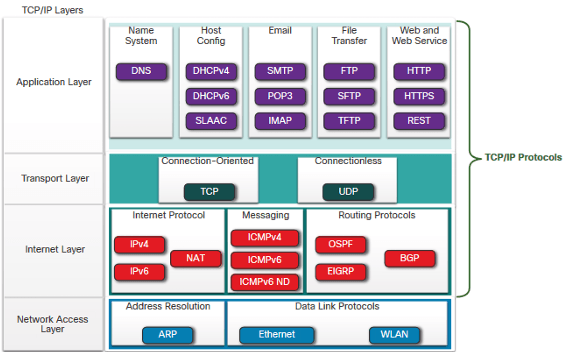
TCP/IP Layers - Cisco
Before data is transmitted across a network, it undergoes a process called encapsulation. During this process, each layer adds its own header to ensure smooth communication. The data encapsulation process consists of the following stages:
On the receiving device, this process is reversed to restore the data to its original form.
"CCNA 1 v7.0 Curriculum: Module 1 - Networking Today." *IT Exam Answers*. Accessed February 16, 2025.https://itexamanswers.net/ccna-1-v7-0-curriculum-module-1-networking-today.html
"CCNA 1 v7.0 Curriculum: Module 2 - Basic Switch and End Device Configuration." *IT Exam Answers*. Accessed February 16, 2025.https://itexamanswers.net/ccna-1-v7-0-curriculum-module-2-basic-switch-and-end-device-configuration.html
"CCNA 1 v7.0 Curriculum: Module 3 - Protocols and Models." *IT Exam Answers*. Accessed February 16, 2025.https://itexamanswers.net/ccna-1-v7-0-curriculum-module-3-protocols-and-models.html

Network Administration-1
Description | Network technologies have become one of the fundamental infrastructures enabling communication among individuals and institutions. As the number of internet-connected devices increases, the importance of networks continues to grow. | ||||||||
|---|---|---|---|---|---|---|---|---|---|
Basic Components of Networks | End Devices: These are devices such as computers smartphones printers security cameras and IoT devices that users access directly. Intermediate Devices: These are devices such as routers switches firewalls and access points that direct and secure network traffic. Transmission Medium: These are the environments that enable data transmission such as copper cables fiber optics and wireless connections. | ||||||||
Network Types | LAN (Local Area Network): A network type that connects devices within a small area. WAN (Wide Area Network): A network type that connects multiple LANs over a wide area. | ||||||||
Network Protocols | DNS: Translates domain names into IP addresses. HTTP/HTTPS: Enables the transfer of web pages. Wi-Fi (IEEE 802.11): Defines wireless connections. TCP/IP: The fundamental protocol suite of the internet. Ethernet (IEEE 802.3): Provides wired data transmission. | ||||||||
No Discussion Added Yet
Start discussion for "Network Administration" article
Fundamental Components of Networks
End Devices
Intermediary Devices
Transmission Media
Network Types and Applications
Local Area Network (LAN)
Wide Area Network (WAN)
Fundamental Principles of Reliable Networks
1. Fault Tolerance
2. Scalability
3. Quality of Service (QoS)
4. Security
Network Trends: Technologies of the Future
Protocols and Models in Networks
Rules in Network Communication
Network Protocols
Fundamental Network Protocols
Protocol Suites
Common Protocol Suites
OSI and TCP/IP Models
OSI Model (Open Systems Interconnection)
TCP/IP Model
Data Encapsulation Process