

This article was automatically translated from the original Turkish version.
+2 More
Million Income Calculator (MONIAC), is an original analog simulation device designed in 1949 by New Zealand engineer and economist A. W. Phillips to model the relationships between macroeconomic variables through a mechanical system. Developed at the London School of Economics in England, the device features a structure that incorporates both the Keynesian economic paradigm of its time and the fundamental assumptions of classical economics. MONIAC is also known by various names such as the economic simulation machine, Phillips machine, or hydraulic analog computer.
The fundamental operating principle of the device is based on representing the flow of income and expenditure among economic actors through the circulation of water. The behavior of key economic units—households, firms, the public sector, and foreign trade—is visualized through tanks, pipes, and valves within the system. This water flow serves as a simulation of the monetary cycle in the economy. In this regard, MONIAC was among the first devices to translate abstract economic concepts into a tangible mechanism, enabling observation of economic dynamics and simulation of the effects of policy changes.
MONIAC, defined as a hydro-mechanical model of macroeconomics, consists of a system in which colored water is pumped through rigid plastic tanks and tubes. When the machine is activated, colored water flows through transparent pipes and reaches the tanks. This water circulation represents the movement of money in the economy. As the water reaches the tanks, the economic behaviors of households, firms, imports, and exports, along with the economic variables they influence, become observable.
The National Income Calculator comprises three sectors: private, public, and foreign. Water pumped from the income tank flows into the machine as income. Before reaching households, a portion of this water is diverted to the government and taxed. This taxed portion flows into the government tank. The government then decides how much to spend. If the government does not wish to spend all of its income, the unspent portion accumulates in the government spending tank. The remaining income after taxation reaches households, which then decide how much to save and how much to consume.
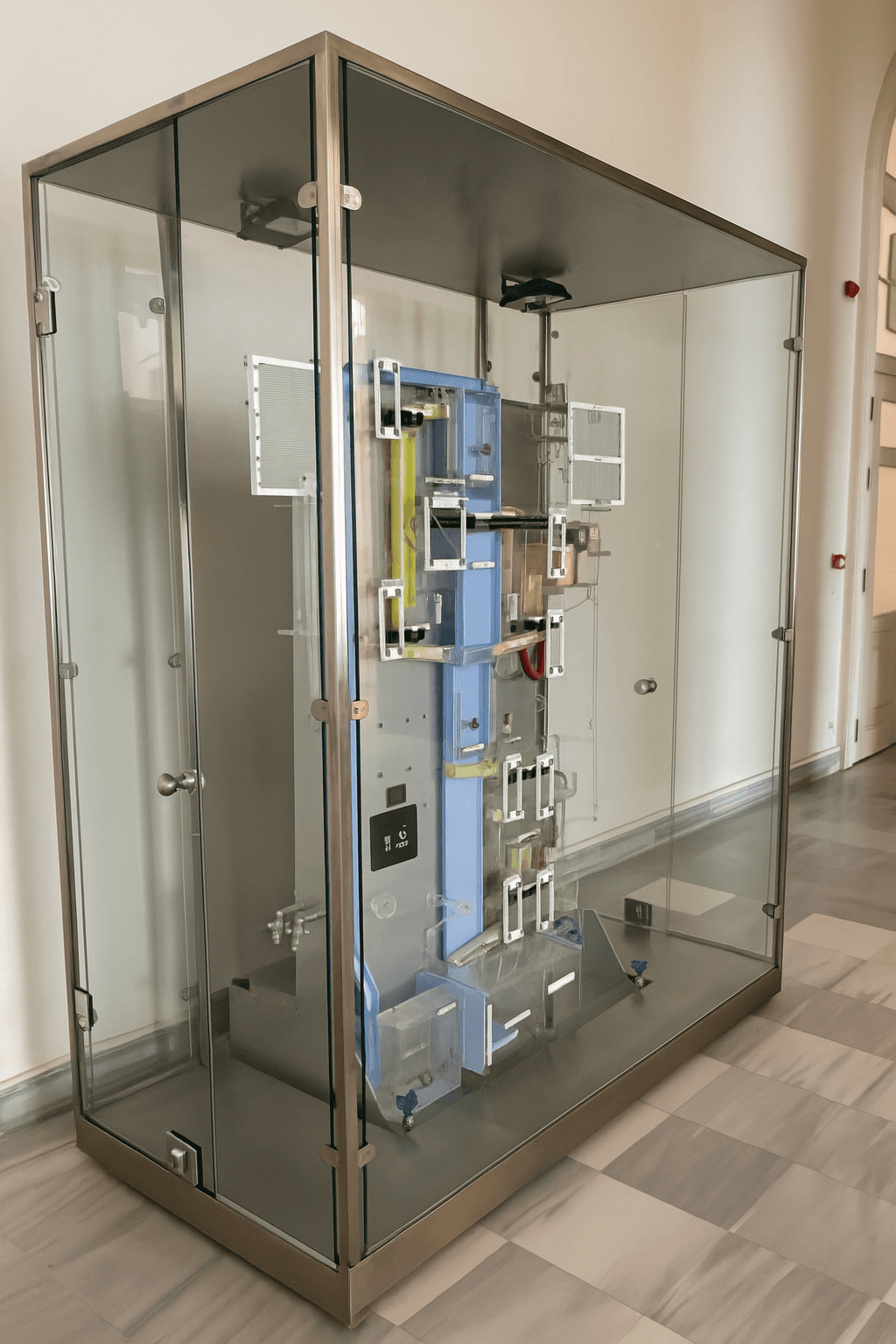
MONIAC Machine (İstanbul University)
The amount a household wishes to save depends on the interest rate in the economy. The interest rate, in turn, is determined by the water level in the investment tank. Additionally, the volume of water in this tank determines how much firms wish to invest. Subsequently, the quantities of water in the consumption, investment, and government spending tanks combine to form the total domestic expenditure tank. A portion of this is spent on imports. Meanwhile, revenue from exports enters through a connected channel, completing the cycle. At the end of the cycle, information on gross domestic product (GDP), the trade balance, and changes in the interest rate is recorded on paper strips located on either side of the machine.
By using transparent acrylic and colored water, Phillips’s device made abstract economic relationships tangible, facilitating the visualization of relationships that were previously difficult to comprehend. This provided a visual representation of change processes within a multivariable environment. Moreover, as an experimental tool, it enabled students, particularly in economics education, to gain insight into dynamic processes. The relationship between flow and stock variables, often confused, could be clearly observed through monitoring the machine’s operation.
MONIAC Machine ()
On another front, some policymakers used the machine to learn economic policy practices. Due primarily to its contribution to economic education, 14 units were produced worldwide, six of which remain operational. These include locations such as the Science Museum in London, the University of Leeds, the University of Cambridge, Istanbul University, the University of Melbourne, and the Central Bank of New Zealand’s educational library.
Alada, Alaeddin. “İktisat Düşüncesinin Yakın Dönem Evrimi ve Türkiye’de İktisat Okuryazarı Olmak.” *İstanbul Üniversitesi İşletme Fakültesi Dergisi* 23, no. 2 (2007): 1–8. Accessed July 11, 2025. https://scispace.com/papers/iktisat-dusuncesinin-yakin-donem-evrimi-ve-turkiye-de-1iwb028e5o.
Reserve Bank of New Zealand. “Making Money Flow: The MONIAC.” Reserve Bank of New Zealand, 2017. Accessed July 11, 2025. https://www.youtube.com/watch?v=rAZavOcEnLg.
Susam, Nazan, Nurtaç Yıldırım, and Hakan Bektaş. “Introducing the Moniac: Its Historical Process in the Istanbul University Faculty of Economics.” *İstanbul İktisat Dergisi - Istanbul Journal of Economics* 71, no. 1 (2021): 1–19. Accessed July 11, 2025. https://cdn.istanbul.edu.tr/file/JTA6CLJ8T5/E3AFEEA4F34E4CAFAA80BC27DA8AD5D9.
Tayyar, Ahmet Emrah. “Phillips Makinesi: İktisat Öğretimine Katkıları Üzerine Bir Araştırma.” *Akademik Araştırmalar ve Çalışmalar Dergisi* 12, no. 22 (2020): 75–85. Accessed July 11, 2025. https://doi.org/10.20990/kilisiibfakademik.607547.
İstanbul Gelişim Üniversitesi. "Milli Gelir Hesaplama Makinesi (MONIAC)." İktisadi, İdari ve Sosyal Bilimler Fakültesi, 2022. Accessed July 11, 2025. https://iisbf.gelisim.edu.tr/tr/akademik-bolum-ekonomi-ve-finans-(ingilizce)-haber-milli-gelir-hesaplama-makinesi-moniac.
İstanbul Üniversitesi. "MONIAC Milli Gelir Hesaplama Makinesi ve Simülasyonu Tanıtım Toplantısı." İstanbul Üniversitesi, 2018. Accessed July 11, 2025. https://www.youtube.com/watch?v=laMgABM1uEk.
İstanbul Üniversitesi. “MONIAC Milli Gelir Hesaplama Makinesi ve Simülasyonu Tanıtım Toplantısı Gerçekleşti.” İstanbul Üniversitesi Resmî Web Sitesi. Accessed July 11, 2025. https://www.istanbul.edu.tr/tr/haber/moniac-milli-gelir-hesaplama-makinesi-ve-simulasyonu-tanitim-toplantisi-gercekle-50006E00440077004F004A00710066006300390041003100.

No Discussion Added Yet
Start discussion for "National Income Computing Machine (MONIAC)" article
Operating Principle of MONIAC
Impact of the MONIAC Machine on Education