


This article was automatically translated from the original Turkish version.
Nahıl Ağacı, during the Ottoman Empire, a monumental three-dimensional craft object used in festivals, weddings, and circumcision processions, symbolizing abundance, prosperity, power, and the continuity of life. Typically designed in the form of a cypress or date palm tree, it is adorned with beeswax, precious stones, mirrors, and various figurative elements. The term derives from the Arabic word “nahl,” meaning “date palm,” and over time entered popular usage as “nakıl.”Arabic【1】.
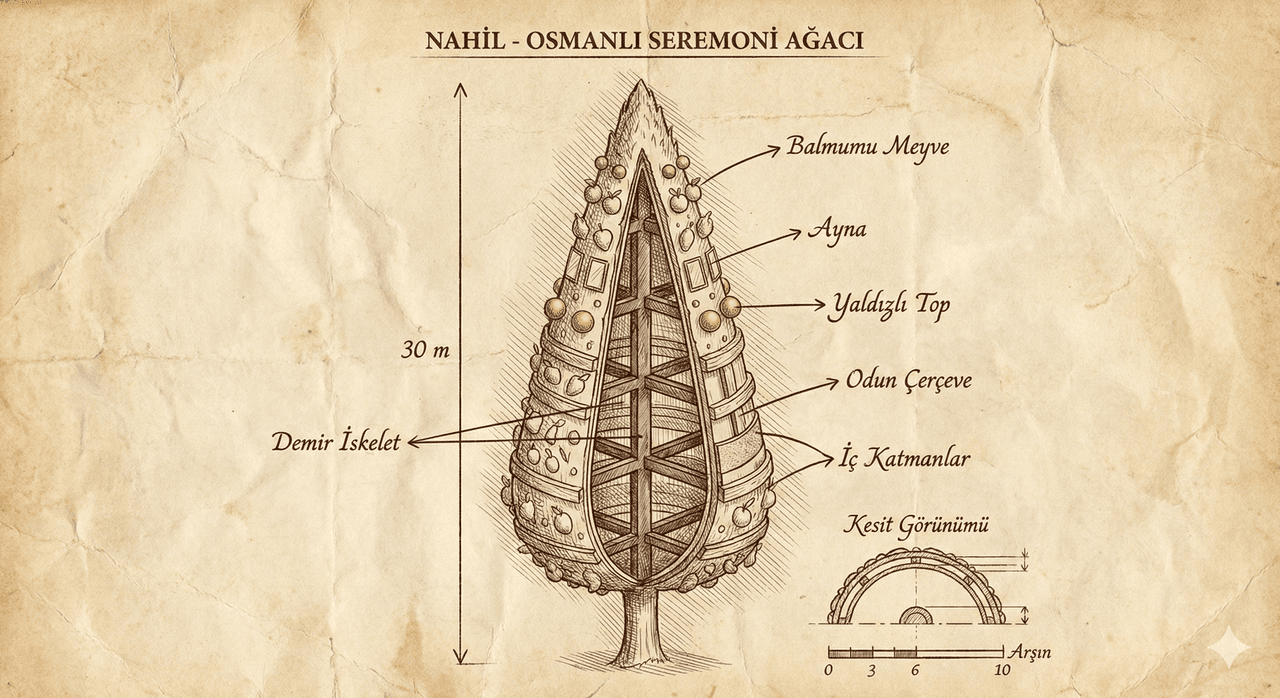
Technical cross-section drawing showing the internal framework, iron skeleton, and decorative layers of a large nahıl used in Ottoman festivals (generated by AI)
Although the word nahıl literally means “date palm” in Arabic, its form and symbolism trace their roots to pre-Islamic Turkish belief systems and Shamanism. In Turkish mythology, the cult of the “Tree of Life” or “World Tree,” believed to connect the earth, sky, and underworld, forms the conceptual foundation of the nahıl.【2】 In Shamanism, this cult was associated with the birch tree, and during the Ottoman period it transformed into the nahıl tree.
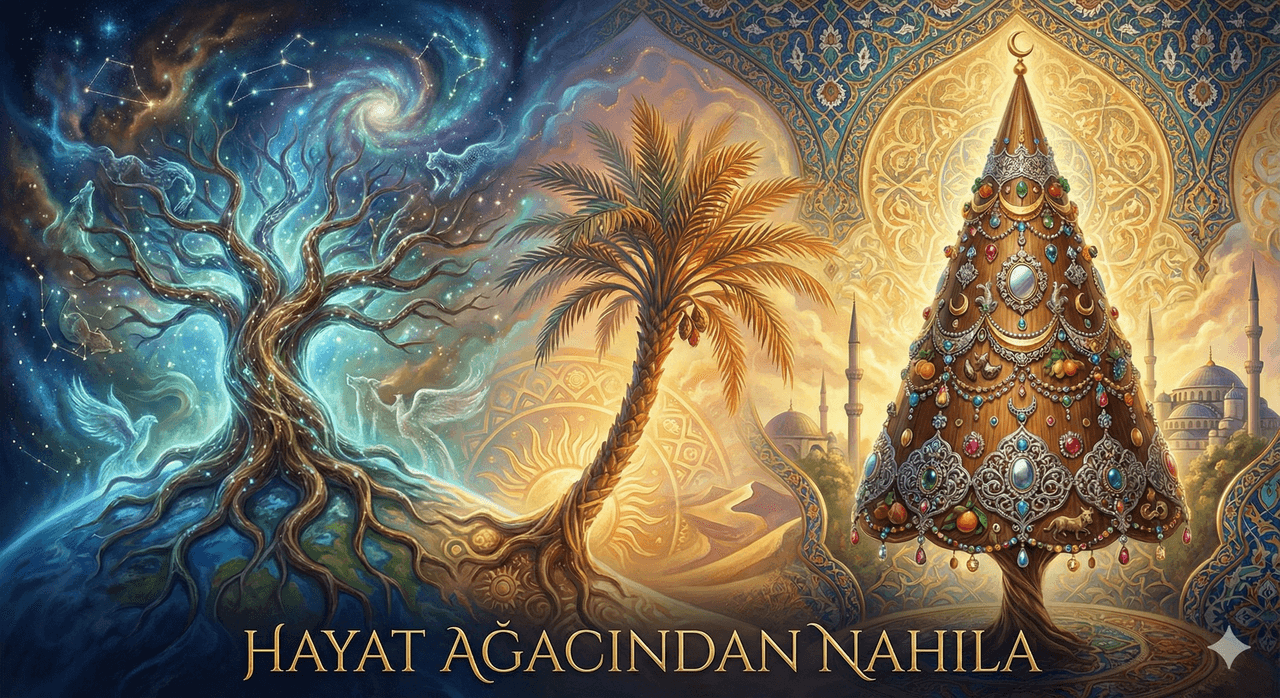
Artistic representation of the cultural evolution from the shamanic Tree of Life belief to the classical Ottoman festival nahıl (generated by AI)
Symbolically, the nahıl possesses a layered structure:
Although the exact origin of the nahıl in Turkish celebrations remains uncertain, the earliest documented record dates to 1449, during the wedding of Mehmed (the Conqueror), son of Murad II, and Sitti Hatun.【5】 During periods of expansion and stagnation in the Ottoman Empire, the use of nahıllar reached its peak in grand imperial celebrations known as “Sûr-ı Hümâyun,” particularly for princely circumcision ceremonies and sultanic marriages.
Some notable historical examples include:
For this festival, five colossal nahıllar exceeding 24 meters in height and over 300 medium-sized ones were used. These giant nahıllar were paraded through the city for a week prior to the event, effectively serving as displays of imperial power.【6】.
English traveler Dr. Covel recorded that the nahıllar he observed stood approximately 25 meters tall and had trunks as thick as a ship’s mast. During this period, special nahıllar were also crafted not only from beeswax but also from solid silver and sugar.【7】.
From the late 18th century onward, nahıllar began to lose their former monumental scale. By the 19th century, as depicted in Melling’s drawings, nahıllar had evolved into simpler, symbolic “wreath-like” structures, primarily adorned with silver threads.【8】.
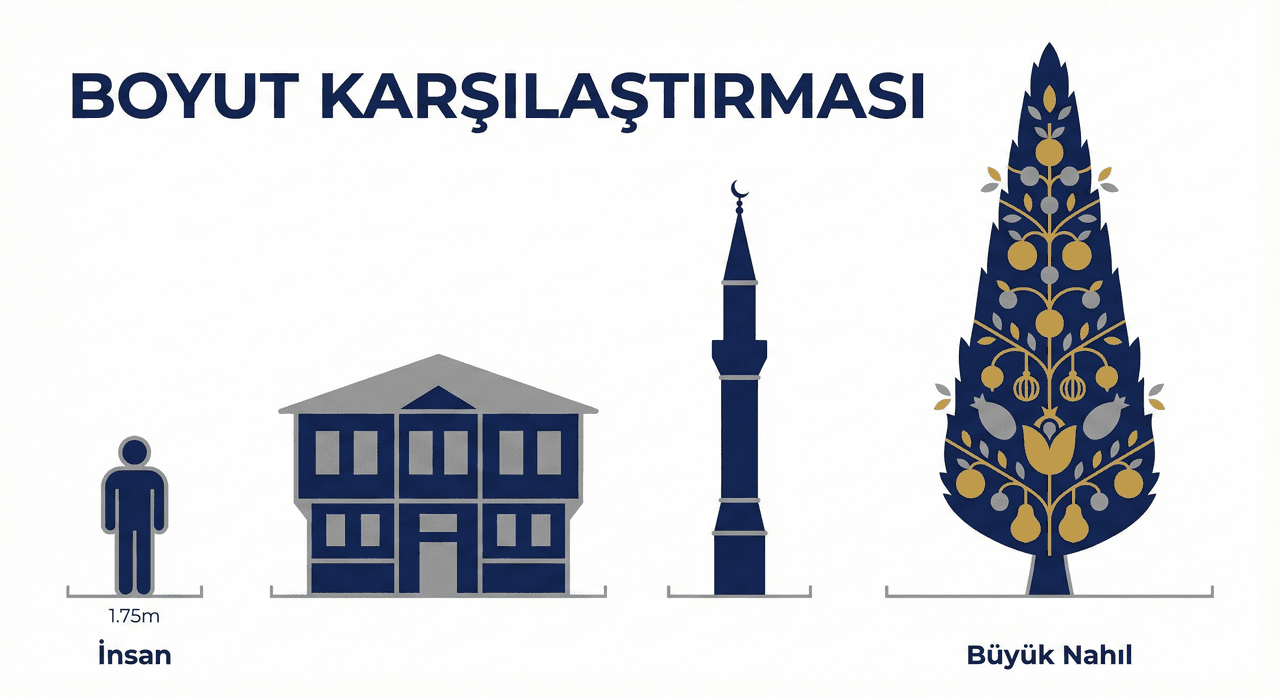
Comparative graphic illustrating the scale of a large nahıl relative to a human, a traditional house, and a mosque minaret (generated by AI)
Nahıllar were constructed by specialized artisans known as “Nahılbent,” who combined expertise in architecture, engineering, and art. Evliya Çelebi notes that in 17th-century Istanbul, a guild of 55 craftsmen practiced this trade, with their workshops located in the Aksaray and Tahtakale districts.【9】.
Nahıllar were generally produced in two main categories: “large” and “small.”
These monumental structures ranged from 9 meters in height to as much as 24–30 meters, with base diameters reaching 4–6 meters. They were typically used in princely circumcision ceremonies and marriages of imperial princesses.
Standing 2–4 meters tall, these were more portable and often numbered in the thousands. They were carried at the front of bridal processions or wedding parades.
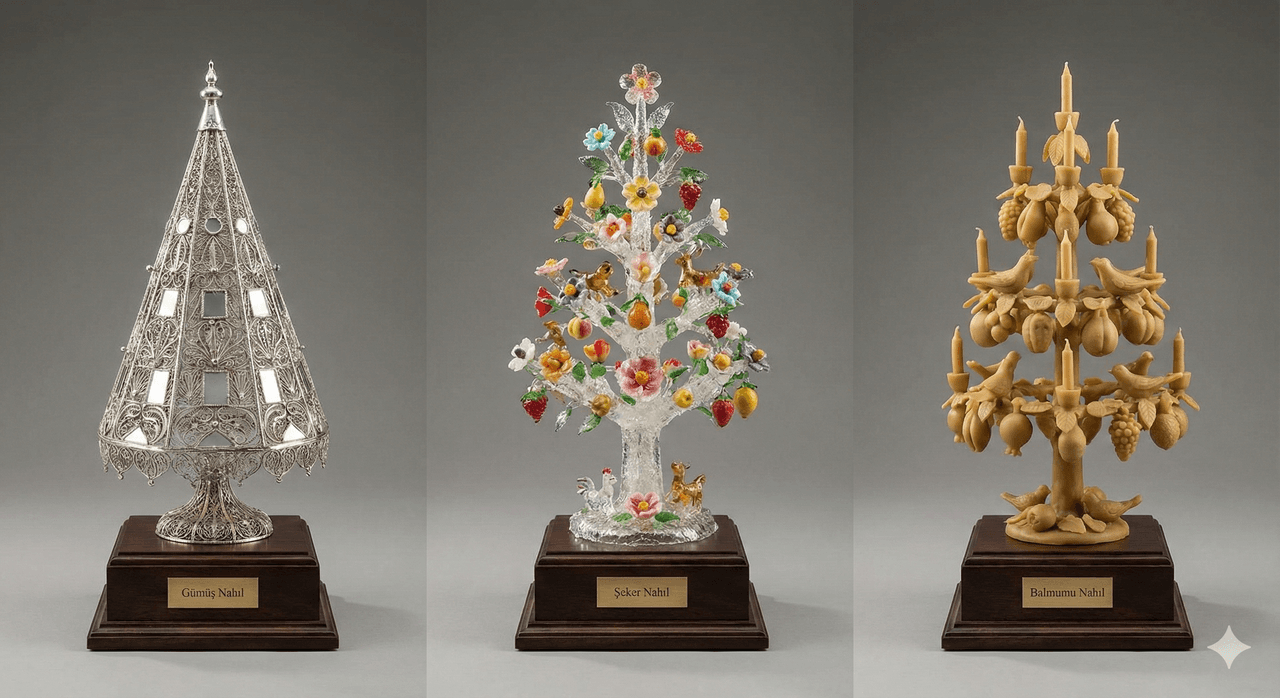
Examples of nahıllar made from silver, sugar, and beeswax, displayed in museum-style arrangements (generated by AI)
The internal framework of a nahıl was typically constructed from iron rods or wooden poles (often poplar). This conical structure was then decorated with:
Transporting nahıllar of such colossal dimensions constituted a major logistical operation, requiring the mobilization of the entire state apparatus.
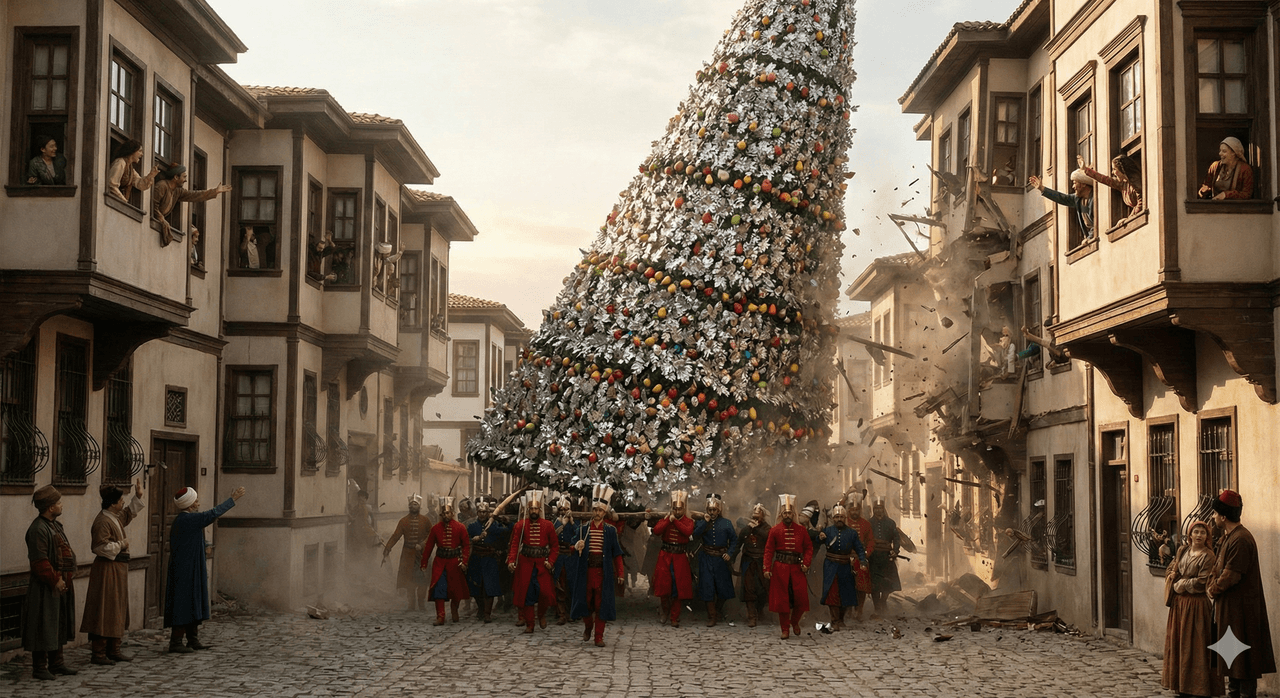
Artistic representation of a colossal nahıl being carried through the narrow streets of Istanbul, with rooftops and eaves being removed (generated by AI)
The largest nahıllar were carried by “Tersane esirleri” or “forsalar,” specialized laborers. Beneath each nahıl, eight to ten parallel poles were attached for bearers to shoulder. Hundreds of men would simultaneously lift the structure on the command of a ship’s whistle (silistre).
The nahıllar were so large that as they passed through Istanbul’s narrow streets, they often struck rooftops, eaves, or walls. Consequently, before each festival, the “Mimarbaşı” oversaw route inspections; sections of obstructing buildings were demolished, and after the festival, the state compensated property owners and restored the damaged structures.【10】.
Although the nahıl tradition was largely forgotten with the decline of imperial court festivities in the late Ottoman period, it has persisted in the folk culture of certain regions of Anatolia.
One of the most vibrant surviving centers of the nahıl tradition in Türkiye is Ürgüp. However, the nahıllar here have diverged from their imperial predecessors; those once adorned with fruits and candles are now made of colored paper, artificial flowers, and plastic ornaments, standing approximately 2 meters tall.
In the modern era, the nahıl has partially lost its ritual significance in weddings and evolved into a type of “wish tree” or “votive tree.” Today, at festivals, people hang written wishes on modern nahıllar, reflecting a recombination of this ancient tradition with older Turkish customs such as tying offerings to trees.
Accessed December 30, 2025.https://dergipark.org.tr/en/pub/ataunitaed/article/38895.
Accessed December 30, 2025.https://dergipark.org.tr/en/pub/ttkbelleten/article/1166182.
Accessed December 30, 2025.https://dergipark.org.tr/en/pub/yedi/article/234846.
Accessed December 30, 2025.https://doi.org/10.53718/gttad.940879.
Accessed December 30, 2025.https://gcris.ieu.edu.tr/server/api/core/bitstreams/2761b3f3-d38c-4f39-a66e-67f26dd9ab76/content.
Büyükcan Sayılır, Şeyda. "Türklerin Ağaç ile Mitolojik ve Tarihî Bağları Üzerine Bir Değerlendirme." Genel Türk Tarihi Araştırmaları Dergisi 3, sy. 6 (2021): 187–198.
Uzunçarşılı, İsmail Hakkı. "Nahıl ve Nakıl Alayları." Belleten 40, no. 157 (1976): 55–70.
Yerdelen, Selda Kulluk. "Osmanlı Şenliklerinde Kullanılan Nahıl, Yapma Bahçe, Şekerden Tasvirler ve Tasarımcıları." (2010): 157–164.
Öngen Corsini, Duygu Ebru. "Osmanlı Saray Şenliklerinden Günümüze Bir Kültür Ürünü: Nahıl." Yedi: Sanat, Tasarım ve Bilim Dergisi (2013).
Öngen Corsını, Duygu. "Osmanlı Saray Şenliklerinden Günümüze Bir Kültür Ürünü: Nahıl." Yedi 10 (2013): 49–57.
[1]
İsmail Hakkı Uzunçarşılı, “Nahıl ve Nakıl Alayları,” Belleten 40, no. 157 (1976): 55–56,
[2]
Şeyda Büyükcan Sayılır, “Türklerin Ağaç ile Mitolojik ve Tarihî Bağları Üzerine Bir Değerlendirme,” Genel Türk Tarihi Araştırmaları Dergisi 3, sy. 6 (2021): 187,
[3]
Sayılır, “Türklerin Ağaç ile Mitolojik ve Tarihî Bağları Üzerine Bir Değerlendirme,” 195.
[4]
Duygu Ebru Öngen Corsini, “Osmanlı Saray Şenliklerinden Günümüze Bir Kültür Ürünü: Nahıl,” Yedi: Sanat, Tasarım ve Bilim Dergisi 10 (2013): 50,
[5]
Selda Kulluk Yerdelen, “Osmanlı Şenliklerinde Kullanılan Nahıl, Yapma Bahçe, Şekerden Tasvirler ve Tasarımcıları,” Atatürk Üniversitesi Türkiyat Araştırmaları Enstitüsü Dergisi 17 (2001): 157, https://dergipark.org.tr/en/pub/ataunitaed/article/38895.
[6]
Uzunçarşılı, “Nahıl ve Nakıl Alayları,” 59-60.
[7]
Yerdelen, “Osmanlı Şenliklerinde Kullanılan Nahıl…,” 158-160.
[8]
Uzunçarşılı, “Nahıl ve Nakıl Alayları,” 64.
[9]
Uzunçarşılı, “Nahıl ve Nakıl Alayları,” 56.
[10]
Yerdelen, “Osmanlı Şenliklerinde Kullanılan Nahıl…,” 159.

Origin, Etymology, and Symbolism
Historical Development and Role in Ottoman Festivals
The 1582 Festival
The 1675 Edirne Festival
The 1720 Festival
Structural Features, Design, and Production
Size and Classification
Large Nahıllar
Small Nahıllar
Materials and Decoration
Logistics and Transportation
Transport Crews
Urban Adjustments
Modern Era and Living Traditions
Ürgüp (Ortahisar) Tradition
Cultural Transformation