This article was automatically translated from the original Turkish version.
+1 More
Other Name(s) | Mazık sheep | ||||||||
|---|---|---|---|---|---|---|---|---|---|
Origin(s) | Anatolia | ||||||||
Fiber Fineness | 30-34 microns (Coarse-mixed) | ||||||||
Wool Yield | 1.2 - 2.0 kg | ||||||||
Live Weight | Ewes 45-60 kg, Rams 60-90 kg | ||||||||
Color | Red-brown (purplish tones) | ||||||||
Body Structure | Large, sturdy, and fat-tailed (S-shaped, 4-7 kg) | ||||||||
Population Ratio | 21.5% of Turkey's total, 61.1% of Eastern Anatolia | ||||||||
Geographical Distribution | Eastern Anatolia, Southeastern Anatolia, and Central Anatolia | ||||||||
Morkaraman sheep is a native genetic resource native to the Anatolian region, with documented presence in these lands from the 10th to 13th centuries BCE. Primarily raised in the Eastern Anatolia Region (Erzurum, Ağrı, Iğdır, Van, Kars, Muş, etc.), it is also found in the Southeastern Anatolia Region and to a lesser extent in Central Anatolia. Known among the public as the “Mazık” sheep, this breed accounts for approximately 21.5% of Türkiye’s total sheep population and 61.1% of the sheep population in Eastern Anatolia.【1】
The Morkaraman breed has a robust, large-bodied and fat-tailed morphology. Anatomical measurements on adult animals have determined that the withers height averages 70–70.23 cm, chest circumference 91–91.27 cm, body length 64.59–65 cm, and chest depth 31.5–31.51 cm.【2】
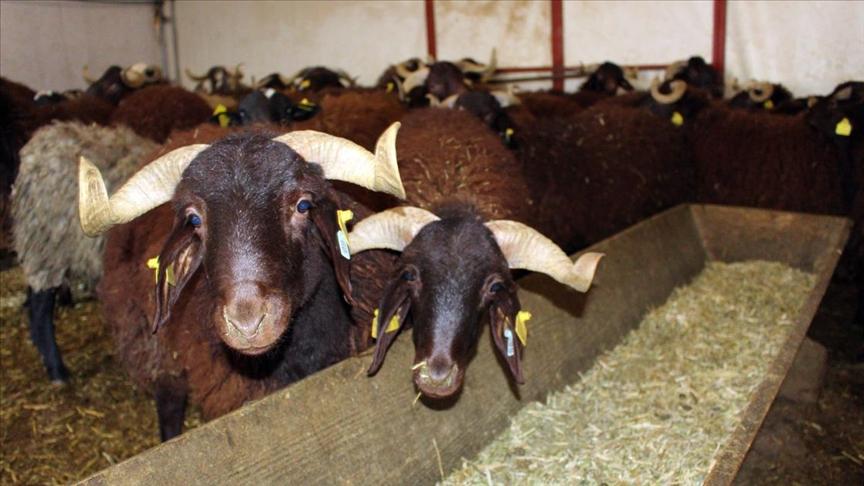
It is one of only three sheep breeds in Türkiye with colored wool, and its fleece exhibits a reddish-brown hue reminiscent of purple. The head structure features a concave forehead and a prominent convex nose, especially in rams; ears are typically pendulous or semi-pendulous. A large proportion of males possess large, spiral horns, while females are mostly polled or have weak horns. The fat tail structure, due to two bends in the vertebrae, takes an “S” shape and weighs between 4 and 7 kg on average.【3】
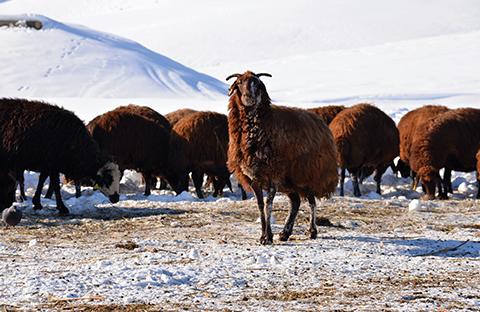
Morkaraman koyunu(Tarım Ve Orman Dergisi)
The Morkaraman sheep has developed high adaptability to the continental climate of Eastern Anatolia, including long and cold winters and inadequate feeding conditions. The fat stored in its tail serves as an energy reserve during periods of hunger and poor nutrition. Its ability to use its front legs to dig through snow for grazing and its strong maternal instinct enhance the breed’s resilience under harsh environmental conditions.
As a dual-purpose breed, Morkaraman is particularly notable for its meat production performance.
Adult ewes weigh between 45 and 60 kg, while rams weigh between 60 and 90 kg. Lamb birth weights average 3.4–4 kg. In fattening programs, daily weight gain reaches 220–252 grams, with carcass yield estimated at around 50%.【4】
The lactation period generally lasts 130–150 days (or 4–5 months), during which milk yield ranges from 50 to 80 kg. In a study conducted under semi-intensive conditions in Erzurum, the lactation period was measured at 188.8 days with an average milk yield of 132.88 kg, with peak production occurring on day 75 of lactation.【5】
Ram mating typically occurs in September–October, with lambing taking place in February–March. The age at first breeding for ewes is reported as 18 months. Under extensive conditions, twinning rates range from 2% to 8%, but specific studies have observed rates rising as high as 42.9% in older ewes.【6】
Dirty wool yield in adult ewes ranges from 1.2 to 2.0 kg. Wool fineness measures 30–34 microns and has a coarse, mixed structure; this specific fiber composition and natural reddish-brown color make it highly ideal for traditional handicrafts such as carpets and kilims. Its ability to be processed without dyeing, using its natural color, enhances its commercial value in the textile industry and sustainable rural economies.【7】
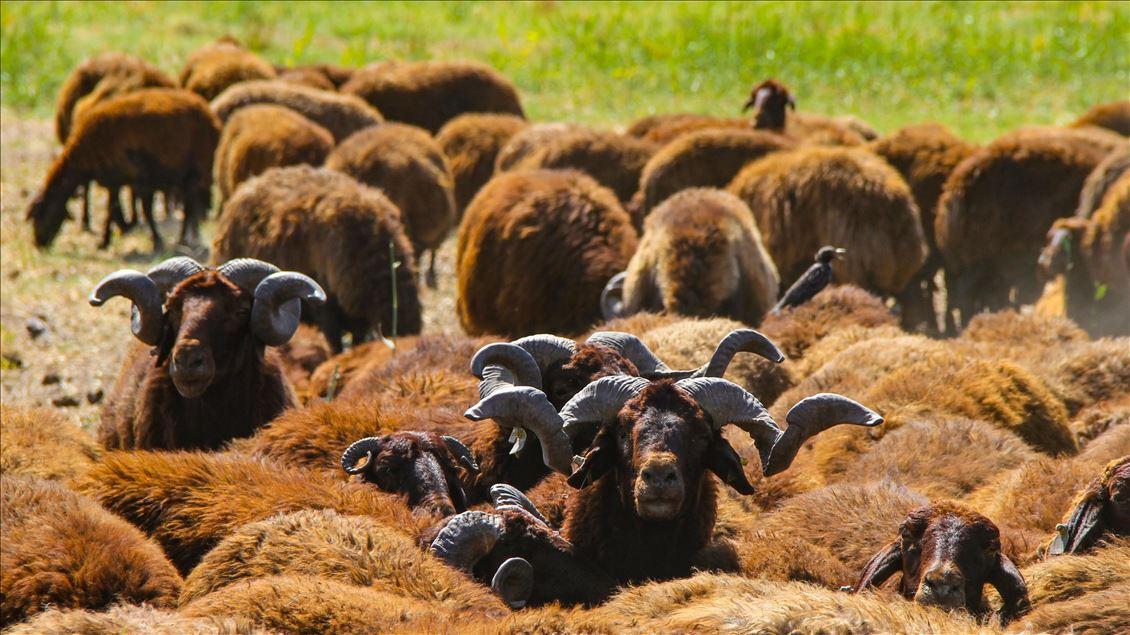
Morkaraman Koyunları(AA)
Various strategies are being implemented by academic institutions and state agencies to enhance the genetic potential and conserve the population of the Morkaraman breed.
Under this project led by the Ministry of Agriculture and Forestry, support is provided to breeders in provinces such as Ağrı who maintain flocks of 100 or more ewes, aiming to increase milk yield, lambing rate, growth rate and feed conversion efficiency.
The Kazım Karabekir Agricultural Enterprise, under the General Directorate of Agricultural Enterprises (TİGEM), raises thousands of Morkaraman sheep around Iğdır and Mount Ağrı and supplies high-genetic-quality breeding animals to local farmers.
Although crossbreeding studies with other breeds such as Merino, İvesi, Romanov and Charollais have been conducted for decades to improve meat and milk production in Morkaraman sheep, breeders consistently prefer purebred Morkaraman due to its disease resistance and resilience under harsh conditions. Experts emphasize that this genetic resource must not be lost through crossbreeding with foreign breeds and should instead be improved through selective breeding and pureline conservation methods.
Akçapınar, Halil, İhsan Aydın, and Ramazan Kadak. “Morkaraman Koyunlarının Erzurum’da Özel Bir İşletmede Kuzu ve Süt Verimleri.” *Ankara Üniversitesi Veteriner Fakültesi Dergisi* 31, no. 1 (1984): 114–127. Accessed April 17, 2026. https://dergipark.org.tr/en/download/article-file/1449921.
Kayalık, Mehmet Şerif, and Mehmet Bingöl. “Tüm Yönleriyle Morkaraman Koyunları.” *Iğdır Üniversitesi Fen Bilimleri Enstitüsü Dergisi* 5, no. 2 (2015): 89–97. Accessed April 17, 2026. https://dergipark.org.tr/en/download/article-file/412788.
Omrak, Hülya. “Anadolu Coğrafyasına Özgü Bir Koyun Irkı: Morkaraman.” Tarım ve Orman Bakanlığı. June 13, 2022. Accessed April 17, 2026. https://www.turktarim.gov.tr/Haber/781/anadolu-cografyasina-ozgu-bir-koyun-irki-morkaraman.
T.C. Ministry of Agriculture and Forestry. "Duyuru."Ağrı İl Directorate of Agriculture and Forestry, n.d. Accessed April 17, 2026. https://agri.tarimorman.gov.tr/Sayfalar/Detay.aspx?OgeId=296&Liste=Duyuru.
T.C. Tarım İşletmeleri Genel Müdürlüğü (TİGEM). "Haber." Accessed April 17, 2026. https://www.tigem.gov.tr/Haber/Detay/7b177738-48d7-f011-9b04-005056011751.
Tellioğlu, Saip, and Sezer Sabaş. “Atatürk Morkaraman Koyunlarında Vücut Ölçüleri.” Accessed April 17, 2026. https://dergipark.org.tr/en/download/article-file/34770.
[1]
Hülya Omrak, “Anadolu Coğrafyasına Özgü Bir Koyun Irkı: Morkaraman,” Tarım ve Orman Bakanlığı, 13 Haziran 2022, erişim 17 Nisan 2026, https://www.turktarim.gov.tr/Haber/781/anadolu-cografyasina-ozgu-bir-koyun-irki-morkaraman.
[2]
Saip Tellioğlu and Sezer Sabaş, “Atatürk Morkaraman Koyunlarında Vücut Ölçüleri,” erişim 17 Nisan 2026, https://dergipark.org.tr/en/download/article-file/34770.
[3]
Hülya Omrak, “Anadolu Coğrafyasına Özgü Bir Koyun Irkı: Morkaraman,” Tarım ve Orman Bakanlığı, 13 Haziran 2022, erişim 17 Nisan 2026, https://www.turktarim.gov.tr/Haber/781/anadolu-cografyasina-ozgu-bir-koyun-irki-morkaraman.
[4]
Mehmet Şerif Kayalık and Mehmet Bingöl, “Tüm Yönleriyle Morkaraman Koyunları,” Iğdır Üniversitesi Fen Bilimleri Enstitüsü Dergisi 5, no. 2 (2015): 89–97, erişim 17 Nisan 2026, https://dergipark.org.tr/en/download/article-file/412788.
[5]
Halil Akçapınar, İhsan Aydın and Ramazan Kadak, “Morkaraman Koyunlarının Erzurum’da Özel Bir İşletmede Kuzu ve Süt Verimleri,” Ankara Üniversitesi Veteriner Fakültesi Dergisi 31, no. 1 (1984): 114–127, erişim 17 Nisan 2026, https://dergipark.org.tr/en/download/article-file/1449921.
[6]
Mehmet Şerif Kayalık and Mehmet Bingöl, “Tüm Yönleriyle Morkaraman Koyunları,” Iğdır Üniversitesi Fen Bilimleri Enstitüsü Dergisi 5, no. 2 (2015): 89–97, erişim 17 Nisan 2026, https://dergipark.org.tr/en/download/article-file/412788.
[7]
Hülya Omrak, “Anadolu Coğrafyasına Özgü Bir Koyun Irkı: Morkaraman,” Tarım ve Orman Bakanlığı, 13 Haziran 2022, erişim 17 Nisan 2026, https://www.turktarim.gov.tr/Haber/781/anadolu-cografyasina-ozgu-bir-koyun-irki-morkaraman.

Other Name(s) | Mazık sheep | ||||||||
|---|---|---|---|---|---|---|---|---|---|
Origin(s) | Anatolia | ||||||||
Fiber Fineness | 30-34 microns (Coarse-mixed) | ||||||||
Wool Yield | 1.2 - 2.0 kg | ||||||||
Live Weight | Ewes 45-60 kg, Rams 60-90 kg | ||||||||
Color | Red-brown (purplish tones) | ||||||||
Body Structure | Large, sturdy, and fat-tailed (S-shaped, 4-7 kg) | ||||||||
Population Ratio | 21.5% of Turkey's total, 61.1% of Eastern Anatolia | ||||||||
Geographical Distribution | Eastern Anatolia, Southeastern Anatolia, and Central Anatolia | ||||||||
No Discussion Added Yet
Start discussion for "Morkaraman Sheep Breed" article
Morphological Characteristics (Physical Structure)
Environmental Adaptation Capacity
Meat, Milk and Reproductive Performance Traits
Live Weight and Fattening Performance
Milk Yield
Reproduction and Lambing Rate
Wool Characteristics and Economic Value
Breeding, Conservation and Support Programs
Livestock Improvement by Local Breeders National Project
Breeding Stock Production
Academic Research