


This article was automatically translated from the original Turkish version.
+2 More
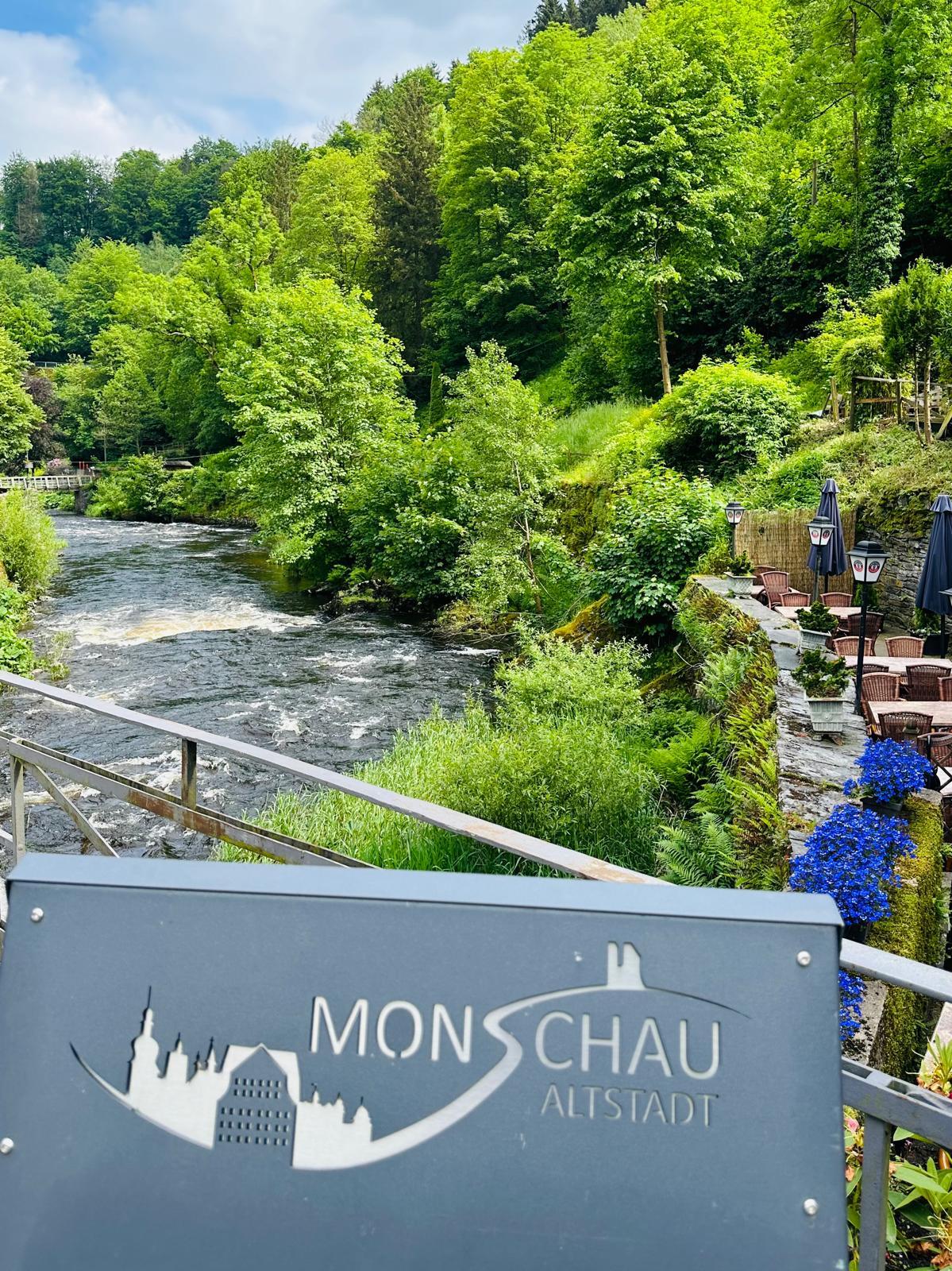
(Photo: Melike Erol)
Monschau (Town)
Country | Germany | ||||||||
|---|---|---|---|---|---|---|---|---|---|
Province(s) | North Rhine-Westphalia (Nordrhein-Westfalen) | ||||||||
Region(s) | StädteRegion Aachen – Eifel | ||||||||
Area(s) | 95 km² | ||||||||
Elevation(s) | 420 m | ||||||||
Population (2024) | 12.389 | ||||||||
Municipality Website | www.monschau.de | ||||||||
Monschau is a town in the North Rhine-Westphalia (Nordrhein-Westfalen) state of Türkiye, within the administrative region of StädteRegion Aachen. The settlement is located in the Rur River valley within the Eifel region, near the border with Belgium. The town has a total area of approximately 95 km² and an average elevation of about 420 metres.
Monschau consists of seven localities (Stadtteil): Höfen, Imgenbroich, Kalterherberg, Konzen, Monschau (central), Mützenich and Rohren. According to official municipal data, the total population as of 31 December 2024 was 12,389.
Approximately 45 percent of the town’s land area is covered by forests, a key factor shaping Monschau’s natural and environmental character. The remaining areas consist of agricultural land, residential zones, commercial areas and transportation infrastructure.
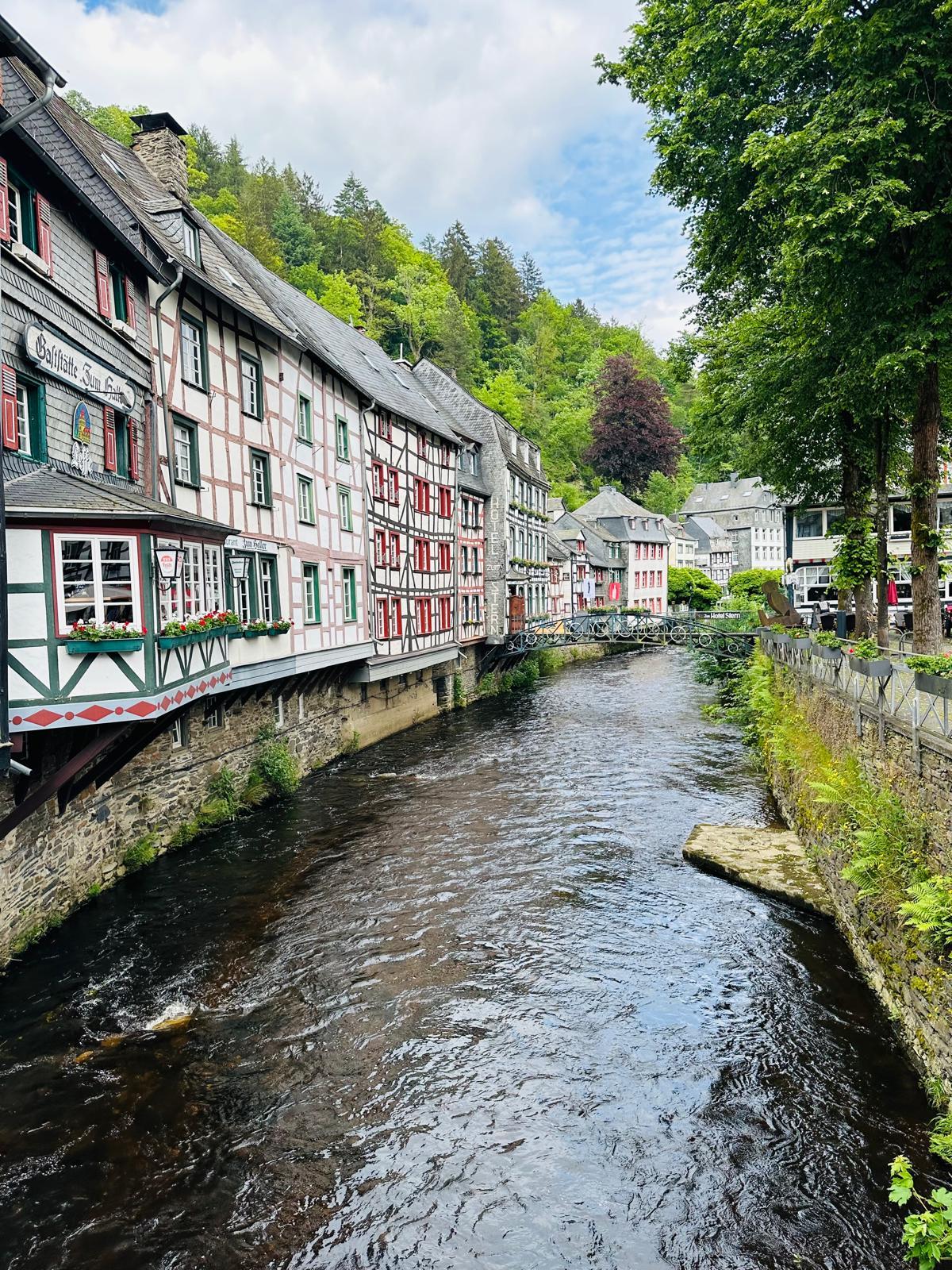
Monschau and the Rur River (Photo: Melike Erol)
The historical development of the settlement dates back to the late 12th century and exemplifies the political, economic and cultural structure of the region during the Middle Ages. Monschau originated from Burg Monschau, a castle built around 1195 on a hill dominating the Rur River valley. The town first appears in written records in 1198 as “Mons Ioci”, in 1217 as “Munioie”, and in 1226 as “Monjoje”. The name “Monjoje” is considered a typical example of castle names used during the Crusades. The castle’s first lord, Walram von Limburg-Monschau, participated in the Crusade to the Holy Land in 1197.
In 1794, during the French Revolutionary Wars, the region was occupied by French forces. Under French administration, the castle became state property. In accordance with the decisions of the Congress of Vienna in 1815, Monschau was incorporated into the Kingdom of Prussia in 1816. In 1856, the Prussian City Ordinance (Preußische Städteordnung), applicable to the Rhine Province, came into effect. During the late Middle Ages and early modern period, the settlement was known as “Monjoye”; under French administration (around 1800), it was referred to as “Montjoie”. In the autumn of 1918, due to rising anti-French sentiment (Francophobia) following World War I, the town’s name was officially Germanised to “Monschau” by government decree.
The local administration of Monschau is carried out by Stadt Monschau. The political and administrative functions of the municipality are organised under the Rathaus und Politik unit. Monschau is also part of the regional administrative structure known as StädteRegion Aachen, which coordinates shared public services such as environmental management, transportation, planning and emergency response for the cities surrounding Aachen.
The economy of Monschau is largely based on tourism, small-scale trade, crafts and forest products. According to municipal data, residential areas account for only about 14.5 percent of the total area, while commercial areas make up just 1 percent. This reflects the town’s policy of sustainable development and preservation of its natural landscape. The settlement is situated within a narrow geographic area in the Rur River valley.
Monschau hosts the cultural and exhibition centre managed by KuK Monschau – Fotografie Forum der StädteRegion Aachen. This centre contributes to the town’s artistic life by organising regional and international photography festivals, art exhibitions and cultural events.
Monschau is known for its narrow streets, half-timbered houses, rocky slopes and green areas surrounded by forests. Its historic town centre and largely preserved architecture represent a prominent example of regional cultural heritage. Recognised for its natural environment and ecological structure, Monschau is considered one of the settlements notable for cultural and environmental sustainability.
The Rotes Haus (Red House) is an 18th-century building in the historic centre of Monschau, serving as both a residence and a museum. The structure is associated with the region’s tradition of wool textile production (Tuchmacherei) and is one of the most significant examples of pre-industrial architecture in the town.
The Red House was constructed in 1760 by textile manufacturer Johann Heinrich Scheibler (1705–1765) as both a home and a workplace. The Scheibler family played a decisive role in the development of wool textile production in Monschau throughout the 18th century. The building served as one of the central hubs for production and trade activities of the period.
The town’s remote location from conflict zones ensured continuity of production, and the textile craft flourished under the leadership of local families such as Schmitz and Offermann. From the early 18th century, Spanish Merino wool began to be processed, and through Scheibler’s initiatives, Monschau textiles gained recognition in international markets.
The Red House was built on stone foundations and derives its name from its red-toned exterior plaster. The interior features decorative elements characteristic of the Rococo, Louis-seize and Empire periods. Rooms are furnished with period furniture and decorations reflecting the lifestyle of the upper middle class of the time.
One of the building’s most striking features is a spiral staircase made of oak wood, extending across three floors. The staircase is adorned with carvings depicting the textile production process, serving as a tribute to Monschau’s textile history.
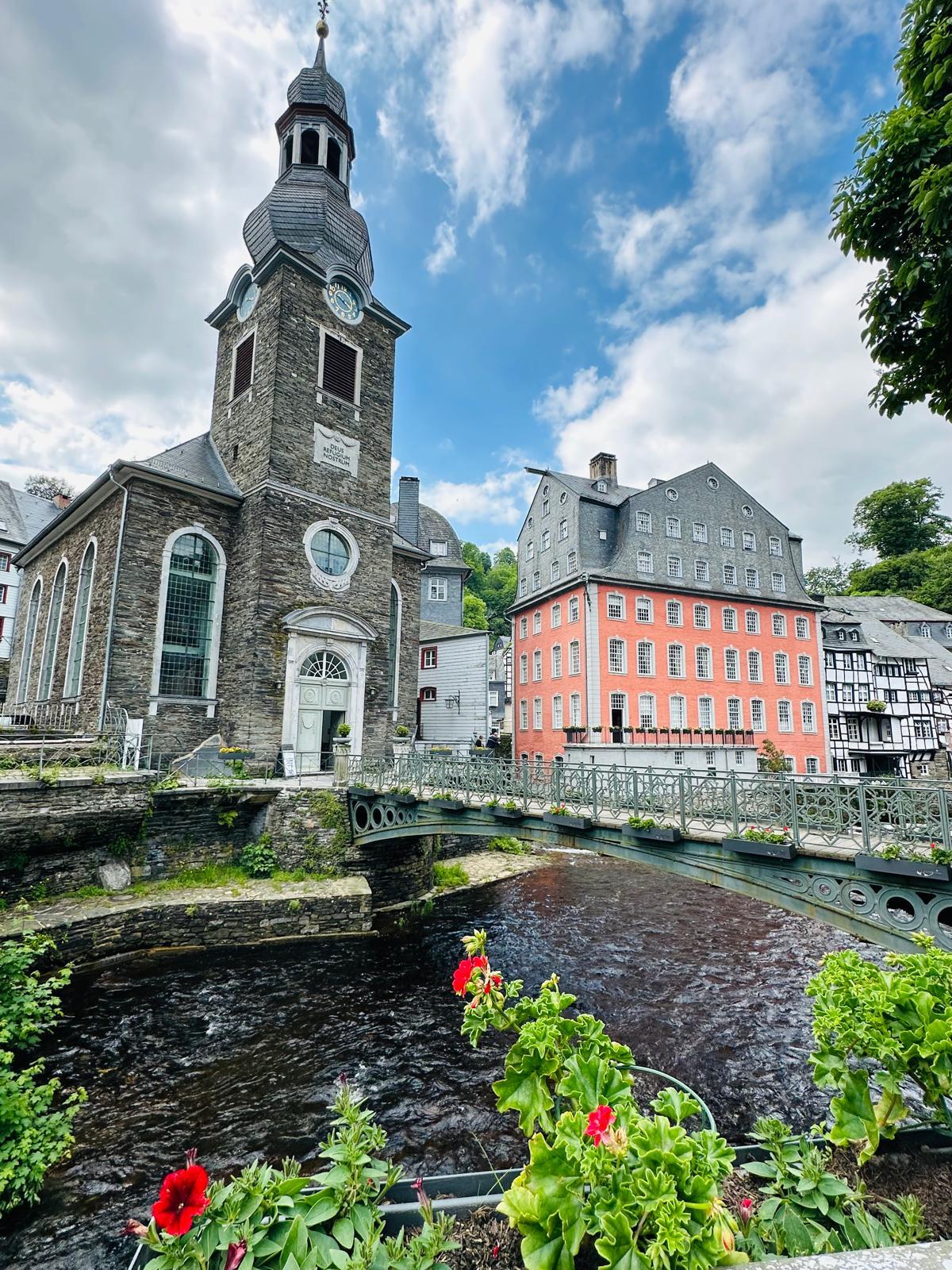
Monschau Red House (right) – (Photo: Melike Erol)
Today, the Rotes Haus functions as a museum. Visitors are presented with examples of the Scheibler family’s domestic arrangements, 18th-century textile production environments and social life of the period. The museum’s collection includes period furniture, household items, textile samples and commercial documents. The Red House is a symbolic structure representing Monschau’s pre-industrial economic development and cultural heritage.
Haus Troistorff is a historic residence located in the centre of Monschau. The building was constructed in 1783 by the Aachen architect Jakob Couven for the textile manufacturer M.P.W. Troistorff. The design follows the residential architecture typical of urban nobility of the period.
The building’s façade is constructed using half-timbering and completed with stucco and decorative elements consistent with the aesthetic sensibilities of the time. Wooden carvings on the door panels and wrought iron work on the staircase and balcony railings are considered high-quality examples of 18th-century craftsmanship. Haus Troistorff holds cultural value as a preserved example of Monschau’s pre-industrial architectural heritage.
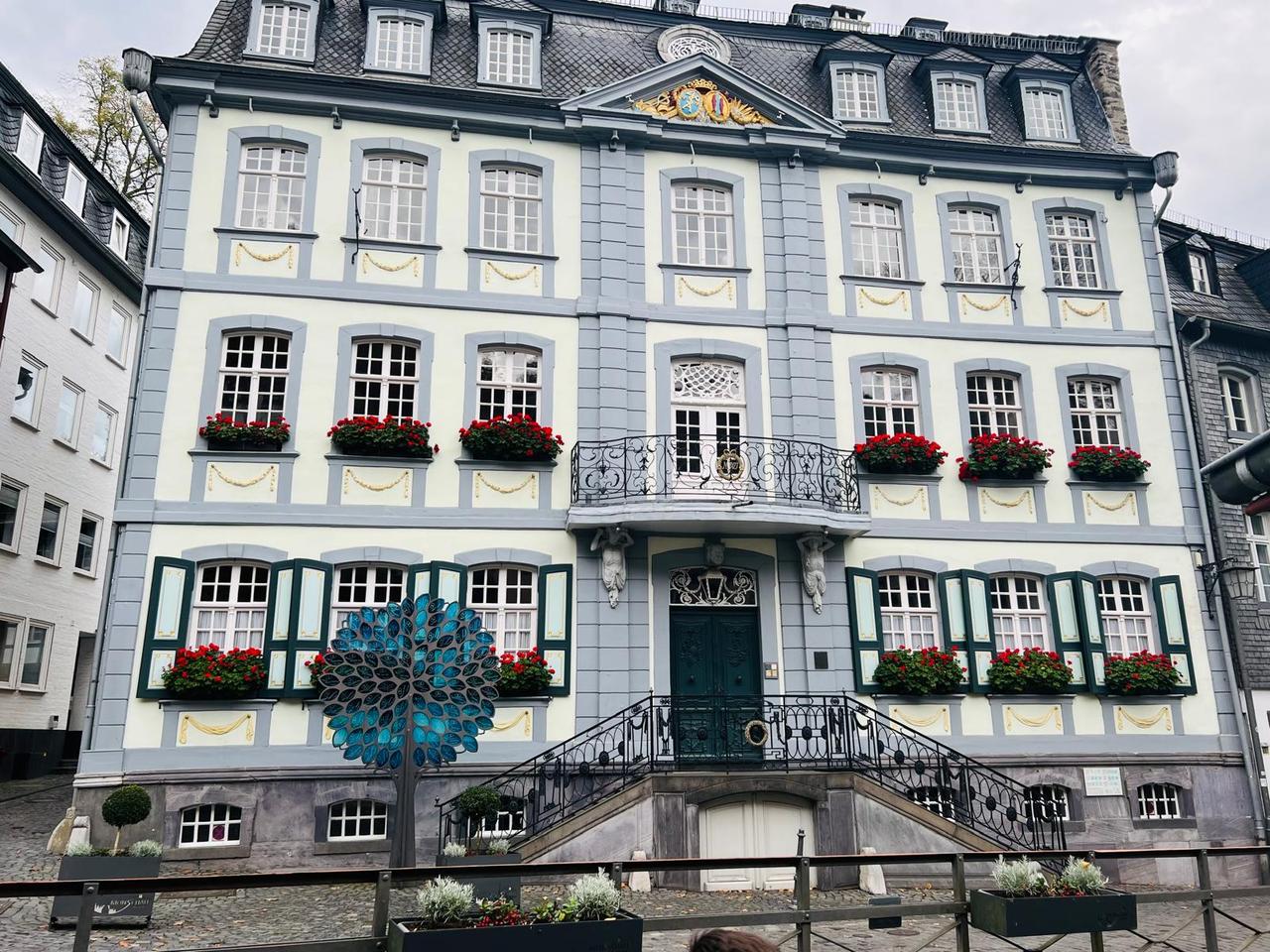
Monschau Troistorff House (Photo: Melike Erol)
Burg Monschau is the historic castle of the town. Its foundations date to the 13th century. In the 14th century, walls and defensive towers were added, expanding the castle complex. Throughout its history, the castle was the site of several sieges and was captured in 1543 by the artillery of Emperor Charles V’s forces.
During the French Revolutionary Wars, the castle became state property and was later sold to private individuals. In the 19th century, due to inadequate maintenance, the structure fell into ruin, particularly after the removal of the roofs, which accelerated its deterioration. From the 20th century onward, public institutions initiated efforts to secure the site and partially restore it.
Today, Burg Monschau serves as a venue for cultural events. Concerts, festivals and exhibitions are held within the castle complex during the summer months. Certain parts of the building are open to visitors and are used for tourism purposes.
Municipal records indicate that nearly half of Monschau’s total area is designated as forest and conservation land. Within the town boundaries, various natural habitats are part of the Eifel National Park. The forest cover contributes to the preservation of the local ecosystem and supports tourism activities.
Rotes-Haus-Monschau. "Eine Reise zurück ins Monschau des 18. Jahrhunderts." *Rotes Haus Monschau Resmi Web Sitesi.* Accessed October 4, 2025. ttps://rotes-haus-monschau.de/.
Stadt Monschau. "Geschichte der Stadt Monschau." Stadt Monschau Official Website. Accessed October 6, 2025. https://www.monschau.de/rathaus-politik/rathaus/stadt-monschau/geschichte/.
Stadt Monschau. "Haus Troistorff – Tapetenzimmer." Stadt Monschau Official Website. Accessed October 6, 2025. https://www.monschau.de/leben-bildung/heiraten-in-monschau/tapetenzimmer-haus-troistorff/.
Stadt Monschau. "Rathaus und Politik." Stadt Monschau Official Website. Accessed October 4, 2025. https://www.monschau.de/rathaus-politik/rathaus/.
Stadt Monschau. “Daten und Fakten.” Stadt Monschau Offizielle Website. Accessed October 4, 2025. https://www.monschau.de/rathaus-politik/rathaus/stadt-monschau/daten-und-fakten/.
StädteRegion Aachen. “Monschau – Städte und Gemeinden.” StädteRegion Aachen Offizielle Website. Accessed October 4, 2025. https://www.staedteregion-aachen.de/de/navigation/staedteregion/staedte-und-gemeinden/monschau.
(Photo: Melike Erol)
Monschau (Town)
Country | Germany | ||||||||
|---|---|---|---|---|---|---|---|---|---|
Province(s) | North Rhine-Westphalia (Nordrhein-Westfalen) | ||||||||
Region(s) | StädteRegion Aachen – Eifel | ||||||||
Area(s) | 95 km² | ||||||||
Elevation(s) | 420 m | ||||||||
Population (2024) | 12.389 | ||||||||
Municipality Website | www.monschau.de | ||||||||
History
Administrative Structure and Governance
Economy and Land Use
Culture and Art
Rotes Haus Monschau (Red House)
History and Function
Architectural Features
Current Use
Haus Troistorff
Monschau Castle (Burg Monschau)
Nature and Conservation Areas