


This article was automatically translated from the original Turkish version.
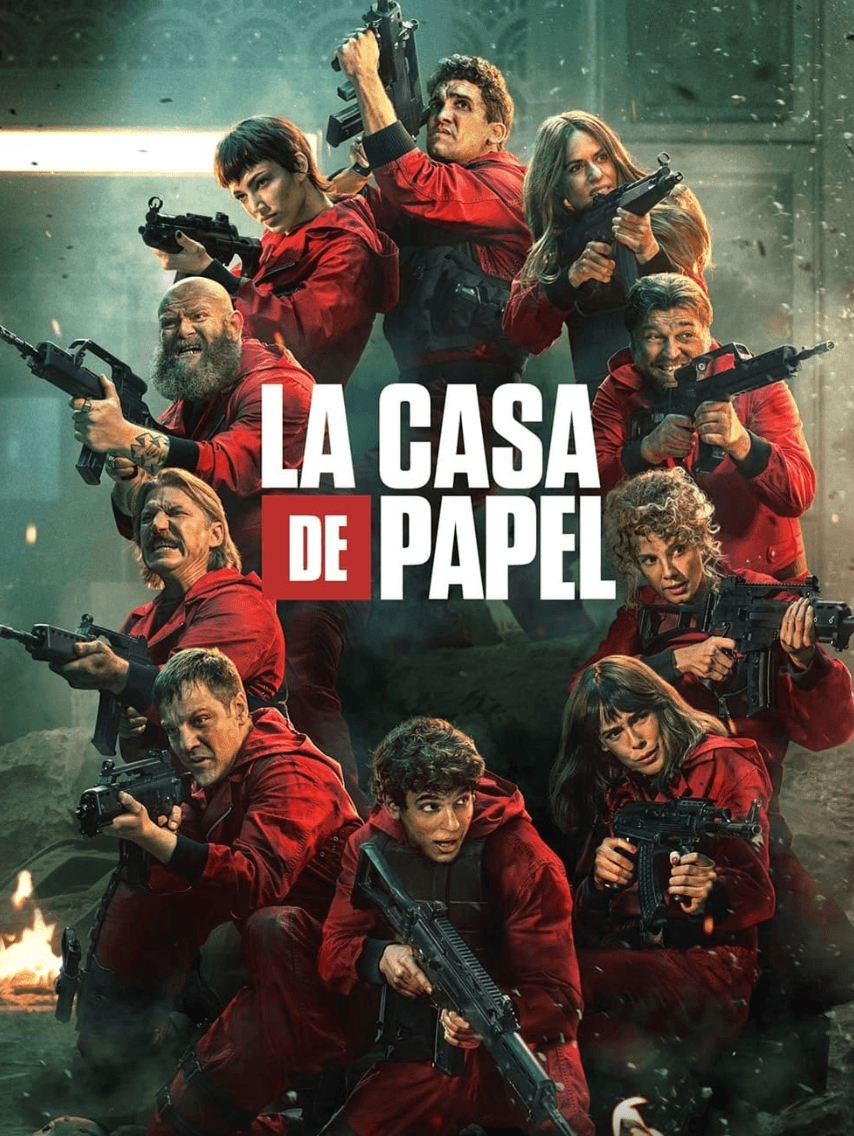
La Casa de Papel
Type(s) | Crime Drama Tension | ||||||||
|---|---|---|---|---|---|---|---|---|---|
Creator | Álex Pina | ||||||||
Producer(s) | Álex Pina, Jesús Colmenar, Sonia Martínez | ||||||||
Actors | Álvaro Morte, Úrsula Corberó, Pedro Alonso, Itziar Ituño | ||||||||
Platform | Netflix | ||||||||
Number of Episodes | 41 (5 seasons) | ||||||||
Duration | Approximately 45-55 minutes | ||||||||
La Casa de Papel (Money Heist), on the surface, appears to be a heist story like, but it is far more than a mere construct of plans and masks. At the center of the series, the character known as “The Professor” and the group assembled around him transcend the narrative frameworks of classical crime to become representatives of an ideology. The series begins with the first raid on the Royal Mint of Spain and continues with further operations. Yet its true building lies in its deepening social, political, and psychological dimensions that unfold with each season.
Screenplay shapes events not only through logic but also through the emotional highs and lows of its characters. Just as much as the technique of the plan, the psychological makeup of those executing it aims to captivate the viewer. Particularly, the tension between “cold calculation” and “sudden instinct” becomes a central theme in many episodes.
The red jumpsuits and Salvador Dalí masks of La Casa de Papel are not merely visual choices but explicit political statements. Dalí’s anti-capitalist views, the source of the masks, merge with the rebellion depicted in the story. The anthem “Bella Ciao” is not simply background music; it is an ideological symbol embodying the series’ rebellious nature.
The series engages with systems of target, while also touching on layers such as moral certainties, power relationships, and people-state conflicts. Armed resistance here is not merely a physical vehicle but a symbolic transformation maneuver. Each Main character is part of this rebellion not only through their assigned role but through their pasts and traumas.
One of the series’ most prominent features is its character development. While early seasons focus on the mechanics of the plan, later episodes place increasing emphasis on the characters’ personal inner conflicts, histories, and transformations. Tokyo’s role as narrator, in particular, aims to infuse this structure with emotional depth. Tokyo was not originally intended for this role, but the team’s desire to create a more balanced narrative structure led to this choice.
The Professor, on one hand, assumes the role of a cold and strategic brain, yet time he also experiences moments of vulnerability. This fragility elevates him beyond the classic “genius criminal” archetype. Other characters—particularly Berlin, Nairobi, Denver, and Palermo—contribute to this evolution through their own internal dynamics.
The production process of La Casa de Papel is one of the key factors behind its success. The first two seasons were filmed solely in Madrid with a humble budget. However, with the arrival of Netflix, the series was elevated to an together production scale, incorporating special islands, exotic recording locations, and high-budget scenes.
The costumes used in the series carry a unique importance. Over 600 red tulum had to be resewn due to the demands of action sequences and repeated use. Although much of the action is set in the Royal Mint, the majority of filming took place not on location but in the building of the Madrid City Council.
Upon its initial release, the series received low ratings and nearly faced cancellation, but its acquisition by Netflix led to an unexpected international success. By 2020, it had become Netflix’s most-watched series, accumulating over 65 million views.
This success must be understood not only as the result of its technical structure but also as the outcome of universal themes that resonated with viewers. Concepts such as rebellion, justice, solidarity, and individual freedom have inspired real protests in many countries; the series’ symbols have been adopted in social movements.
Dee, Lenny. “15 Interesting Facts You Didn’t Know About Money Heist.” *Screen Rant*. Accessed March 27, 2025. https://screenrant.com/interesting-facts-about-money-heist.
IMDb. "La casa de papel (TV Series 2017–2021)." Accessed March 27, 2025. https://www.imdb.com/title/tt6468322.
Jain, Gunjan. “La Casa De Papel: Review.” Medium. Accessed March 27, 2025. https://medium.com/@gunjanofficial/la-casa-de-papel-review-8bee5040e5d7.
Netflix Türkiye. "La Casa de Papel | Fragman." YouTube video. Accessed March 27, 2025. https://www.youtube.com/watch?v=VSgm-gcP_GU.

La Casa de Papel
Type(s) | Crime Drama Tension | ||||||||
|---|---|---|---|---|---|---|---|---|---|
Creator | Álex Pina | ||||||||
Producer(s) | Álex Pina, Jesús Colmenar, Sonia Martínez | ||||||||
Actors | Álvaro Morte, Úrsula Corberó, Pedro Alonso, Itziar Ituño | ||||||||
Platform | Netflix | ||||||||
Number of Episodes | 41 (5 seasons) | ||||||||
Duration | Approximately 45-55 minutes | ||||||||
No Discussion Added Yet
Start discussion for "Money Heist (TV Series)" article
A Political and Aesthetic Rebellion
Character Evolution and Emotional Weight
Production Process, Symbols, and Details
Global Impact and Lasting Legacy