


This article was automatically translated from the original Turkish version.
+1 More
Ministry of Culture and Tourism of the Republic of Türkiye. “Aya Thekla Manastırı - Mersin.” Türkiye Kültür Portalı. Accessed 20 June 2025. https://www.kulturportali.gov.tr/turkiye/mersin/gezilecekyer/aya-thekla-manastiri.
Period(s) | 4th and 6th centuries | ||||||||
|---|---|---|---|---|---|---|---|---|---|
Structure(s) | Basilica cistern bathhouse domed church underground church | ||||||||
Feature(s) | Corinthian-capital columns mosaic floor cradle vault | ||||||||
Archaeological Excavations | Ernst Herzfeld, Samuel Guyer (1907) | ||||||||
Aya Thekla Monastery is located within the boundaries of the Silifke district of Mersin Province in Türkiye and is one of the significant centers of Christian history. During the pagan era, the region was associated with the temple of Athena Kannetis; following the adoption of Christianity, it became linked with Saint Thekla. The underground church, constructed in the 4th century, and the church ruins built above it in the second half of the 5th century form the foundational structures of the settlement during the Christian period.

Aya Thekla Monastery (Türkiye Culture Portal)
Thekla, a disciple of St. Paul, one of the apostles of Jesus Christ, arrived in Silifke around AD 55 and engaged in missionary activities to spread Christianity. As pagan persecution intensified, Thekla recognized the threat to her life and took refuge in a cave in the Seleucia region, where she continued to promote the Christian faith. It is believed that Thekla performed miracles and ultimately disappeared from the cave after narrowly escaping death. The cave where Thekla sought refuge was used as a secret place of worship until Christianity was officially recognized in AD 312 and was converted into a church by the end of the 4th century.
The Meryemlik settlement comprises a large complex of structures including basilica-plan churches, cisterns, baths, and cemeteries. The main church measures approximately 80 meters in length and 36.80 meters in width and consists of three naves supported by fifteen columns. The floor is adorned with opus sectile-style mosaics in black, white, and red colors. To the east of the church is a cistern measuring 14.40 meters in length and 11.10 meters in width, divided into three sections by two rows of columns. Additionally, the settlement contains a square-plan bath constructed from cut stone, measuring 18.5 by 15 meters.
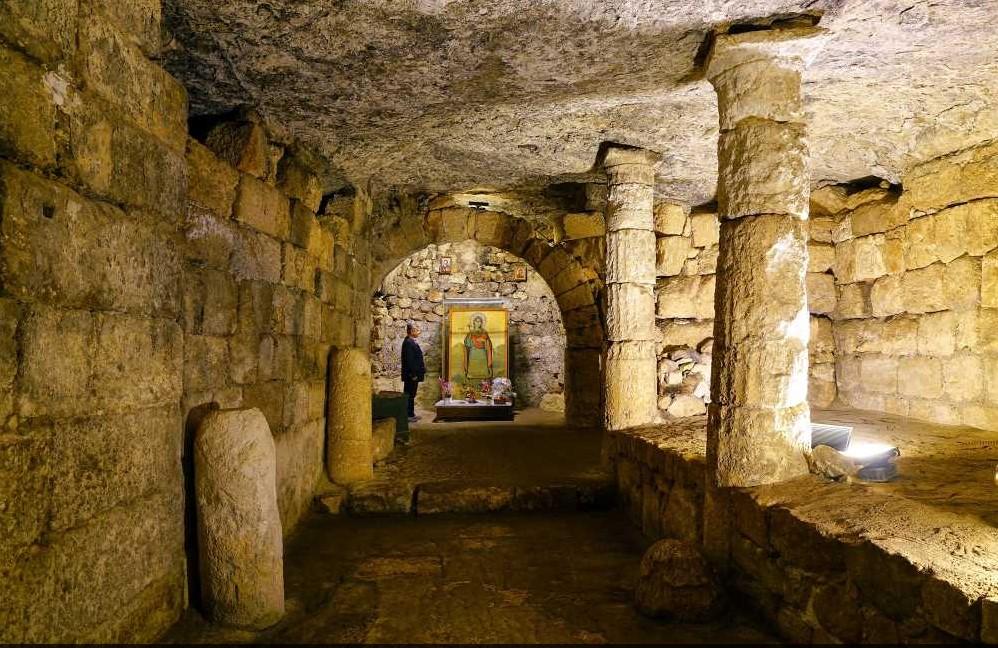
The underground church is situated to the east of the basilica plan and was built in the 4th century. It is divided into three naves by columns with Corinthian capitals. To its east lies a semicircular apse with small chapels on either side. The western section of the church contains a rectangular space. To the north of the underground church stands the Dome Church, a structure covered by a dome and barrel vaults. This building was commissioned by the Eastern Roman Emperor Zeno in the second half of the 5th century and holds significant importance in art history as an early example of the fusion of the basilica plan with a dome.

Aya Thekla Monastery (Türkiye Culture Portal)
The cave where Saint Thekla lived has been regarded as sacred in the Christian world, and Thekla is recognized as one of the first female martyrs of Christianity. The settlement has served as an important place of worship since the clandestine period of Christianity. During the 4th and 5th centuries, the construction of numerous buildings transformed it into a major religious center. The basilica and other structures commissioned by Emperor Zeno enhanced the region’s status as a pilgrimage site. Every year on September 24, a commemorative ceremony is held in the underground church in honor of Thekla, who is venerated as a saint by the Orthodox Church.

Aya Thekla Monastery (Türkiye Culture Portal)
In 1907, Ernst Herzfeld and Samuel Guyer dated the structures in the region to the 5th century. The architecture of the Dome Church is regarded as a significant milestone in the development of architectural techniques later used in the construction of Hagia Sophia in Istanbul, as it represents one of the earliest examples of the integration of a dome with a basilica plan. The cisterns, baths, and remains of fortification walls found at the site also provide valuable insights into the social and cultural structure of the period.
Akmaz, Abdullah. “Aya Tehkla Manastırı.” Türkiye Turizm Ansiklopedisi, 2020. Accessed June 20, 2025. https://turkiyeturizmansiklopedisi.com/aya-tehkla-manastiri.
Bakar, Nur and Demir, Özkan. “Tarihi Yapıların Tarih, Kültür ve İnanç Turizmine Etkileri: Silifke Örneği.” In N. Kozak and B. Özdemir (Eds.), 2. Disiplinlerarası Turizm Araştırmaları Kongresi, pp. 648-670. Ankara: Anatolia Turizm Araştırmaları Dergisi, 2012. Accessed June 20, 2025. https://anatoliajournal.com/turizmkulliyati/ulusalkongreler/disiplinlerarasi2.pdf.
Ministry of Culture and Tourism of the Republic of Türkiye. "Aya Thekla Monastery - Mersin." *Türkiye Kültür Portalı.* Accessed June 20, 2025. https://www.kulturportali.gov.tr/turkiye/mersin/gezilecekyer/aya-thekla-manastiri.
Turkish Museums. "Mersin Aya Tekla Örenyeri." Turkish Museums. Accessed June 20, 2025. https://www.turkishmuseums.com/museum/detail/2160-mersin-ayatekla-orenyeri/2160/1.

Ministry of Culture and Tourism of the Republic of Türkiye. “Aya Thekla Manastırı - Mersin.” Türkiye Kültür Portalı. Accessed 20 June 2025. https://www.kulturportali.gov.tr/turkiye/mersin/gezilecekyer/aya-thekla-manastiri.
Period(s) | 4th and 6th centuries | ||||||||
|---|---|---|---|---|---|---|---|---|---|
Structure(s) | Basilica cistern bathhouse domed church underground church | ||||||||
Feature(s) | Corinthian-capital columns mosaic floor cradle vault | ||||||||
Archaeological Excavations | Ernst Herzfeld, Samuel Guyer (1907) | ||||||||
No Discussion Added Yet
Start discussion for "Monastery of Saint Thecla" article
The Life of Saint Thekla and Her Influence on the Region
Architectural Features and Complex
Religious and Cultural Significance
Archaeological Assessment