


This article was automatically translated from the original Turkish version.
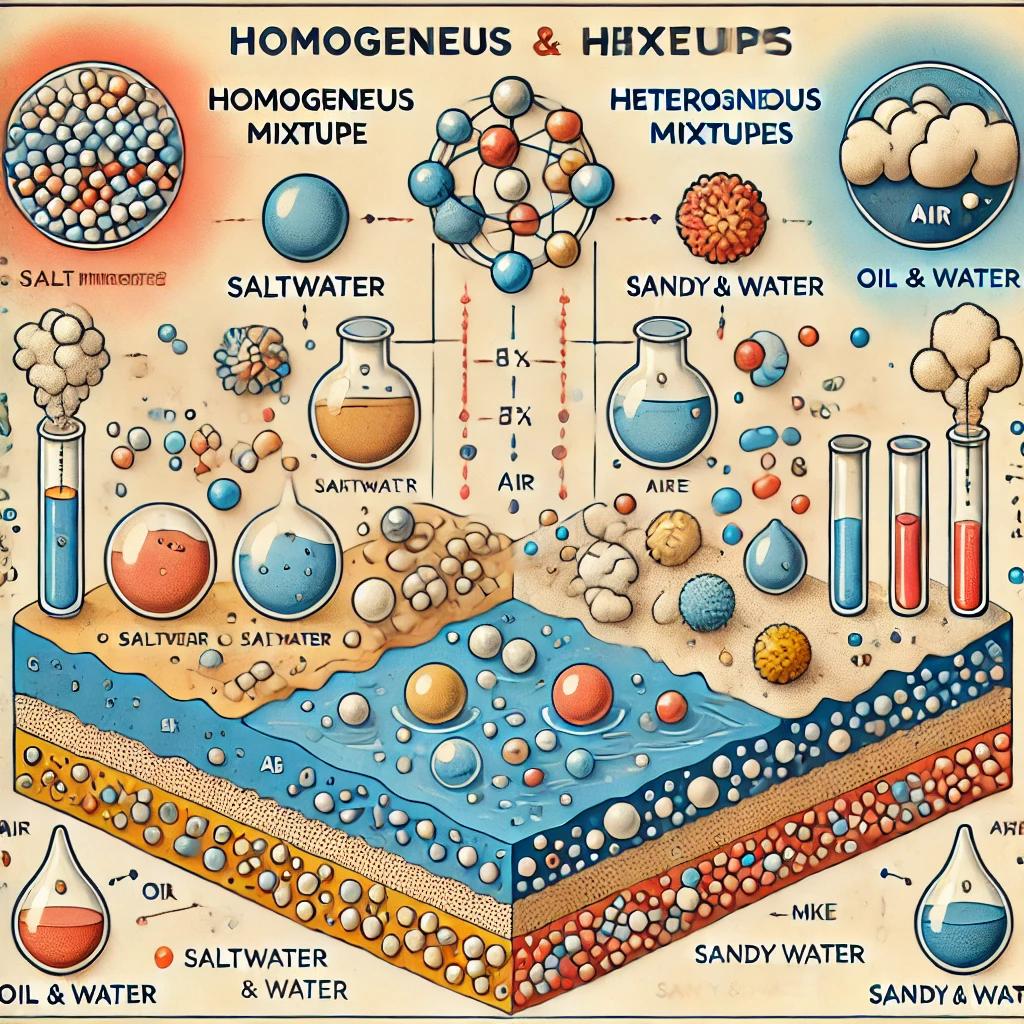
Mixing Examples
Homogeneous Mixture | Sugar water, Soda, Air, Phlegm | ||||||||
|---|---|---|---|---|---|---|---|---|---|
Heterogeneous Mixture | Blood, Fog, Cloud, Oil paint, Olive oil water, Diesel water | ||||||||
Mixture is a collection of substances formed by the combination of different types of atoms and molecules. Pure substances consist of either a single element or a single compound but most substances are neither a single element nor a single compound. Many objects we encounter in daily life are not pure and belong to the category of mixtures. For example, the air we breathe, the chocolate we eat, and the milk we drink are all examples of mixtures.
The components are uniformly distributed throughout. They consist of a single phase. These types of mixtures are also called solutions. They can arise from interactions between solid-solid, liquid-gas, gas-gas and other substance combinations.
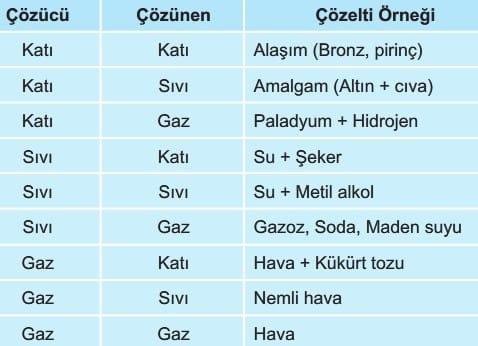
Solutions of substances under different physical conditions-Eokultv
Heterogeneous mixtures are those in which the composition is not uniform throughout, the components are not evenly distributed, and the substances do not dissolve in one another. They consist of multiple phases. Examples include sand in water, ink, fog, chalk dust in water, and oil in water. When one substance in a mixture is dispersed within another, the dispersed substance is called the dispersed phase and the substance in which it is dispersed is called the dispersion medium. Heterogeneous mixtures are classified according to the physical states of the dispersion medium and the dispersed phase:
Mixtures in which both the dispersion medium and the dispersed phase are liquids are called emulsions. Examples include water-oil mixtures, water-diesel mixtures, milk, and mayonnaise.
Mixtures in which the dispersion medium is a liquid and the dispersed phase is a solid are called suspensions. Examples include chalk in iodine water, muddy water, sand-water, and ayran. In these mixtures, the solid phase settles over time due to gravity.
Heterogeneous mixtures in which the dispersion medium is a gas and the dispersed phase is a solid or liquid are called aerosols. If the dispersed phase is solid, it is called a solid aerosol; if it is liquid, it is called a liquid aerosol. Fog, spray, insect sprays, deodorants, and clouds are liquid aerosols. Smoke and dusty air are solid aerosols.
These are solid-solid heterogeneous mixtures. In simple mixtures, it is not possible to distinguish between the dispersed and dispersion phases. Examples include sand-sugar, salt-sugar, rice-bulgur, soil, and nut mixtures.
These are mixtures in which a solid or liquid is suspended in a liquid or gas, appearing homogeneous to the naked eye but actually heterogeneous. They can be identified by the scattering of a beam of light in all directions or by microscopic observation, since homogeneous mixtures do not scatter light. The majority of emulsions and aerosols are also colloids. Examples include milk, smoke, mayonnaise, cream, jelly, soapy water, and blood.
Bikifi. "Heterojen Karışımlar." Accessed March 1, 2025.https://bikifi.com/biki/heterojen-karisimlar.
Bingöl Üniversitesi. "Genel Kimya Ders Sunumları." Accessed March 1, 2025.https://www.bingol.edu.tr/documents/Genel%20kimya%20Ders%20Sunumlar%C4%B1.pdf.
Bingöl Üniversitesi. "VI ve VII Hafta." Accessed March 1, 2025.https://www.bingol.edu.tr/documents/VI%20ve%20VII%20Hafta.pdf.
Eokul TV. "Karışımların Sınıflandırılması." 10. Sınıf. Accessed March 1, 2025.https://www.eokultv.com/karisimlarin-siniflandirilmasi-10-sinif/30628.

Mixing Examples
Homogeneous Mixture | Sugar water, Soda, Air, Phlegm | ||||||||
|---|---|---|---|---|---|---|---|---|---|
Heterogeneous Mixture | Blood, Fog, Cloud, Oil paint, Olive oil water, Diesel water | ||||||||
General Properties of Mixtures
Homogeneous Mixtures
Heterogeneous Mixtures
Emulsion
Suspension
Aerosol
Simple Mixture
Colloid