


This article was automatically translated from the original Turkish version.

In daily life, we often speak with great confidence on many topics.
Why does the air become cold, how do plants grow, how do electrical circuits work, or why do the phenomena we see in the sky occur???…

The Formation Process of Conceptual Misconceptions in Early Childhood (Generated by Artificial Intelligence)
We frequently give quick and seemingly logical answers to such questions. However, some of these answers may not fully align with scientific facts. It is precisely at this point that conceptual misconceptions arise.
Conceptual misconceptions occur when a concept is understood or interpreted differently from its scientific meaning. The human mind, when learning new information, tends to relate it to what it already knows. While this process often facilitates learning, it can sometimes lead to incorrect conclusions.
Children, in particular, may interpret certain concepts differently from their scientific meaning by combining expressions they hear from their environment, everyday observations, and their own reasoning.
Conceptual misconceptions often form unnoticed within daily life. For example, some people believe that heavier objects fall faster than lighter ones. Although everyday observation may seem to confirm this at first glance, scientifically the key factor determining falling speed is gravitational acceleration; in the absence of air resistance, all objects fall at the same rate.
Similarly, the idea that “a cold object gives off temperature” is a common misconception. Physically, heat is energy transferred from a warmer object to a cooler one. Expressions used in everyday language can sometimes lead to misunderstandings of these concepts.

Conceptual Misconceptions in Astronomy (Generated by Artificial Intelligence)
Similarly, the changing shape of the Moon, known as its phases, is sometimes mistakenly thought to be caused by the Earth’s shadow falling on the Moon. In reality, this occurs only during a lunar eclipse; the Moon’s phases result from its reflection of sunlight at different angles.
Celestial phenomena are also a common area where conceptual misconceptions arise. For instance, some students may attribute the seasons to the Earth being sometimes closer to and sometimes farther from the Sun. In fact, the primary cause of the seasons is the tilt of the Earth’s axis. Due to this tilt, different regions receive sunlight at varying angles throughout the year.
Conceptual misconceptions often arise not only from verbal explanations but also from visual representations. Schematics, drawings, and symbolic models used in educational materials leave strong impressions in students’ minds. However, when these visuals fail to accurately represent reality, they can lead to incorrect perceptions that are not only conceptual but also can be termed “visual misconceptions”.
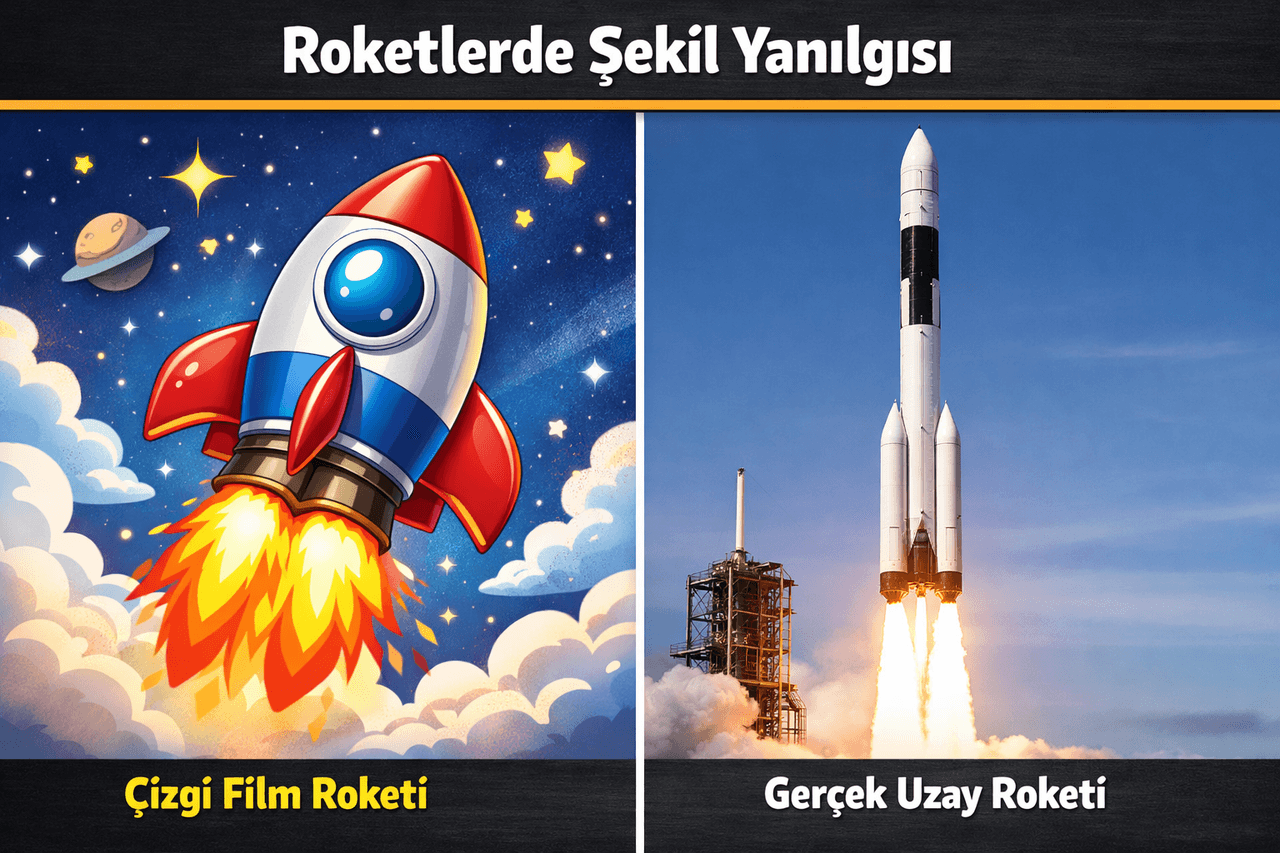
Example of Visual Misconception in Rocket Drawings (Generated by Artificial Intelligence)
In recent years, rocket drawings frequently seen in social media posts and some educational materials provide a striking example. In most such images, rockets are depicted with short bodies, wide wings, large flames emerging from the bottom, and a cartoon-like aesthetic. In reality, actual space rockets differ significantly from these depictions. Real rockets typically have long, cylindrical bodies, and due to aerodynamic design, their wings are either very small or absent entirely in some models. Moreover, the flame visible beneath rockets is only the result of exhaust gases during launch and is rarely as large or continuous as shown in drawings.
Such visuals can create lasting but inaccurate mental schemas of what a rocket “looks like.” When students later encounter actual rocket photographs, they may experience conceptual dissonance, believing the real vehicle does not match their expected image of a rocket.
Visual misconceptions can also hinder students’ ability to develop realistic and functional models during engineering design processes. Established incorrect visual schemas can limit students’ capacity to generate original and scientifically grounded design ideas, negatively affecting the development of creative engineering thinking.
It is crucial that visuals used in educational materials be as realistic, accurately scaled, and scientifically grounded as possible. Otherwise, students may learn not only incorrect concepts but also incorrect visual representations of those concepts. In science education, correctly visualizing a concept is as important as understanding the concept itself.
Several fundamental reasons explain the prevalence of conceptual misconceptions. People often attempt to understand complex phenomena by simplifying them. Everyday experiences, intuition, and information received from the environment strongly influence this process. Additionally, the abstract nature of some scientific concepts can make accurate understanding difficult.
In fields such as physics and astronomy, many phenomena cannot be directly observed or easily explained through everyday experience. As a result, individuals may make erroneous inferences when attempting to explain these phenomena using their own reasoning.

Conceptual Misconceptions in the Learning Process (Generated by Artificial Intelligence)
Although the term “misconception” carries a negative connotation, it is in fact a natural part of the learning process. The human mind uses existing cognitive structures to interpret new information. Recognizing and correcting an incorrect idea is a crucial step in learning.
Therefore, in educational settings, simply presenting correct information is insufficient. It is necessary to bring students’ existing ideas to light, understand the reasons behind their incorrect interpretations, and then reconstruct these ideas using scientific explanations.
The most effective way to reduce conceptual misconceptions is to develop scientific thinking skills. Observing, asking questions, seeking evidence, and comparing alternative explanations are fundamental components of this process. Scientific knowledge is not merely memorized information; it is a system of understanding that is questioned, tested, and revised when necessary.
Rather than being certain about a topic, it is often more valuable to ask:
“Is what I believe actually true?”
Because often, the beginning of learning starts with the realization that something we thought we knew might be incomplete or incorrect.
Addido, Johannes, Andrea C. Burrows, and Timothy F. Slater. “The Effect of the Conceptual Change Model on Conceptual Understanding of Electrostatics.” *Education Sciences* 12, no. 10 (2022): 696. Accessed March 16, 2026. https://doi.org/10.3390/educsci12100696
Aydoğan, Şaban, and Ela Ayşe Köksal. “İlköğretim Fen Eğitiminde Kavram Yanılgıları Konusunda Yapılan Çalışmaların İçerik Analizi.” *Eğitimde Kuram ve Uygulama* 13, no. 2 (2017): 232–260. Accessed March 16, 2026. https://dergipark.org.tr/tr/pub/eku/issue/28997/310220
Heller, Andrew. “Conceptual Change in Science Teaching and Learning: The Role of Pre-Instructional Conceptions.” *Learning to Teach Through Research and Practice*. Accessed March 16, 2026. https://openjournals.utoledo.edu/index.php/learningtoteach/article/view/584.
Misconceptions Formed Unconsciously in Daily Life
An Example from Astronomy
Visual Misconceptions
Why Are Conceptual Misconceptions So Common?
The Role of Misconceptions in the Learning Process
The Importance of Scientific Thinking