


This article was automatically translated from the original Turkish version.
+1 More
The Minamata Disaster is an environmental and public health catastrophe caused by the transfer of methylmercury (CH₃Hg⁺) pollution from industrial processes into the food chain, affecting humans and ecosystems around Minamata Bay on Japan’s Kyushu Island. The condition was first identified in the 1950s among local populations consuming fish and shellfish, presenting with severe neurological symptoms and entering the literature as “Minamata Disease.” The disease also encompasses a congenital form resulting from fetal exposure during pregnancy.
The disaster stands as a landmark case in environmental health history due to the bioaccumulation and biomagnification of chemical pollutants in marine organisms, leading to permanent neurotoxicity in humans. The health sciences literature examines Minamata at the intersection of toxicology, epidemiology, neurology, and environmental policy; the event later served as a model for national and international regulations.
The first warning signs emerged as abnormal behaviors observed in cats around Minamata—known as the “dancing cats”—alongside mass deaths of birds and fish, followed by neurological symptoms in humans including loss of balance, visual impairment, and speech disturbances. Reports from local physicians and field observations indicated that the phenomenon was likely foodborne and specifically linked to seafood consumption.
As field investigations progressed, it became clear that methylmercury compounds generated in industrial wastewater were being discharged into the bay and accumulating along the trophic chain from benthic organisms to plankton, fish, and ultimately humans. This finding, combined with the chemical’s lipophilic nature and high affinity for the central nervous system, explained the widespread prevalence and severity of the clinical presentation.
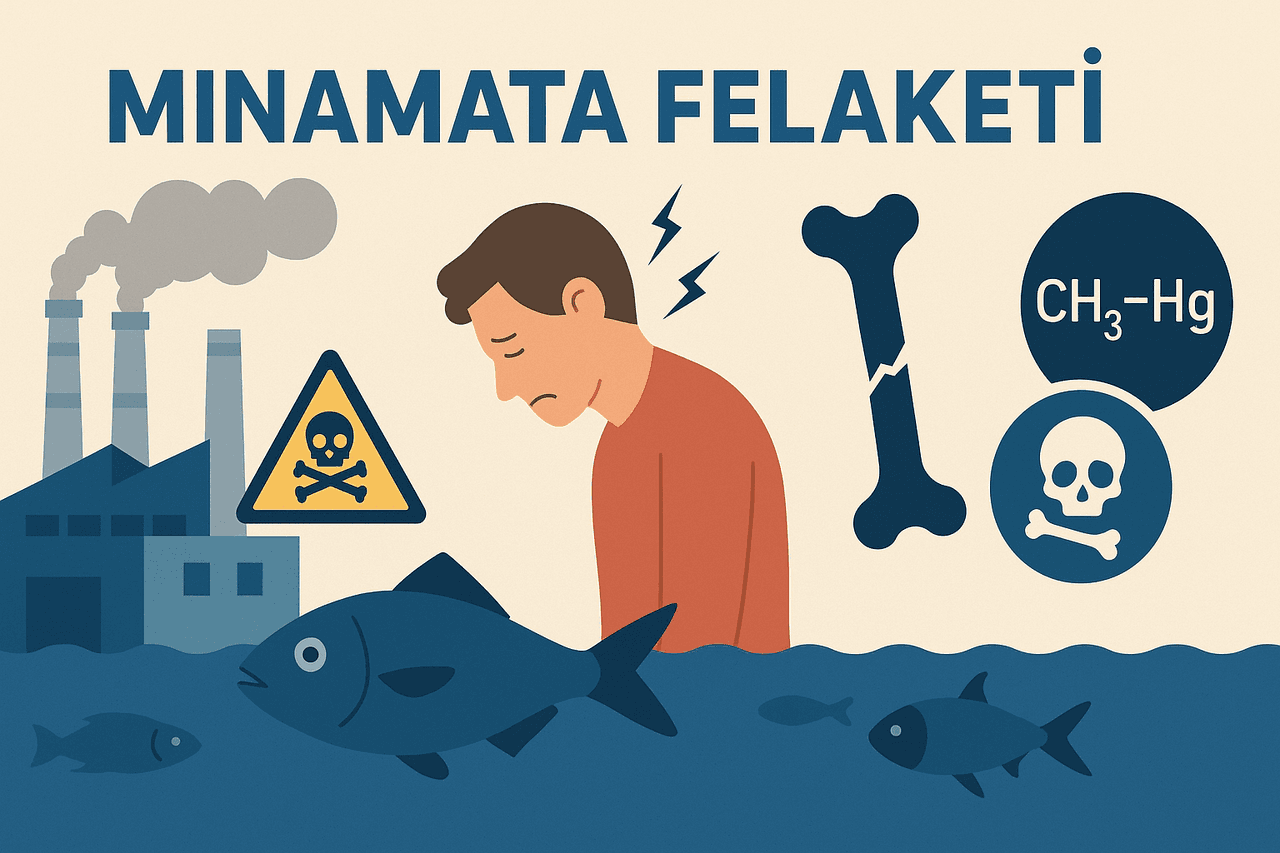
Minamata Disaster (Generated by Artificial Intelligence)
Methylmercury is a potent neurotoxin capable of effectively crossing the blood-brain barrier and the placenta. The molecule accumulates in the body, particularly in nervous tissue, causing selective damage to regions such as Purkinje cells, visual pathways, and the somatosensory cortex. This selectivity accounts for the characteristic clinical pattern of visual field constriction, ataxia, and dysarthria.
The primary route of exposure is chronic consumption of seafood. Methylmercury concentrations increase with higher trophic levels in the marine food web; long-lived predatory fish exhibit the highest burdens. Consequently, dietary differences within the same community significantly influence interindividual clinical variability.
Bioaccumulation patterns observed in benthic and pelagic species of Minamata Bay document the widespread and persistent impact of methylmercury in marine biota. Accumulation increases across trophic levels, from bivalves such as oysters and mussels to predatory fish. This has left deep marks not only on human health but also on the region’s fishing economy and food safety.
Remediation of ecological damage required multi-layered interventions including source control (cessation of discharges), management of contaminated sediments, and consumption advisories. Long-term monitoring programs were designed to assess persistent downward trends in sediment and biota samples; however, eliminating residual risk has taken considerable time.
The technical backdrop of the disaster lies in the formation of organomercury compounds as byproducts or through catalytic processes during industrial production, followed by their discharge into aquatic environments without adequate treatment. The incident demonstrated that focusing solely on total mercury parameters in wastewater management is insufficient; chemical speciation analysis and separate monitoring of bioavailable forms—particularly methylmercury—are essential.
It was also recognized that risk assessments failing to account for the long-term environmental fate of wastewater—such as sediment binding, resolubilization, and methylation/demethylation processes—could falsely portray the site as safer than it actually was. The Minamata experience played a standardizing role in promoting preventive measures for industrial facilities, including process modifications, closed-loop systems, and advanced treatment technologies.
The Minamata case is exemplary in addressing compensation for environmental pollution and public health harm, formal recognition of victimhood, and legal attribution of responsibility. The process unfolded through victim petitions, medical evaluations, administrative and judicial rulings, and the establishment of compensation mechanisms. Over time, debates arose regarding the criteria and scope of victim designation; social and legal pressure played a decisive role in adopting more inclusive policies.
The risks of deregulation and the precautionary principle became prominent in this case. The disaster contributed to strengthening national instruments such as emission standards, discharge permits, environmental monitoring, and food safety alert systems. At the international level, it became a reference point for global policy frameworks targeting the management of mercury and its compounds in production, use, and emissions.
From a public health perspective, the response encompassed not only strengthening medical care but also risk communication and behavioral interventions. In Minamata, consumption advisories regarding seafood, promotion of alternative protein sources, and culturally sensitive public education proved critical. Training of health workers, development of early warning systems, and enhancement of laboratory capacity were also lasting achievements.
Socioeconomically, the region faced a decline in fishing activities, reputational damage, and reduced income. In the long term, rehabilitation programs, economic incentives, and environmental restoration projects helped rebuild livelihoods. Educational, employment, and care support for victims served as practical applications of the “social determinants of health” approach.
Minamata accelerated research into environmentally induced neurotoxicity; parallel advances were made in experimental modeling and ecotoxicological monitoring methods. Hair and blood biomarkers have become standard tools for elucidating dose-response relationships and exposure timing.
On the ethical plane, the case brought to the forefront principles of informed consent, environmental justice, and intergenerational responsibility. The principles of “non-maleficence” and “beneficence” have been adopted not only in clinical practice but also in industrial and administrative decision-making; norms of transparency and accountability in the public interest have been strengthened.
Anadolu Ajansı. “İç Savaşlara Yol Açan Çevresel Felaketler Yeni Endüstriyel Standartlar Kazandırdı.” Accessed September 28, 2025. https://www.aa.com.tr/tr/dunya/ic-savaslara-yol-acan-cevresel-felaketler-yeni-endustriyel-standartlar-kazandirdi/3386317
Aslıyüce, Sevgi, and Adil Denizli. “Tokyo Cıva Zehirlenmesi Kurbanları Giderek Artıyor.” Bioreg Bilim, February 2021. Accessed September 28, 2025. https://www.bioreglab.org/site/assets/files/1936/bioreg_bilim_3.pdf
Environmental Ministry of Japan. “Minamata Disease The History and Measures - Chapter 4”. Accessed September 28, 2025. https://www.env.go.jp/en/chemi/hs/minamata2002/ch4.html
HG-NIC. "History of Mercury Poisoning." Accessed September 28, 2025. https://www.hg-nic.com/history-of-mercury-poisoning/
Kayhan, Ali Kerem. “Cıva Tehlikesi ile Mücadelede Küresel Uzlaşı: Minamata Sözleşmesi.” Marmara Üniversitesi Hukuk Fakültesi Hukuk Araştırmaları Dergisi, Volume 28, Issue 2, December 2022. Accessed September 28, 2025. https://dergipark.org.tr/tr/download/article-file/2625726
Kugler, Mary. “Minamata Disease: Causes, Symptoms, and Treatment.” Verywell Health. Accessed September 28, 2025. https://www.verywellhealth.com/minamata-disease-2860856
McCurry, Justin. “Minamata Disease.” The Lancet. Accessed September 28, 2025. https://www.thelancet.com/journals/lancet/article/PIIS0140-6736(06)67944-0/fulltext
Millar, Helen. “Minamata Disease.” Medical News Today. Accessed September 28, 2025. https://www.medicalnewstoday.com/articles/minamata-disease


Historical Background and Discovery
Pathophysiology and Exposure Pathways
Ecotoxicology and Ecosystem Impacts
Industrial Processes and Waste Management
Legal Proceedings, Compensation, and Regulatory Outcomes
Public Health, Risk Communication, and Socioeconomic Impacts
Scientific and Ethical Legacy