


This article was automatically translated from the original Turkish version.
Musical Instrument Digital Interface (MIDI) is a symbolic music representation format and protocol that enables communication between electronic musical instruments and computers to facilitate musical composition and editing. Designed primarily for Western music, this system is based on the 12-tone equal temperament scale in which each semitone corresponds to one step. MIDI is a standard that transmits performance data as digital messages rather than recording sound itself; it conveys information such as when a note is played, how long it is held, its intensity, and which instrument timbre is used. Historically, MIDI has transformed the use of electronic technologies in music production and performance alongside synthesizers and digital audio processing technologies.
MIDI data follows an architecture in which various messages are serially read and recorded across 16 distinct channels. The basic data format consists of a "status byte" followed by one or two "data bytes." The first four bits of the status byte indicate whether a note is turned on or off, while the second four bits determine the channel through which the message is sent. The data bytes transmit numerical values such as which note is played and at what velocity.
MIDI messages are classified into four main categories based on their functions:
The pitch bend message allows representation of pitches outside the standard MIDI notes defined for Western music. This feature enables MIDI to accommodate musical cultures with tuning systems different from the 12-tone equal temperament, such as Turkish music. The pitch bend message uses a 14-bit data structure: a value of 8192 preserves the original note, 16383 represents a full semitone upward pitch shift, and 0 represents a full semitone downward pitch shift. This system allows a full semitone to be divided into 8192 equal parts, enabling extremely high resolution.【1】
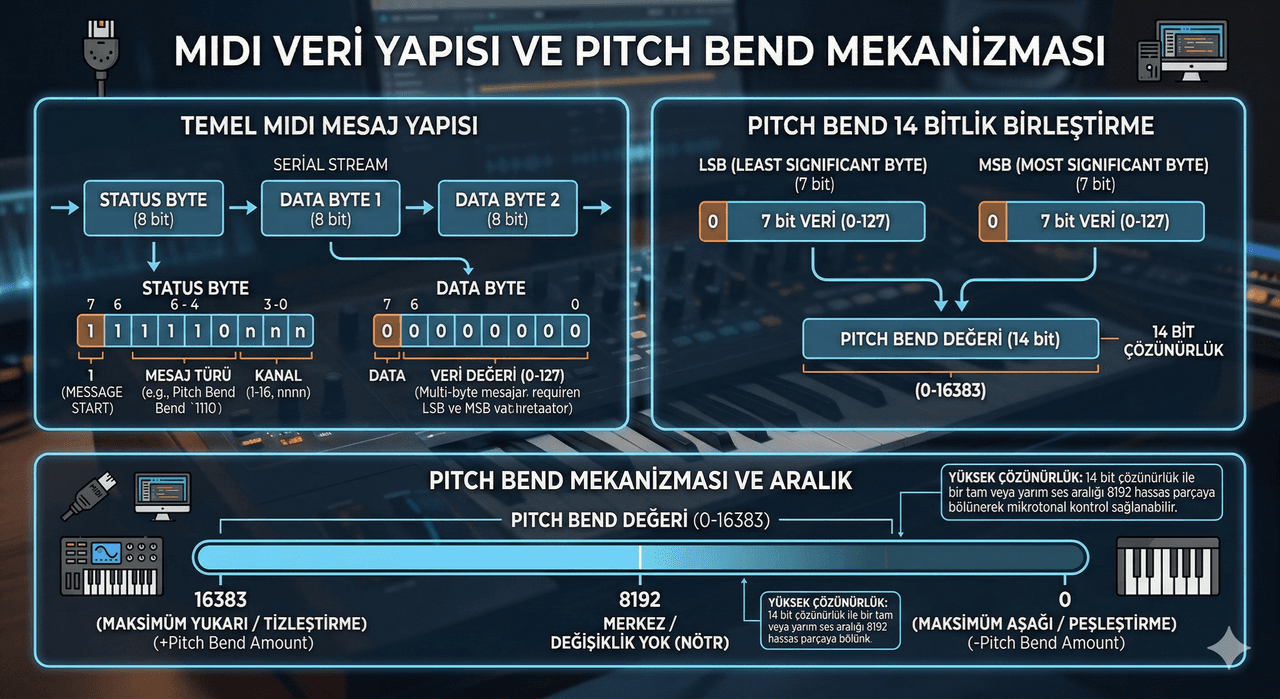
MIDI data structure and pitch bend mechanism. (Generated by artificial intelligence.)
MIDI files consist of a header chunk followed by sequences of meta events and MIDI events. Three distinct file format types are defined:
The header chunk contains information about the file format and number of tracks, while tempo and parameters for converting time in seconds into MIDI timing are managed accordingly.
The MIDI protocol forms the foundational operating principle of digital audio workstations (DAWs), notation software, and virtual instruments (VSTs). DAWs such as Ableton Live, Logic Pro, Cubase, and FL Studio process MIDI data to produce music. Additionally, MIDI editors play a critical role in accessibility tools developed for visually impaired individuals. Specialized software such as Sibelius Speaking, Lime Aloud, and CakeTalking integrate with screen reader technologies (JAWS, VoiceOver, etc.) to enable music education and production via MIDI.【3】
A significant portion of graduate research in Türkiye in the field of music technology focuses on MIDI-based technologies. Topics such as the digital transcription of Turkish makam music, automatic makam classification, MIDI-based microtonal interface design, and the use of MIDI software in music education occupy a prominent place in the academic literature.
Arıcı, İsmet. "Görme Engelliler İçin Müzik Yazılımları." Batı Anadolu Eğitim Bilimleri Dergisi 16, no. 2 (2025): 1988-2002. Accessed April 10, 2026. https://dergipark.org.tr/en/download/article-file/4491572
Delikara, Ali. "Türkiye’de Müzik Teknolojileri Alanında Yapılmış Lisansüstü Tezler." EKEV Akademi Dergisi 23, no. 79 (Summer 2019): 1–16. Accessed April 10, 2026. https://dergipark.org.tr/en/download/article-file/2583651
Gedik, Ali C. "Türk Müziği İcralarının Analizi için bir MIDI Projesi." Yedi: Sanat, Tasarım ve Bilim Dergisi, no. 10 (Summer 2013): 81–92. Accessed April 10, 2026. https://dergipark.org.tr/tr/download/article-file/203741
Karatay, Serkan. "Medyatizasyon Süreci Bağlamında Müziğin Teknolojisi, Teknolojinin Müziği." Konservatoryum - Conservatorium 12, no. 1 (2025): 275-297. Accessed April 10, 2026. https://dergipark.org.tr/en/download/article-file/4700479
[1]
Ali C. Gedik. "Türk Müziği İcralarının Analizi için bir MIDI Projesi." Yedi: Sanat, Tasarım ve Bilim Dergisi, no. 10 (Yaz 2013): 81. https://dergipark.org.tr/tr/download/article-file/203741
[3]
İsmet Arıcı. "Görme Engelliler İçin Müzik Yazılımları." Batı Anadolu Eğitim Bilimleri Dergisi 16, no. 2 (2025): 1992.https://dergipark.org.tr/en/download/article-file/4491572

No Discussion Added Yet
Start discussion for "MIDI (Musical Instrument Digital Interface)" article
MIDI Data Structure and Communication Protocol
Message Types and Control Mechanisms
Pitch Bend and Pitch Representation Capacity
MIDI File Architecture
Software Applications and Accessibility
Academic Research and the Turkish Case