

This article was automatically translated from the original Turkish version.
+2 More
Construction Date(s)(Text) | 820–810 BCE | ||||||||
|---|---|---|---|---|---|---|---|---|---|
Location | Van | ||||||||
Purpose of Construction | Preservation of the inscription containing lists of gods and sacrifices related to the Urartian religion, sacred belief center | ||||||||
Civilization | Kingdom of Urartu | ||||||||
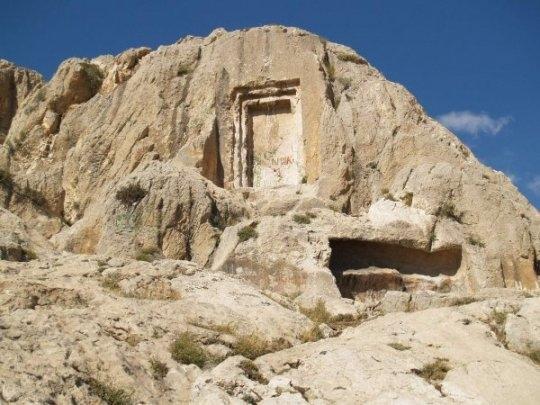
Taşkapı, also known as Meher Kapısı, is a rock niche carved into the bedrock located approximately five kilometers northeast of Van, near Akköprü Village. This structure dates to the period of the Urartian Kingdom and is regarded as one of the key sources of information about Urartian religion and belief systems due to its surface inscriptions in cuneiform script. The structure resembles a monumental gate carved from limestone bedrock, with its front facade bounded by two rectangular frames.
Taşkapı is situated near Akköprü Village in the northeastern part of Van. The structure was created by carving into a natural rock mass and takes the form of a rock niche enclosed within two vertical rectangular frames. The front surface of the gate has been carefully smoothed and assumes a rectangular shape.
The structure is approximately 2.60 meters wide and 4 meters high. The inner surface of the niche is inscribed with a total of 47 lines of Urartian cuneiform script. Directly in front of the niche, a horizontal rectangular altar has been carved into the rock for sacrificial offerings.
The inscription on Taşkapı is one of the most important texts providing information about Urartian religion. It lists the gods and goddesses considered sacred in Urartu, along with the daily offerings made to them. The text also mentions sacred mountains, rivers, and cities.
The first deity listed is Haldi, the chief god of Urartu, followed by the gods Teişeba and Šivini. It is recorded that the structure was commissioned during the reign of the Urartian kings Ishpuini and his son Menua, around 820–810 BCE, in the name of the god Haldi.
The structure is also known as Meher Kapısı. The term “Meher” is said to mean “illuminating.” According to belief, the god Haldi was thought to emerge from this site in a beam of light, which is why it bears this name.
Various folk beliefs are associated with Taşkapı. One such belief holds that the structure is a treasure gate that opens only once a year for a brief period.
According to one legend, a shepherd girl from Akköprü Village climbed the cliffs where Taşkapı is located while tending her animals. As she stood before the gate, it suddenly opened with a loud noise, revealing an interior filled with gold. The girl entered and began collecting gold, but the gate closed shortly afterward, trapping her inside. Villagers searching for her found her animals near the site but found no trace of her.
According to tradition, many animals were sacrificed in front of the gate in an attempt to rescue the girl, but the gate did not reopen. A year later, when the gate opened again, those who entered found the shepherd girl standing with her shoulders bent under a sack filled with gold, turned to stone. They quickly carried her out before the gate closed once more.
The monumental rock gate known as Meher Kapısı, located in the Tuşba district of Van, has been cleaned using methods that preserved its natural structure. Under a project prepared by the Van Provincial Directorate, the structure was entirely cleaned using mechanical techniques in accordance with the decision of the Van Conservation Board dated 4 April 2012, thereby ensuring its protection and reintroducing it to tourism.
Türkiye Kültür Portalı. "Taşkapı." Türkiye Kültür Portalı. Accessed March 16, 2026. https://www.kulturportali.gov.tr/turkiye/van/kulturatlasi/taskapi
Vaha Tuder. “Meher Kapı.” *Van Gölü Havzası Tanıtım Sayfası.* Accessed March 16, 2026. https://www.vahatuder.org.tr/van-golu-havzasi/van/tarihi-yerler-ve-dogal-guzellikler/25/meher-ka
İpekyolu Belediyesi. "Meher Kapı." *İpekyolu Municipality City Guide.* Accessed March 16, 2026. https://kentrehberi.ipekyolu.bel.tr/gezilecek-yerler/tarihi-mekanlar/meherkapi/57

Construction Date(s)(Text) | 820–810 BCE | ||||||||
|---|---|---|---|---|---|---|---|---|---|
Location | Van | ||||||||
Purpose of Construction | Preservation of the inscription containing lists of gods and sacrifices related to the Urartian religion, sacred belief center | ||||||||
Civilization | Kingdom of Urartu | ||||||||
Location and Architectural Features
Urartian Religion and Inscription
Naming and Meaning
Legends
Conservation and Recent Work