


This article was automatically translated from the original Turkish version.
Mechanism technology is an engineering discipline that deals with the analysis and design of mechanical systems used to transmit, transform, and direct motion and force. Mechanisms are formed by connecting rigid bodies through joints (kinematic pairs) in a specific arrangement. These structures convert externally applied motion or force into a different output form based on the system’s geometric configuration.
A mechanism is typically regarded as a fundamental functional subunit within a machine. For example, in a printer, the paper feeding system and the crank-slider mechanism of an engine are both examples of mechanisms. These systems do not possess inherent motion capability but operate through an external input such as a motor, force, or torque. However, through these inputs, they generate and direct mechanical motions such as rotation, translation, and oscillation.
Mechanism technology encompasses both analysis and synthesis processes. Analysis aims to determine the motion and force characteristics of an existing mechanism, while synthesis involves designing a new mechanism to perform a specific function. During analysis, calculations of position, velocity, and acceleration (kinematic analysis) as well as force and torque distributions (kinetic analysis) are performed.
A machine is a system capable of converting input energy into a specific useful work. A mechanism, on the other hand, serves to generate the necessary motion or force for that work to be performed. In other words, every machine contains at least one mechanism, but not every mechanism is a machine. Mechanisms are generally general-purpose and can be used for various tasks across different machines.
Mechanism technology is directly related to kinematics, a branch of mechanics. Kinematics examines quantities such as position, velocity, and acceleration without considering the causes of motion. Kinetics deals with the forces and torques that cause motion. In dynamic systems, these two concepts are evaluated together to determine the motion characteristics of the system.
The fundamental components of mechanisms are called links and kinematic pairs (joints). A link is a rigid element that transmits motion. A kinematic pair is a connection that constrains the relative motion between two links. These pairs are classified into two types based on the nature of contact:
The degree of freedom (F) of a mechanism is the number of independent parameters required to fully define its motion. This value can be calculated using the following formula based on the number of links and joints:
Where:
This formula applies to planar mechanisms. The degree of freedom also determines the controllability and motion capacity of the mechanism.
Kinematic chain is a collection of rigid bodies connected by kinematic pairs. When one of the links in this chain is fixed and the system becomes capable of a specific motion, it is called a mechanism. Kinematic chains are classified as follows:
Mechanisms can be categorized according to their functions and types of motion. Some fundamental types include:
Four-bar mechanism consists of three moving links connected to a fixed frame. These mechanisms are commonly used to convert rotary motion into oscillatory or linear motion. Motion analysis is performed using the Grashof Theorem. This theorem determines whether the mechanism will exhibit full rotation or oscillation based on the ratios of link lengths.
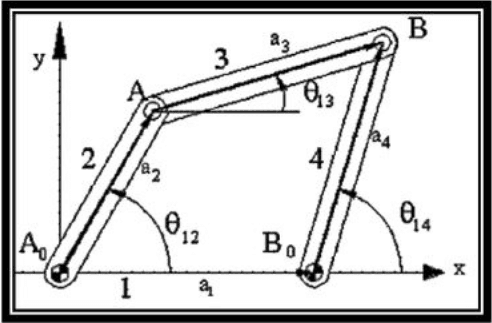
Dört Kol Mekanizması (Kaynak: Eres Söylemez)
Mechanisms appear in a wide range of engineering and everyday applications:
Abdulla, G. & Arsoy, R. 2000. "Makine Teorisi (Mekanizma Tekniği ve Makine Dinamiği)" Birsen Yayınevi, İstanbul.
Demir, Cihan. 2014. "Mekanizma Tekniği I". Makine Fakültesi, Yıldız Teknik Üniversitesi, İstanbul.Accessed Adresi.
Ministry of National Education. 2013. "Mekanizma Tekniği-4". Machine Technology. Milli Eğitim Basımevi, Ankara.
Çayıroğlu, İbrahim. 2020. "Mekanizma Tekniği Temel Kavramlar". Karabük Üniversitesi Mühendislik Fakültesi, Karabük.Accessed Adresi.

No Discussion Added Yet
Start discussion for "Mechanism Technology" article
Difference Between Mechanism and Machine
Mechanics, Kinematics, and Kinetics
Links and Kinematic Pairs
Degree of Freedom
Kinematic Chains and Mechanisms
Types of Mechanisms
Applications