


This article was automatically translated from the original Turkish version.
+1 More
History | 27 May 1960 | ||||||||
|---|---|---|---|---|---|---|---|---|---|
Took Over Governance | National Unity Committee (NUC) | ||||||||
Place of Judgment | Yassıada, High Court of Justice | ||||||||
Number of Defendants | 592 | ||||||||
Executed Persons | Fatin Rüştü Zorlu (Minister of Foreign Affairs) Hasan Polatkan (Minister of Finance) Adnan Menderes (Prime Minister) | ||||||||
Date of Restoration of Honor | 11 April 1990 | ||||||||
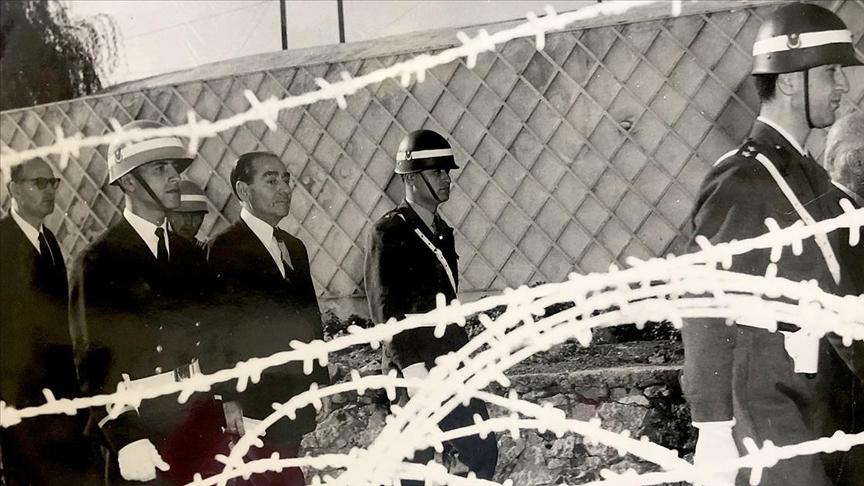
The May 27, 1960 Coup was a military intervention carried out by a group of officers within the Turkish Armed Forces who forcibly removed the ruling party of the time, the Democrat Party (DP). It was the first military coup in the history of the Republic of Türkiye, resulting in the suspension of the constitutional order, the arrest of elected government officials, and the dissolution of the Grand National Assembly of Türkiye. During this process, Prime Minister Adnan Menderes, Foreign Minister Fatin Rüştü Zorlu, and Finance Minister Hasan Polatkan were executed by court order. The coup had profound political and social consequences in Türkiye’s history and is recorded as a serious intervention against the democratic order.
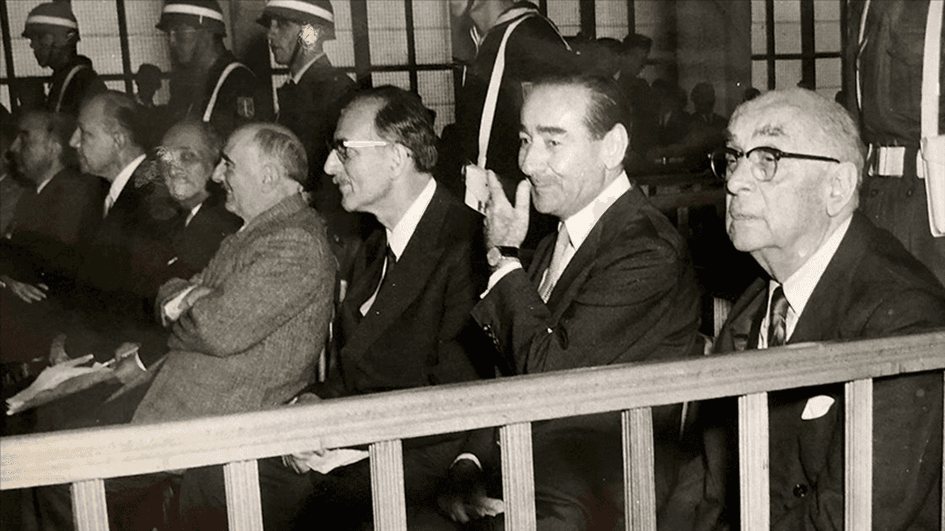
President Celal Bayar (right) and Prime Minister Adnan Menderes (left) (AA)
The DP came to power in the 1950 elections under the slogan “Enough, the Will of the Nation” and gained broad support as the first successful example of multi-party political life. Instead of the state-led economy of the CHP era, the DP adopted an economic approach that favored liberalism and private enterprise. During this period, growth based on agriculture was prioritized, and transportation and infrastructure investments were expanded with aid from the United States. Road construction projects stood out, and the private sector in industry and transportation received state support.
Alongside its economic development drive, the DP made transportation, industry, and agriculture its primary policy areas. Regulations such as Law No. 6224 on the Encouragement of Foreign Capital and the Petroleum Law were enacted to attract foreign investment, and road construction accelerated. At the same time, a decision was made to revert the call to prayer from Turkish back to Arabic, marking a significant step regarding religious freedom. A legal amendment issued on June 16, 1950, allowed the call to prayer to be recited in Arabic, and this change received widespread public support.
Türkiye During the Democrat Party Era (AA)
Incidents that began with news of a bomb being thrown at Atatürk’s house in Thessaloniki led to riots in Istanbul and İzmir. A protest against Greek Cypriots’ demand for Enosis transformed into widespread looting in Istanbul on September 6–7, 1955, placing the government in a difficult position both domestically and in foreign policy.
In an effort to improve the economy, the government reintroduced protectionist policies used during World War II with the National Defense Law. However, this approach was abandoned in 1958, and the country returned to a liberal economic model following IMF recommendations.
Following the coup, the National Unity Committee (NUC), composed of 38 officers, assumed all powers. The Grand National Assembly was dissolved, the constitution was suspended, and the activities of all political parties were halted. Military commanders were appointed to govern across the country. General Cemal Gürsel was placed at the head of the NUC and served as President, Prime Minister, and Minister of National Defense.
Internal disagreements emerged within the committee shortly after its formation. On November 13, 1960, members known as the “Fourteen” were removed from the committee. This development revealed power struggles and institutional imbalances within the NUC.
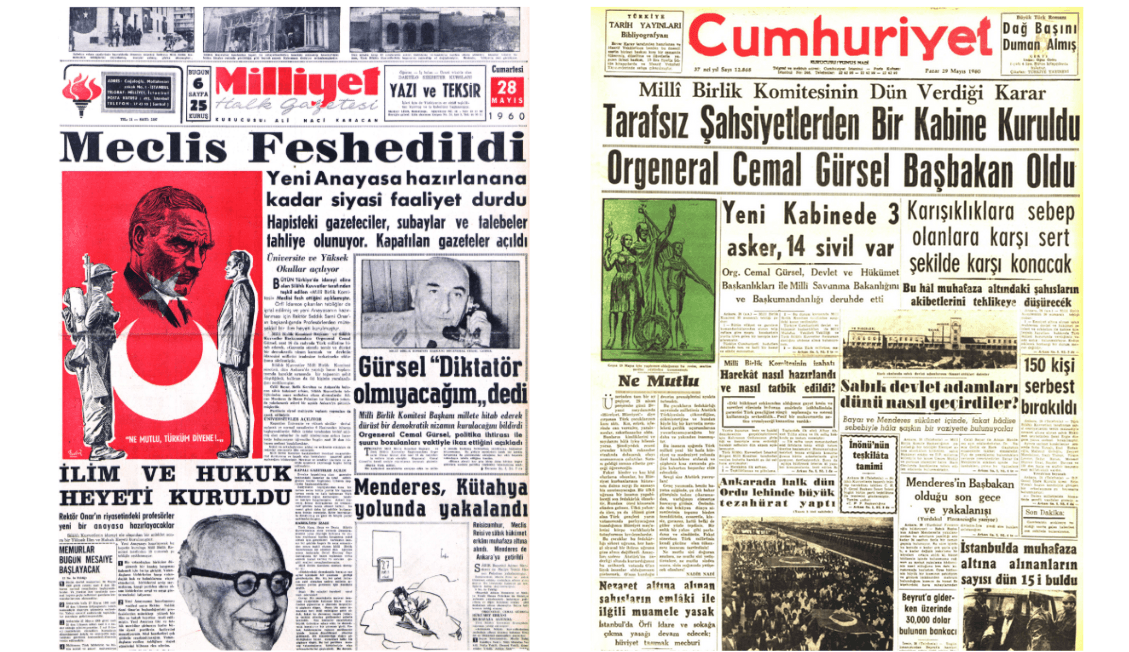
May 28, 1960 Front Page of Milliyet Newspaper (Gaste Archive) May 29, 1960 Front Page of Cumhuriyet Newspaper (Gaste Archive)
After the coup, DP leaders were arrested and tried before the High Court of Justice established on the island of Yassıada near Istanbul. Between October 14, 1960, and September 15, 1961, charges were brought against 592 individuals, and the death penalty was sought for 288. The High Court of Justice sentenced 15 individuals to death.
Death sentences were carried out against Prime Minister Adnan Menderes, Foreign Minister Fatin Rüştü Zorlu, and Finance Minister Hasan Polatkan. Although a death sentence was also issued against President Celal Bayar, it was commuted to life imprisonment due to his age exceeding 80. Some of the verdicts were reached by unanimous vote, while others were decided by majority vote.
Both domestic and international reactions to the death sentences were strong, with numerous appeals calling for the executions to be halted. Nevertheless, the National Unity Committee proceeded with the executions of Adnan Menderes and the two ministers.
Legal scholars and historians from the period and subsequent eras have seriously debated whether the trials were conducted independently and impartially. The Yassıada Courts operated as a special structure established outside the normal judicial system for specific purposes. During the trial process, intense propaganda was directed at public opinion, and DP members were labeled as “low” elements.
Audio Recordings of the Yassıada Trials (TRT)
To legitimize the coup in the eyes of the public, the NUC launched multifaceted propaganda campaigns. Under the name “May 27 Revolution,” it distributed brochures, organized rallies, supported cultural associations, conducted village visits, and published printed materials to create a negative perception of DP rule. These efforts included radio broadcasts, systematic accusations in newspapers, the display of Atatürk busts, and commemorative “May 27 coins.” In particular, the Yassıada Brochure, which listed accusations and narratives against DP members, aimed to secure public acceptance of the court decisions within the political climate of the time.
Following May 27, the DP was stripped of its legal personality, and all political parties were banned from operating. The NUC drafted a Provisional Constitution to reestablish the constitutional order and initiated a new constitutional process. The 1961 Constitution, prepared by the Constituent Assembly, was approved in a public referendum with 60.4 percent of the vote.
General elections were held on October 15, 1961, and the new Grand National Assembly opened on October 25, marking the end of NUC rule. However, the military continued to exert influence over the political system in the new era.
The reputations of Adnan Menderes, Hasan Polatkan, and Fatin Rüştü Zorlu, who were executed as a result of the May 27 coup, were officially restored by a law passed by the Grand National Assembly on April 11, 1990. The same law ordered the transfer of their remains from İmralı Island to a state mausoleum in Istanbul, accompanied by a state funeral. This step is regarded as a historical correction following decades of debate over the legitimacy of the post-coup trials.
The restoration of reputation process was not merely symbolic; it also affirmed the supremacy of democratic politics and the rule of law. An assessment conducted in 2013 by the Presidency of Legal Services of the Grand National Assembly stated that, legally, the Yassıada verdicts could not be annulled but could be subject to retrial.
Anadolu Ajansı. "Demokrat Parti Özel Sektörle Yatırımlarda Altın Yıllara İmza Attı." *AA*, May 26, 2020. Accessed May 27, 2025.https://www.aa.com.tr/tr/ekonomi/demokrat-parti-ozel-sektorle-yatirimlarda-altin-yillara-imza-atti-/1854680
Anadolu Ajansı. *Menderes’le Türkiye’nin Atılım Yılları.* YouTube video, 6:23. Published May 24, 2021. Accessed May 27, 2025.https://www.youtube.com/watch?v=cu5Iddgzzwc
Anadolu Ajansı. “27 Mayıs Darbesinin Üzerinden 54 Yıl Geçti.” AA, May 27, 2014. Accessed May 27, 2025.https://www.aa.com.tr/tr/turkiye/27-mayis-darbesinin-uzerinden-54-yil-gecti/156303
Anadolu Ajansı. “Türk Demokrasi Tarihinin Kara Lekesi: 27 Mayıs Darbesi.” *AA*, May 27, 2021. Accessed May 27, 2025.https://www.aa.com.tr/tr/pg/foto-galeri/turk-demokrasi-tarihinin-kara-lekesi-27-mayis-darbesi
Anadolu Ajansı. “Türk Demokrasi Tarihinin Kara Lekesi: 27 Mayıs Darbesi.” AA. Accessed May 27, 2025.https://www.aa.com.tr/tr/demokrasinin-infazi-27-mayis/turk-demokrasi-tarihinin-kara-lekesi-27-mayis-darbesi/2254435
Dikici, Ali. “27 Mayıs 1960 Askerî Darbesi ve Türk Polisi.” *Atatürk Araştırma Merkezi Dergisi* 30, no. 89 (July 2014): 11–60.https://dergipark.org.tr/en/pub/aamd/issue/44048/542691
Ertürk, Yaşar. “27 Mayıs 1960 Askerî Darbesi, Darbe Sürecinde Silahlı Kuvvetler İçindeki Bölünme ve Rekabet.” *Türk Dünyası Araştırmaları* 134, no. 264 (July 2023): 1–42.https://dergipark.org.tr/tr/pub/tda/issue/79035/1121453
Kara, İbrahim Hilmi. “Ezan.” Türkiye Diyanet Vakfı İslâm Ansiklopedisi. Accessed May 27, 2025.https://islamansiklopedisi.org.tr/ezan
Milliyet. “Ordunun Müdahalesiyle Hükümet Düşürüldü.” May 28, 1960, p. 1. Accessed May 27, 2025.https://www.gastearsivi.com/gazete/milliyet2/1960-05-28/1
TRT Haber. "Türk Demokrasisine İlk Darbe: 27 Mayıs 1960." TRT Haber, May 27, 2022. Accessed May 27, 2025.https://www.trthaber.com/haber/gundem/turk-demokrasisine-ilk-darbe-27-mayis-1960-683379.html
Çelik, Fatma. “27 Mayıs 1960 Askeri Darbesi Sonrası Millî Birlik Komitesi ve Propaganda Çalışmaları.” *Adnan Menderes Üniversitesi Sosyal Bilimler Enstitüsü Dergisi* 8, no. 2 (December 2021): 1–23.https://dergipark.org.tr/tr/pub/adusobed/issue/67324/939399

History | 27 May 1960 | ||||||||
|---|---|---|---|---|---|---|---|---|---|
Took Over Governance | National Unity Committee (NUC) | ||||||||
Place of Judgment | Yassıada, High Court of Justice | ||||||||
Number of Defendants | 592 | ||||||||
Executed Persons | Fatin Rüştü Zorlu (Minister of Foreign Affairs) Hasan Polatkan (Minister of Finance) Adnan Menderes (Prime Minister) | ||||||||
Date of Restoration of Honor | 11 April 1990 | ||||||||
No Discussion Added Yet
Start discussion for "May 27 Military Coup" article
Background: The Early Years of DP Rule
Events Leading Up to the Coup
September 6–7, 1955
June 6, 1956
1957
1959
1960
Seizure of Power and the National Unity Committee
Trials and Executions
Propaganda and Public Opinion Management
Dissolution of the DP and Political Transformation
Restoration of Reputation Process