


This article was automatically translated from the original Turkish version.
Marmaray, designated as the B1 (Suburban 1) line on Istanbul’s transit map, is one of the city’s longest rail systems and extends as far as Gebze within the boundaries of Kocaeli province. This line connects the continents of Asia and Europe beneath the seabed and is among the largest infrastructure projects implemented in Istanbul in recent years. With high passenger capacity, Marmaray plays a critical role in both urban transit and intercity rail connections.
MARMARAY Animation Film (Anadolu Ajansı)
The origins of the Marmaray project date back to the Ottoman era. The idea of connecting the two continents beneath the Bosphorus was first proposed in 1860 during the reign of Sultan Abdülmecid, with a submarine tunnel project titled “Cisr-i Enbubi” designed by French engineer Prerault aiming to link Sirkeci and Haydarpaşa stations.
In 1892, the project’s plans were commissioned by Sultan Abdülhamid II. However, technological limitations of the time and subsequent wars prevented its implementation.
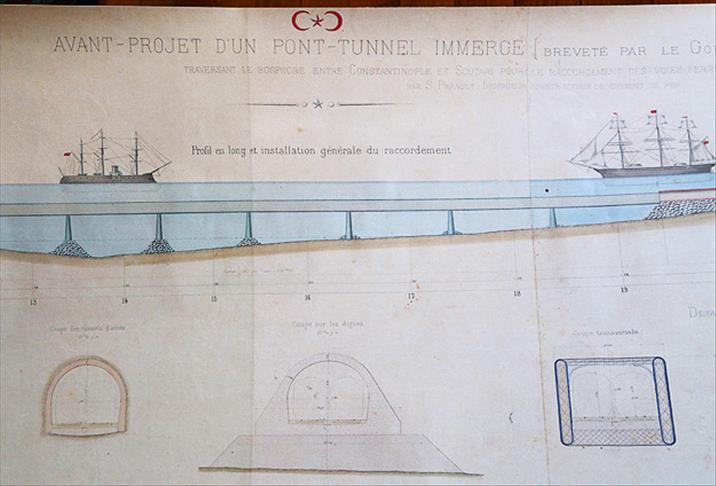
First plan from the Ottoman period. (Anadolu Ajansı)
In the 1980s, the idea of connecting Asia and Europe by rail resurfaced, and feasibility studies were conducted in 1987 during the government of Turgut Özal. The project reemerged in the 2000s and was officially launched in May 2004 with the approval of then Prime Minister Recep Tayyip Erdoğan. Tunnel excavation began on 21 December 2006. The deepest point of Marmaray is a tubular tunnel reaching 60 meters below the surface of the Sea of Marmara.
Subsequently, archaeological discoveries at the excavation site in Yenikapı forced the project to be halted. The Yenikapı rescue excavations, which began in 2004, continued until 2013; work resumed only after all findings had been individually recovered and studied. On 4 August 2013, the first test run on Marmaray was conducted by a delegation led by Prime Minister Recep Tayyip Erdoğan.
On 29 October 2013, marking the 90th anniversary of the Republic of Türkiye, the first phase of Marmaray opened, connecting Kazlıçeşme (Europe) and Ayrılıkçeşmesi (Asia) over a 13.6-kilometer stretch. The stations along this route are Ayrılıkçeşmesi, Üsküdar, Sirkeci, Yenikapı, and Kazlıçeşme.
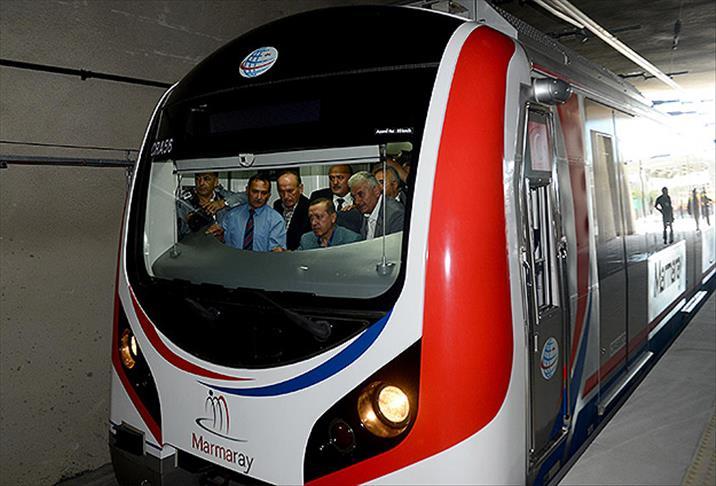
Opening of Marmaray. (Anadolu Ajansı)
The opening ceremony at Üsküdar Square was attended by President Abdullah Gül, Prime Minister Recep Tayyip Erdoğan and his wife Emine Erdoğan, Somali President Hasan Sheikh Mahmud, Speaker of the Grand National Assembly Cemil Çiçek and his wife Gülten Çiçek, Japanese Prime Minister Shinzo Abe, Romanian Prime Minister Viktor Ponta, and Minister of Transport Binali Yıldırım, who all traveled together on the train.
After completion, Marmaray not only connected the European and Asian shores of Istanbul but also became a strategic transit point enabling uninterrupted rail travel between Beijing and London.
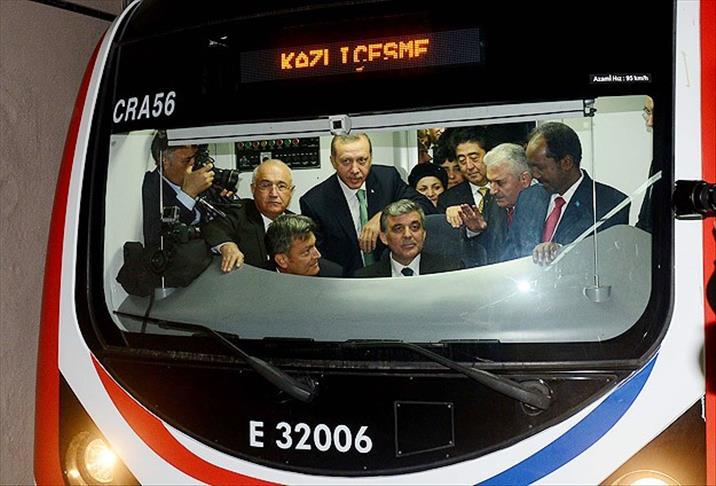
First journey of Marmaray. (Anadolu Ajansı)
Before Marmaray opened, an average of 140,000 passengers crossed each of the two Bosphorus bridges in one direction per hour. After its opening, this number dropped to 75,000, demonstrating that a significant portion of Istanbul’s transportation burden had been shifted to Marmaray. Several years after the initial line opened, the Gebze–Halkalı section was inaugurated on 12 March 2019 at a ceremony held at Istanbul’s Kartal Square, attended by President Recep Tayyip Erdoğan.
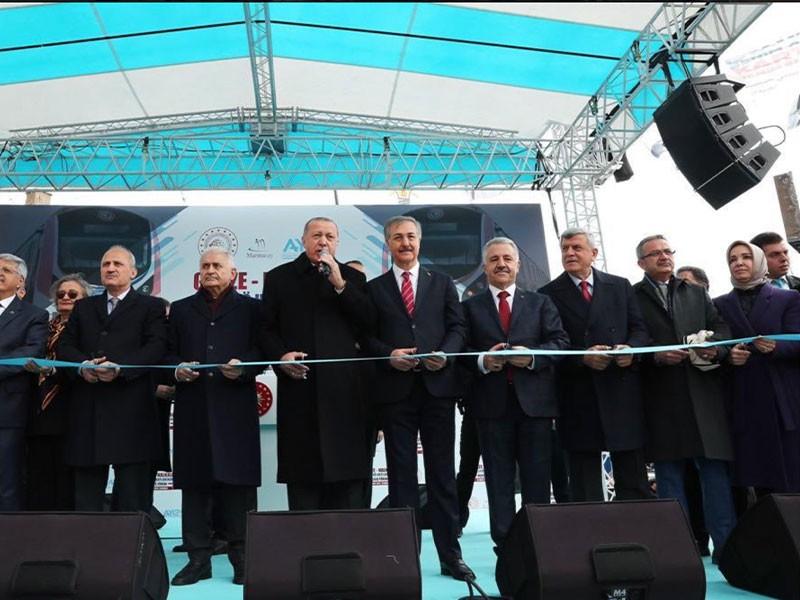
Ribbon-cutting ceremony at the Marmaray opening. (TCDD)
Thus, the total length of the Marmaray line reached 76.6 kilometers with 43 stations. The journey time between Gebze and Halkalı is 108 minutes. As of 2023, the 10-year record of Marmaray shows that total passenger numbers have exceeded one billion.
1. Asian Side: Gebze, Darıca, Osmangazi, GTÜ–Fatih, Çayırova, Tuzla, İçmeler, Aydıntepe, Güzelyalı, Tersane, Kaynarca, Pendik, Yunus, Kartal, Başak, Atalar, Cevizli, Maltepe, Süreyya Plajı, İdealtepe, Küçükyalı, Bostancı, Suadiye, Erenköy, Göztepe, Feneryolu, Söğütlüçeşme, Ayrılıkçeşmesi, Üsküdar.
2. European Side: Sirkeci, Yenikapı, Kazlıçeşme, Fişekhane, Yenimahalle, Bakırköy, Ataköy, Yeşilyurt, Yeşilköy, Florya Akvaryum, Florya, Küçükçekmece, Mustafa Kemal, Halkalı.
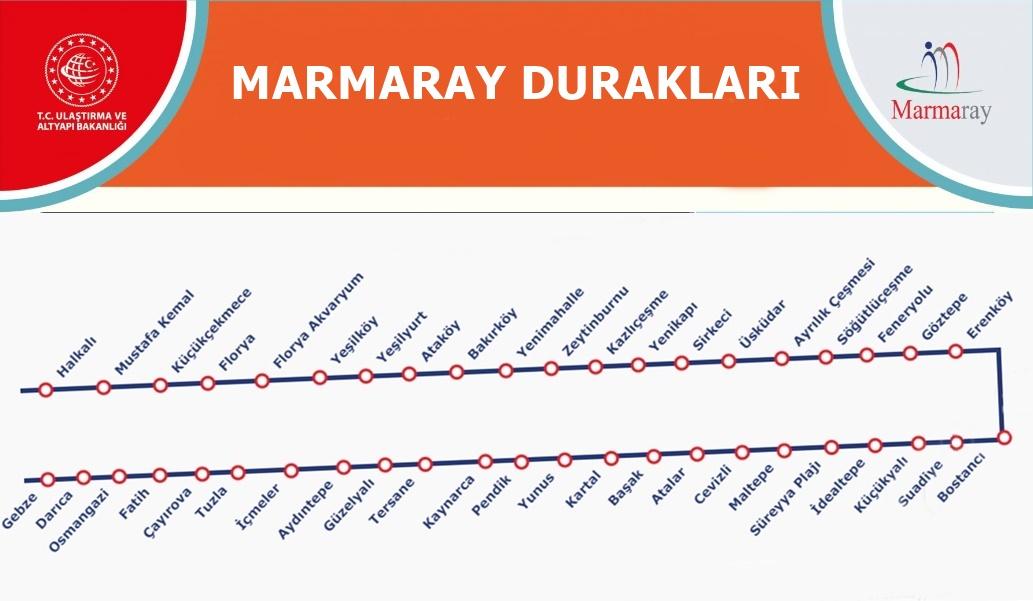
Marmaray stations. (
Anadolu Ajansı (AA). 2013. “Marmaray Tarihi Yolculuğunu Gerçekleştirdi.” Accessed May 3, 2025.https://www.aa.com.tr/tr/turkiye/marmaray-tarihi-yolculugunu-gerceklestirdi/208124
Anadolu Ajansı (AA). 2013. “Marmaray'a Cisr-i Enbubi’li Açılış.” Accessed May 3, 2025.https://www.aa.com.tr/tr/turkiye/marmaraya-cisr-i-enbubili-acilis/209403
Anadolu Ajansı (AA). “Marmaray’ın İlk Test Sürüşü Gerçekleştirildi.” Accessed May 3, 2025.https://www.aa.com.tr/tr/turkiye/marmarayin-ilk-test-surusunu-gerceklestirdi/227689
BBC Türkçe. "Marmaray Açıldı." Accessed May 3, 2025.https://www.bbc.com/turkce/haberler/2013/10/131029_marmaray_acildi
Ilıcalı, Mustafa, Mehmet Çağrı Kızıltaş, Erkan Ergin, and Burcu Ekinci. 2013. "İstanbul Ulaştırma Sisteminde Modlar Arası Entegrasyon ve Dengeli Modal Dağılım." Toplu Ulaşım Haftası Transist 2013 6. Ulaşım Sempozyumu ve Fuarı, 140–146. İstanbul, 25–26 Aralık.
Kızıltan, Zeynep. 2014. "Marmaray-Metro Projeleri ve Yenikapı Arkeolojik Kurtarma Kazıları." Colloquium Anatolicum 13: 11–44.
Marmaray. "Resmî Web Sitesi." Accessed May 3, 2025.https://marmaray.istanbul/.
T.C. Devlet Demiryolları (TCDD). “Gebze–Halkalı Banliyö Hatları Açıldı.” Accessed May 3, 2025.https://www.tcdd.gov.tr/haberler/gebze-halkali-banliyo-hatlari-acildi
TRT Haber. "Marmaray 10 Yılda 1 Milyardan Fazla Yolcu Taşıdı." Accessed May 3, 2025.https://www.trthaber.com/haber/turkiye/marmaray-10-yilda-1-milyardan-fazla-yolcu-tasidi-821389.html
YouTube. "Marmaray Belgeseli." Accessed May 3, 2025.https://www.youtube.com/watch?app=desktop&v=NV5Bv_UJLDs
Yüzüncü Yıl Galerisi. "Marmaray." EBA. Accessed May 3, 2025.https://yuzuncuyilgalerisi.eba.gov.tr/tema/marmaray-73.
Özkan, Özlem, and İbrahim Cüneyt Ay. 2020. "Marmaray Hattı’nın Bir Kuşak Bir Yol Kapsamında Değerlendirilmesi." Anadolu Bil Meslek Yüksekokulu Dergisi 15 (60): 353–362.

History
Current Marmaray Stations