This article was automatically translated from the original Turkish version.
+2 More
Date(s) | 1. Massacre: February 5 1995 2. Massacre: August 28 1994 | ||||||||
|---|---|---|---|---|---|---|---|---|---|
Location | Markale Market Bosnia and Herzegovina Sarajevo | ||||||||
Peace Treaty | Dayton Peace Agreement (November 1995) | ||||||||
Military Outcome | NATO "Steadfast Force Operation" | ||||||||
Legal Consequences | Registration of "War Crimes" and "Crimes Against Humanity" by the ICTY | ||||||||
Political Leader | Alija Izetbegović | ||||||||
Total Casualties | 111 dead, 228 injured | ||||||||
Ammunition | 120 mm Air Defense Shell | ||||||||
Perpetrator | Army of the Republika Srpska (VRS) - Sarajevo-Romania Corps | ||||||||
War / Conflict | Bosnian War (Siege of Sarajevo 1992–1995) | ||||||||
Markale Market Massacre refers to two separate bloody attacks carried out by the Army of the Republika Srpska (VRS) on the historic market square in the center of Sarajevo, which was under siege during the Bosnian War (1992–1995). Markale, one of the few areas where the besieged civilian population could access food and essential supplies, was deliberately targeted because of this critical function. These attacks resulted in the deaths of more than 100 civilians and injuries to hundreds more, and are widely regarded as a turning point in the war that compelled the international community to demand military intervention.
A Video on the Bloody Markale Massacre in Sarajevo (TRT News)
On Saturday, 5 February 1994, one of the most critical moments of the Siege of Sarajevo occurred. The Markale Market, located in the city center and serving as a lifeline for the besieged population, was struck at exactly 12:15 by a mortar shell fired from positions held by the Army of the Republika Srpska (VRS).
The 120 mm mortar shell landed directly in the center of the market stalls, where crowds were densest. A total of 68 civilians died at the scene or while being transported to hospitals, and 144 others were seriously injured. Within seconds of the explosion, the market was reduced to shattered stalls and pools of blood. According to eyewitness accounts, the need to transport corpses by pickup trucks and the hospitals’ inability to cope with the influx created the largest civilian shock the city had witnessed up to that point.【1】
Immediately after the massacre, international public opinion debated who was responsible. While the Serb side denied responsibility and attempted disinformation by claiming the Bosnian army had fired on its own people, detailed ballistic examinations and crater analyses conducted by the United Nations Protection Force (UNPROFOR) determined the shell’s trajectory. These reports provided technical evidence confirming that the shell had been fired from the northern hills of the city, which were under Serb control.【2】
The attack shattered the international community’s passive “observer” stance toward civilian massacres in Sarajevo and laid the groundwork for NATO’s first ultimatum demanding the withdrawal of heavy weapons from Serb positions.
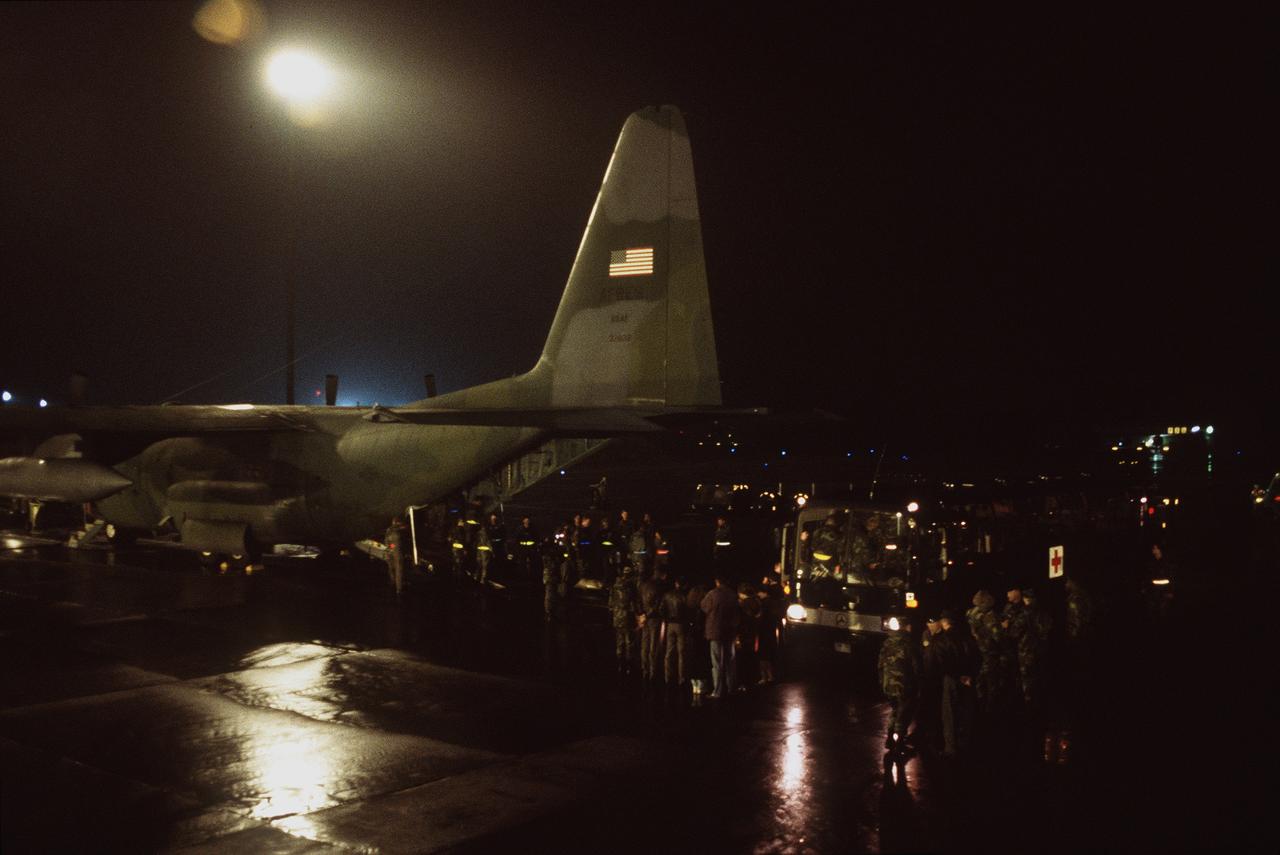
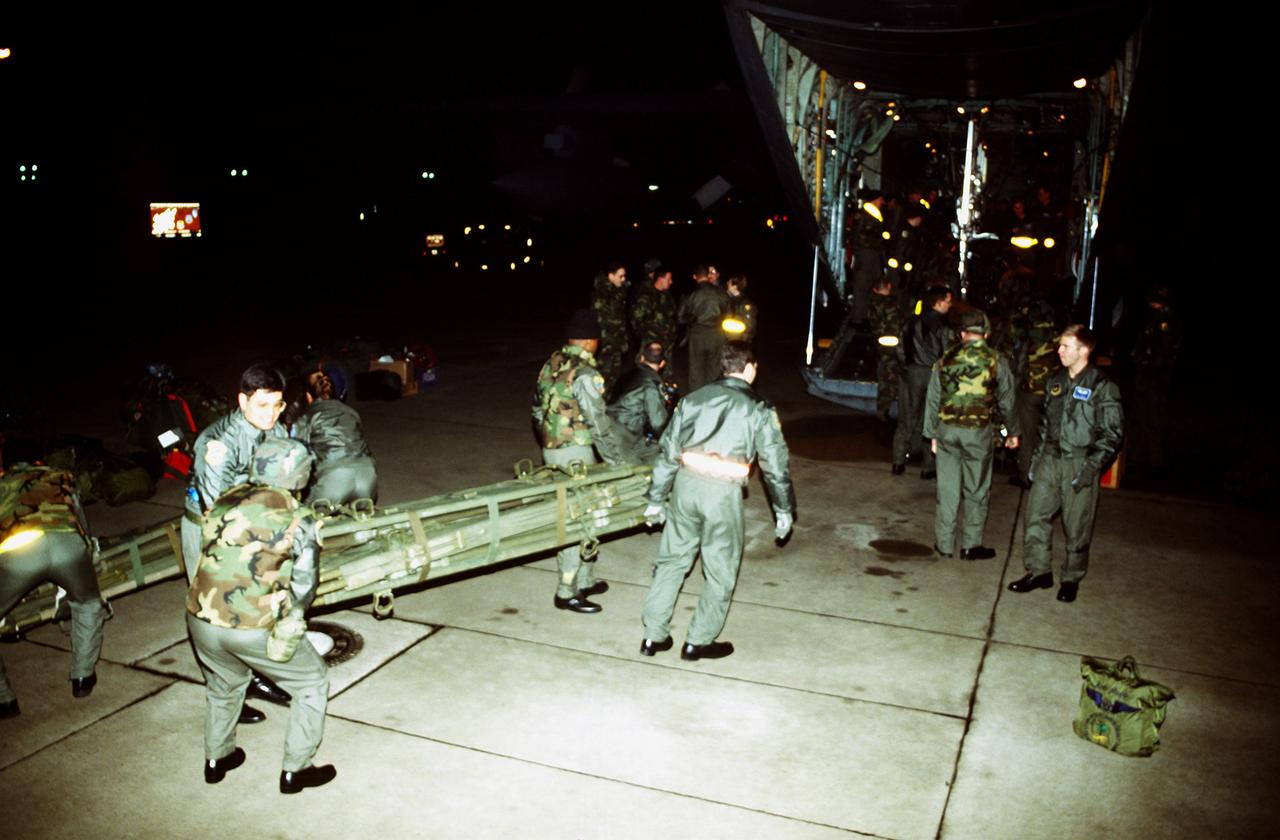
Injured from the Markale Market in Sarajevo Being Unloaded from a C-130 Aircraft at Ramstein Air Base in Germany. (National Archives Catalog)
On Monday, 28 August 1995, at around 11:00, nearly 18 months after the first massacre, the Markale Market was targeted again by the Army of the Republika Srpska (VRS). This time, the attack was carried out not by a single shell but by five mortar rounds fired from Serb positions, all striking the crowded entrance area of the market.
In this attack, 43 civilians were killed and 84 others seriously injured.【3】 The second massacre occurred during one of the most critical phases of the Bosnian War. Just weeks after the global outcry over the Srebrenica Genocide in July 1995, the repeated targeting of Sarajevo’s bustling civilian center completely dispelled any remaining international doubts that Serb forces systematically targeted “safe areas” and civilians. The blast’s intensity shattered windows of buildings near the market entrance and reduced civilian vehicles to scrap.
Alija Izetbegović treated the Markale Market massacres as strategic turning points in Bosnia-Herzegovina’s struggle for independence, where international legitimacy was gained and diplomatic deadlock was overcome. Immediately after the first massacre, Izetbegović sent personal letters to world leaders, framing Markale as a global crisis and presenting the attacks as undeniable proof of Serbian aggression and terror, thereby generating public pressure to lift the unjust arms embargo on Bosnia and to compel NATO to intervene actively.
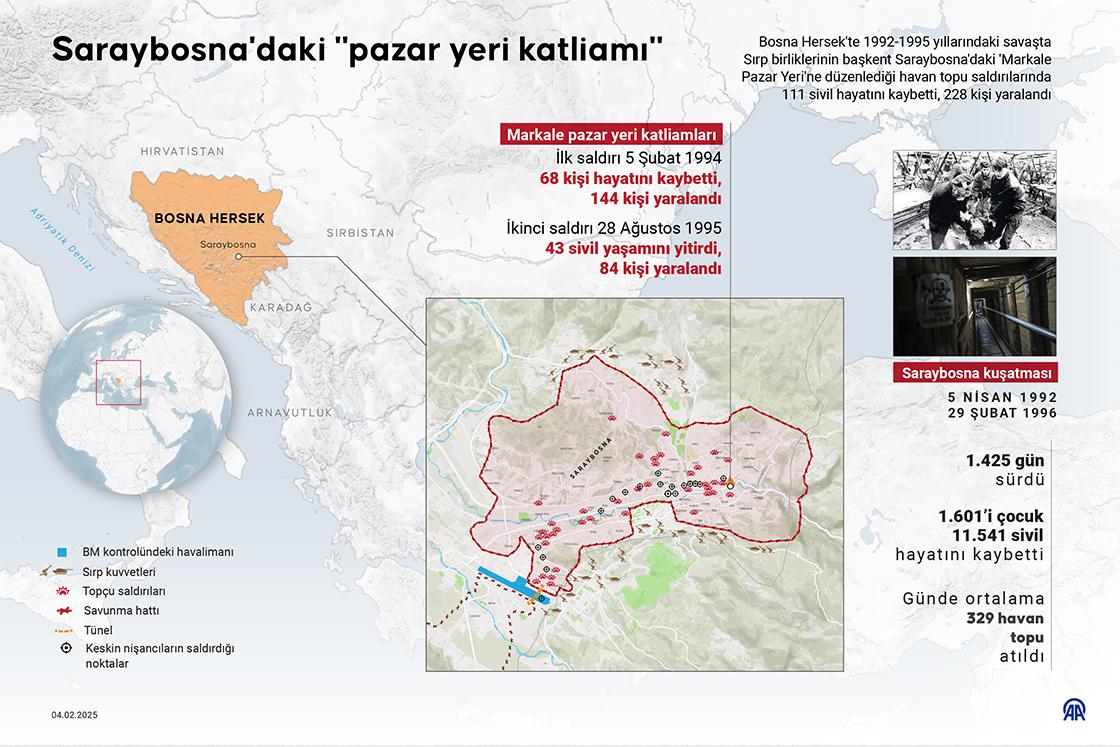
On the Markale Market Massacre in Sarajevo (Anadolu Agency)
In response to systematic disinformation campaigns by the Serb side and some international actors claiming that the Bosnian government had fired on its own people, Izetbegović invited international independent observers and UN experts to the scene to ensure a transparent judicial process, thereby cementing technical evidence of the perpetrators’ identity before the world.
Especially after the second massacre in 1995, he transformed civilian suffering into a lever for Bosnia’s just cause, reconsolidating domestic resilience shaken by the war.
The attacks on the Markale Market, particularly the second massacre on 28 August 1995, ultimately ended the international community’s longstanding “cautious observer” policy toward the Bosnian War and led to a fundamental change in military engagement rules. Immediately after the massacre, meticulous ballistic investigations conducted by military experts within the United Nations Protection Force (UNPROFOR) and NATO confirmed with technical certainty that the shells had been fired from Serb positions. This triggered an overwhelming pressure for intervention among Western powers. As a result, on 30 August 1995, NATO launched Operation Deliberate Force, the most comprehensive air campaign in its history up to that point, against Serb military elements in Bosnia-Herzegovina.
Under this operation, command and control centers, ammunition depots, air defense systems, and strategic logistical routes belonging to the Army of the Republika Srpska were precisely destroyed, severely degrading Serb military capacity. The operation marked a defining moment demonstrating the international community’s resolve in the face of genocide and civilian massacres, forcing Serb leadership to confront the reality of their lost military superiority and compelling them to the negotiating table to accept the path toward the Dayton Peace Agreement.
The Dayton Peace Agreement is one of the most comprehensive “coerced peace” texts in international legal history, designed to end the war in Bosnia-Herzegovina between 1992 and 1995. The process leading to the agreement was triggered by shifting military balances following the second Markale massacre and the Srebrenica Genocide in 1995. NATO’s Operation Deliberate Force, which weakened Serb military power, forced the parties to the negotiating table under U.S. mediation. The agreement was initialled on 21 November 1995 at the Dayton Air Force Base in Ohio and formally signed in Paris on 14 December 1995. It recognized Bosnia-Herzegovina’s territorial integrity but established a divided internal structure.
While the agreement recognized Bosnia-Herzegovina as a single state under international law, it divided the country into two main entities: the Federation of Bosnia and Herzegovina (comprising 51% of the territory, inhabited by Bosniaks and Croats) and the Republika Srpska (comprising 49%). This structure allowed the entities to establish their own legislative, executive, and judicial mechanisms while limiting the powers of the central government. The tripartite Presidency Council (composed of Bosniak, Croat, and Serb members) and the ethnically quota-based parliament created a system prone to frequent gridlock due to veto mechanisms.
One of the original features of Dayton was the establishment of the Office of the High Representative (OHR) to oversee the implementation of civil peace. The High Representative was granted extensive powers known as the Bonn Powers, including the authority to suspend local laws, remove officials deemed unconstitutional, and enact legislation directly. Although this arrangement drew criticism for establishing a form of international tutelage over Bosnia-Herzegovina, it played a critical role in preserving postwar stability.
Negotiations between Alija Izetbegović, Franjo Tuđman, and Slobodan Milošević at the Dayton Air Force Base in Ohio concluded in November 1995 with an agreement, transforming the civilian blood spilled at Markale into a political climate in which peace became the only viable option. The agreement, formally adopted in Paris on 14 December 1995, ended the war in Bosnia-Herzegovina while preserving its territorial integrity. The global outrage generated by the tragedies at Markale became the primary driving force behind the diplomatic resolution of the bloody conflict in the Balkans.
The International Criminal Tribunal for the former Yugoslavia (ICTY) did not treat the Markale Market massacres as isolated incidents but as concrete and bloody evidence of a systematic campaign of “terror, murder, and inhumane treatment” against the civilian population of Sarajevo. citation-content='<p class="paragraph" style="text-align: start;"><span style="white-space: pre-wrap;">Olovčić, Adem, Mirdin Zilić. "Alija Izetbegović and the Markale Massacre: Media, Responsibility, and Public Reaction." Društvene i humanističke studije 10(2 (28)):127-142 page 134, Accessed 2 February 2026, </span><kure-link link-reference-type="external" link-reference="https://www.researchgate.net/publication/399755364_Alija_Izetbegovic_and_the_Markale_Massacre_Media_Responsibility_and_Public_Reaction">https://www.researchgate.net/publication/399755364_Alija_Izetbegovic_and_the_Markale_Massacre_Media_Responsibility_and_Public_Re
Anadolu Ajansı. "Bosna Hersek'te 'pazar yeri katliamı'nın 28. yılında acılar hala taze." Accessed February 2, 2026. https://www.aa.com.tr/tr/dunya/bosna-hersekte-pazar-yeri-katliaminin-28-yilinda-acilar-hala-taze/2494622
Anadolu Ajansı. "Bosna Hersek'teki 'pazar yeri katliamı'nın tanığı foto muhabiri Larma, yaşadıklarını anlattı." Accessed February 2, 2026. https://www.aa.com.tr/tr/dunya/bosna-hersekteki-pazar-yeri-katliaminin-tanigi-foto-muhabiri-larma-yasadiklarini-anlatti/3470915
Anadolu Ajansı. "Saraybosna'daki 'pazar yeri katliamı'." Accessed February 2, 2026. https://www.aa.com.tr/tr/info/infografik/44512
Anadolu Ajansı. "Saraybosna'daki pazar yeri katliamının 31. yılında hayatını kaybedenler törenle anıldı." Accessed February 2, 2026. https://www.aa.com.tr/tr/dunya/saraybosnadaki-pazar-yeri-katliaminin-31-yilinda-hayatini-kaybedenler-torenle-anildi/3472742
Anadolu Ajansı. "Tanıkları ''pazar yeri'' katliamını anlattı." Accessed February 2, 2026. https://www.aa.com.tr/tr/dunya/taniklari-pazar-yeri-katliamini-anlatti/77603
Dalar, Mehmet. "Dayton Barış Antlaşması ve Bosna-Hersek'in Geleceği." *Sosyal Bilimler Enstitüsü Dergisi*, Volume:1, Year:9, Issue:16, pp. 91-123. Accessed February 3, 2026. https://dergipark.org.tr/tr/pub/basbed/article/174822
GZT. "Markale Pazar Yeri Katliamları." GZT. Accessed February 2, 2026. https://www.gzt.com/dunya/markale-pazar-yeri-katliamlari-3711689
Maričić, Slobodan. "Saraybosna'da Markale pazarı katliamının 30'uncu yılında izler hala taze." BBC. Accessed February 2, 2026. https://www.bbc.com/turkce/articles/c514p5y5jn7o
National Archives and Records Administration. “National Archives Item Identifier 6494498,” *National Archives Catalog.* Accessed February 3, 2026. https://catalog.archives.gov/id/6494498
National Archives and Records Administration. “Record Group/Item Identifier 6494499.” *National Archives Catalog*. Accessed February 3, 2026. https://catalog.archives.gov/id/6494499
National Archives and Records Administration. “Records Related to Radium Dial Painters, 1917–1949,” *National Archives Catalog*. Accessed February 3, 2026. https://catalog.archives.gov/id/6494515
Olovčić, Adem, and Mirdin Zilić. "Alija Izetbegović and the Markale Massacre: Media, Responsibility, and Public Reaction." Društvene i humanističke studije 10(2 (28)): 127-142. Accessed February 2, 2026. https://www.researchgate.net/publication/399755364_Alija_Izetbegovic_and_the_Markale_Massacre_Media_Responsibility_and_Public_Reaction
TRT Avaz. "Saraybosna'daki pazar yeri katliamı kurbanları 30. yılında törenle anıldı." Accessed February 2, 2026. https://www.trtavaz.com.tr/haber/tur/turkistandan/saraybosnadaki-pazar-yeri-katliami-kurbanlari-30-yilinda-torenle-anildi/65c0e4b9f92ee6f63a3a5a03
TRT Türk. "Bosna'daki pazar yeri katliamı kurbanları 28. yılında törenle anıldı." Accessed February 2, 2026. https://www.trtturk.com.tr/haber/balkanlar/bosnadaki-pazar-yeri-katliami-kurbanlari-28-yilinda-torenle-anildi_19524
YouTube. "Saraybosna'daki kanlı 'Markale katliamının' 27. yıldönümü." TRT Haber. Date Published February 5, 2021. Accessed February 2, 2026. https://www.youtube.com/watch?v=QdGwUFDtoAQ
[1]
Anadolu Agency, "Witnesses Describe the 'Market Place' Massacre." Anadolu Agency, Accessed 2 February 2026, https://www.aa.com.tr/tr/dunya/taniklari-pazar-yeri-katliamini-anlatti/77603.
[2]
Slobodan Maričić, "At the 30th Anniversary of the Markale Market Massacre in Sarajevo, the Traces Remain Fresh." BBC, Accessed 2 February 2026, https://www.bbc.com/turkce/articles/c514p5y5jn7o
[3]
GZT, "Markale Market Massacres." GZT, Accessed 2 February 2026, https://www.gzt.com/dunya/markale-pazar-yeri-katliamlari-3711689.

Date(s) | 1. Massacre: February 5 1995 2. Massacre: August 28 1994 | ||||||||
|---|---|---|---|---|---|---|---|---|---|
Location | Markale Market Bosnia and Herzegovina Sarajevo | ||||||||
Peace Treaty | Dayton Peace Agreement (November 1995) | ||||||||
Military Outcome | NATO "Steadfast Force Operation" | ||||||||
Legal Consequences | Registration of "War Crimes" and "Crimes Against Humanity" by the ICTY | ||||||||
Political Leader | Alija Izetbegović | ||||||||
Total Casualties | 111 dead, 228 injured | ||||||||
Ammunition | 120 mm Air Defense Shell | ||||||||
Perpetrator | Army of the Republika Srpska (VRS) - Sarajevo-Romania Corps | ||||||||
War / Conflict | Bosnian War (Siege of Sarajevo 1992–1995) | ||||||||
No Discussion Added Yet
Start discussion for "Markale Market Massacre" article
First Massacre
Second Massacre
Alija Izetbegović’s Role and Political Implications
International Reactions and NATO Intervention
Dayton Peace Agreement
International Criminal Tribunal Proceedings and Rulings