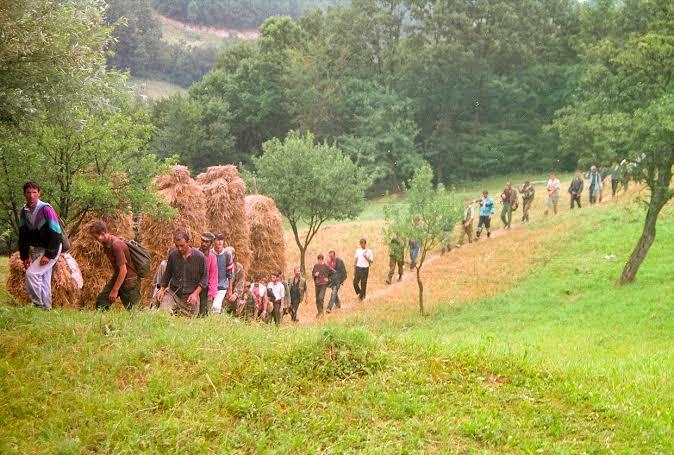
This article was automatically translated from the original Turkish version.
Type | International commemorative march | ||||||||
|---|---|---|---|---|---|---|---|---|---|
Purpose | To commemorate the victims of the Srebrenica Genocide To preserve historical memory To support a culture of peace | ||||||||
Scheduled Time | Every year on July 8–10 | ||||||||
Commemoration Day | July 11 | ||||||||
Starting Point | Nezuk, Sapna Municipality | ||||||||
Ending Point | Potočari Memorial Cemetery | ||||||||
Related Event | Srebrenica Genocide (1995) | ||||||||
Legal Status | Has been recognized as a genocide | ||||||||
March of Peace (Bosnian: Marš mira), is an international commemorative march held annually in Bosnia and Herzegovina between 8 and 10 July. The march follows a significant portion of the route taken by Bosniak civilians in 1995 who attempted to reach Tuzla, a designated safe zone, from the besieged town of Srebrenica during the Srebrenica Genocide. The event is organized to honor those who lost their lives in the genocide, ensure that the events are not forgotten, and promote a culture of peace.
The origin of the March of Peace stems from the Srebrenica Genocide that occurred in July 1995 during the Bosnian War. Before the war, Srebrenica, populated predominantly by Bosniak Muslims, was besieged by Bosnian Serb forces in 1992. As civilians fled surrounding areas and sought refuge in the town, the population rapidly increased, leading to severe shortages of food, water, and medical supplies. On 16 April 1993, the United Nations declared Srebrenica a “Safe Area” and deployed Dutch peacekeeping forces to the region. However, the disarmament of Bosniak forces and the failure to effectively protect the safe area paved the way for the events that followed.
Footage of the March of Peace (Anadolu Agency)
In July 1995, Bosnian Serb forces under the command of Ratko Mladić launched a military offensive against Srebrenica. The anticipated military intervention by United Nations peacekeepers did not materialize, and NATO air operations failed to halt the attack. After Srebrenica fell to Bosnian Serb forces on 11 July 1995, thousands of Bosniak civilians in the town attempted to flee toward the UN camp in Potočari and onward to Tuzla. Women and children were separated from men; between 11 and 17 July 1995, more than 8,000 Bosniak men were systematically killed. These events were later formally classified as genocide by international courts.
Following the fall of Srebrenica, approximately 15,000 Bosniak civilians and soldiers attempted to escape the besieged area by traversing forested and mountainous terrain toward Tuzla. Along this route, later known as the “Path of Death,” thousands perished due to ambushes, attacks, and executions; only about 3,500 reached the safe zone.【1】 This escape route became the foundation for the annual March of Peace, organized after the Srebrenica Genocide to honor the victims and ensure the events are never forgotten.
In this event, attended by thousands from countries around the world, participants visit mass execution sites and mass grave areas along the route. Historical information is provided at designated stops, and survivors of the genocide share their testimonies with participants.
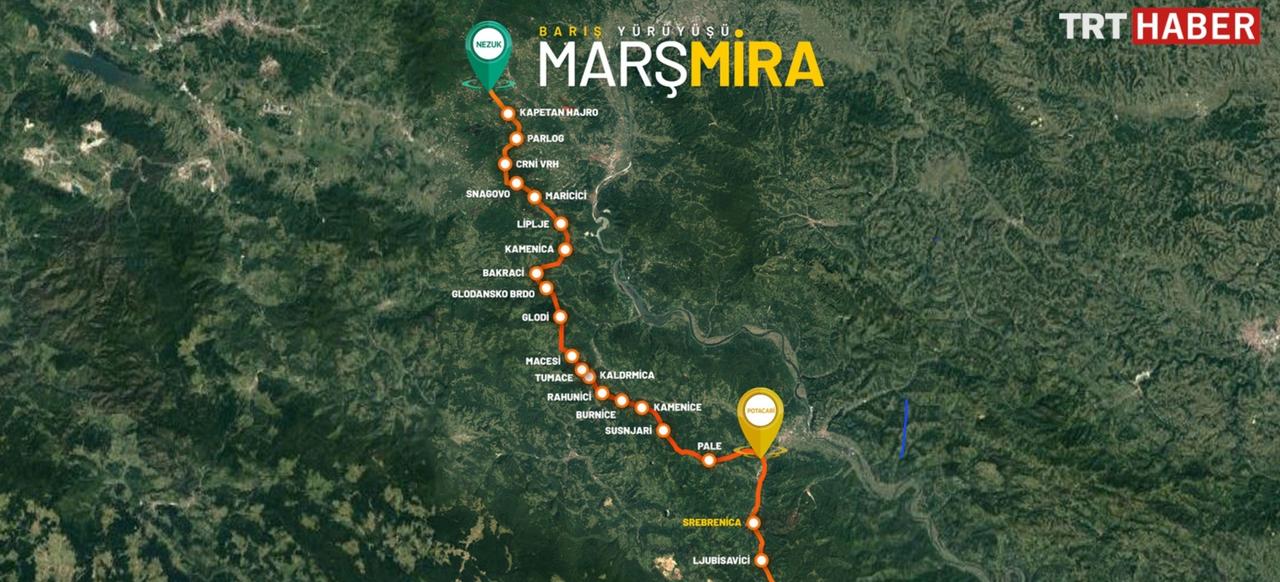
Visual Representing the March Mira Walk Stops (TRT Haber)
The route of the March of Peace begins in the settlement of Nezuk, within the municipality of Sapna, and ends at the Potočari site in the municipality of Srebrenica. Participants cover approximately 100 kilometers over three days, traversing mountainous terrain such as Mount Udrč at 1,043 meters above sea level, dense forested areas with streams, and various settlements affected by the war and subsequent returns. 【2】 Along the route, participants encounter numerous sites from the recent past; areas where Bosniaks were summarily executed and primary and secondary mass grave sites serve as key stops. As participants proceed along the path, they directly confront physical spaces that bear the traces of the massacre, alongside geographic obstacles.
Following the massacre in Srebrenica, international legal mechanisms were activated, resulting in judicial rulings. In 2007, the International Court of Justice in The Hague, based on evidence from the International Criminal Tribunal for the former Yugoslavia (ICTY), formally classified the military actions in and around Srebrenica as genocide.【3】 The first legal step toward this determination was taken in 2001, when the International Criminal Tribunal for the former Yugoslavia formally recognized the Bosnian Serbs’ commission of genocide and sentenced Serbian General Radislav Krstić to 46 years in prison for his role in the massacre.【4】 After appeal, Krstić’s sentence was reduced to 35 years in 2004, making him the first person convicted of genocide in Europe since World War II; this case solidified the legal recognition of the Srebrenica massacre as genocide under international law.【5】 The tribunal later convicted Serbian commanders Vidoje Blagojević and Dragan Jokić of aiding and abetting genocide, sentencing them to 18 and 9 years in prison respectively.
The prosecution of political and military leaders who played central roles in the war and genocide was a protracted process. Slobodan Milošević, the Serbian leader who directed the Bosnian War from its outset, was arrested by the Serbian government on 1 April 2001 and transferred to the ICTY in The Hague. His trial began on 30 January 2002. Milošević, who was expected to receive a life sentence for war crimes reaching the scale of genocide, died in his prison cell on 11 March 2006 from a heart attack before the trial concluded.
Ratko Mladić, commander of the Bosnian Serb Army who managed to evade capture for 16 years, was arrested by Serbian intelligence on 26 May 2011 and transferred to The Hague on 31 May 2011. Although the Serbian government had long denied Mladić’s presence in the country, photographs of him attending a wedding in 2009 were leaked to the press, intensifying international pressure from the United Nations, the United States, European Union member states, and Bosnian authorities, which accelerated his capture.
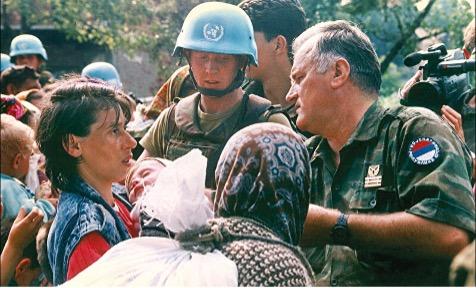
Units Under the Command of Ratko Mladić Enter Srebrenica (Anadolu Ajansı)
International failures and political accountability in the massacre also led to government resignations, as revealed in official reports. A report issued on 27 January 2003 by the Dutch Parliamentary Inquiry Commission concluded that Dutch peacekeeping units, tasked with protecting the safe area, had provided assistance amounting to complicity in the Serbs’ ethnic cleansing campaign, and directly assigned responsibility for the massacre to the Dutch government.【6】 In response, on 16 April 2003, Dutch Prime Minister Wim Kok publicly accepted full responsibility on behalf of the Netherlands for the deaths of those killed and the suffering of survivors, and submitted the resignation of his government.* The United Nations, however, only addressed its silence during the massacre four years later, in November 1999, with the publication of a 155-page report.【7】
In this report, the UN admitted that flawed decisions and an inability to recognize the threat posed by opposing forces had left the people of Srebrenica unprotected from Serb forces. Subsequent documents revealed that while the massacre was underway, senior UN officials had negotiated with Milošević to secure the safety of their own personnel and equipment; however, no UN official has ever been held legally accountable or punished for these failures.【8】
Anadolu Ajansı. "Marş Mira: Barış için yürünen ölüm yolu." Accessed July 8, 2026.https://www.aa.com.tr/tr/ayrimcilikhatti/ayrimcilik/mars-mira-baris-icin-yurunen-olum-yolu/1820821.
Anadolu Ajansı. "Ölüm yolunda ‘Barış Yürüyüşü’ başladı." YouTube Video, July 8, 2021. Accessed July 8, 2026.https://www.youtube.com/watch?v=jdHT65yXwSU
Doğaner, Yaprak. "Tarihçe", *marsmiraturkiye.org*. Accessed July 8, 2026.https://marsmiraturkiye.org/tarihce.
TRT Haber. "Marş Mira Barış Yürüyüşü." Accessed July 8, 2026.https://interaktif.trthaber.com/2018/masmira/.
marsmira.info. "Barış Yürüyüşü." Accessed July 8, 2026.https://www.marsmira.info/tr/
Özkan, Yusuf. “Ratko Mladiç: Eski Bosnalı Sırp generale verilen ömür boyu hapis cezası onandı.” BBC News Türkçe. Accessed July 8, 2026.https://www.bbc.com/turkce/haberler-dunya-57404778.
[1]
Anadolu Ajansı. "Marş Mira: Barış için yürünen ölüm yolu." Accessed July 8, 2026.
[2]
marsmira.info. "Barış Yürüyüşü." Accessed July 8, 2026.
[3]
Anadolu Ajansı, "Marş Mira: Barış için yürünen ölüm yolu."
[4]
Yaprak Doğaner, "Tarihçe", marsmiraturkiye.org, Accessed July 8, 2026.
[5]
Yaprak Doğaner, "Tarihçe."
[6]
Yaprak Doğaner, "Tarihçe."
[7]
Yaprak Doğaner, "Tarihçe."
[8]
Yaprak Doğaner, "Tarihçe."

Type | International commemorative march | ||||||||
|---|---|---|---|---|---|---|---|---|---|
Purpose | To commemorate the victims of the Srebrenica Genocide To preserve historical memory To support a culture of peace | ||||||||
Scheduled Time | Every year on July 8–10 | ||||||||
Commemoration Day | July 11 | ||||||||
Starting Point | Nezuk, Sapna Municipality | ||||||||
Ending Point | Potočari Memorial Cemetery | ||||||||
Related Event | Srebrenica Genocide (1995) | ||||||||
Legal Status | Has been recognized as a genocide | ||||||||
No Discussion Added Yet
Start discussion for "March Mira (Peace March)" article
History
Route and Geographic Structure
Legal Proceedings and Outcomes