


This article was automatically translated from the original Turkish version.

Marcel Duchamp, who rejected conventional and established art concepts and opposed the bourgeoisification of art and cultural values, is one of the artists who left a mark on the 20th century. He believed that art should be guided primarily by ideas and can therefore be considered the father of conceptual art. We can say that his fundamental reason for rejecting traditional art-making was his fear of repetition. Recognized as a pioneer of Dada, Duchamp influenced and reshaped art through movements such as expressionism, abstract expressionism, surrealism, and like pop art.
Dada was a movement that challenged aesthetic and social norms and opposed the bourgeoisification of art. Dada’s primary aim was not to be admired or to deliver a direct message. Rather, it sought to provoke thought by posing questions such as “What is art?” or “What qualifies as an artwork?”. Marcel Duchamp preferred art that challenged the mind rather than appealed to the eye, because for him the true purpose was not to please the senses but to enable thinking.
Turning to the Fluxus art movement, we can see that it adopted the witty tone of Dada. It also rejected the elite world of “high art.” Fluxus sought not only to transform art history but also world history. The persistent goal of most Fluxus artists was to dismantle all boundaries between art and life. According to this movement, what matters is not the finished artwork but the process of creation. In my view, this movement, focused on the moment, liberated itself by breaking down all conventions. We all move within life according to certain rules, often without being aware of them; yet Dada and Fluxus succeeded in transcending all of them.
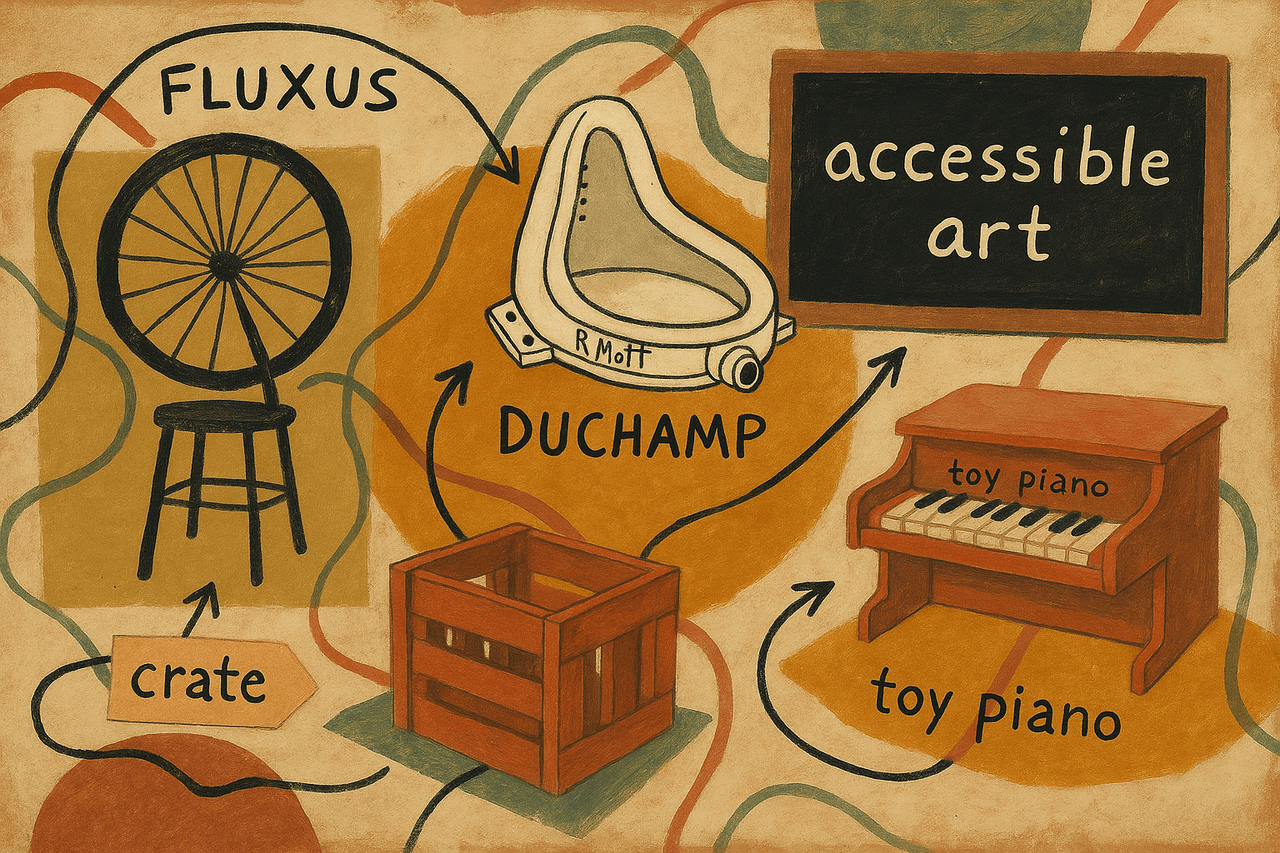
Artistic Collage Reflecting Conceptual Flow (Generated by Artificial Intelligence.)
For Joseph Beuys, a participant in the Fluxus movement, every human being is an artist and every action we take is an artwork. Beuys’s expanded definition of art has generated both sensationalism and intense debate throughout his life. To him, artworks are as ephemeral as life itself. Rather than creating eternal masterpieces, he aimed to inspire people to think. Although many misunderstood the idea that everyone is an artist, this approach rests on a coherent philosophical foundation. For Beuys, the term “artist” defines the essence of being human. Creativity and being creative are deep-seated capacities. He argued that this capacity resides in everyone. From a broad perspective, we can all be “artistic” students, “artistic” mothers, even “artistic” politicians. Regardless of the form of expression, what matters is being creative in the way that is most natural and authentic to ourselves.
We can also say that Altan Gürman was part of the Fluxus movement. Gürman, who practiced outside conventional norms, emphasized that art should be less sacred and closer to life. In terms of materials, he preferred to work with unconventional objects rather than the common materials widely used in Turkey. For instance, he used wood letter stamps, plastic materials, and cellulose-based paints. He employed techniques such as cutting, carving, engraving, removing, and stamping, and applied paint by spraying it with an insecticide pump. Gürman, who made art with accessible materials without barriers, was an artist whose value was only recognized later in Türkiye, yet he successfully embodied the spirit of his movement.
Art without barriers is a medium through which the individual can express themselves without any limiting factors. Transcending rules and addressing the mind rather than the eye makes art far more free. Although retinal (eye-centered) art may seem more appealing to some, human nature inherently inclines toward thought. Therefore, mind-oriented and accessible art may be more fulfilling. When compared with older conceptions of art, the most fundamental difference lies in “ordinariness.” While traditional art is largely shaped within specific rules, barrier-free art can arise from any event or object in life.
In conclusion, Duchamp’s conceptual departure, which set aside his “retinal” aesthetics, along with Fluxus’s experimental attitude prioritizing process and participation, and Beuys’s vision of the “social sculpture,” form a conceptual line that historically and theoretically nourishes what we now call “barrier-free art.” This legacy creates a cultural foundation that shatters the sanctity of the art object, integrates it into the flow of everyday life, transforms the viewer from a passive observer into an active participant in the process, and provokes critical thinking rather than aesthetic appreciation. Embracing the concept of barrier-free art offers the opportunity to elevate ordinary objects and actions into highly creative tools and bring the question “What is art?” into a broader public dialogue. Thus, every moment of life (an action, a word, even a thought) becomes a potential site of art, and art transforms into an accessible form of expression for everyone.
De Duve, Thierry. Kant after Duchamp. Cambridge, MA: MIT Yayınları, 1996.
Smith, Owen F. Fluxus: The History of an Attitude. San Diego: San Diego State University Press, 1998.Accessed adresi
Umay, Zeki. “Altan Gürman’ın Sanatında Değer Ve Görünüm.” Sanat Ve Tasarım Dergisi 1, no. 4 (December 2009): 95–105.https://dergipark.org.tr/tr/download/article-file/192593
Özayten, Nilgün. “Batı’da Obje Sanatı/Kavramsal Sanat/Post-Kavramsal Sanat.” PhD thesis, Mimar Sinan Üniversitesi, 2013.Accessed adresi
Joseph Beuys: “Life is Art, Everyone is an Artist”