


This article was automatically translated from the original Turkish version.
Macroeconomic equilibrium is a state in which total demand equals total supply in an economy, ensuring economic stability. Total demand represents the sum of all expenditures on goods and services across the entire economy, while total supply reflects the economy’s current production capacity and available resources. Achieving this equilibrium indicates that the economy is operating efficiently, unemployment is at its natural rate, inflation is close to target levels, and factors of production are being utilized at full capacity.
Total demand consists of four main components: consumption expenditures (C), investment expenditures (I), government spending (G), and net exports (X-M). Total demand is determined by the aggregation of these components and is influenced by economic growth, interest rates, consumer confidence, and external trade factors. According to the Keynesian approach, total demand determines the level of production in the short run, and its growth is critical to the overall health of the economy. Total supply represents the total quantity of goods and services an economy can produce over a specific period.
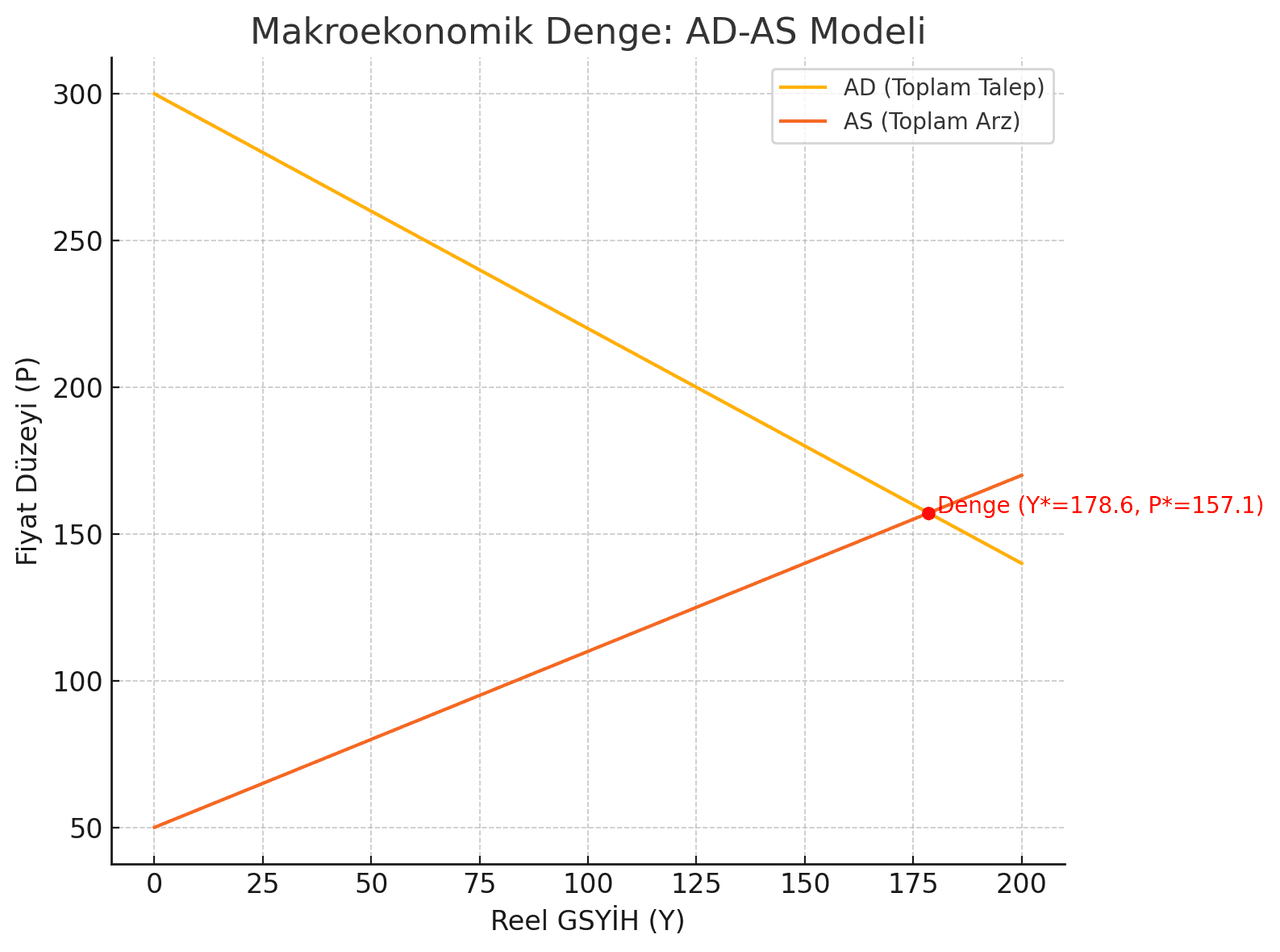
An AI-generated visual illustrating macroeconomic equilibrium.
Total supply takes different forms in the short and long run. In the short run, it fluctuates due to price and wage flexibility, while in the long run, it reaches the economy’s potential production capacity. In the long run, supply is primarily determined by labor, capital, and technological innovation. Efficient use of production factors is the key determinant of an economy’s potential output level.
Several main models explain macroeconomic equilibrium. These models interpret the interaction between total demand and total supply and its impact on macroeconomic indicators in different ways. However, macroeconomic equilibrium is not merely the balance between total supply and demand. Inflation and the unemployment rate are also important factors influencing this equilibrium. The unemployment rate rises when the economy fails to reach its potential output level. Inflation increases when total demand exceeds total supply.
The Keynesian model argues that total demand plays a critical role in achieving short-run economic equilibrium. Keynes contended that economic imbalances and recessions arise from insufficient total demand. According to this model, government intervention through fiscal and monetary policies to increase total demand can restore equilibrium. Additionally, in the Keynesian framework, unemployment is typically caused by demand deficiencies.
In the Classical model, markets are believed to self-correct and reach equilibrium naturally. According to this view, economic agents make rational decisions, and when prices and wages are flexible, supply and demand automatically balance. Classical economists argue that government intervention is unnecessary and that free market mechanisms alone ensure economic equilibrium.
The monetarist approach is based on the relationship between money supply and inflation. Monetarists argue that increases in the money supply affect only price levels in the long run and do not influence output. In this model, maintaining economic stability requires central banks to control the money supply.
The neoclassical model, similar to the classical approach, asserts that a free market economy can achieve equilibrium. However, neoclassical models emphasize equilibrium through a greater number of market participants and higher flexibility in prices and wages. Moreover, neoclassical models consider efficient utilization of production factors and technological progress as key determinants of equilibrium.
Fiscal policies by the government and monetary policies by central banks play a critical role in achieving macroeconomic equilibrium, sustaining economic stability, and supporting long-term growth. These two policy instruments help establish economic balance by directly influencing total demand and total supply. Below is a detailed explanation of how fiscal and monetary policies contribute to macroeconomic equilibrium. Fiscal policies encompass government efforts to steer economic activity through taxation and spending. These policies serve primarily as a stabilizing tool against short-term economic fluctuations. The main objective of fiscal policy is to increase or decrease total demand. Government spending (G) and tax rates (T) directly affect total demand.
Monetary policies are tools used by central banks to guide the economy by controlling interest rates and the money supply. The primary goal of monetary policy is to ensure price stability, control inflation, and support economic growth. In addition to influencing total demand in the short run, monetary policy also manages liquidity in financial markets and the stability of the banking system.
Fiscal and monetary policies are two essential tools that complement each other in achieving macroeconomic equilibrium. However, these policies can sometimes pursue conflicting objectives. For example, while the government may seek to increase total demand through higher spending, the central bank may raise interest rates to prevent inflation. Such situations can lead to policy inconsistency and economic uncertainty.
The effectiveness of fiscal and monetary policies generally depends on economic conditions and the specific policies applied. For instance, during an economic crisis, monetary policies typically stimulate demand in the short run, while fiscal policies aim for sustainable growth through structural reforms and public investments over the longer term.
Blanchard, Olivier. Macroeconomics. 7th ed. Boston: Pearson, 2017.
European University Institute. *Executive Certificate in Economics for Policymakers*. Accessed March 27, 2025.https://www.eui.eu/apply?id=economics-for-policymakers.
Keynes, John Maynard. The General Theory of Employment, Interest, and Money. London: Macmillan, 1936.
Mankiw, N. Gregory. Principles of Macroeconomics. 9th ed. Cengage Learning, 2021.

No Discussion Added Yet
Start discussion for "Macroeconomic Equilibrium" article
Total Demand and Total Supply
Macroeconomic Equilibrium Models
Keynesian Model
Classical Model
Monetarist Model
Neoclassical Model
The Role of Fiscal and Monetary Policies