


This article was automatically translated from the original Turkish version.
+1 More
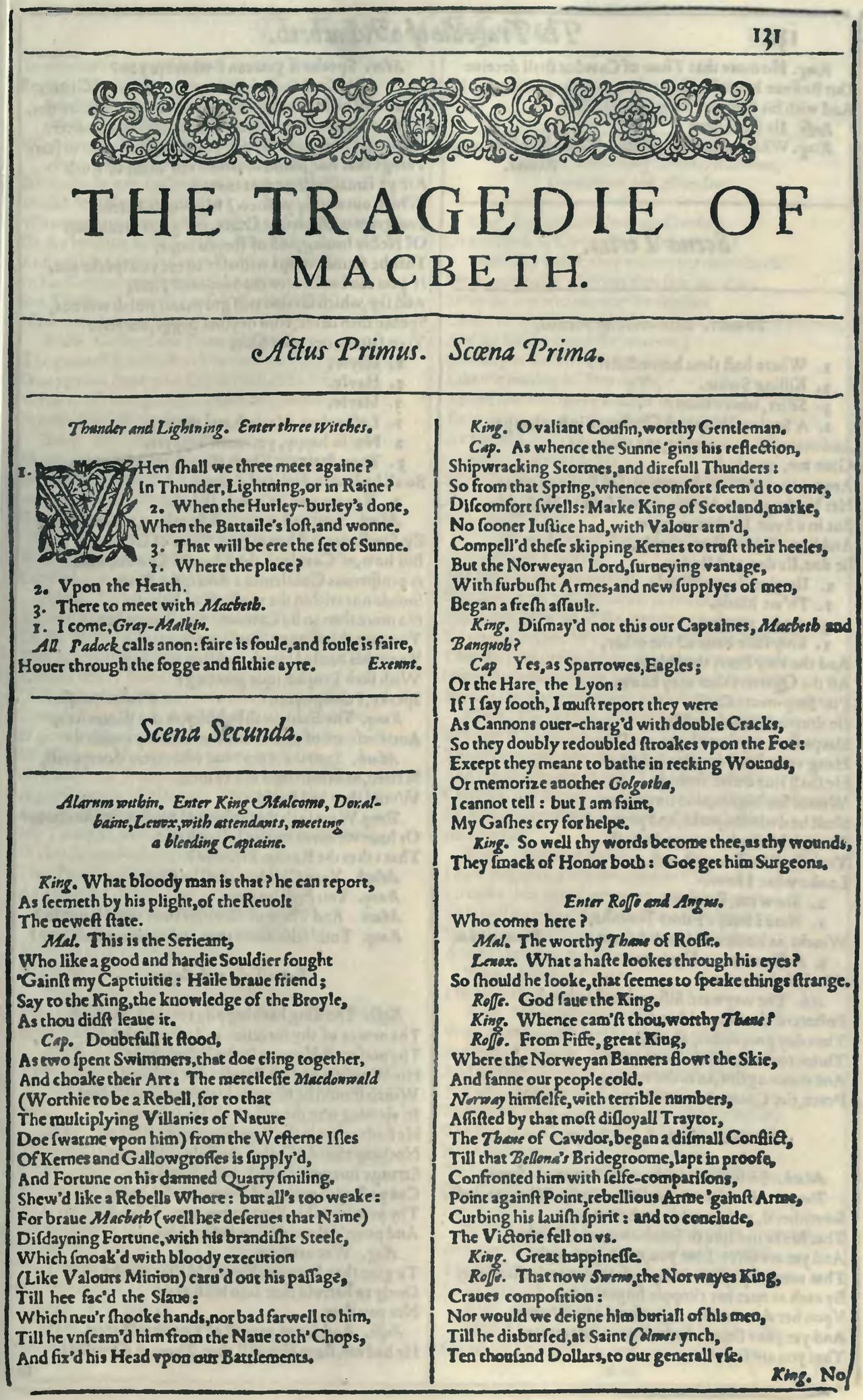
Author | William Shakespeare | ||||||||
|---|---|---|---|---|---|---|---|---|---|
Genre | Tragedy | ||||||||
First Performance | 1606 | ||||||||
Number of Acts | 5 | ||||||||
Macbeth is a five-act tragedy written by William Shakespeare. It was first performed in 1606 and is regarded as one of the dark and intensely atmospheric works of English Renaissance theatre. The play centers on the crimes and inner collapse of Macbeth, a Scottish general who embarks on a path of murder driven by ambition for power.
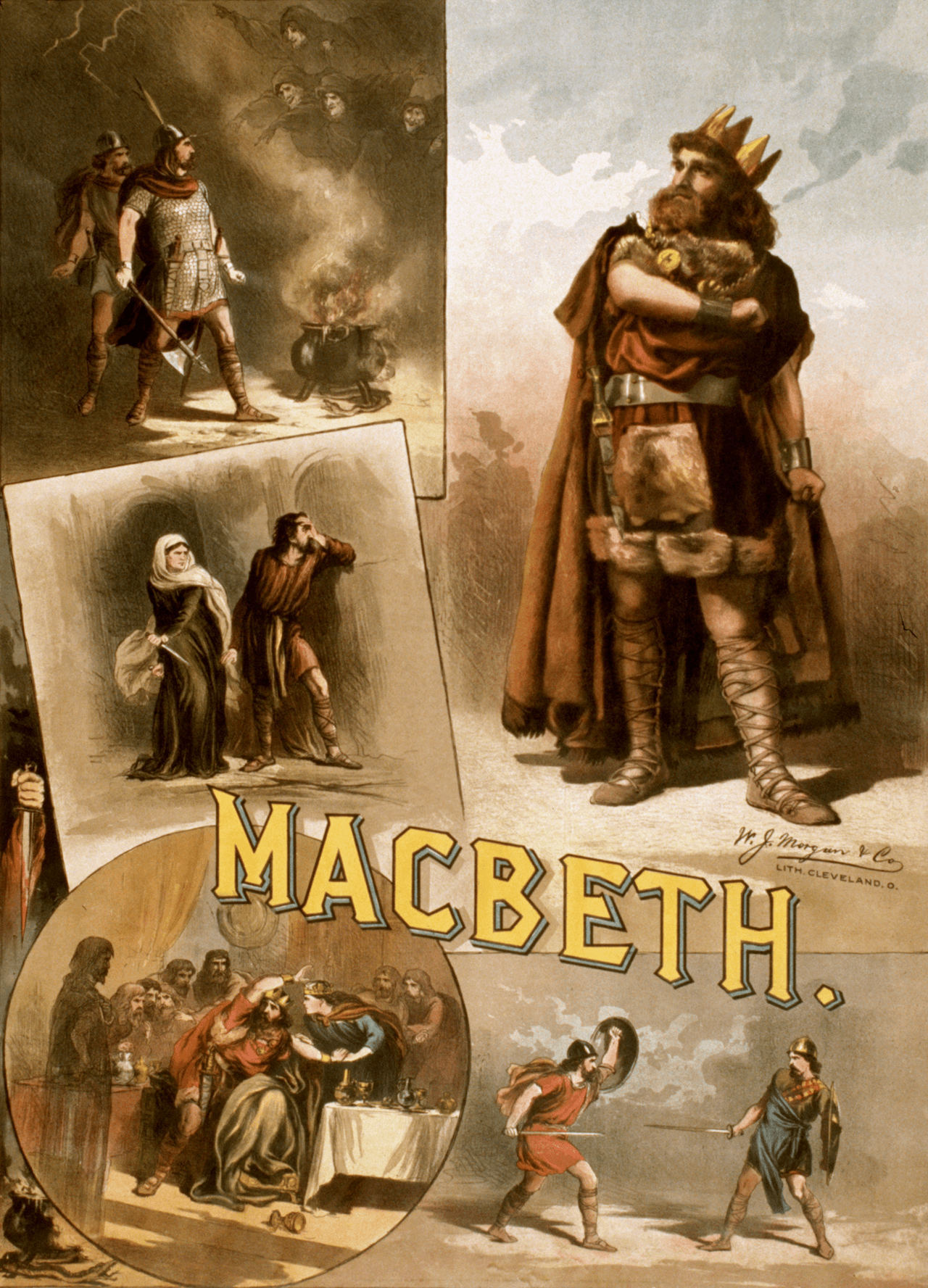
1884 Thomas Keene Macbeth rolünde
【1】
He is a commander in the army of King Duncan of Scotland. For his battlefield success, he receives praise and is rewarded with the titles of Thane of Glamis and Thane of Cawdor. After the three witches prophesy that he will become king, his ambition intensifies. Under the influence of his wife Lady Macbeth, he murders King Duncan and seizes the throne. Over time, he kills others to secure his power. Consumed by guilt, he is overwhelmed by fear, remorse, and paranoia. At the end of the play, he is killed by forces rebelling against his rule. His character arc represents moral decay and personal downfall.
She is Macbeth’s wife. She takes a guiding role when Macbeth hesitates, persuading him to kill King Duncan. Initially displaying determination and dominance, she later becomes consumed by guilt. She suffers from insomnia and psychological collapse. In her sleepwalking episodes, she confesses to the murders. In later acts of the play, she commits suicide. Her transformation reveals the impact of conscience on human behavior.
He is Macbeth’s close friend and a commander in the Scottish army. The witches tell him that his descendants will become kings in the future. This prophecy leads Macbeth to view him as a threat. Banquo is murdered on Macbeth’s orders, but his son Fleance escapes. Banquo is associated with values such as honesty and loyalty.
He is a Scottish nobleman who is disturbed by Macbeth’s rule. After Macbeth has his family murdered, he swears revenge. He travels to England to gain Malcolm’s support. At the end of the play, he kills Macbeth and plays an important role in restoring order. The character stands out for his pursuit of justice.
He is the king of Scotland. He trusts Macbeth and rewards him for his service. However, he is murdered as a result of Macbeth’s ambition. His death triggers the collapse of both political and social order.
These supernatural figures appear at the beginning of the play and deliver prophecies to Macbeth and Banquo. They do not directly determine the course of events but influence the characters’ decisions. Their prophecies are ambiguous and multilayered. This situation supports the idea that characters act according to their own will. They blur the boundary between the supernatural and reality.
He is the eldest son of King Duncan. After his father’s death, he is forced to flee. He gathers support in England and returns to Scotland to fight against Macbeth. At the end of the play, he becomes king. He represents the restoration of political order.
He is Banquo’s son. He escapes during the plot to kill his father. The possibility of the prophecy being fulfilled in the future is left open through him. Although he does not play a direct role throughout the play, he is of importance in ensuring the continuation of the bloodline.
Act 1:
The play opens with the appearance of the three witches. They encounter Macbeth, a Scottish general who has achieved great success in battle, and deliver a series of prophecies: Macbeth will first become Thane of Glamis, then Thane of Cawdor, and ultimately king. These predictions awaken Macbeth’s desire for power. The news is quickly confirmed; Macbeth is named Thane of Cawdor. His wife, Lady Macbeth, sees this development as a chance and urges him to kill King Duncan. Thus, Macbeth’s tragic journey, fueled by ambition, begins with the mental justification of murder.
Act 2:
Under his wife’s guidance, Macbeth murders King Duncan while he sleeps in Macbeth’s own castle. He frames the crime on Duncan’s loyal servants and kills them to eliminate evidence. After the murder, Duncan’s sons Malcolm and Donalbain flee Scotland, fearing they may be the next targets. Their flight leads the public to suspect them of guilt, removing any obstacle to Macbeth’s ascension. Yet Macbeth, despite gaining the throne, begins to act under a constant sense of threat. His reign, begun with regicide, is shadowed by inner unrest and paranoia.
Act 3:
King Macbeth grows increasingly fearful because of the witches’ prophecy that Banquo’s descendants will inherit the throne. He decides to eliminate Banquo and his son. Banquo is killed in an assassination, but his son Fleance escapes. At a banquet held in the palace, Macbeth sees Banquo’s ghost and suffers a severe psychological breakdown in front of the guests. This event is the first clear manifestation of his mental instability and guilt on stage.
Act 4:
Unable to cope with his growing inner fears, Macbeth returns to the witches seeking further information about his future. The witches give him new prophecies filled with symbolic language: Macbeth cannot be killed by any man born of a woman; his power will remain secure until Birnam Wood moves to Dunsinane Hill. Macbeth misinterprets these prophecies and believes himself invincible. However, upon learning that Macduff has gone to England to ally with Malcolm, Macbeth orders a brutal attack on Macduff’s castle and has his entire family slaughtered. This act marks the turning point where Macbeth completely crosses ethical boundaries and embraces absolute violence to preserve his personal power.
Act 5:
Lady Macbeth, overwhelmed by the weight of their crimes, descends into a mental collapse. Her sleepwalking and hallucinations of trying to wash away “blood stains” are tangible signs of her conscience’s torment. She eventually commits suicide. Meanwhile, an army led by Malcolm and Macduff marches against Macbeth. Soldiers carry branches from Birnam Wood to conceal their numbers as they advance on Dunsinane Hill, fulfilling the prophecy metaphorically. When Macduff confronts Macbeth, he reveals he was not “born of woman” but delivered by caesarean section. Thus, the final piece of the prophecy is explained. Macbeth is killed by Macduff. The throne passes to the rightful heir, Malcolm, and the play ends with the restoration of order on legitimate foundations.
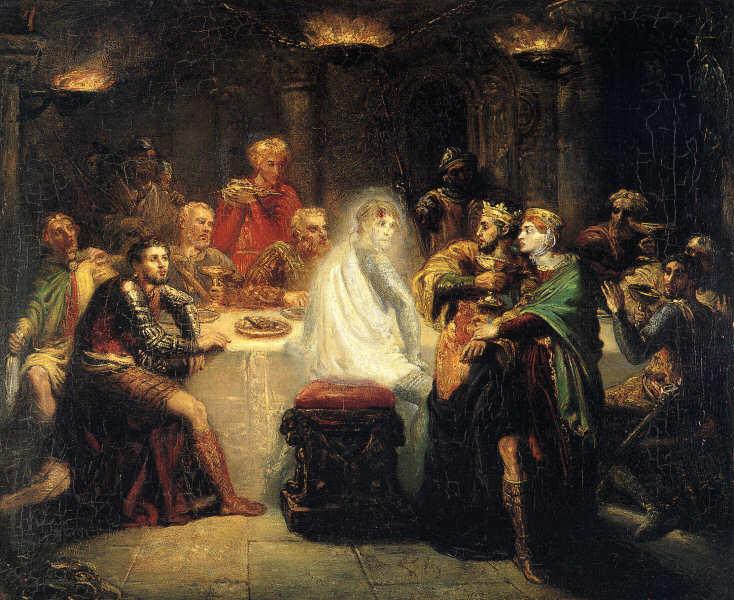
The Ghost of Banquo
【2】
Macbeth dramatically illustrates how individual ambition can erode ethical values. Initially an honorable soldier and patriotic figure, Macbeth abandons his moral principles in pursuit of the throne. This transformation becomes not only a personal but also a political symbol of corruption. When power ceases to be a means and becomes an end, the individual becomes alienated from both himself and his surroundings.
Although the prophecies in the play appear to be external forces determining the course of events, the real determining factor is how the characters respond to them. The witches’ words do not present a fixed fate but create a potential shaped by the characters’ own choices. This raises philosophical questions about free will versus destiny:
After committing murder, Macbeth and Lady Macbeth are tormented by intense guilt. This shows that guilt is not merely an external act but also an internal collapse. Lady Macbeth’s repeated attempts to wash the “blood stains” from her hands symbolize her futile effort to erase guilt mentally. Macbeth, meanwhile, tries to suppress the consequences of his crime through increasing violence; this process leads to the distortion of his perception of reality.
The boundary between reality and appearance is constantly blurred in the play. The witches’ symbolic and ambiguous utterances disrupt Macbeth’s perception of reality. Macbeth begins to live in an illusory world, interpreting events according to his own desires. This reveals how easily individuals can deceive themselves and how vulnerable perception is to manipulation. Reality is continuously reshaped according to the character’s psychological state.
Lady Macbeth’s transformation into a “masculine” character, defying societal gender norms, is one of the play’s most striking features. Traits traditionally assigned to women—passivity, obedience, and emotionality—are replaced in her by determination, ambition, and manipulation. Conversely, Macbeth’s hesitation and psychological breakdown present a picture contrary to the traditional ideal of masculinity. This reversal of roles suggests Shakespeare’s critical stance toward societal gender norms.
Macbeth stands out for its adherence to classical tragedy conventions and its reflection of Shakespeare’s dramatic genius:
The dialogue is richly woven with internal conflicts and psychological unraveling. Lady Macbeth’s monologue “Out, damned spot!” powerfully reflects her torment of conscience.
Macbeth was written by William Shakespeare in 1606. The play was performed during the reign of King James I of England and is linked to the political climate of the time. The king’s Scottish origins gave the play’s subject matter and character choices political meaning. Thus, Macbeth is considered a theatrical work connected to the political outlook of its era.
Work has been performed many times since its composition and has been open to diverse interpretations. In some 18th and 19th century productions, the language and structure of the play were altered. From the 20th century onward, Macbeth has been reinterpreted through the lenses of human psychology, politics, and ethical issues. Particularly the themes of power and responsibility have contributed to its enduring appeal across different periods.
Macbeth continues to be reimagined in the 21st century through theatre, cinema, and digital platforms in various forms. In modern adaptations, the classic narrative is preserved, but interpretations vary according to directors’ political, social, and aesthetic approaches.
On theatre stages, Macbeth continues to be performed using modern and experimental techniques. Traditional costume and set designs are increasingly replaced by minimalist or symbolic staging incorporating contemporary political references. The central themes of power, ambition, and moral decay are restructured to resonate with modern audiences. In some interpretations, Macbeth is portrayed as a state official, a military leader, or a figure from the business world, offering a critique of contemporary power structures.
Among cinematic adaptations, Justin Kurzel’s 2015 film Macbeth and Joel Coen’s 2021 film The Tragedy of Macbeth stand out. Both films largely preserve the original text but employ contemporary cinematic aesthetic tools in their visual storytelling. Particularly the use of black-and-white cinematography and atmospheric camera arrangements highlight elements that emphasize the play’s theatrical origins.
On digital platforms and in educational contexts, interactive content, animations, and abridged versions of Macbeth are being developed. Such adaptations increase the accessibility of the text and facilitate its connection with younger audiences.
In contemporary productions, the witches and supernatural elements are also interpreted through diverse techniques. In some stagings, these characters are represented using digital projections, sound technology, or abstract dance, expanding the audience’s interpretive space.
This diversity demonstrates that Macbeth is a text capable of being regenerated in different cultural contexts without being bound to a single interpretation. The work holds a place among texts that continue to be represented in both classical and contemporary forms in today’s art world.
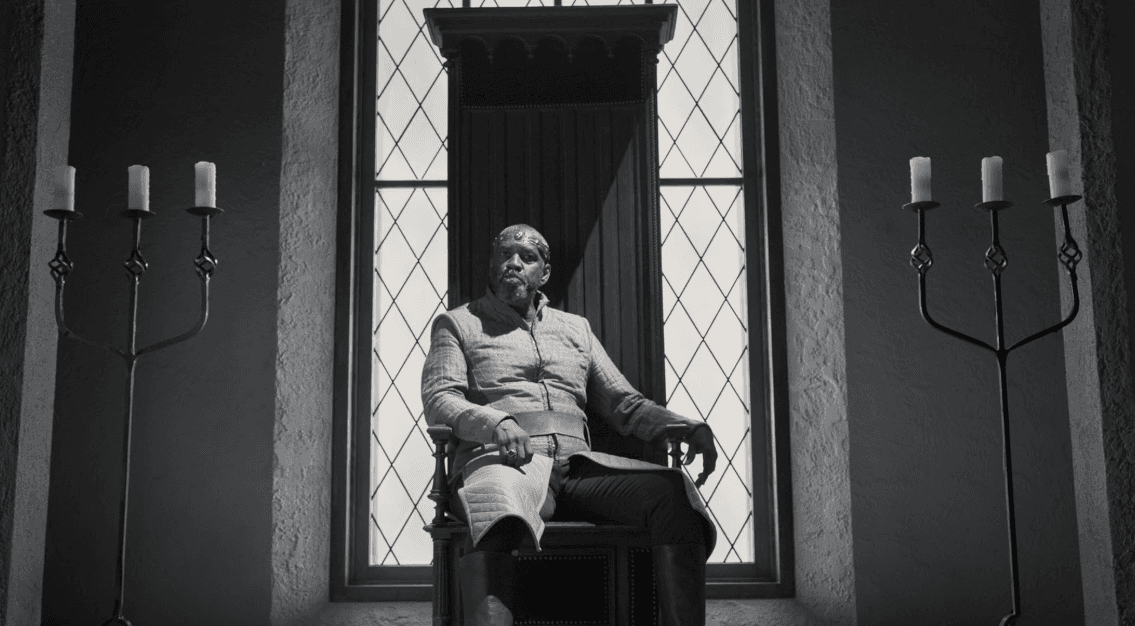
The Tragedy of Macbeth Filminden Bir Görüntü
【3】
Britannica. 2025. "William Shakespeare." Encyclopaedia Britannica. Accessed April 9, 2025.
Dollimore, Jonathan. Radical Tragedy: Religion, Ideology and Power in the Drama of Shakespeare and His Contemporaries. Durham: Duke University Press, 2004.
Hadfield, Andrew. Shakespeare and Republicanism. Cambridge: Cambridge University Press, 2005.
Neely, Carol Thomas. Women and Men in Shakespeare’s Plays. New Haven: Yale University Press, 1985.
Shakespeare Birthplace Trust. n.d. “Macbeth.” *Shakespedia*. Accessed April 9, 2025.https://www.shakespeare.org.uk/explore-shakespeare/shakespedia/shakespeares-plays/macbeth/
Shakespeare Birthplace Trust. t.y. "Macbeth." Accessed April 9, 2025.
Shakespeare, William. Macbeth. Çev. Sabahattin Eyüboğlu. 36. baskı. İstanbul: Türkiye İş Bankası Kültür Yayınları, 2019.
Variety. "Shakespeare’s Macbeth Reimagined as Indie Horror Video Game." Variety, March 20, 2025.https://variety.com/2025/gaming/news/shakespeare-macbeth-game-1236335046/
Washington University in St. Louis. t.y. "Something Wicked: The Macbeth Video Game." Fabula(b): Theater + New Media Lab. Accessed April 9, 2025.
[1]
AnyLang. t.y. "Macbeth (Makbet) in Polish with Parallel Translation." Erişim 9 Nisan 2025. https://anylang.net/tr/articles/pl/makbet
[2]
Accessed November 26, 2025.
[3]
IMDb. t.y. "Denzel Washington in The Tragedy of Macbeth (2021)." Erişim 9 Nisan 2025. https://www.imdb.com/title/tt10095582/mediaviewer/rm2010193409/IMDb

Author | William Shakespeare | ||||||||
|---|---|---|---|---|---|---|---|---|---|
Genre | Tragedy | ||||||||
First Performance | 1606 | ||||||||
Number of Acts | 5 | ||||||||
No Discussion Added Yet
Start discussion for "Macbeth (Theater Play)" article
Characters
Macbeth
Lady Macbeth
Banquo
Macduff
King Duncan
The Three Witches
Malcolm
Fleance
Macbeth – Act Summaries
Themes
Ambition and Corruption
Prophecy and Fate
Guilt and Conscience
Reality and Illusion
Gender Roles
Dramatic Features
Place in Theatre History
Contemporary Adaptations