


This article was automatically translated from the original Turkish version.
Lületaşı, known scientifically as sepiolite, is a magnesium silicate mineral composed primarily of magnesium and silicon. This natural stone undergoes hydrothermal metamorphism and hydration, typically occurring in soft and moist conditions at depths ranging from 20 to 130 meters. Noted for its light and porous structure, lületaşı is an easily workable and durable material, commonly found in white or near-white tones. With a hardness ranging from 2 to 2.5, it is also recognized for its ability to float in water when dry and its slippery texture when moist.
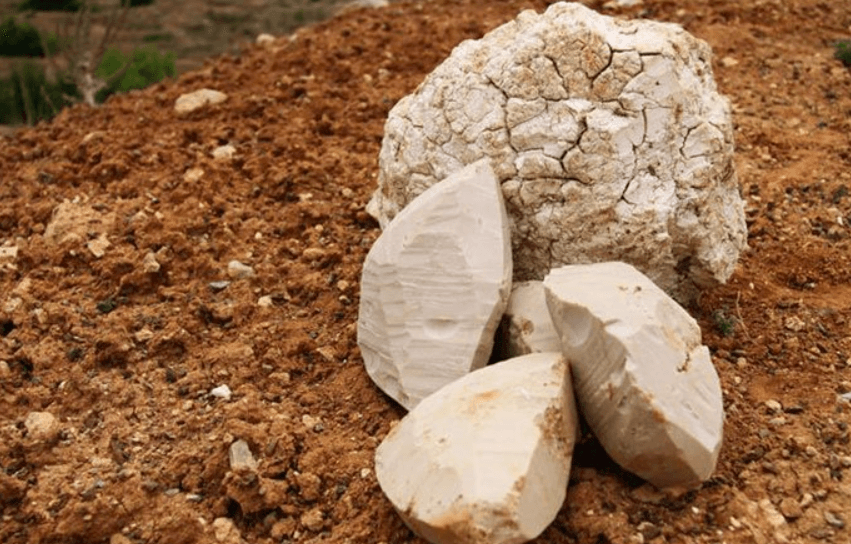
Raw Lületaşı
Although lületaşı is found in various parts of the world, the highest quality reserves are located in Eskişehir Province in Türkiye. Türkiye holds approximately 70 percent of the world’s reserves and is a leading country in the extraction and processing of this stone. Lületaşı is also known locally as “Eskişehir Stone,” “Denizköpüğü,” or among the public as “Patal” and “Aktaş.”
Lületaşı has a microscopic irregular crystal structure and is distinguished by its porous texture. Its chemical formula is generally Mg4Si6O15(OH)2•6 H2O. Its fine-grained structure exhibits clay-like properties, making it suitable for artistic and industrial applications due to its ease of workability. Its porous nature allows it to retain natural moisture, which facilitates processing. When dried, it loses moisture, becomes lighter and harder, thereby gaining durability. The hardness of lületaşı ranges from 2 to 2.5 on the Mohs scale.
There are two main types of lületaşı:
Archaeological excavations have revealed that lületaşı was known and used as early as 3000 BCE. An artifact made of lületaşı discovered at the Demirci Höyük site in Eskişehir confirms that this stone has a history spanning over 5,000 years. Known in Europe as “meerschaum,” lületaşı became popular in Western countries from the 17th century onward. Lületaşı extracted from Eskişehir was transported to Vienna, where it was crafted into pipes and ornamental items, leading to its designation in the West as the “Vienna Stone.”
During the Ottoman period, lületaşı craftsmanship was an important source of income. However, artistic production was actively promoted during the Republican era, gaining international recognition. Mythological stories surrounding lületaşı have further enhanced its cultural importance. Particularly well-known is the legend of the mole and the shepherd from Karatepe village in Eskişehir, which recounts the discovery of the stone.
Lületaşı is generally extracted from villages surrounding Eskişehir. The main mining sites are located in the villages of Sarısu, Sepetçi, Nemli, Margı, Söğütçük, Karaçay, and Başören. Narrow shafts are dug to reach the ore deposits, and once the lületaşı beds are accessed, horizontal tunnels are excavated to extract the stone. While traditional methods rely heavily on manual labor, modern techniques now incorporate machinery and compressors.
Processing begins while the stone is still moist and involves several stages. Primary tools used in processing include chisels, carving knives, files, and drills. Production processes consist of stages such as “rough shaping,” “saykal,” “arış,” and “polishing.”
Lületaşı is used in numerous artistic and industrial applications:
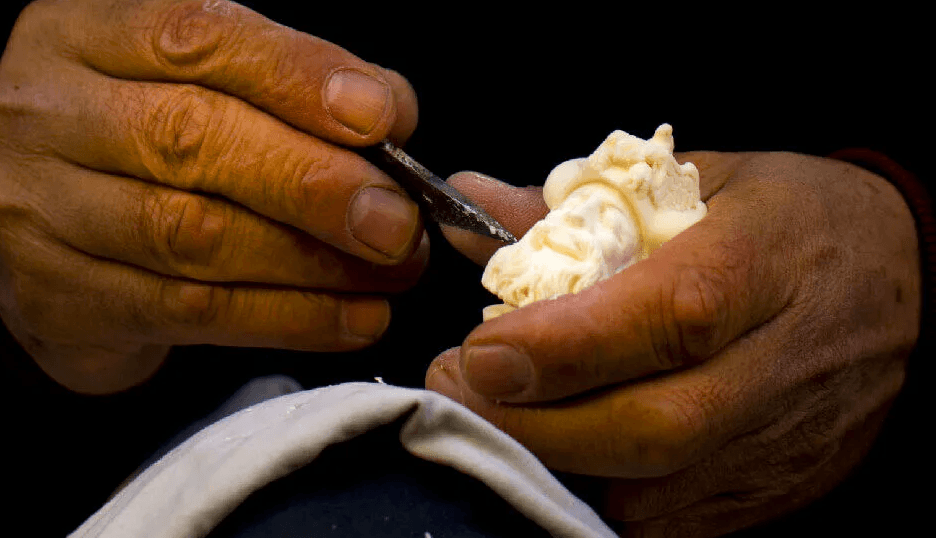
Lületaşı Craftsmanship (Source: Sakarya Gazetesi)
Lületaşı craftsmanship is a vital source of income for Eskişehir’s economy. Local communities process the extracted stone in artisan workshops, producing goods for both the domestic market and export. In Türkiye, lületaşı art was actively promoted during the Republican era, and exports of lületaşı products have made significant contributions to the national economy.
However, lületaşı craftsmanship faces threats due to declining interest among younger generations and the weakening of the apprenticeship system. To sustain this tradition, increased educational and promotional efforts are necessary.
"Lüle Taşı Nedir?" Makaleler.com. Accessed January 14, 2025.https://www.makaleler.com/lule-tasi-nedir.
"Lüle Taşı ve Taş İşçiliği." Jeoloji Mühendisleri Odası (JMO). Accessed January 14, 2025.https://www.jmo.org.tr/resimler/ekler/d64e092b1764308_ek.pdf.
"Lüle Taşı." Değerli Taşlar. Accessed January 14, 2025.https://www.degerlitaslar.gen.tr/luletasi.
Milli Eğitim Bakanlığı. El Sanatları Teknolojisi: Lüle Taşı Desen Çizimi, 215ESB439. Ankara, 2012.

Physical and Chemical Properties of Lületaşı
History and Cultural Significance of Lületaşı
Extraction and Processing of Lületaşı
Applications
Lületaşı Craftsmanship and Economic Contributions