This article was automatically translated from the original Turkish version.
Role | Experimental supersonic aircraft | ||||||||
|---|---|---|---|---|---|---|---|---|---|
Country of Origin | United States | ||||||||
Manufacturer | Lockheed Martin/NASA | ||||||||
First Flight | 2025-10-28 | ||||||||
Status | In Testing Phase | ||||||||
Engine | General Electric F414-GE-100 - 22,000 lbf | ||||||||
Length | 30.4 meters | ||||||||
Wingspan | 9 meters | ||||||||
Maximum Takeoff Weight | 14,700 kg | ||||||||
Cruise Speed | Mach 1.42 (1,510 km/h) | ||||||||
Altitude | 55,000 ft (16,800 m) | ||||||||
Estimated Noise | 75 EPNdB | ||||||||
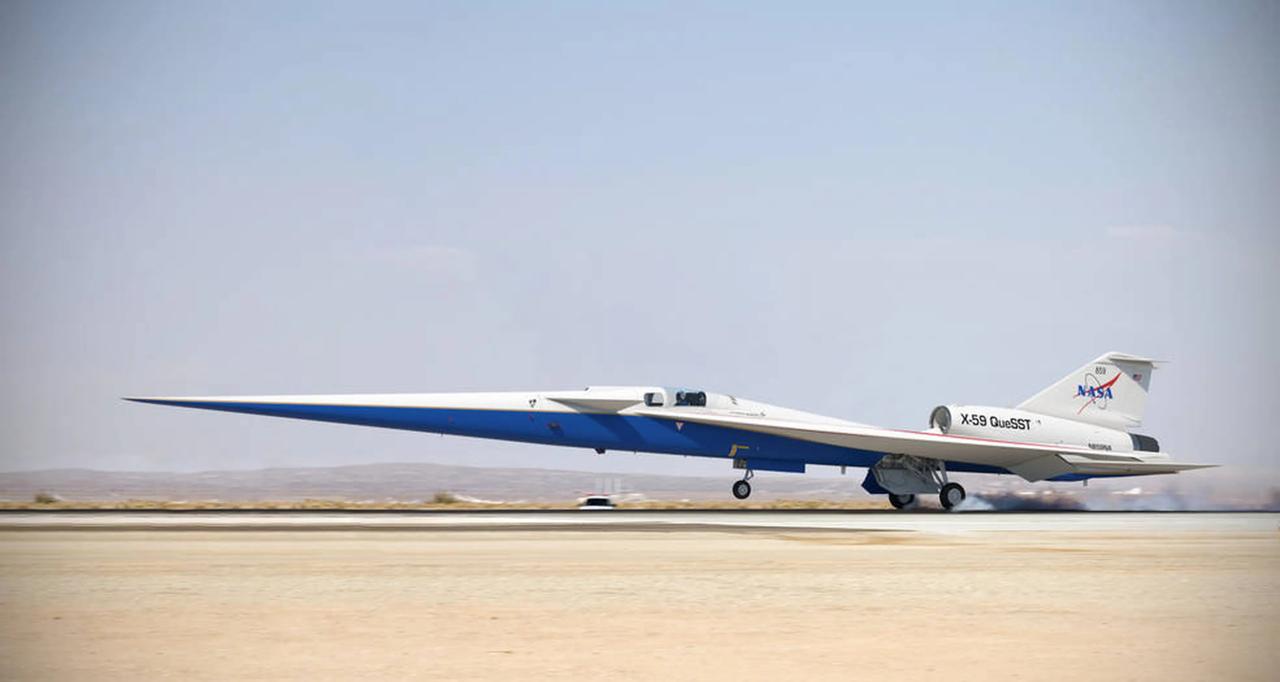
Lockheed Martin X-59 Quesst (Quiet SuperSonic Technology), NASA’s Low-Boom Flight Demonstrator program under which an experimental supersonic aircraft was developed at Lockheed Martin’s Skunk Works facilities. The aircraft’s purpose is to test whether commercial supersonic flight over land can be made viable by significantly reducing the sonic boom generated when exceeding the speed of sound.
The program’s long-term goal is to provide scientific data to support the lifting of the United States’ ban on supersonic flight over land, which has been in effect since 1973. NASA plans community-based test flights over ten selected U.S. cities between 2026 and 2028. These data are expected to contribute to the International Civil Aviation Organization’s revision of noise standards.
X-59 is considered a continuation of the Bell X-1 (1947) and Concorde (1969) projects in the history of supersonic research, but it is the first aircraft designed specifically to produce a “quiet sonic boom.” The project has been described as the forerunner of the 21st century’s “civil supersonic renaissance.”
In February 2016, NASA awarded Lockheed Martin its first contract for the preliminary design of the X-59. In 2017, wind tunnel tests conducted at NASA Langley using 9% and 8% scale models evaluated aerodynamic stability, control surfaces and low-noise performance. On 2 April 2018, NASA awarded Lockheed Martin a primary contract worth $247.5 million covering the design, production and delivery of the aircraft. In the same year, the U.S. Air Force designated the aircraft “X-59 QueSST.”
By 2020, half of the airframe assembly was completed. The aircraft received its General Electric F414-GE-100 engine in 2022. The engine is 4 meters long and produces 98 kN (approximately 22,000 lbf) of thrust. In 2024, the aircraft was completed at Lockheed Martin’s Skunk Works facility in Palmdale, California, and conducted its first test flight on 28 October 2025 under the supervision of NASA Armstrong Flight Research Center.
Flight Test on 28 October (Lockheed Martin)
The X-59 is designed with a long slender fuselage (length 30.4 m, wingspan 9 m) to prevent the formation of shockwaves that coalesce into a loud sonic boom, thereby reducing the perceived noise level on the ground. The aircraft is designed to cruise at Mach 1.42 (1,510 km/h) at an altitude of 55,000 ft (16,800 m) and has a maximum takeoff weight of 14,700 kg.
The cockpit is equipped with the seat and canopy from the Northrop T-38. The landing gear is derived from the F-16. Due to its long nose, the pilot has no direct forward visibility. Therefore, an External Vision System (XVS) and an Enhanced Vision System (EVS) developed by Collins Aerospace are used. 4K resolution cameras and infrared sensors digitally provide the pilot with a view during landing and cruise.
The aircraft’s fuselage, wing roots and engine air intakes were designed using an aerodynamic optimization technique known as “boom shaping.” This design ensures that supersonic shockwaves disperse without merging, thereby softening the pressure change detected on the ground. NASA refers to this effect as “Mach cut-off shaping.”
NASA’s goal is for the aircraft to produce a “thump” of only 75 EPNdB on the ground — roughly equivalent to the sound of a car door closing. For comparison, the Concorde’s average noise level was 105–110 EPNdB.
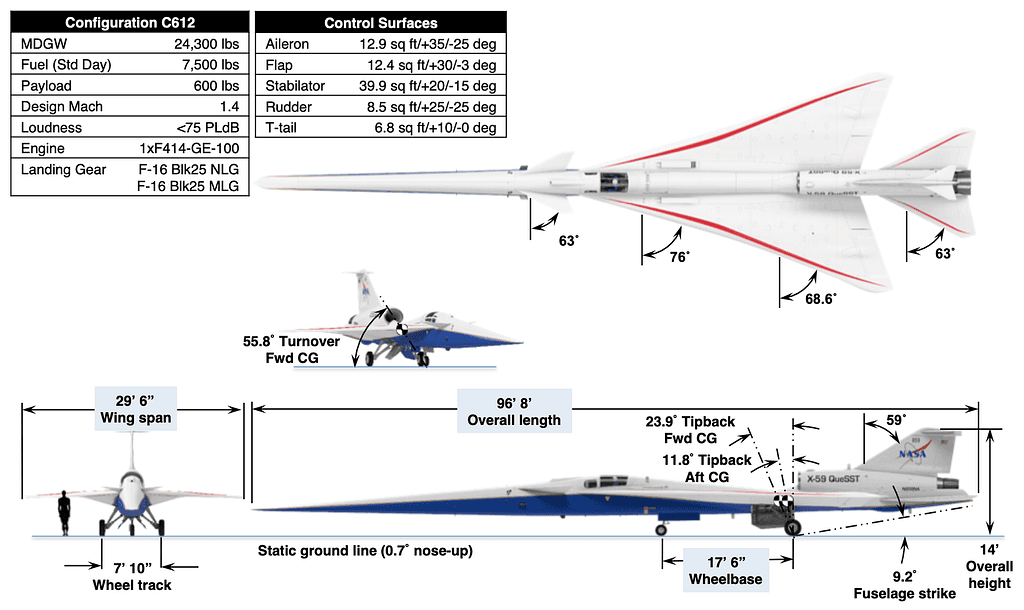
Technical Details of the X-59 Published by NASA (NASA)
The X-59 will test public acceptance of quiet supersonic technologies through demonstration flights over various U.S. cities as part of NASA’s Quesst program. Community feedback is expected to provide the basis for the International Civil Aviation Organization and the U.S. Federal Aviation Administration to review the ban on supersonic flight over land by 2028.
Banke, Jim. “QueSST – New Era of X-Plane Research.” NASA, April 22, 2016. Accessed October 30, 2025.https://www.nasa.gov/aeronautics/nasa-moves-to-begin-historic-new-era-of-x-plane-research/
Clash Report. “NASA’s Quiet Supersonic X-59 Completes First Test Flight.” Clash Report, October 29, 2025. Accessed October 30, 2025.https://clashreport.com/world/articles/nasas-quiet-supersonic-x-59-completes-first-test-flight-t97pias7rh9
Kamlet, Matt. “Jet Engine Installed on NASA’s X-59.” NASA, November 14, 2022. Accessed October 30, 2025.https://www.nasa.gov/feature/jet-engine-installed-on-nasa-s-x-59
Lockheed Martin. “X-59 Quiet Supersonic Technology.” Lockheed Martin Products Page. n.d. Accessed October 28, 2025.https://www.lockheedmartin.com/en-.us/products/x-59-quiet-supersonic.html
Lockheed Martin. “X-59 Takes to the Skies.” YouTube, October 29, 2025. Accessed October 30, 2025.https://www.youtube.com/watch?v=zIwcModSxdE
Picryl. "X-59." Picryl.com, March 13, 2019. Accessed October 30, 2025.https://picryl.com/media/x-59-fc8f74
Rajagopalan, Rishikesh. “NASA Set to Unveil Experimental X-59 Aircraft Aimed at Commercial Supersonic Travel.” CBS, January 9, 2024. Accessed October 30, 2025.https://www.cbsnews.com/news/nasa-experimental-x-59-aircraft-commercial-supersonic-travel/
Tingley, Brett. “Watch NASA’s Sci-Fi-Looking X-59 ‘Quiet’ Supersonic Jet Roll out of the Hangar (Video).” *Space*, August 4, 2023. Accessed October 30, 2025.https://www.space.com/nasa-x-59-quiet-supersonic-jet-hangar-video
Warwick, Graham, and Guy Norris. “Lockheed to Build NASA’s Low-Boom Supersonic X-Plane.” *Aviation Week*, April 4, 2018. Accessed October 30, 2025.https://aviationweek.com/aerospace/lockheed-build-nasas-low-boom-supersonic-x-plane

Role | Experimental supersonic aircraft | ||||||||
|---|---|---|---|---|---|---|---|---|---|
Country of Origin | United States | ||||||||
Manufacturer | Lockheed Martin/NASA | ||||||||
First Flight | 2025-10-28 | ||||||||
Status | In Testing Phase | ||||||||
Engine | General Electric F414-GE-100 - 22,000 lbf | ||||||||
Length | 30.4 meters | ||||||||
Wingspan | 9 meters | ||||||||
Maximum Takeoff Weight | 14,700 kg | ||||||||
Cruise Speed | Mach 1.42 (1,510 km/h) | ||||||||
Altitude | 55,000 ft (16,800 m) | ||||||||
Estimated Noise | 75 EPNdB | ||||||||
No Discussion Added Yet
Start discussion for "Lockheed Martin X-59 Quesst" article
Development Process
Design and Technical Specifications
Program Objective and Application