

badge icon

This article was automatically translated from the original Turkish version.

Article

Laser distance meter

Quote

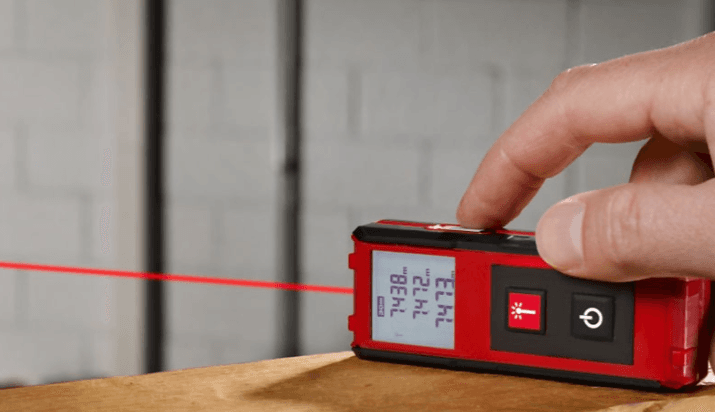
Laser meters, also known as laser distance meters or laser telemeters, are devices that use laser beams to measure distances with high precision. These devices operate on the principle of measuring the time it takes for a laser pulse to reach a target and return. This method is called the time-of-flight principle and provides high accuracy in distance measurements.

Working Principle

Laser distance meters use the "time-of-flight" method as their working principle. The device directs a laser beam toward a target surface, and the reflected beam is detected by a sensor. The time taken for the laser to return is calculated based on the speed of light, and this data is used to determine the distance.

Applications

Laser meters are used in many different fields:
  • Architecture and Construction: Interior building measurements, area and volume calculations, alignment checks.
  • Engineering and Surveying: Precise distance determination in land surveying and infrastructure projects.
  • Industry and Manufacturing: Machine positioning, quality control and logistics processes.
  • Military Use: Target detection, range calculation and surveillance applications.
  • Outdoor and Sports Applications: Distance measurement during golf, hunting and hiking.

Advantages

  • High Precision: Can measure with millimeter-level accuracy.
  • Ease of Use: Simple interface and rapid results.
  • Time Efficiency: Faster than traditional measurement methods.
  • Compact and Portable: Can be carried in a pocket or on a tool belt.
  • Multifunctional: Some models include additional features such as angle measurement, area calculation and Bluetooth connectivity.

Types of Laser Meters

  • Handheld Laser Distance Meters: Portable and widely used in construction and individual projects.
  • Industrial Laser Sensors: Integrated into machines for automation and quality control processes.
  • Surveying Laser Telemeters: Used for large-scale outdoor measurements.
  • Military-Grade Laser Telemeters: Designed to withstand harsh conditions and feature advanced targeting capabilities.

Limitations

  • Surface Optical Properties: The device provides more accurate measurements on reflective surfaces, but accuracy may decrease on dark or matte surfaces.
  • Atmospheric Conditions: Weather conditions such as fog, rain and dust can affect laser beam propagation and reduce measurement precision.
  • Energy Consumption: In battery-powered models, prolonged use may increase the need for recharging.


【1】

Laser distance meters are widely used in various fields requiring precise distance measurement. With advancing technology, they are becoming more functional through integration with global positioning systems (GPS), wireless data transmission and augmented reality gibi additional features. However, specific limitations must be considered depending on the application. Future developments are progressing toward improved measurement accuracy and efficiency.

Bibliographies

Elglmady, Karim, Osama Terra, Hatem Hussein, and Mohamed Medhat. "Calibration of Laser Distance Meter Using Opto-Electronic Oscillator." Ain-Shams University, Cairo, Egypt

Citations

Author Information

Avatar
AuthorElyesa KöseoğluJuly 14, 2026 at 2:53 PM

Discussions

No Discussion Added Yet

Start discussion for "Laser distance meter" article

View Discussions

Contents

  • Working Principle

  • Applications

  • Advantages

  • Types of Laser Meters

  • Limitations