


This article was automatically translated from the original Turkish version.
+2 More
1 Mayıs Emek ve Dayanışma Günü, dünya genelinde işçilerin mücadeleleri ve emek hareketinin kazanımlarını anmak üzere her yıl 1 Mayıs’ta kutlanan uluslararası bir bayramdır. Küresel ölçekte “Uluslararası İşçi Günü” veya “İşçi Bayramı” olarak da bilinen bu gün, pek çok ülkede resmî tatil olup işçilerin birlik ve dayanışmasının simgesi haline gelmiştir. Türkiye’de de Emek ve Dayanışma Günü adıyla anılan 1 Mayıs, 2009 yılında çıkarılan bir yasayla ulusal bayram ve genel tatil günü ilan edilmiştir.
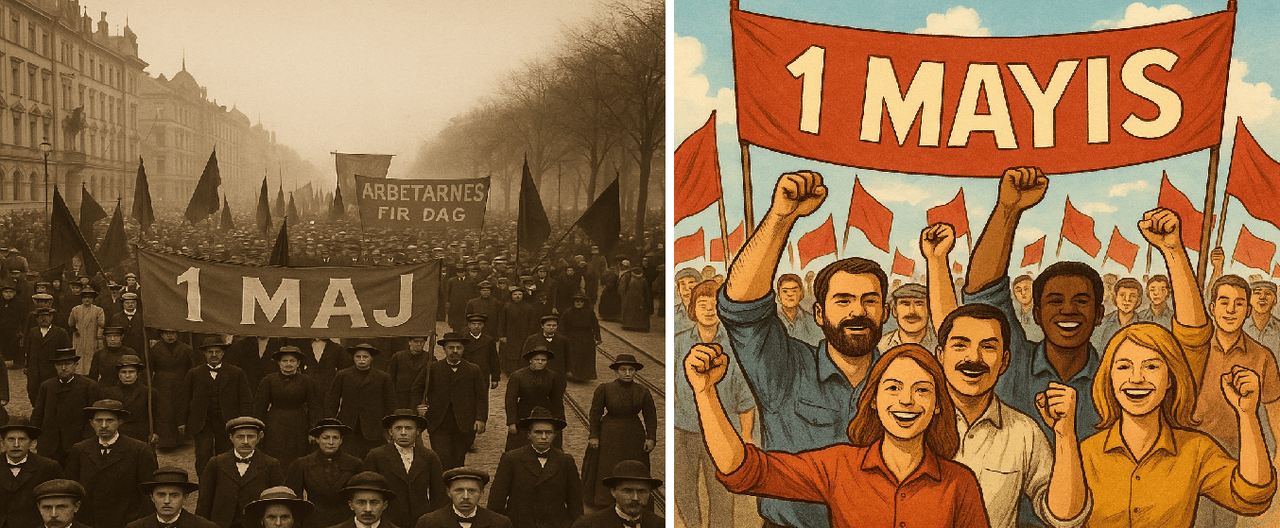
Citizens Celebrating May 1 After a 100-Year Interval (generated by artificial intelligence.)
In the 19th century, alongside the organization of the working class in response to harsh working conditions created by the Industrial Revolution, mass actions emerged centered on the demand for an eight-hour workday. On 1 May 1886, hundreds of thousands of workers in the United States participated in widespread strikes and demonstrations demanding the right to an eight-hour workday. During these actions, several people lost their lives in a clash that took place in Chicago and became known as the Haymarket Affair 【1】; this event acquired symbolic significance for the international labor movement.
In 1889, an international congress of labor organizations convened in Paris decided, in memory of the Haymarket Affair in Chicago, to commemorate 1 May as a day of unity and struggle for workers worldwide. In accordance with this call, the first mass Workers’ Day rallies were held on 1 May 1890 in many countries, especially in Europe and America, thus establishing the tradition of annual observance of 1 May. In 1904, the International Socialist Congress in Amsterdam issued a call for demonstrations and, where possible, work stoppages on 1 May to demand an eight-hour workday and other workers’ rights, reinforcing the day as a universal act of solidarity.
As of today, 1 May is officially recognized as a public holiday under the name Workers’ Day or similar designations in more than 160 countries worldwide. In many countries, workers and trade unions organize marches, rallies, and various events in public squares to voice demands for improved working conditions and expanded social rights. In European, Asian, African, and Latin American countries, 1 May is generally observed as a public holiday, while in countries such as the United States and Canada, similar celebrations are held on the first Monday of September; in the United Kingdom and Ireland, the first Monday of May is designated as an official public holiday. Throughout the 20th century, 1 May became one of the most important holidays in countries under socialist and communist regimes. In the Soviet Union, China, Cuba, and other Eastern Bloc nations, 1 May was celebrated with state ceremonies and large-scale parades that included not only workers and laborers but also military displays, reflecting the ideological values of those societies. At the same time, some cultures also observe traditional Spring Festival (May Day) celebrations on the same date; however, in the modern era, the term “1 May” generally refers to celebrations centered on labor solidarity.
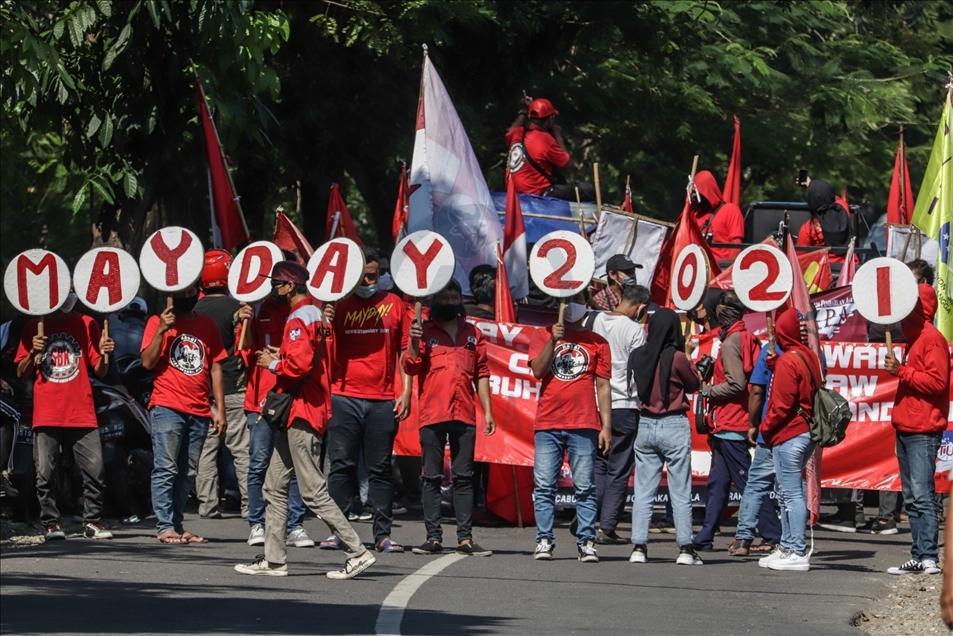
May Day Celebrations Worldwide. (AA)
In the Ottoman Empire, one of the strongest centers of worker organization was Thessaloniki, where on 1 May 1911 a demonstration was held involving tobacco, port, and cotton workers. The following year, the first 1 May celebration in Istanbul took place. Even under the conditions of Istanbul’s occupation in 1921, workers held unauthorized demonstrations to commemorate 1 May. Immediately after the founding of the Republic of Türkiye, 1 May was officially declared “Workers’ Day” in 1923 and granted legal status. However, in 1924 the government banned mass 1 May celebrations; in 1925, the Takrir-i Sükûn Law【2】 completely prohibited all forms of strikes, union activities, and demonstrations, including 1 May events. In subsequent years, limited and controlled celebrations were occasionally permitted, and in 1935, the Law on National Holidays and General Rest Days removed the political content of 1 May and declared it an official holiday under the name “Spring Festival”.
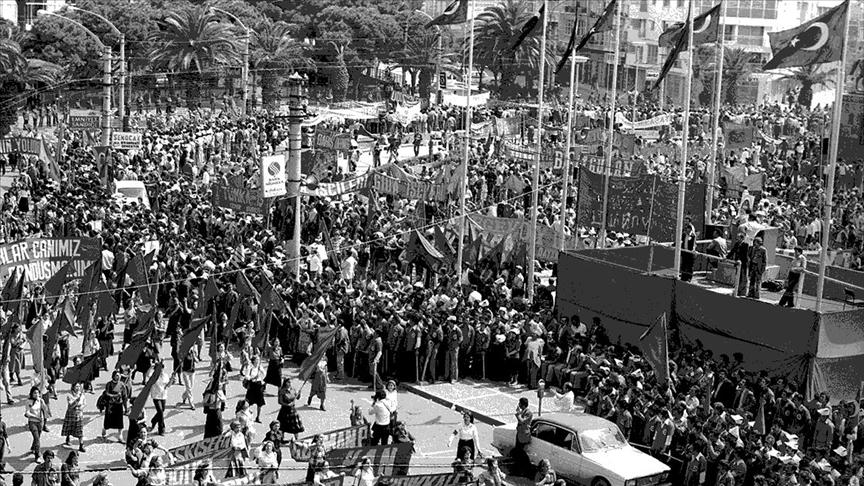
The first May Day celebrations in Türkiye. 1 May 1921
With the transition to multi-party politics and the revival of trade union activity, a large-scale 1 May rally was held in Istanbul’s Taksim Square in 1976 after a long hiatus. Organized under the leadership of the Confederation of Revolutionary Trade Unions 【3】 (DİSK), this rally marked the first mass Workers’ Day celebration since the 1930s. In 1977, another rally in Taksim Square drew hundreds of thousands of participants and became the largest 1 May celebration in Turkish history; however, toward the end of the event, unexplained gunshots fired into the crowd triggered panic and resulted in a massive stampede. As a result, 34 people lost their lives, and the tragic incident entered history as the Bloody 1 May【4】 . In 1978, 1 May was again commemorated in Taksim Square with the participation of hundreds of thousands. However, in 1979, the martial law administration banned demonstrations in Istanbul and imposed a curfew. Despite the official ban, small unauthorized 1 May demonstrations continued in Istanbul’s streets in 1979. The 1980 1 May observance was only possible in Mersin with limited participation.
Following the military coup, all mass activities in the country, including 1 May celebrations, were banned. As one of the first measures of the junta, 1 May, previously recognized as a public holiday under the name “Spring and Flower Festival”, was removed from the list of general holidays and no public celebrations were permitted for many years. Throughout the 1980s, 1 May could not be commemorated in Türkiye through official or open mass events. In the 1990s, with the gradual revival of trade union activity and improvement in the democratic environment, 1 May commemorations slowly returned to public life. In 1996, tens of thousands participated in a major 1 May rally held in Kadıköy, Istanbul, due to the ban on Taksim Square; during the first moments of the demonstration, police opened fire, resulting in the deaths of three workers. The ensuing tension became one of the defining events of that period. After this incident, central 1 May rallies in Istanbul were not permitted for many years, and commemorations continued as symbolic and small-scale events.
In 2007, on the 30th anniversary of the 1977 events, unions and civil society organizations sought to commemorate 1 May again in Taksim Square. However, due to interventions by security forces, widespread clashes occurred in Istanbul that year, and hundreds of people were detained. In response, the government announced in April 2008 that it officially recognized the name “Labour and Solidarity Day” in official literature. On 22 April 2009, the Grand National Assembly of Türkiye passed a decision that, for the first time since 1981, declared 1 May a national public holiday. Starting in 2009, 1 May was once again publicly and massively commemorated in many provinces of Türkiye. In 2010, a 1 May celebration in Taksim Square with approximately 140,000 participants became the largest official Workers’ Day observance in Istanbul in 32 years. In 2011 and 2012, peaceful demonstrations continued to mark 1 May across Türkiye, with Istanbul at the forefront.
By 2013, 1 May celebrations in Taksim Square were again prohibited due to ongoing pedestrianization projects and security concerns. Since then, alternative venues have been used for 1 May commemorations in Istanbul; in some years, rallies were held in areas such as Yenikapı or Maltepe, while clashes occurred between groups attempting to reach Taksim and security forces, resulting in numerous detentions. Today, 1 May continues to be commemorated annually in Türkiye with large-scale rallies and events led by trade unions, professional associations, and various civil society organizations, bringing workers’ demands to public attention.
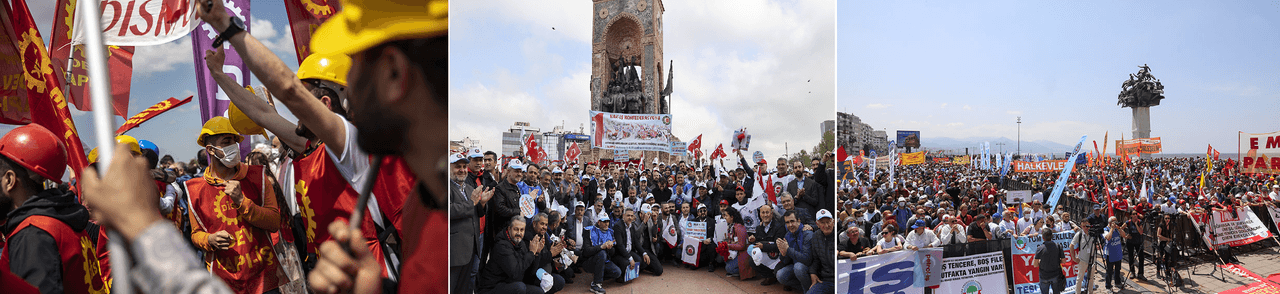
May Day Landscapes from Türkiye (AA)
Labour and Solidarity Day on 1 May continues to hold great significance both globally and in Türkiye in terms of labor life, despite the decades that have passed. As a public holiday in many countries’ calendars, it serves not only to recall the historical struggle for workers’ rights but also as a vital opportunity to raise awareness of current issues. Annual events and demonstrations on 1 May draw attention to issues such as unemployment, low wages, precarious work, and workplace safety, making workers’ demands visible. In this sense, Labour and Solidarity Day has become a symbol of international solidarity among workers in an increasingly globalized world and embodies the pursuit of social justice. The 1 May commemorations, which honor past achievements of the labor movement and pass them on to new generations, continue to emphasize the importance of labor life and workers’ rights in contemporary societies.
Anadolu Ajansı. International Labour Day Around the World. May 1, 2021. Accessed May 1, 2025.
BLS (Bureau of Labor Statistics). "History of Labor Movements." United States Department of Labor. Accessed April 25, 2025.https://www.bls.gov/opub/mlr/2000/06/art2full.pdf
Canadian Labour Congress. "Why May Day Matters." CLC Official Website. Accessed April 25, 2025.https://canadianlabour.ca/may-day/
History.com Editors. "Haymarket Riot." History.com, April 25, 2025.https://www.history.com/topics/19th-century/haymarket-riot
International Labour Organization. "Labour Day and the Eight-Hour Movement." International Labour Organization. Accessed April 25, 2025.https://www.ilo.org/global/about-the-ilo/history/lang--en/index.htm
Roediger, David R., and Franklin Rosemont. *Haymarket Scrapbook*. Chicago: Charles H. Kerr Publishing Company, 1986. Accessed April 26, 2025.https://books.google.com.tr/books?id=8HJWPMg2FrQC
Türk News. "Osmanlı’da 1 Mayıs." Published date not specified. April 26, 2025.https://turknews.ca/osmanlida-1-mayis
United States Department of Labor. "The History of Labor Day." U.S. Department of Labor. Accessed April 25, 2025.https://www.dol.gov/general/laborday/history
[1]
Chicago History Museum. "Moment of Truth: Haymarket Tragedy Enacted." Chicago History Resources. Accessed April 26, 2025.https://www.chicagohistoryresources.org/dramas/act2/tragedyEnacted/momentOfTruth_f.htm.
[2]
Çetinoğlu, Çetin. "Takrir-i Sükûn Kanunu." Çankaya Üniversitesi Ders Notları. Accessed April 26, 2025.https://psi203.cankaya.edu.tr/uploads/files/Cetinoglu%2C%20Takrir-i%20Sukun%20Kanunu.pdf.
[3]
Revolutionary Confederation of Trade Unions (DİSK). "Ana Sayfa." DİSK Resmî Web Sitesi. Accessed April 26, 2025.https://disk.org.tr/.
[4]
Özcan, Serhat. "1 Mayıs ve İşçi Hareketleri Üzerine Bir İnceleme." Master's thesis, [University Name Missing], 2022. Accessed April 26, 2025.https://www.proquest.com/docview/2606902823.

No Discussion Added Yet
Start discussion for "Labor and Solidarity Day" article
History
Global Observance
Development in Türkiye
Ottoman Empire and Early Republican Period
1970s: Strengthening of Trade Union Movements
After the 12 September 1980 Military Coup
The 2000s and Beyond
Contemporary Significance